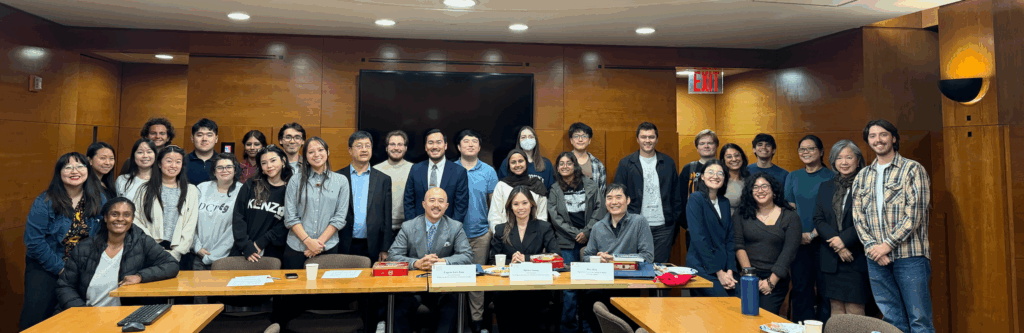
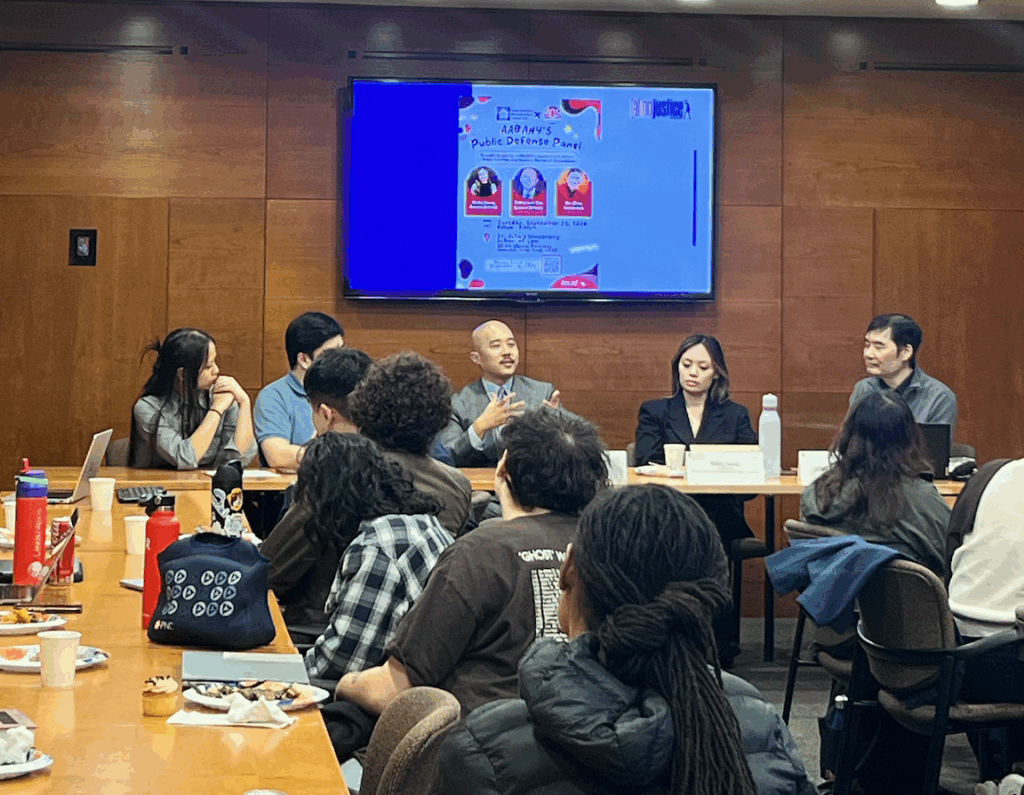
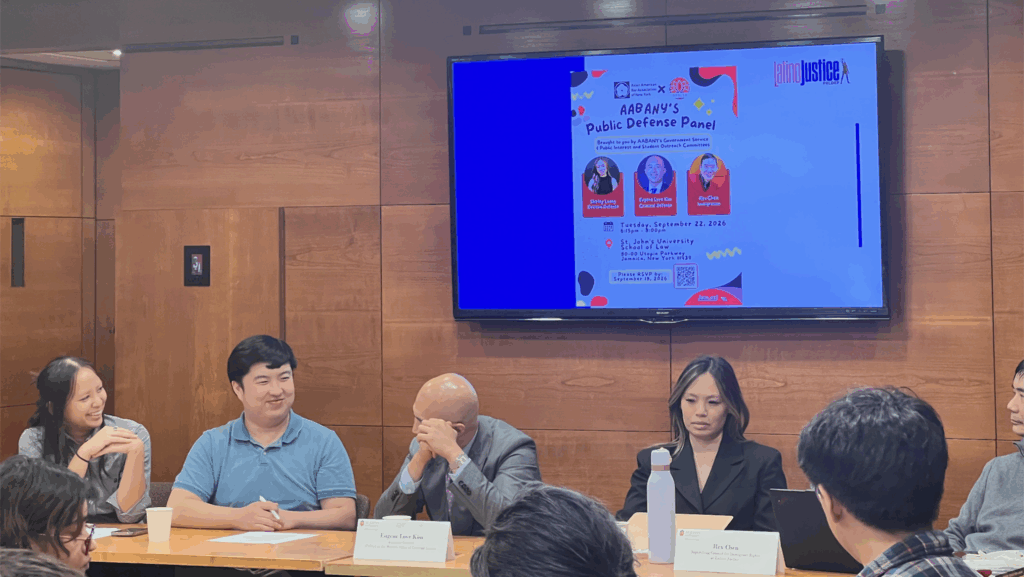
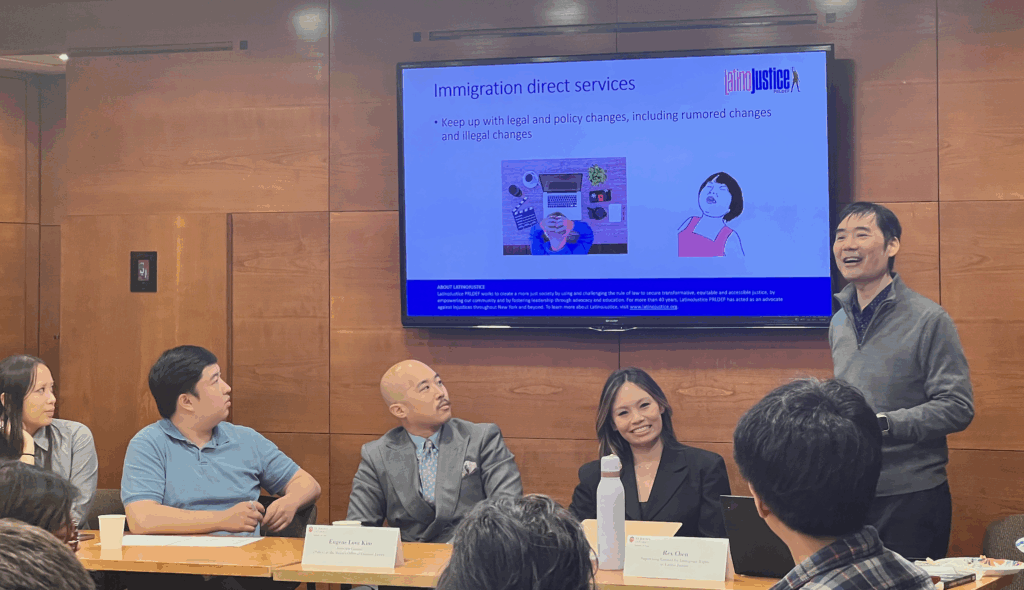
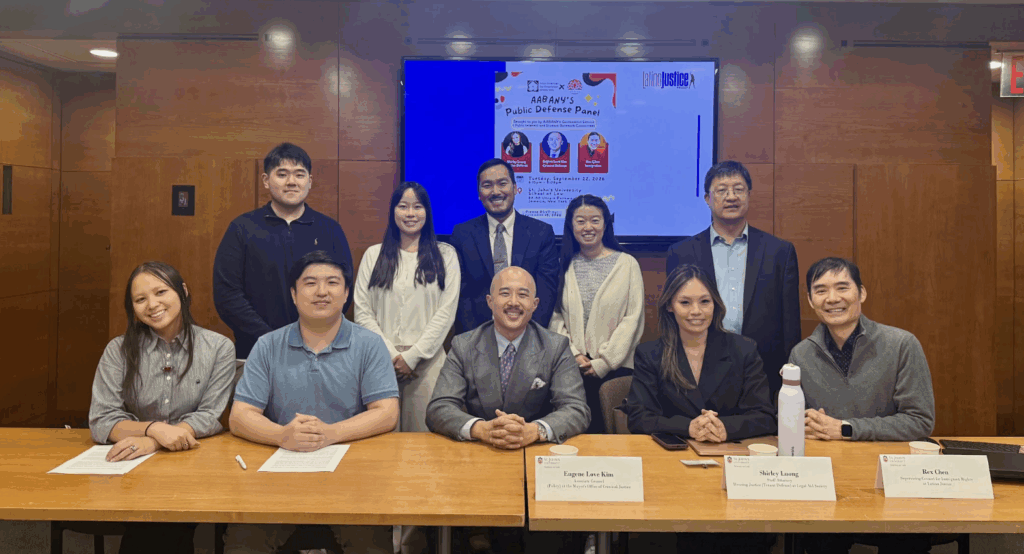
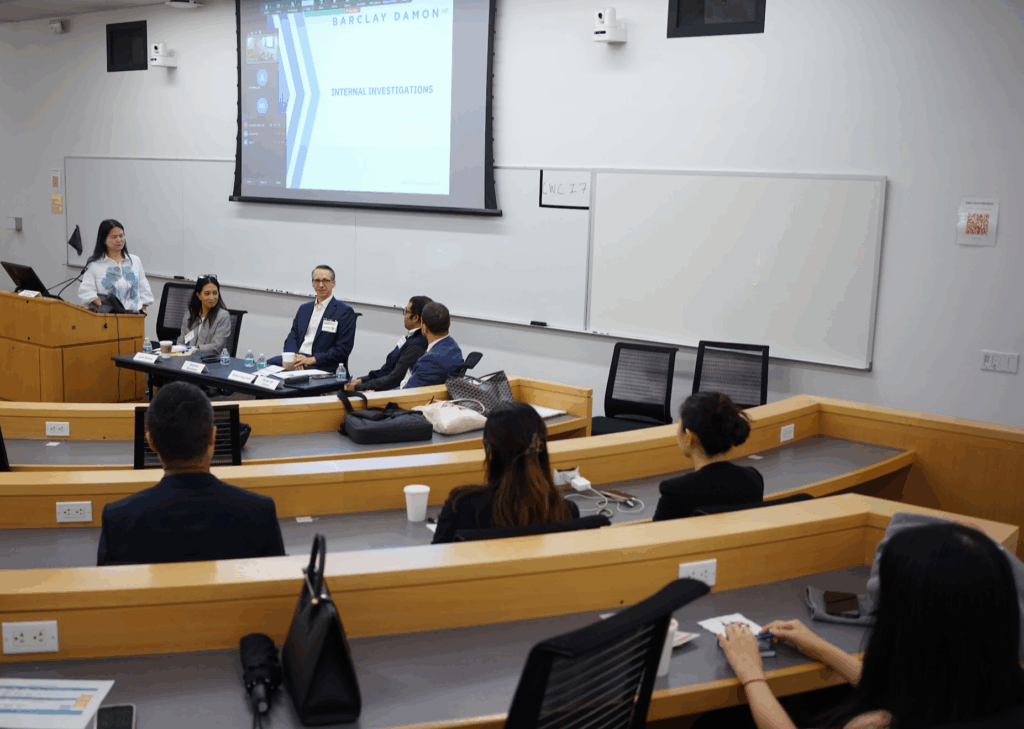
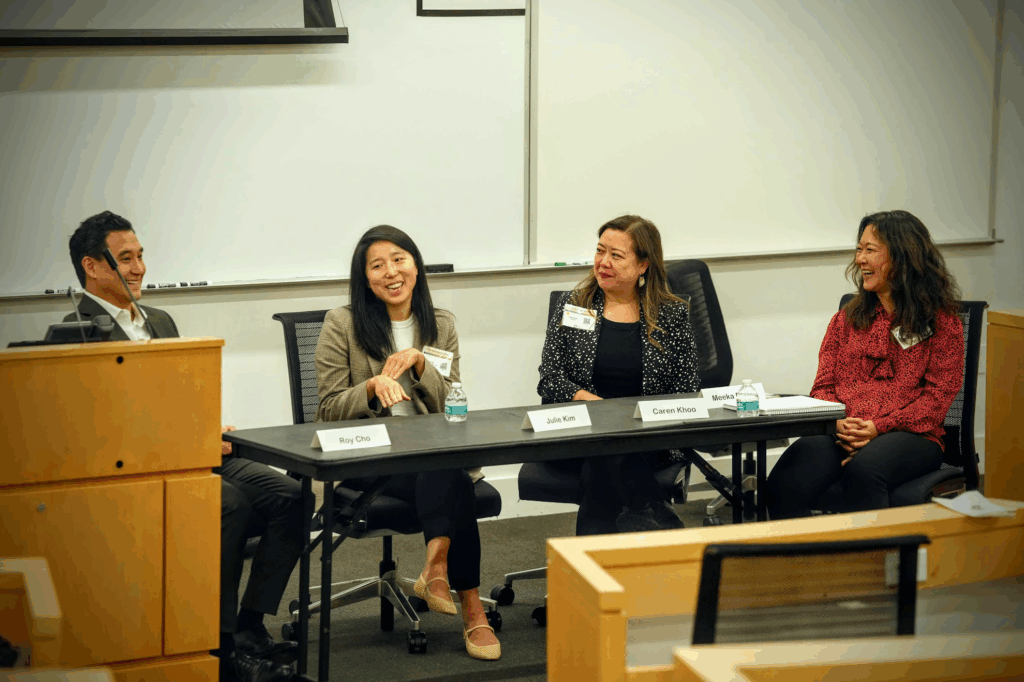
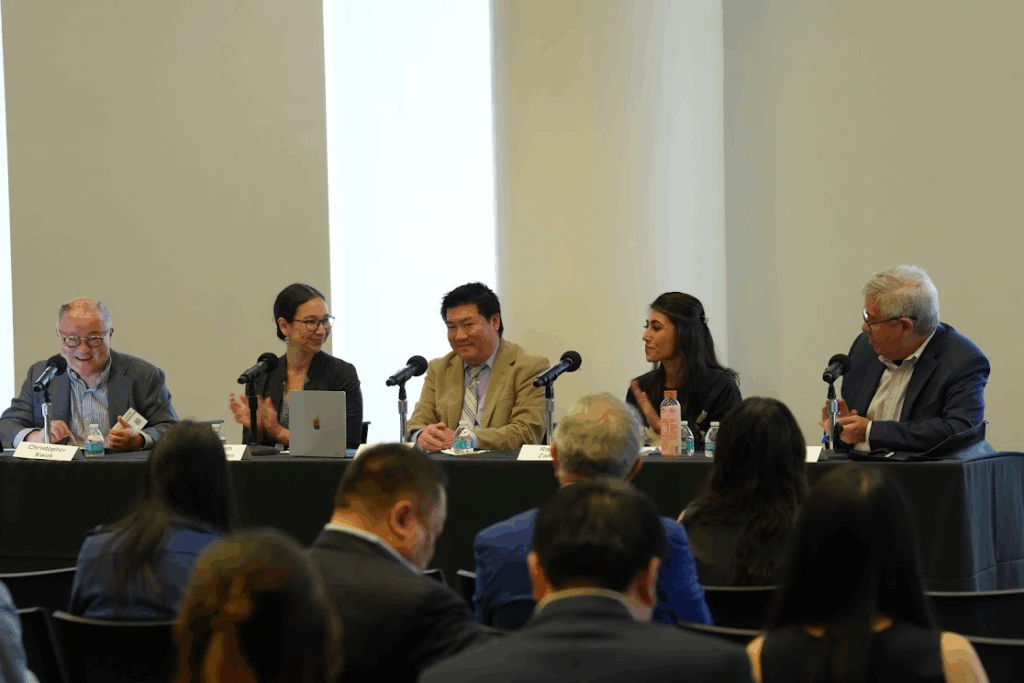
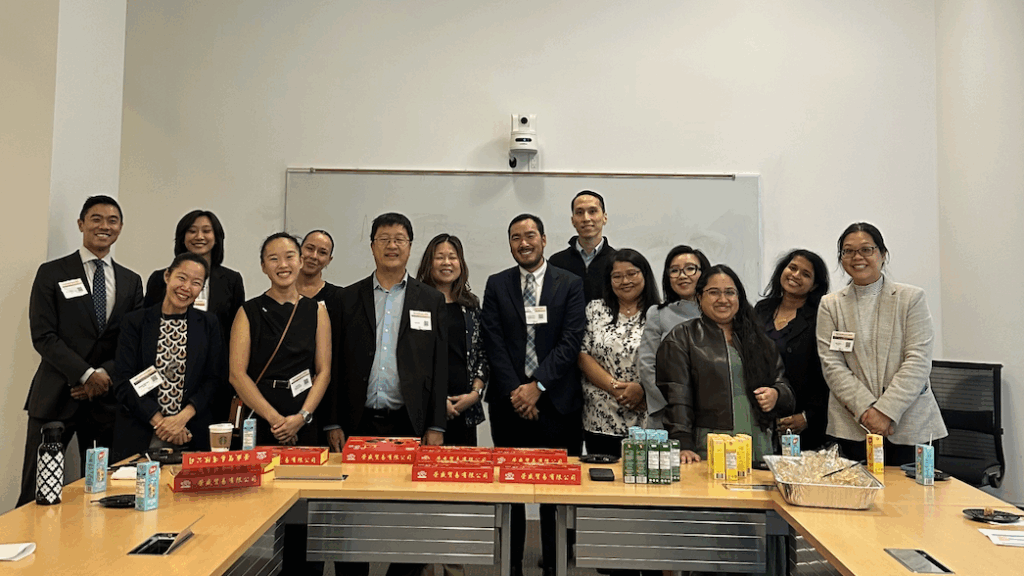
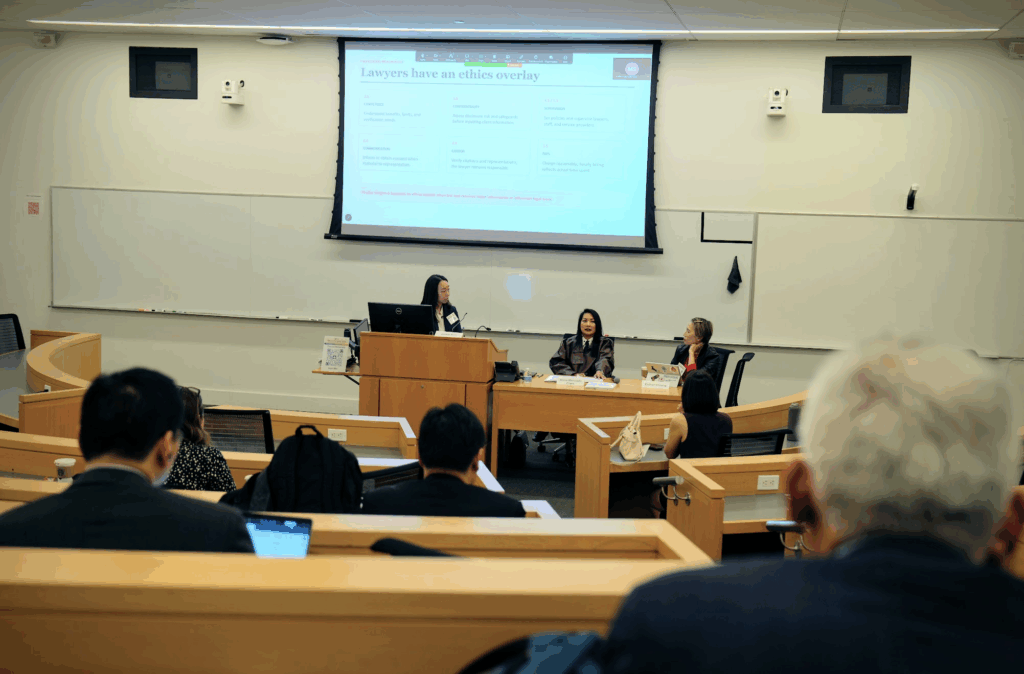
On September 22, 2026, AABANY’s Student Outreach Committee and Government Service and Public Interest Committee co-hosted a panel discussion at St. John’s University School of Law on public defense and public interest careers, bringing together law students, attorneys, and community members. Three lawyers – Eugene Kim, Criminal Defense; Shirley Luong, Tenants’ Rights; and Rex Chen, Immigration – provided insight on their day-to-day, the work that keeps them going, and how their practices confront systemic struggles while serving and representing the Asian American Pacific Islander (AAPI) community.
Criminal Defense: Eugene Kim
After graduating from Northeastern University School of Law, Eugene began his career at the Legal Aid Society, where he spent many years representing approximately 3,000 clients. He went on to work in the Mayor’s Office, but during the panel, Eugene reflected on his time at the Legal Aid Society. He has also served previously as Vice Chair and Co-Chair of AABANY’s Pro Bono & Community Service Committee.
When asked to describe what his typical day at work looked like, he talked about time spent staffing the courtroom, moving between court appearances, legal research, and visits to Rikers Islands to take on new cases.
Eugene described both the challenges and rewards of his practice. The biggest challenge, he said, was that there are “no moral victories in court,” especially in criminal defense. For Eugene, the most rewarding aspect is “winning for a client when their family is in the room,” which he said is what kept him going.
On the issue of racism in his profession, Eugene was direct: In the criminal justice system, racism is unfortunately a “feature” of it. As a public defender, his goal was to provide “the best defense that money can’t buy.” Turning to the AAPI community, Eugene expressed his belief that AAPI residents are underrepresented because there are fewer attorneys who share their backgrounds and can understand them, and he called for greater advocacy towards proper representation. His advice for attorneys entering the profession: leadership cannot be forced. “Figure out who you are and stay true to it, because people will notice if you don’t.”
Tenants’ Rights: Shirley Luong
A lifelong New Yorker born and raised in Flushing, Shirley attended Brooklyn Law School. From 2024-25, she served as Vice Chair of AABANY’s Pro Bono & Community Service Committee and is currently Vice Chair of AABANY’s Government Service & Public Interest Committee. She is a Staff Attorney in housing justice and tenant defense at the Legal Aid Society, where she has worked for the past decade. Shirley is passionate about pursuing justice for her clients’ housing circumstances. For example, just before the pandemic struck, she compelled a landlord to build a wheelchair-accessible ramp so that her client could safely and conveniently access his own home.
For Shirley, secondary trauma is the greatest challenge of her direct service work. As a client’s first line of defense, she found it difficult to balance sympathy with maintaining the emotional distance needed for her profession. The reward is the flip side: the impact on people’s lives is immediate and tangible.
When asked about racism in her area of practice and how her work addresses it, she describes it as systemic and deeply rooted – a theme all the panelists shared. Housing policies like redlining, she explained, historically excluded communities of color from homeownership and, with it, generational wealth. This turns into exclusion from employment opportunities, education, and other benefits, rights, and privileges. Though such practices are now illegal, they have lasting effects, and minority communities continue to be targeted in housing court today. To Shirley, tenants’ rights form an essential aspect of racial justice work. For AAPI clients specifically, language access remains a barrier, as housing law is difficult to understand, even for attorneys, and interpretation often can’t accurately communicate legal terminology.
Immigration Law: Rex Chen
Rex Chen has over 20 years of immigration law experience. After graduating from New York University School of Law, he worked at the Legal Aid Society and the Safe Passage Project, later served as Director of Immigration at Legal Services NYC, and now serves as Supervising Attorney for Immigrant Rights at LatinoJustice PRLDEF, where his work includes impact litigation meant to benefit whole groups of people. His days mix client consultations, tracking constant shifts in immigration law, and mentoring pro bono attorneys on their own cases.
For Rex, keeping a moral compass when everything is changing has presented his biggest challenge. His reward is knowing that he and his work are on what he deems “the right side of history.” Rex spoke candidly about the systemic racism rooted in immigration law and how his team responds: commenting on proposed rules, prioritizing antiracist projects, and educating communities. On AAPI communities specifically, he pointed to how criminal convictions can lead to deportation, including Southeast Asian community members for offenses committed when they were young, and increasingly racist policies aimed at South Asians and Muslims. Stereotypes, he noted, affect AAPI attorneys and inevitably enter public interest spaces – something that continued community engagement and advocacy will help address.
Together, the three panelists offered an introspective and candid look at what it takes to sustain a career in public defense and public interest law: the emotional weight of the work, the systemic issues it addresses, and the communities it serves.
AABANY thanks Eugene, Shirley, and Rex for sharing their perspectives and for the work they do, and Victoria Elise and Nathan Cao of St. John’s University School of Law for moderating. AABANY also thanks St. John’s University School of Law for hosting this event and gratefully acknowledges Student Outreach Committee Co-Chairs, Helen Ding and Joseph D. Eng Jr., and the Government Service & Public Interest Committee Co-Chairs, Kevin Hsi and Johnny Thach, for organizing this event. To learn more about the Student Outreach Committee and how you can get involved, go here. To learn more about the Government Service and Public Interest Committee go here.
Are you attending the NAPABA Convention on November 12-14, 2026 in Los Angeles this year? Check out some of these events and programs at which you can find AABANY members and leaders while you are there!
This list will be periodically updated as we get new information about AABANY member participation, so check back here for updates.
Solo & Small Firm Boot Camp 1 | Scaling Your Practice: Partnerships, Mergers, and Exit Strategies for Solo & Small Firm Lawyers.
AABANY Board Director and Issues Committee Co-Chair Vishal Chander and AABANY Board Director Jennifer Wu will be on this panel.
2:45 PM-4:00 PM
Public Sector Network Workshop 2 | Public Interest Lawyering in the Age of Trump 2.0.
AABANY Academic Committee Co-Chair Dennis Fan will be on this panel.
Solo & Small Firm Boot Camp 2 | Cutting Through the Hype: Practical AI Implementation for Solo & Small Law Firms
AABANY Board Director and Issues Committee Co-Chair Vishal Chander will be on this panel.
Friday, November 13, 2026
9:00 AM-10:15 AM PT
Shark Tank Part IV: The GC Hot Seat — Live Pitch Coaching and Business Development Mastery
AABANY Past President and member Susan Shin and AABANY member Allen Lo will be on this panel.
10:45 AM-12:00 PM
General Counsel Roundtable
AABANY In-House Counsel Committee Co-Chair David Sohn and AABANY member Michael Wu will be co-moderating this panel, and a number of GCs from AABANY, including Don Liu and Allen Lo will be speaking.
Law Student Workshop 2 | Breaking Into Public Interest and Impact-Driven Advocacy: Strategies for Finding Purpose-Driven Legal Careers
AABANY members Louise Lingat and Professor Rose C. Cuison-Villazorwill be on this panel.
Hate Crimes in the COVID‑19 Era and Beyond: The Unfinished Work Facing Attorneys, Advocates, Government, and Society
AABANY Board Director Jennifer Wu will be on this panel.
Behind the Curtain: What Really Happens in Mediation and Arbitration
AABANY Alternative Dispute Resolution Committee Co-Chair Chris Kwok will be on this panel.
12:00 PM-1:30 PM
Mainstage Event: Friday Plenary Luncheon: A Conversation with Min Jin Lee and Don Liu
AABANY member Don Liuwill be moderating. AABANY Board Director Jennifer Wu will introduce the speakers. Her firm, Groombridge, Wu, Baughman & Stone, LLP is sponsoring this luncheon.
2:00 PM-3:15 PM PT
“Concededly Loyal”: Ex Parte Mitsuye Endo
This is the newest AABANY Trial Re-Enactment, presented for the first time at NAPABA. AABANY members Hon. Denny Chin and Kathy Hirata Chin will be narrating this reenactment, along with a cast featuring many AABANY members.
Dueling Experts: Inside the Damages Battles That Decide High-Stakes Litigation
AABANY Past President and member Brian Song will be on this panel.
Hyper Velocity, Higher Stakes: Mitigating Early Tenure Risk for General Counsel
AABANY member Don Liuwill be on this panel.
Saturday, November 14, 2026
9:00 AM-10:15 AM PT
AI in the Crosshairs: Generative AI, Intellectual Property, and the Global Technology Threat
AABANY Past President and member Sapna Palla, and NAPABA incoming President-Elect,will be on this panel.
10:45 AM-12:00 PM PT
Still Under Watch: The China Initiative’s Lasting Impact on Asian American Workers, Academics, and Advocates
AABANY Board Director and Issues Committee Co-Chair Rachel Lee will be on this panel.
Yes, we do have a WhatsApp group for AABANY members at the NAPABA Convention. If you are on WhatsApp and wish to be added, send a request to [email protected].
If you are participating in a panel or will be receiving an honor at the NAPABA Convention but are not listed above, please let us know at [email protected], and we will update this blog post accordingly.
PBCS volunteers, comprising volunteer attorneys and law students, met with 20 clients and provided guidance on a variety of legal issues, including housing, immigration, real estate property, trusts and estates, family law, public benefits, and civil litigation.
Positive feedback from the clients included: “Productive! Helpful.” and “Thank you for this service! Really appreciate it!!“
Thank you to the following volunteers for attending the Manhattan Pro Bono Clinic:
Attorneys: Jingjuan (Max) Guo Kevin Hsi Beatrice Leong Arthur Lin Carrie Nie Ahseon Park Gary Yeung
Interpreters/shadowers: Helen Ding Cheri Chaibut Kaleah Haddock Nandar Win Kerr Alexandra Ly Pan Pan Renato Pangan Ellyse Ramos Jingjing Wang Suzie Yu Wendy Zeng Kangjie Zheng Nathan Zou
Special thanks to those who stayed late to consult on the last-minute housing case!
We invite you to continue supporting our community by joining us at our upcoming Pro Bono Clinics:
October 27th [Woodside Queens pop-up clinic link here] from 6:30-8:30pm, Assemblymember Steven Raga’s Office (Cellar), 60-14 Queens Blvd, Woodside, NY 11377
November 14th [Brooklyn link here], from 12:30 – 3:30pm, CPC Brooklyn Community Services, 4101 8th Avenue, Brooklyn, NY 11232
November 18th [Manhattan link here] from 6:30-8:30pm, AAFE Community Center, 111 Norfolk Street, NY, NY 10002
December 2nd [Queens link here], from 6:30 – 8:30pm, AAFE One Flushing Community Center, 133-29 41st Ave, 2nd Floor, Flushing, NY 11355
To learn more about the Pro Bono & Community Service Committee, visit probono.aabany.org.
We look forward to seeing you at our upcoming clinic sessions.
WASHINGTON—The National Asian Pacific American Bar Association (NAPABA), South Asian Bar Association of Chicago (SABA Chicago), Chinese American Bar Association of Greater Chicago (CABA), and Filipino American Lawyers Association of Chicago (FALA Chicago) condemn the alleged plot to carry out a mass shooting at the largest Hindu temple in Aurora, Illinois. Last week, law enforcement authorities arrested and charged a suspect who allegedly planned an attack targeting worshippers at the temple. According to law enforcement officials, the suspect allegedly possessed white supremacist materials and expressed hate towards individuals of South Asian and Indian descent along with Jewish and Black individuals.
We are deeply disturbed by this alleged act of hate and stand in solidarity with the Hindu, Indian American, and broader South Asian communities. We are grateful to the individuals who alerted law enforcement and to the authorities whose actions helped avert a potential tragedy.
Who we are, and how and where we choose to worship, are part of the tapestry of American life. A refuge for peace and prayer must never be transformed into a place of violence by perpetrators of hate. Hate—whether in the form of anti-South Asian hate or any other form of bigotry—has no place in our society. We remain committed to eradicating hate in all its forms, including by urging governments at every level to fully support and strengthen hate prevention efforts.
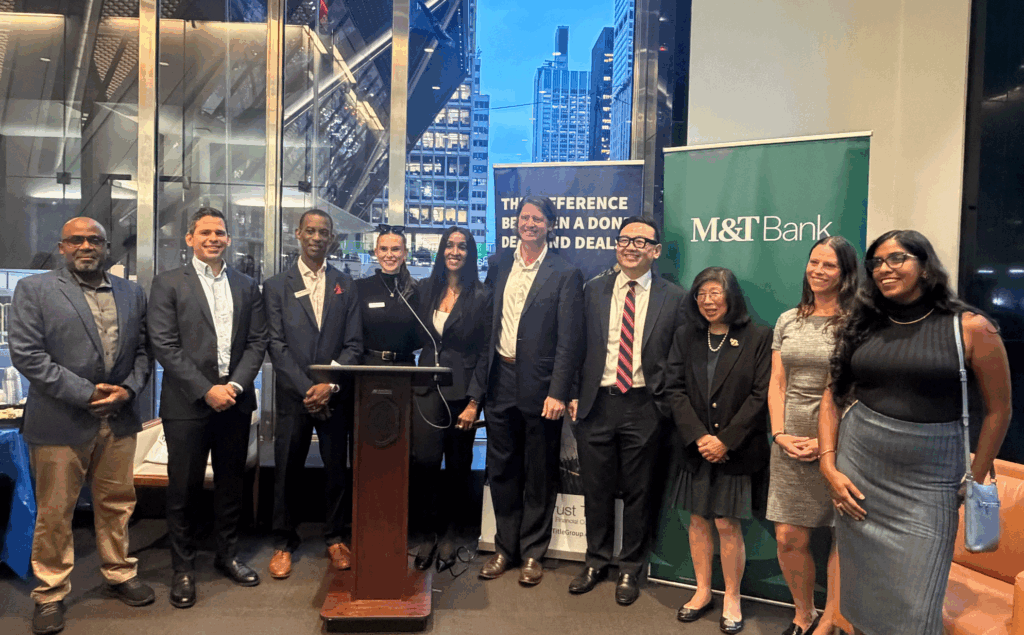
On September 29th, 2026, AABANY’s Real Estate Committee welcomed attorneys, bankers, title professionals, brokers, and other real estate professionals and industry colleagues to M&T Bank in Midtown Manhattan for a special Fall Harvest Moon Festival Professional Networking Event.
The event brought together professionals from across the real estate, banking, and legal industries for an opportunity to meet new colleagues, build new relationships, reconnect with longtime friends, while celebrating the traditions of the Harvest Moon Festival.
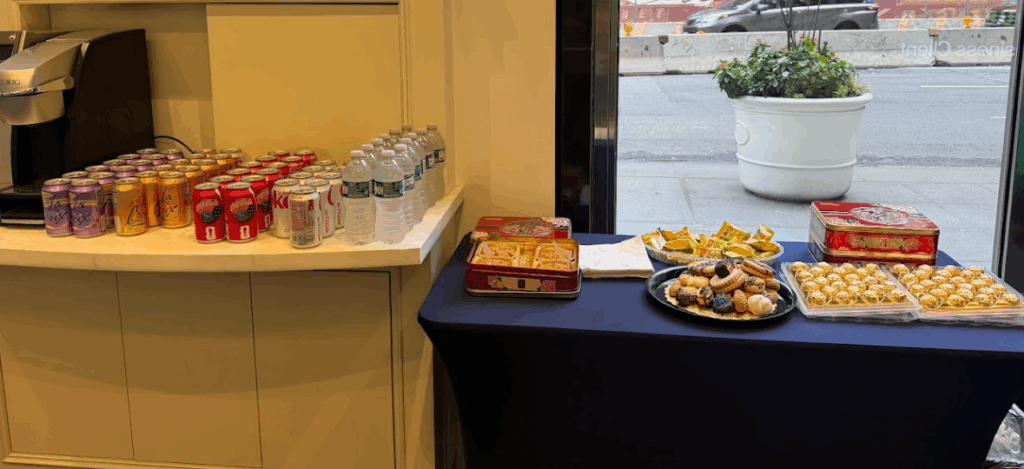
And let it be known– there was absolutely no shortage of food to get the conversations going.
Upon entering, guests were greeted by tables filled with sweets, chocolates, and desserts, alongside an abundance of mooncakes to celebrate the Harvest Moon Festival. A table of beverages offered a variety of refreshments, while the main spread featured an array of sushi. The festive spread quickly turned into a gathering point as guests began mingling and getting to know one another.
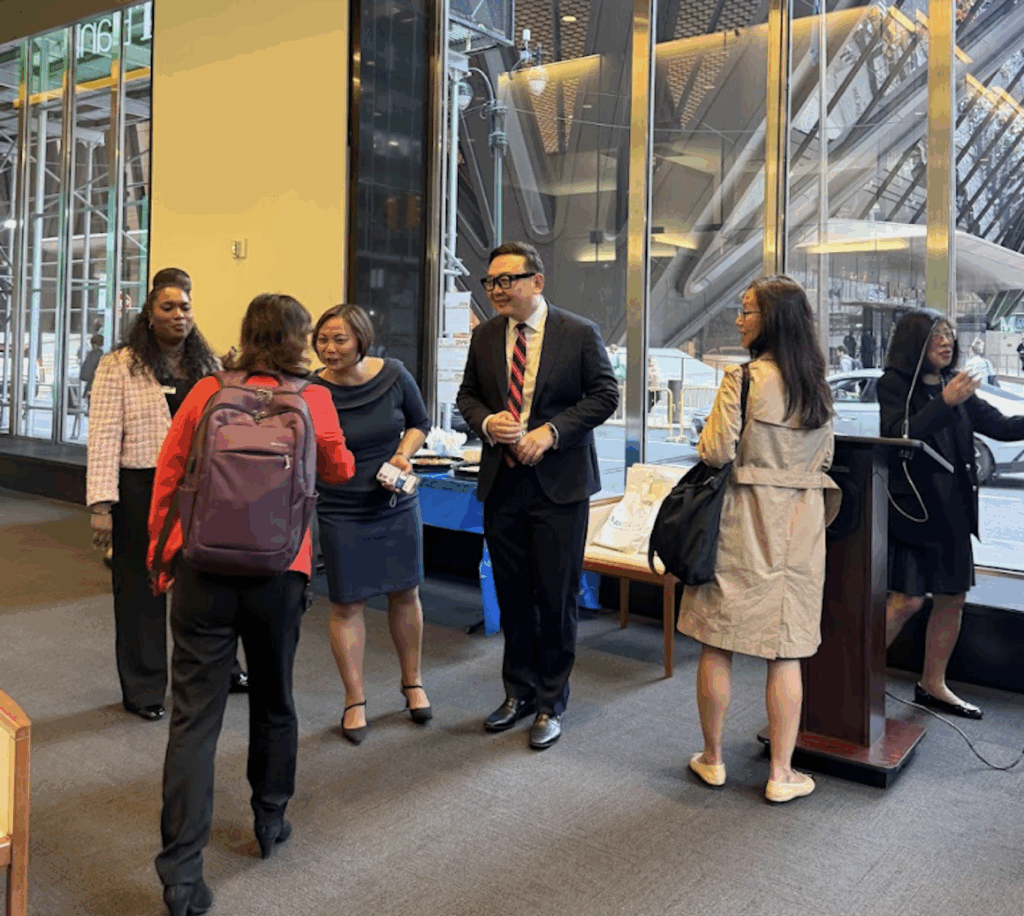
Conversations sparked from every corner of the room. Bankers from M&T compared notes with attorneys on where their services could overlap, title professionals swapped perspectives with brokers and other members of the real estate industry, while business cards exchanged hands through the course of the evening.
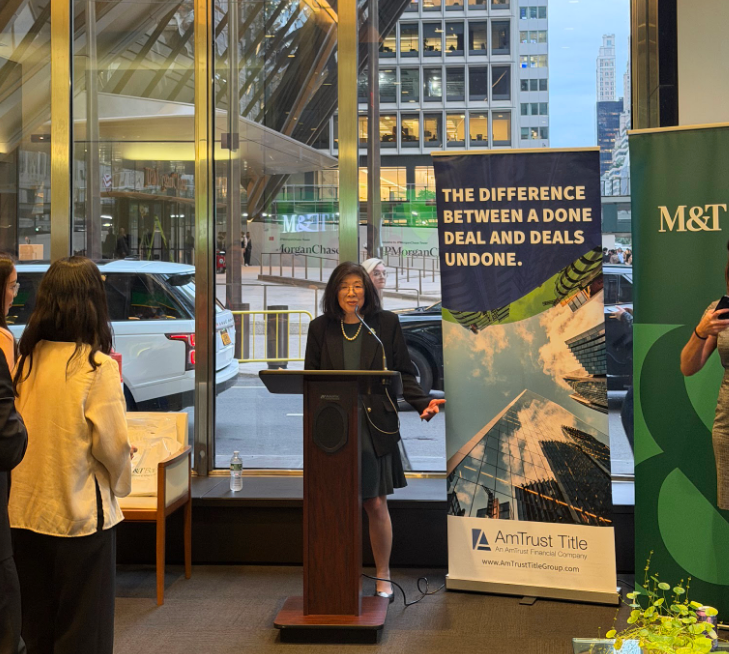
Soon after, Margaret Ling offered remarks and thanks to all those in attendance. A longtime, active AABANY member and former Co-Chair of the Real Estate Committee, Margaret is deeply involved in the AAPI legal community and the city’s broader legal community. She spoke about the connections she has built over the years and about why events like this matter, especially when paired with a celebration like the Harvest Moon Festival.
She also shared with attendees what the holiday means. Celebrated when the moon is at its fullest, the festival, also known as the Mid-Autumn Festival, is a time for reunion, gratitude for the harvest, and abundance. Mooncakes, with their round shape symbolize togetherness, a fitting celebration for an evening focused on building and expanding community.
Margaret then invited AABANY’s current Real Estate Committee Co-Chairs, Jameson Xu and Jason Ganfer, to say a few words. Each thanked the guests for coming, spoke about the value of the relationships to come, and reflected on the meaning of the festival.
Then Margaret did something that truly brought the room together: she asked all 20+ attendees to go around the room, introduce themselves, and share what they do. It was a warm, slightly out-of-comfort zone icebreaker that melted away any shyness and gave everyone a sense of who to talk to next.
Guests returned to mingling with buzzing energy and, later, the evening came to a wonderful close.
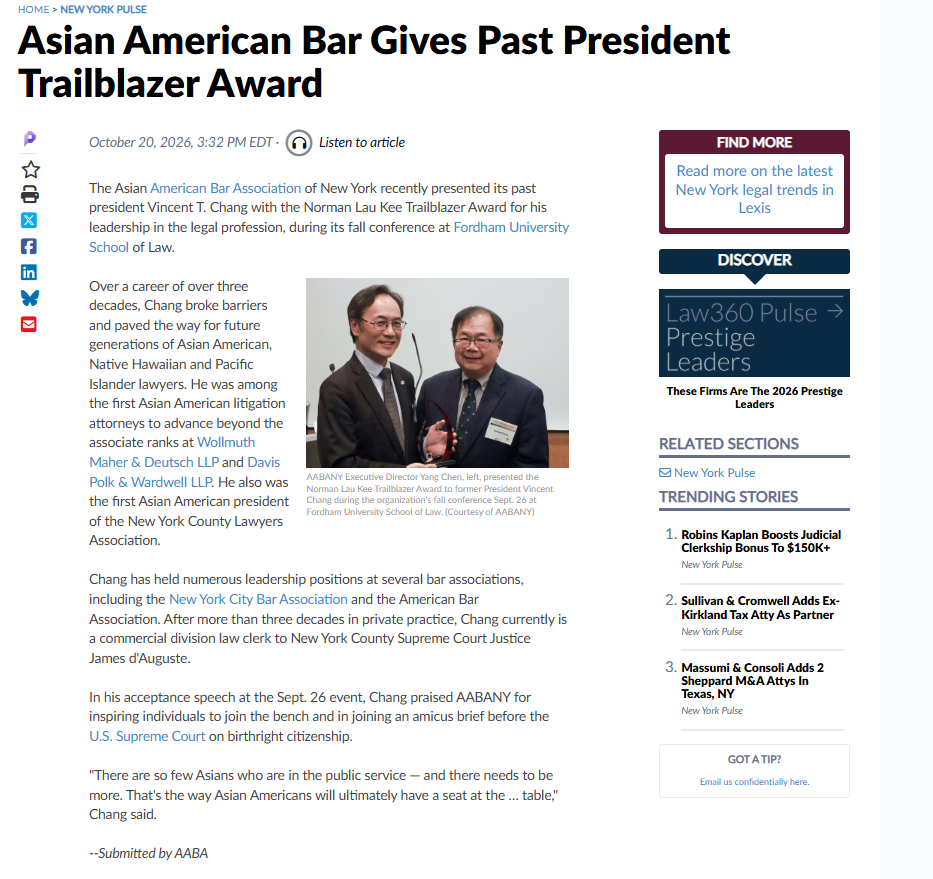
On Oct. 20, Law360’s New York Law & Community section published AABANY’s submission on Vincent Chang receiving the Norman Lau Kee Trailblazer Award at its annual Fall Conference. The full article appears in the screenshot below.
AABANY thanks Law360 for publishing this report, and would like to congratulate again our past president and longtime Asian American legal community leader Vincent Chang for this well-deserved honor.
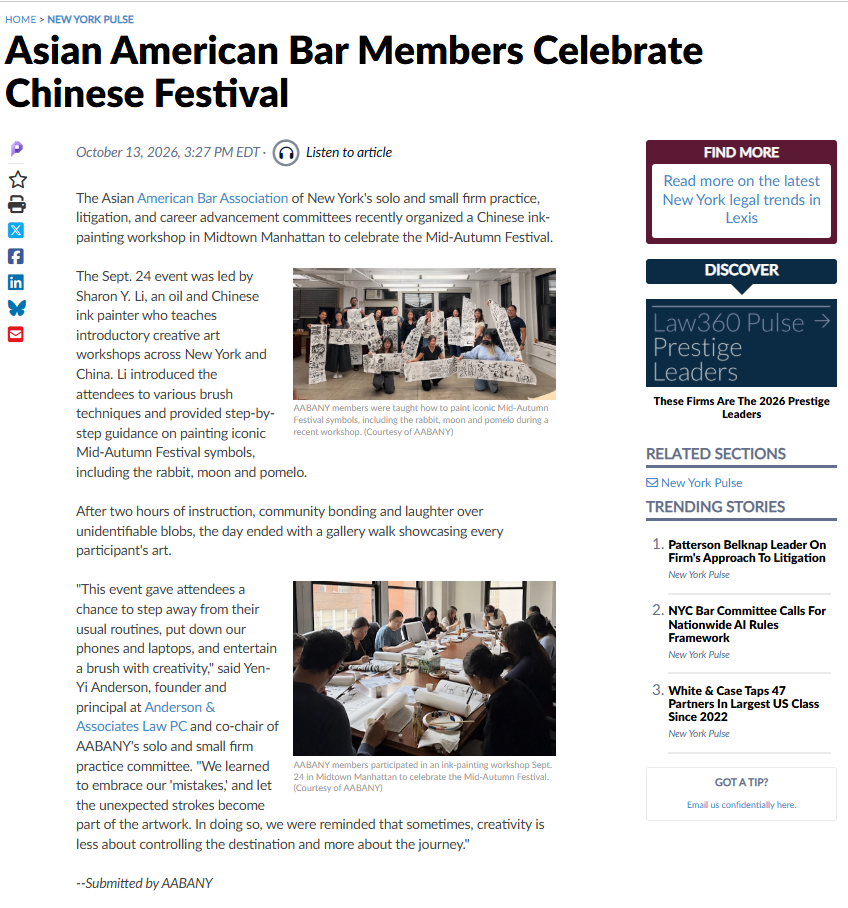
Attendees at the event learned how to grip a traditional Chinese brush properly and practiced various brush techniques. and were provided step-by-step instruction on how to paint iconic Mid-Autumn Festival symbols, including the rabbit, moon, and pomelo.
To read the full article by Law 360, see screenshot above.
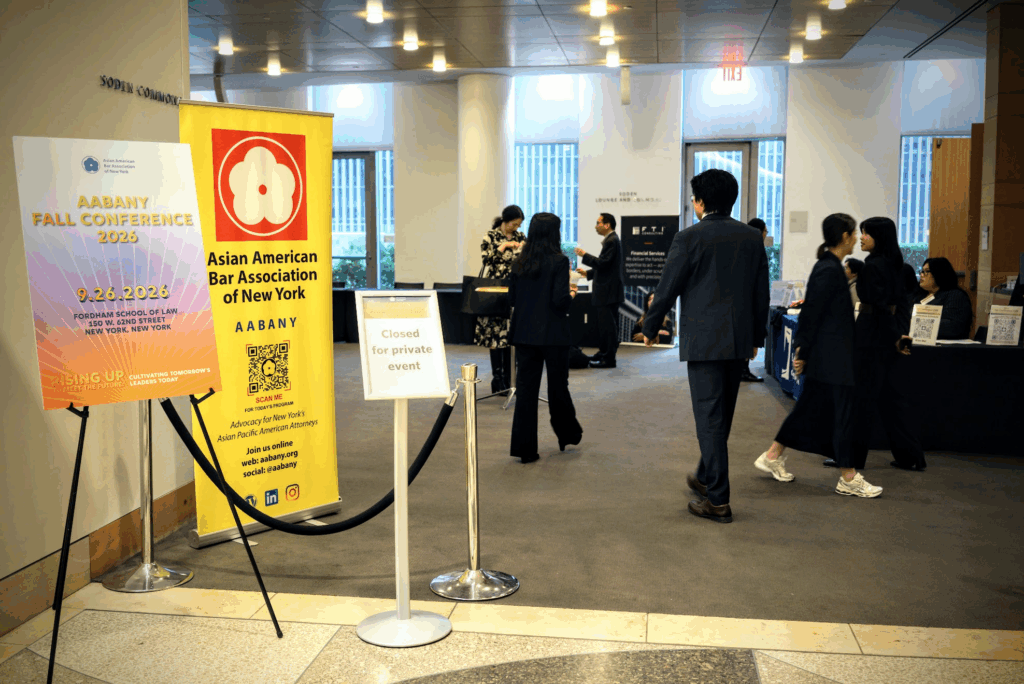
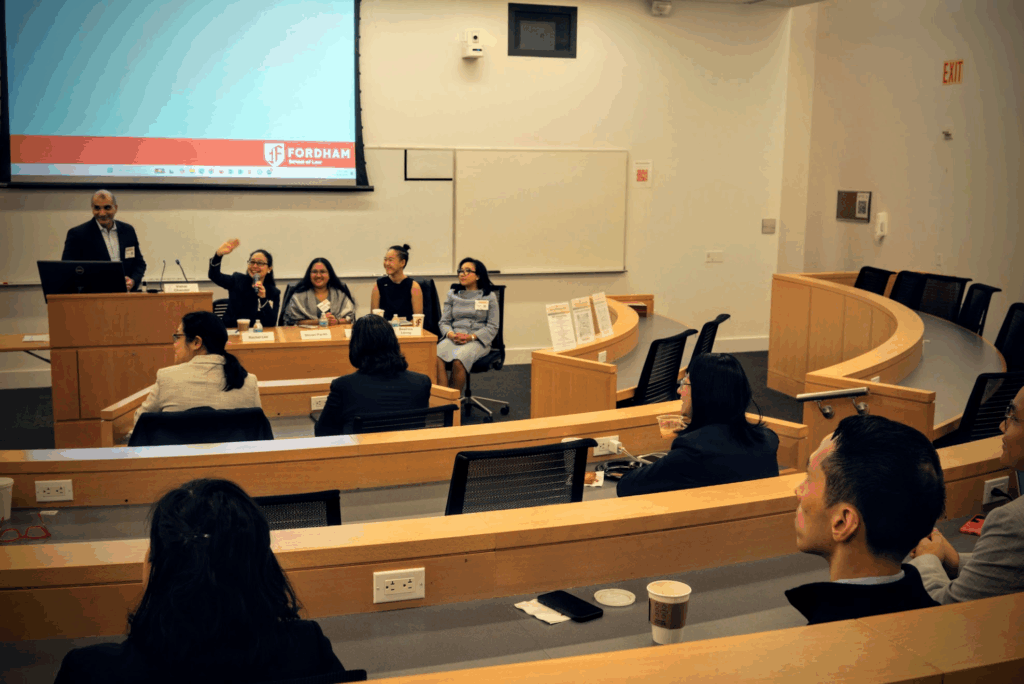
On Saturday, September 26, at Fordham Law School, AABANY hosted its 2026 Fall Conference, with the theme “Rising Up to Meet the Future: Cultivating Tomorrow’s Leaders Today.” Thanks to Fordham Law School for hosting this day-long event. The full-day event offered multi-track CLE programming throughout the morning and afternoon, a plenary lunch session, and different opportunities for professional development, networking, and community-building. In addition to CLE sessions, the Conference also featured the Trial Advocacy Program, Diversity Career Fair, Link-Up Reception, and meetings and gatherings throughout the day hosted by various AABANY Committees.
The day began with an ample breakfast buffet that was most welcome on a wet and stormy morning. Despite the nor’easter brewing outside, the warmth of the food and energy in the room created a welcoming start to the day, bringing together friends and colleagues, old and new, into the AABANY community.
Morning Sessions
From 9:00 to 10:30 AM, participants could choose from the following four CLE panels:
Rising Up to Serve: Leveraging Bar Associations for Community-Centered Lawyering – exploring how attorneys can use bar associations and community organizations to respond to the legal needs of AANHPI and immigrant communities, expand access to legal services, all the while engaging in community-centered advocacy.
AI, Voice, Likeness and Persona: How Tomorrow’s Lawyers Will Define Ownership, Consent, and Control – examining the rapidly changing legal questions surrounding AI-generated replicas of voices, faces, likeness, and other personal attributes, covering issues of ownership, consent, control, monetization, and misuse.
Bridging the Gap! Transitioning from MPRE to Real-World Ethics – focusing on moving beyond the principles tested on the MPRE to consider how ethical obligations arise in the everyday practice of law and how new attorneys can apply those principles in professional and practical settings.
Conducting Effective Internal Investigations – examining the implications involved in managing internal investigations, from establishing protocols and determining scope to working with stakeholders and protecting privilege.
The next block, from 10:45 to 12:15 PM, offered:
How to Lateral: Building a Transferable, and Marketable Skill Set – providing insight into the skills, qualifications, and experiences employers look for in candidates, and how to build transferable skills.
Beyond Forms & Filings: How Tomorrow’s Immigration Attorneys Build Power Through Tech, Data, and Storytelling – examining how immigration attorneys can combine technology, data, and storytelling to strengthen advocacy, address systemic disparities, and better serve AANHPI communities in a rapidly changing policy environment.
The Modern Advocate: Mastering Courtroom Skills in a Changing Legal Landscape – preparing current and aspiring litigators for courtrooms shaped by AI, covering professionalism, oral advocacy, and working with pro se litigants from diverse communities while also discussing the ethical implications of using AI tools in preparing for court.
At the Table: Turning Today’s Great Lawyers into Tomorrow’s Trusted Client Advisors – exploring the judgement, steadiness, and strategic communication skills that enable attorneys to grow from technically excellent lawyers into trusted client advisors.
Plenary Lunch Session: Moving Forward After Trump v. Barbara – Constitutional Principles, Immigration Policy, and the American Process
At 12:30 PM, AABANY President Varuna Bhattacharyya gave opening remarks to a filled room for the Plenary Lunch Session: Moving Forward After Trump v. Barbara – Constitutional Principles, Immigration Policy, and the American Process. The lunch session brought together professors, lawyers, and advocates to examine the recent Supreme Court’s decision in Trump v. Barbara and its implications for birthright citizenship, executive authority, and the Fourteenth Amendment. What stood out, however, was not simply the legal analysis of the decision but also the way the panel connected these constitutional questions surrounding birthright citizenship and the Fourteenth Amendment to the people and stories behind them.
The panel featured Beth Lew-Williams, Professor of History and Director of the Program in Asian American Studies at Princeton University; Edgar Chen, Special Policy Advisor at the National Asian Pacific American Bar Association (NAPABA); Razeen Zaman, Immigrants’ Rights Director at the Asian American Legal Defense and Education Fund (AALDEF); and Gabriel “Jack” Chin, Professor at UC Davis School of Law. The discussion was moderated by Chris M. Kwok, Adjunct Professor at CUNY Hunter College, mediator and arbitrator at JAMS, and Co-Chair of AABANY’s Alternative Dispute Resolution Committee.
The plenary session deepened the appreciation and understanding for how intertwined constitutional law is to individuals’ everyday lives. Hearing Wong Kim Ark’s story alongside Trump v. Barbara made the Fourteenth Amendment feel less like an abstract piece of legal text and more like something tangible that shapes who is recognized as belonging to this country. That’s what made the lunch session so compelling: exploring how someone’s ordinary choices can become a part of a landmark legal history and examining how, over a century later, the country is still grappling with the questions surrounding the idea of belonging.
AABANY’s Career Advancement Committee Presents: Diversity Career Fair
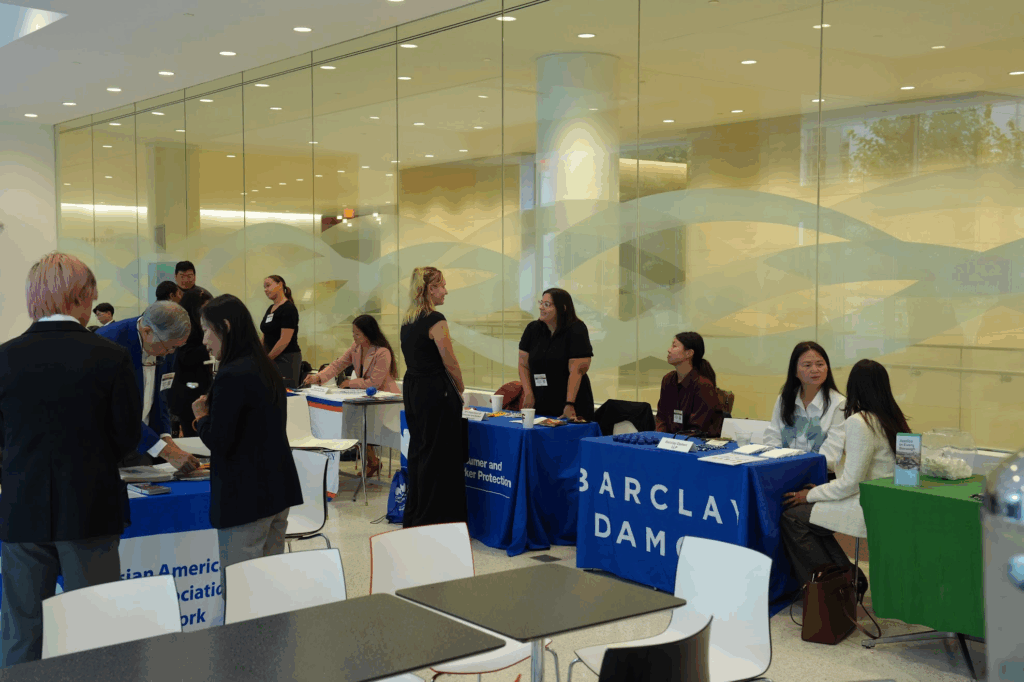
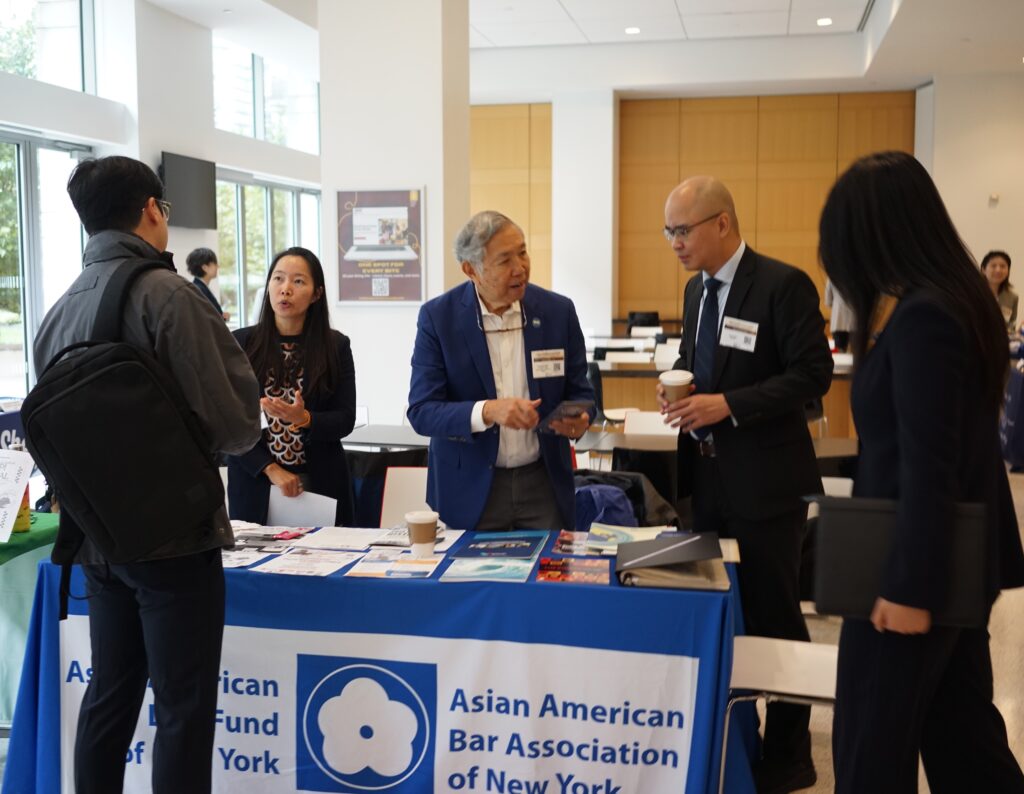
AABANY’s Career Advancement Committee hosted its annual Diversity Career Fair (DCF) at the 2026 Fall Conference, bringing together various public and private sector employers and interested applicants from 10:30 AM to 4:30 PM. Employers hosted informational tables, met with candidates, collected resumes, and conducted first-round on-site interviews. Throughout the day. The room was constantly filled with individuals looking to learn more about available opportunities and meet active members of AABANY in their professional settings.
While some employers were unable to attend due to the weather, the DCF still offered a wide range of career opportunities. Law students and lawyers moved between tables, asked questions, exchanged resumes, and connected directly with employers. At public interest tables, attendees gathered to learn about internships, externships, and volunteer opportunities, including opportunities with The Legal Aid Society. Government and public-sector employers, including the New York City Law Department and District Attorney’s Offices, similarly offered attendees the chance to learn directly from practitioners and representatives about these respective career paths.
In the private sector, employers such as Barclay Damon LLP provided opportunities for one-on-one conversations with one of the partners, allowing attendees to learn about what the firm was looking for while also establishing meaningful professional relationships.
Attendees also had the opportunity to meet members of AABANY’s Career Advancement Committee, receive career advice, and learn about additional career opportunities. The Committee collected resumes and distributed them to all employers after the event.
AABANY’s Litigation Committee Presents: The Trial Advocacy Program (TAP)
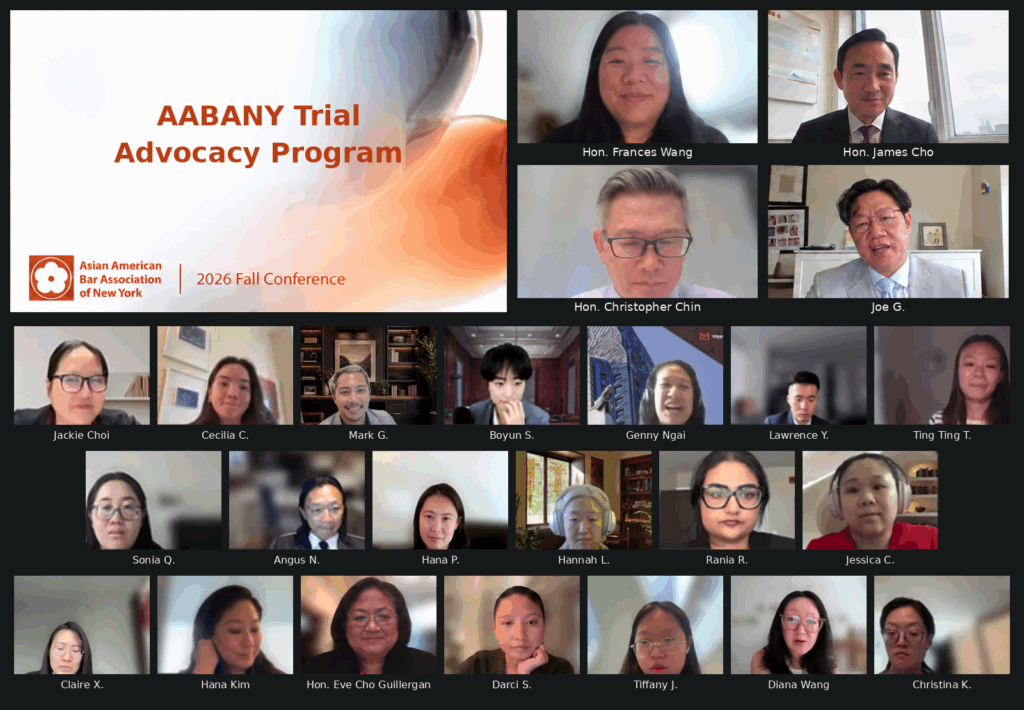
From 9:00 AM to 4:15 PM, AABANY’s Litigation Committee presented the 2026 Trial Advocacy Program (TAP) at the Fall Conference, giving junior lawyers an opportunity to strengthen their trial skills under the guidance of experienced judges and trial attorneys. The program focused on essentials of trial skills: opening statements, direct and cross-examinations, and closing statements.
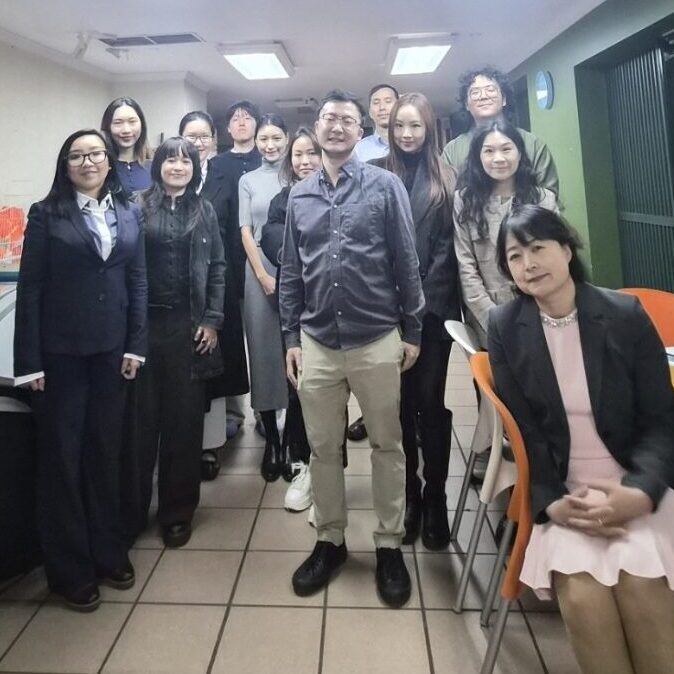
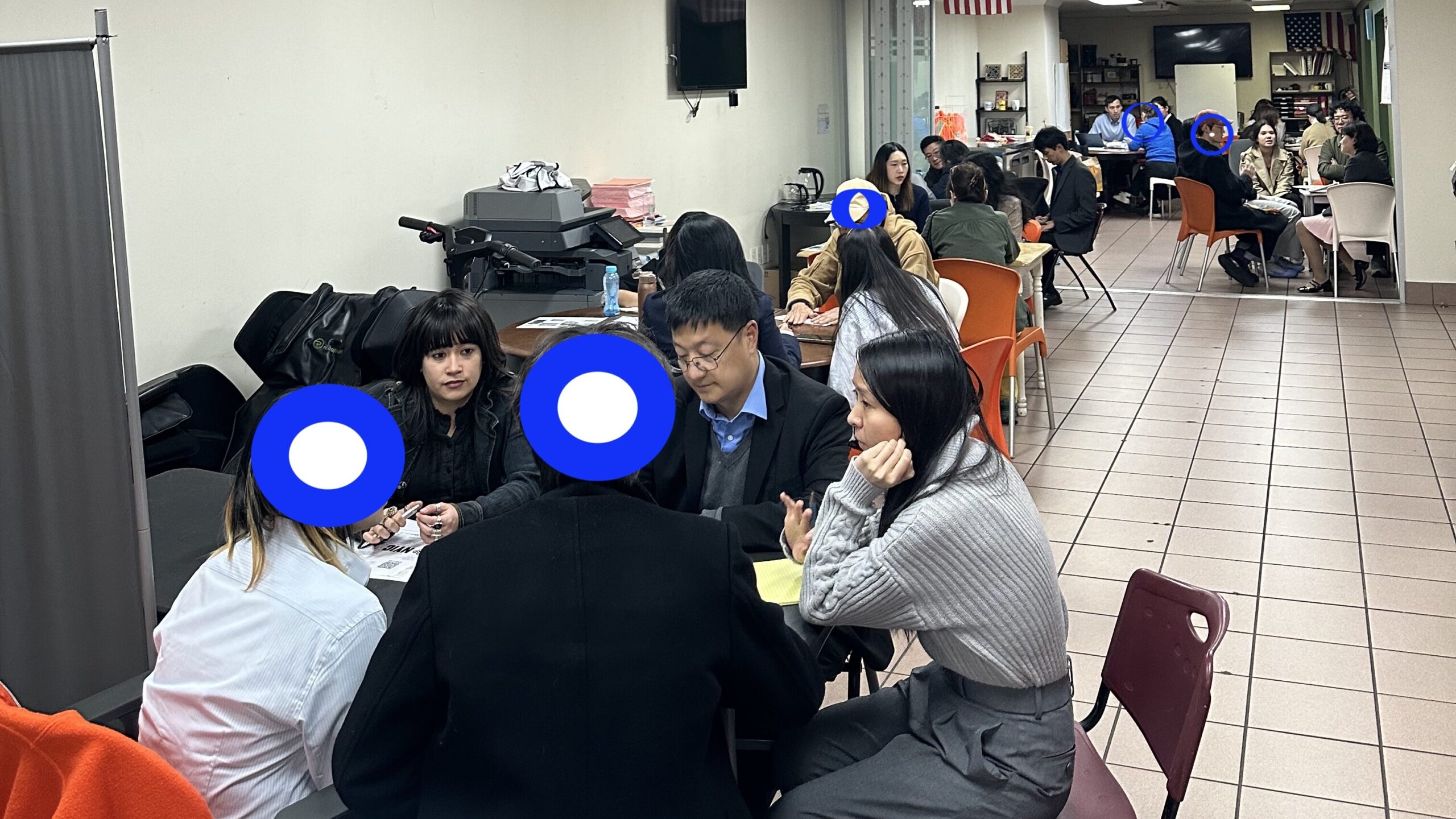
Although TAP is usually held in person, this year’s program was moved to virtual format at the last minute due to the weather. Even with such short notice, the program drew a strong group of participants and maintained the interactive nature of the program. Participants worked through a mock trial scenario and prepared portions of their openings, examinations, and summations with a partner. Through the combination of lectures, practical exercises, and small-group mock trial sessions, participants were able to recreate the experience of an in-person trial as closely as possible. Judges and trial attorneys provided feedback throughout the exercise, allowing participants to strengthen their courtroom skills, receive constructive criticism, and learn strategies they can carry into actual practice. Even in the virtual format, the program fostered productive small break-out group conversations and hands-on participation, showing us how meaningful trial advocacy training could take place both beyond the courtroom and in-person.
The quality of the faculty was truly impressive. Participants learned from bench and bar alike, including the Hon. James R. Cho of the U.S. District Court of the Eastern District of New York; Hon. Frances Wang of Queens Supreme Court; and the Hon. Christopher Chin of the New York Supreme Court. Prosecutorial experience was well represented by Joe Gim, Chief of Criminal Court at the Kings County District Attorney’s Office; Sara Khan, a Homicide ADA at the Manhattan District Attorney’s Office; and Hana C. Kim, Bureau Chief of the Financial Frauds Bureau at the Queens County District Attorney’s Office. Participants were also able to hear from leaders in the private sector and in-house counsel, including Genny Ngai, Partner at Morrison Cohen; Diana Wang, Counsel at Clark Smith Villazor LLP; Hugh Mo, Principal of The Law Firm of Hugh H. Mo, P.C.; and Jacqueline Choi, In-House Litigation Counsel at Red Apple Group, Inc. Together, they offered participants a well-rounded view of effective trial advocacy from every side of the courtroom, and their generosity in sharing both their time and their depth of experience made the program all the more valuable. AABANY thanks each of them for their commitment to imparting trial advocacy skills to the next generation of lawyers.
Committee Meetings and Gatherings
Beyond the main programming, the third floor had its own energy. AABANY opened up rooms for Committees that wanted a space to network and gather, and a few Committees took full advantage, reserving rooms at different points throughout the day. AABANY’s CIRC Program, which is part of the Membership Committee, got things started in the morning, inviting participants to stop by to chat about their program updates, share feedback, and grab some delicious Asian snacks along the way. They brought so many treats that they continued their gathering in the Soden Lounge on the second floor, where Asian sweets and savory favorites disappeared within minutes. The Government Service & Public Interest (GSPI) Committee’s mooncake social stood out, giving members a chance to meet the Co-Chairs, hear about upcoming events, and enjoy a delicious mooncake alongside refreshments in celebration of the Mid-Autumn Festival. The Solo & Small Firm Practice (SSFP) Committee followed in the same room with an assortment of Levain cookies, a relaxed change of pace after a full day of programming where folks got to meet newer members and have a chance to catch up with other colleagues and longtime members. The Pro Bono & Community Service Committee, together with AALFNY, set up a table at the Diversity Career Fair to promote the Pro Bono Clinics and recruit volunteers.
Afternoon Sessions:
From 2:30 PM to 4:00 PM, attendees chose from the following programs:
Rising to the Challenge: A Balancing Act of Caregiving Leaders of the Sandwich Generation – informing potential and future caregivers about basic estate planning tools, long-term care planning, and special needs planning, along with providing them with resources available to help them balance these responsibilities and prepare for any potential crisis.
Clause and Effect: AI Contracting and Vendor Management – focusing on equipping lawyers to lead clients through AI governance by covering the privacy and cybersecurity risks of AI tools and examining the best practices for negotiating vendor agreements on data use, training, security, audit rights, and liability.
The Gentle and the Assertive: What New Motherhood Teaches About Advocacy – two mom litigators sharing how the dual roles of mother and advocate are strengthening their advocacy and leadership skills, offering AAPI attorneys a framework to leading authentically while making full use of their lived experiences.
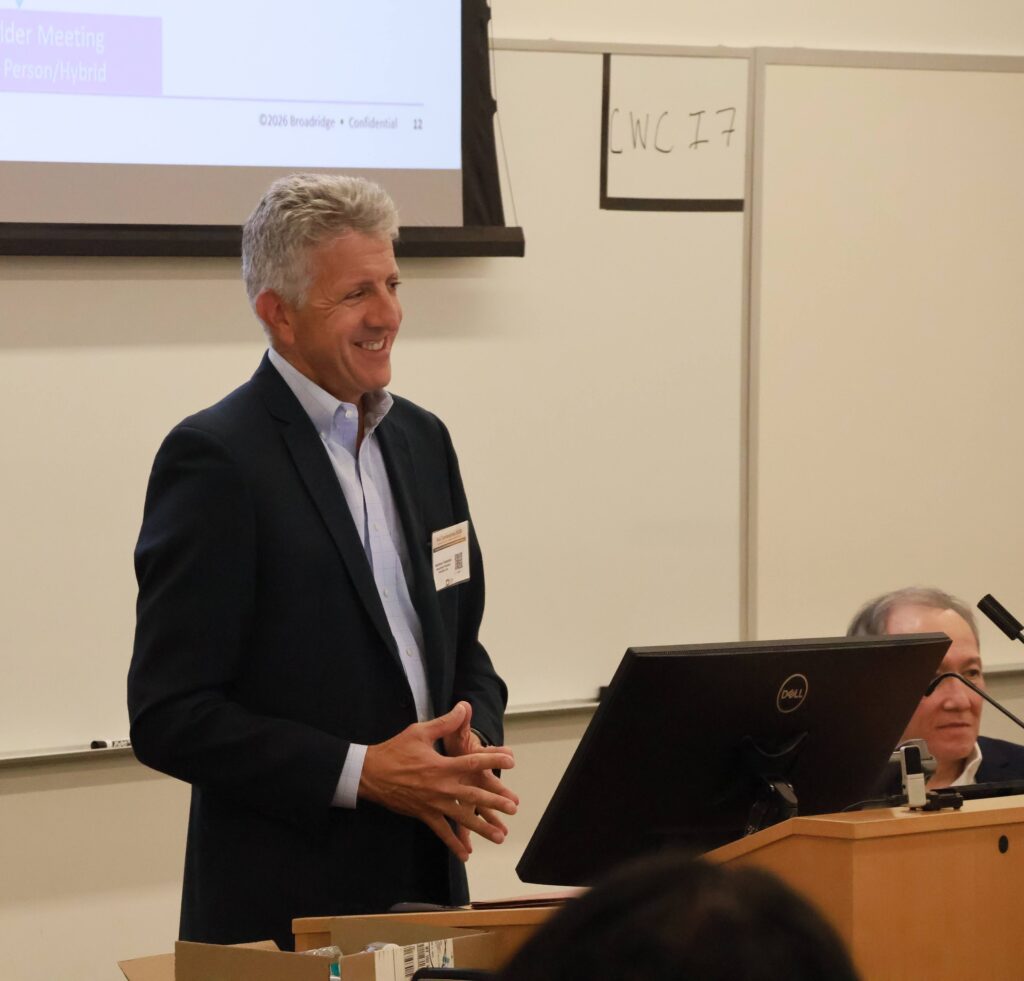
The Mechanics of Public Company Stock Ownership and Voting – introducing proxy plumbing, the infrastructure and process behind shareholder voting, and how Broadridge keeps this process efficient, transparent, and compliant so that shareholders’ voices are heard in corporate governance.
From 4:15 PM to 5:45 PM, attendees could choose from the following programs:
Race and Space: How Laws Create and Impact Asian Spaces – exploring how, despite the promise of Reconstruction, many AANHPI New Yorkers still live and work in racially concentrated spaces, discussing how law and policy created them and what that means for the future of Asian communities.
IP and AI Slop: Why is Pikachu Fighting Darth Vader on My Instagram Feed? – examining the rise of unauthorized generative AI videos, the legal issues and options for IP owners, and what it all means for the future of content.
Building & Using the Diversity Pipeline in Arbitration & Mediation: Why it Matters and How to Participate – focusing on why diversity among arbitrators and mediators matters to the credibility of Alternative Dispute Resolution (ADR) and how lawyers, clients, and institutions can strengthen the pipeline of diverse neutrals, to include AANHPI attorneys interested in becoming neutrals.
No One Teaches This: How Attorneys Actually Build Clients and Become Rainmakers – exploring how attorneys can build credibility and lasting professional relationships that can grow into client development and leadership opportunities.
Link-Up Reception
An exciting way to wind down the day was the Link-Up Reception, which provided an opportunity for law firm attorneys and senior in-house counsel to connect and explore potential external legal services. Now in its second year, the invitation-only event was open to select in-house counsel and Gold-level sponsors and above, creating a more intimate setting for sponsors to engage directly with in-house decision-makers and establish professional connections.
With an almost one-to-one ratio of in-house counsel to law firm attendees, the reception felt intentionally intimate and direct. Rather than having brief introductions before moving onto the next conversation, attendees seemed to have the time and space to really listen to one another. Conversations about professional experiences and careers grew deeper as they continued to talk over hors d’oeuvres, creating opportunities for connections that felt more genuine and lasting.
The sense of possibility in the room was palpable. People were exchanging ideas, learning about one another’s work, and finding ways to build relationships that could grow beyond this gathering. It was a great way to bring together the professional connections and collaboration that had been growing throughout the day, and it set an energetic tone for the rest of the evening.
Cocktail Reception and Trailblazer Award Presentation
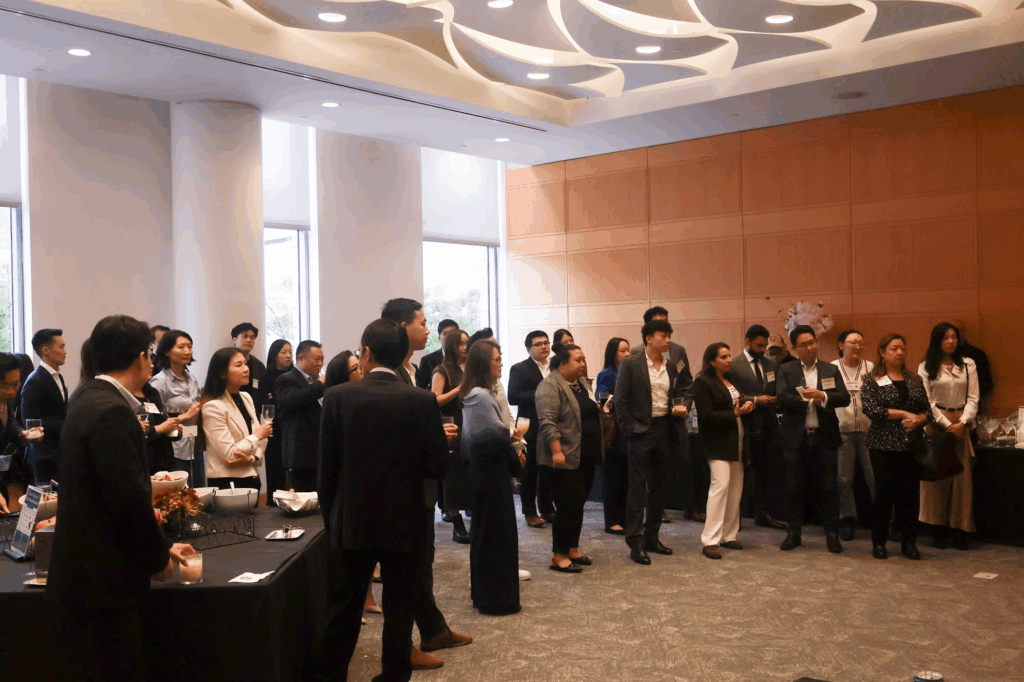
After the conclusion of the day’s programs, at 6:00 pm, all attendees were invited to the general Cocktail Reception, which provided a relaxed and celebratory setting to connect and unwind. The room was filled with food of every kind, from pigs in a blanket to crab cakes with a variety of dipping sauces, plus a vegetable and fruit platter that stretched across the center of the room, as well as both warm and cold options for any preference. Over appetizers and drinks, attorneys, law students, and other members of the AABANY community reconnected with colleagues and formed new professional relationships, with the buzz of conversation filling the air. The reception brought the conference to a close by creating an exciting space for networking and continued community-building.
The highlight of the evening was AABANY’s Executive Director Yang Chen presenting the Norman Lau Kee Trailblazer Award to Vincent Chang, former President of AABANY. Named for a legal and community pillar of Chinatown, the award honors a leader and role model in the AANHPI legal community, and Vincent Chang’s career exemplifies the award. Not only has he served as former AABANY President, but he was also the first Asian American to have served as President of NYCLA. He has held important leadership positions with the American Bar Association and the New York State Bar Association, where he currently serves on the Executive Committee.
In his acceptance remarks, Vince reflected on his involvement in the AANHPI legal community and the relationships and experiences that have shaped his career both in the private and public sphere. Vince expressed his appreciation for the community that has supported him throughout his career and acknowledged the strides made by AABANY and its leaders over the years. It was especially meaningful to see Vince celebrated alongside so many AABANY members, from past, present, and future Presidents to longtime and newer members, making for an inspiring and fitting way to conclude the 2026 Fall Conference.
Thank You!
We extend our deep thanks to all the volunteers from law schools and colleges for providing support with conference logistics, programming, and registration, and to all the moderators, panelists, Program Chairs, and attendees, whose participation and engagement made the Conference so successful and memorable.
We are also grateful to our sponsors, whose support made the Fall Conference possible:
Thanks to our volunteer photographers Alvin, Haoyu, and Zhiqian.
Thank you for joining us at the 2026 AABANY Fall Conference! We hope you found the day inspiring, engaging, and meaningful, and that you left with new connections and a stronger sense of community. We are grateful to have shared this special event with you and look forward to strengthening our engagement at future events.
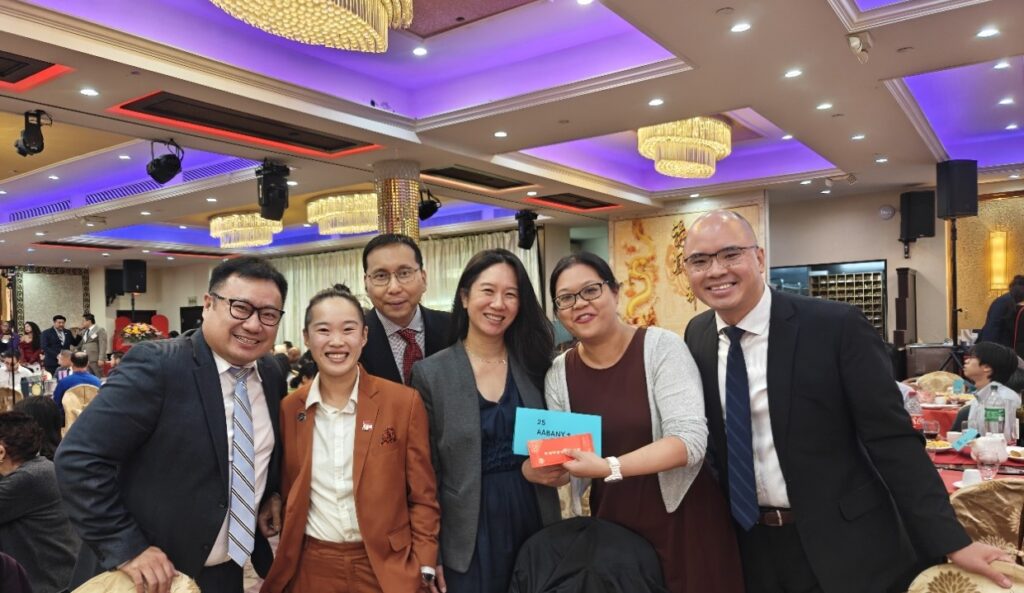
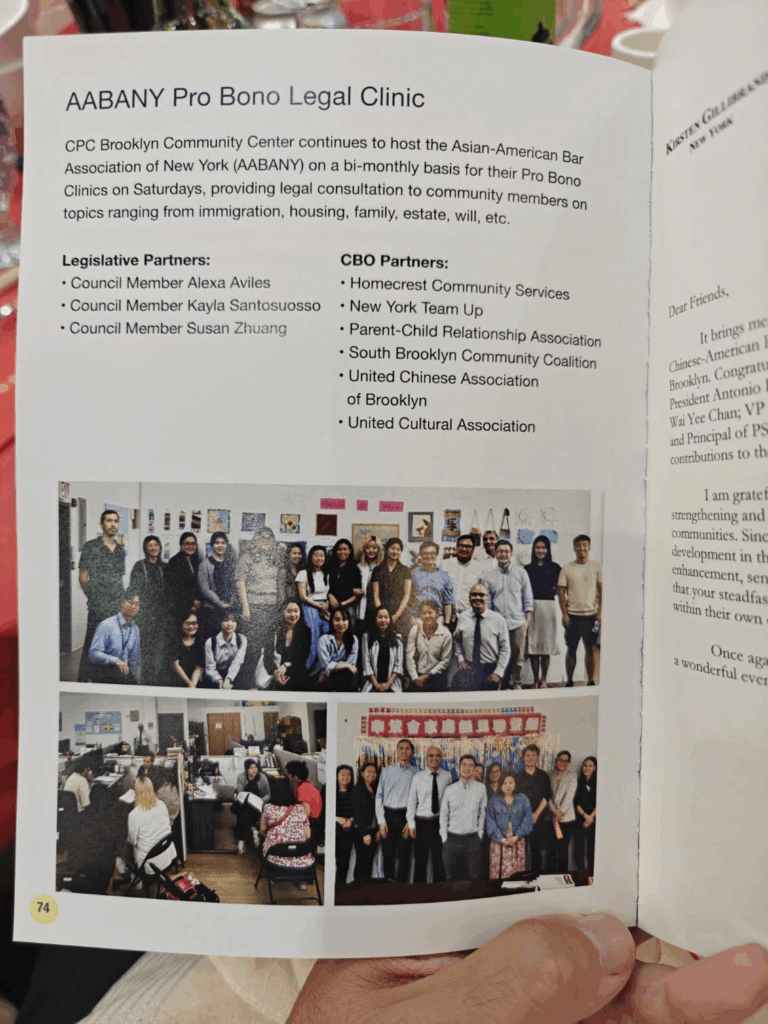
On October 15, 2026, the Asian American Bar Association of New York (AABANY) attended the Chinese-American Planning Council’s (CPC) Harvest Moon Benefit in Brooklyn. The event brought together community leaders, advocates, and local organizations to celebrate CPC’s ongoing commitment to supporting Asian American, immigrant, and low-income communities across New York City.
Representing AABANY at the benefit were regular Brooklyn Pro Bono Clinic volunteers Kwok Kei Ng, May Wong, Francis Chin, Victoria Cheng, and Jameson Xu. We were also joined by CPC attorney Jack Hsia, who also volunteers at our clinics, and Sam Chen.
In addition to celebrating CPC’s achievements, AABANY connected with local leaders and raised awareness about legal support services available to underserved residents.
AABANY values its strong relationship with CPC and remains dedicated to collaborating on initiatives that empower community members, protect immigrant rights, and expand access to justice throughout the city.
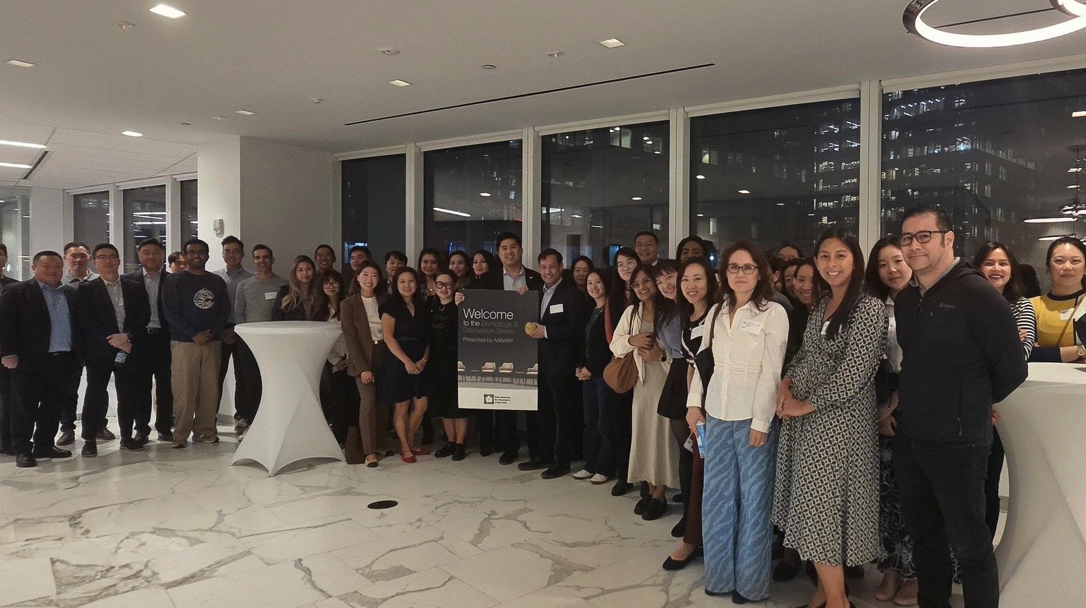
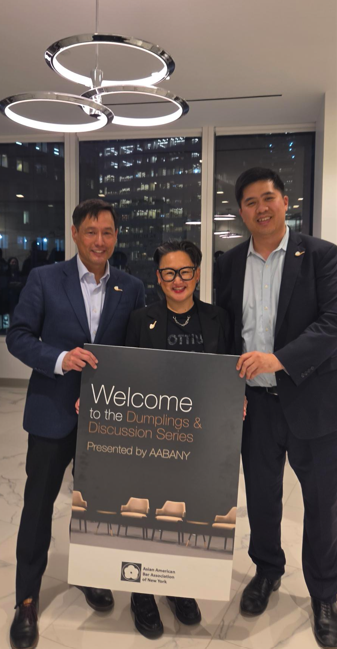
On September 29, 2026, AABANY hosted the latest installment of its Dumplings & Discussion fireside chat series, featuring Allen Lo, Executive Vice President and Chief Legal Officer at Madison Square Garden Entertainment and Sphere Entertainment. The event drew a fantastic turnout, bringing the community together for a night of vibrant conversation, high-level career insights, and excellent networking.
Allen gave a candid look at his remarkable career journey and shared thoughtful, deep insights with the room. Allen stayed well into the night for the reception, generously sharing his time with attendees.
It was a special treat to welcome back Dumplings & Discussion alum Kelly Koyama-Garcia, who proudly sported her dumpling pin.
A big thank you to Allen for his candor, his practical advice, and his generosity with his time. We’re glad to have him in the New York community. Additional thanks to host Jeffrey Mok, and to everyone who joined and made it another memorable night of great conversation, company, and, of course, great dumplings.
See here to read about past Dumplings & Discussion chats.