

NAPABA Supports the Language Access for All Act of 2026

For Immediate Release: January 23, 2026
Contact: Rahat N. Babar, Deputy Executive Director

WASHINGTON – The National Asian Pacific American Bar Association (NAPABA) applauds the introduction of the Language Access for All Act of 2026 in Congress. The bill, if enacted, would ensure that all individuals have meaningful access to critical Federal services, regardless of English proficiency.

In March 2025, President Donald Trump revoked Executive Order 13166 and designated English as the official language of the United States. For nearly 25 years, EO 13166 required that every federal agency meet the needs of individuals with limited English proficiency when it delivers critical services. EO 13166 brought the full import of Title VI of the Civil Rights Act of 1964, which prohibits entities that receive federal funding from discriminating based on national origin, to life. NAPABA objected to the revocation of EO 13166 at the time and called on Congress to act in response. Following our advocacy efforts, NAPABA welcomes the introduction of the Language Access for All Act of 2026, which would restore the key guarantees of EO 13166.

Language access is particularly important for the Asian American, Native Hawaiian, and Pacific Islander (AANHPI) community. The majority of the Asian American community are immigrants. Nearly 32% of the community is limited English proficient. The Asian American population is comprised of over 50 different ethnicities and speak over 100 different languages. NAPABA has long championed linguistic access for AANHPI communities in the legal system, including through our groundbreaking report, which highlighted and provided recommendations on the state of language access in federal and state courts and agencies. Every individual deserves access to critical, federally funded services.

NAPABA is grateful to Rep. Grace Meng, the Chair of the Congressional Asian Pacific American Caucus, along with Rep. Judy Chu, Rep. Juan Vargas, Rep. Daniel Goldman, for their leadership and introducing the Language Access for All Act of 2026. This action coincides with the anniversary of the U.S. Supreme Court’s historic decision in Lau v. Nichols, 414 U.S. 563 (1974), which recognized the right of English learners to participate meaningfully in public school education and served as a catalyst for language access throughout the Nation. We call on Congress to advance this legislation swiftly.
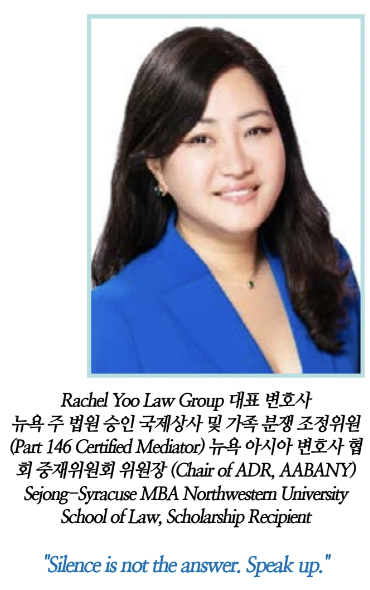
In the News: Rachel Yoo Speaks on Alternative Dispute Resolution (ADR) in the Korean American Community

In a recent feature in The M Magazine (November/December 2025 issue), an East Coast Korean-American community publication, Rachel Yoo of Rachel Yoo Law Group was profiled for her work in conflict resolution and family law within the Korean-American community. The article, titled “법정의 승리보다 저녁 식탁의 평화를 택했습니다” (Choosing Peace Around the Dinner Table Over Victory in Court), explores Yoo’s mission to empower those who have been silenced in family conflicts and educate the community about peaceful alternatives to traditional litigation.

Rachel Yoo, a Part 146 Certified Mediator and Co-Chair of the ADR Committee at the Asian American Bar Association of New York, challenges the cultural tendency among Korean Americans to suppress family conflicts out of fear of community judgment. She warns that this silence often backfires, allowing small issues to escalate into major legal battles. In close-knit communities where relationships are deeply intertwined, Yoo advocates for professional mediation rather than attempting to resolve disputes privately, where emotions can override rational thinking.

As a certified mediator, Yoo creates safe spaces for guided dialogue, helping families express their concerns constructively without public exposure or personal attacks. Her philosophy—”Silence is not the answer. Speak up.”—is transforming how Korean Americans approach family conflict, replacing avoidance with structured communication that preserves both dignity and relationships while preventing escalation.

To read the full article (in Korean), click here.

NAPABA Applauds the Appointment of Justice Sanjay T. Tailor to the Illinois Supreme Court

For Immediate Release: January 21, 2026
Contact: Rahat N. Babar, Deputy Executive Director

WASHINGTON – The National Asian Pacific American Bar Association (NAPABA) congratulates Justice Sanjay T. Tailor on his groundbreaking appointment to serve as a justice on the Illinois Supreme Court.

“Justice Tailor’s appointment marks a historic milestone in NAPABA’s mission for its members, the Asian American, Native Hawaiian, and Pacific Islander (AANHPI) lawyers, and their broader communities,” said Joseph Yao, President of NAPABA.  “In 2022, NAPABA’s Portrait Project 2.0 found that only nine Asian American jurists served on state high courts, a number that remained constant until now. As the first Asian American to serve on the Illinois Supreme Court, Justice Tailor has broken barriers and serves as a beacon of achievement for our legal community and for anyone aspiring to such heights.”

Justice Tailor brings more than two decades of judicial experience to the Illinois Supreme Court. He has served for 23 years on Illinois’s trial and appellate courts, including as an Associate Judge and Circuit Judge and, most recently, as a Presiding Justice of the First District Appellate Court. Prior to joining the bench, he served as an Assistant State’s Attorney in Cook County and practiced law in the private sector. Justice Tailor taught as an adjunct professor at Loyola University of Chicago School of Law. He earned his B.A. from the University of Delaware and his J.D., with honors, from Loyola University of Chicago School of Law.

“Through his many leadership roles, including as the president of the Asian American Judges Association of Illinois, and through his engagement with NAPABA affiliates like the Asian American Bar Association of Greater Chicago (AABA Chicago) and the South Asian Bar Association of Chicago (SABA Chicago), Justice Tailor has demonstrated a deep commitment to public service and the community throughout his career,” said Priya Purandare, Executive Director of NAPABA. “His groundbreaking appointment highlights the importance of continued efforts to ensure that those in the AANHPI legal community are recognized, supported, and elevated to positions of leadership across the country.”

“We are proud and thrilled to see Illinois become one of a small number of states that have a judge on its highest court who is Asian American,” said Stephen Lee, President of AABA Chicago.  “AABA formed decades ago in part to help Asian American attorneys become judges and to help our judiciary better reflect the people whom it serves, and this is a huge milestone not just for Justice Tailor and Asian American attorneys but for everyone.”

“The South Asian Bar Association of Chicago proudly congratulates Justice Tailor on this historic appointment as the first Asian and South Asian Justice to serve on the Illinois Supreme Court,” said Saman Haque, President of SABA Chicago. “This milestone reflects the strength of our justice system and the importance of representation. As a founding member of SABA Chicago, Justice Tailor has remained steadfast in his commitment to inclusion and equity, and to mentoring and encouraging attorneys to hone their craft. We celebrate this achievement and look forward to the lasting impact of Justice Tailor’s leadership and service.”

NAPABA extends its sincere congratulations to Justice Sanjay Tailor and wishes him continued success in his service on the Illinois Supreme Court.