
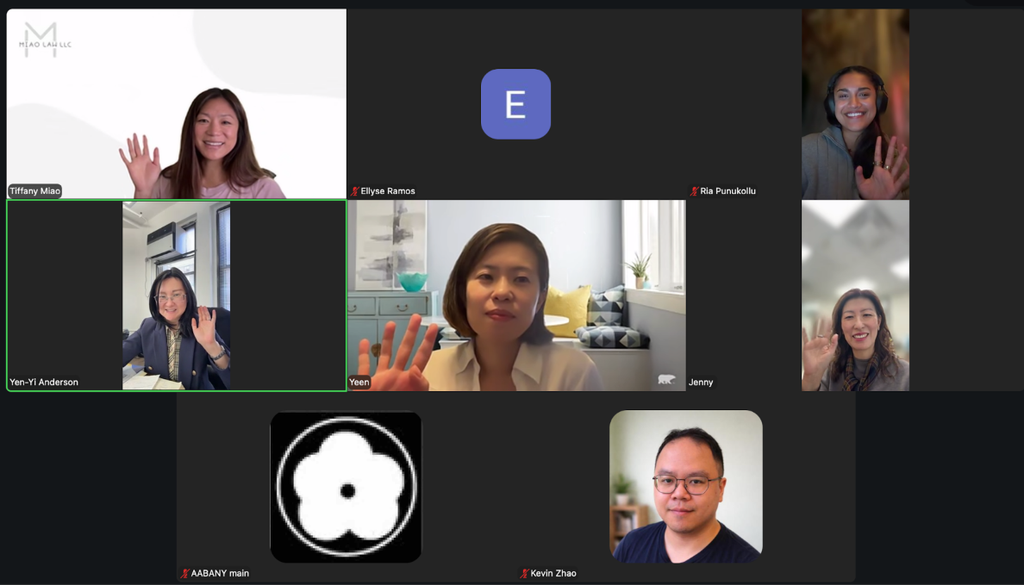
On October 6, 2026, ten attendees joined AABANY’s Solo and Small Firm Practice Committee for a virtual meet-up focused on strategies for success in solo and small firm practice, which included productive discussions on how to get certified in the state and city, ways to secure government work, and how to encourage other small business owners. Committee Co-Chairs Tiffany Miao (solo practitioner at Miao Law LLC, who focuses on business litigation, general counseling ) and Yen-Yi Anderson (owner of Anderson and Associates Law P.C., a small firm focused on business immigration and commercial litigation) led the session. Attendees included criminal and civil practitioners, an IP practitioner, a law student and prospective law students interested in small firms.
A central focus of the discussion was on Minority and Women-Owned Business Enterprise (MWBE) certification, which is available through both the city and the state. Applicants submit tax returns and documentation showing that the owner is a minority or a woman, and holds at least 51% of the business. Certified firms are placed on a list that receives notifications about Requests for Proposals (RFPs), and some RFPs give weight to certification when awarding contracts. One participant noted that New York State has a 30% spending goal for MWBE-certified businesses. City certification does not carry over to the state or the Port Authority however, which each require a separate application.
Participants described several routes to obtaining consistent work. Large RFPs often go to big nonprofits that then subcontract to MWBE firms. One participant has done this, and has also run monthly legal webinars and clinics for the City for about four years. She also encouraged small firms to team up on bids, for example by bringing in another practitioner for an IP or labor component, and said government agencies usually have a need for attorneys in every practice area. City agencies also hold discretionary funds to hire attorneys for smaller matters without a bid. Yen-Yi received two such engagements from city agencies; she also served as escrow agent on a Department of Veterans Affairs property purchase that required federal certification.
The main takeaway was that certification leads to work when it is paired with diligent outreach. Jenny and Megan’s firm was certified for years before it began pursuing contracts actively. They mentioned a solo practitioner who spoke at a recent state certification event who researched more than 90 state agencies, sent each General Counsel a capability statement describing her firm, and eventually landed a fractional general counsel assignment for one agency. Panelists added that government payment is reliable but can lag three to four months around fiscal year-end, and that rates run lower than private work, so a financial cushion helps.
Closing the session, Tiffany Miao, who started her solo practice three years ago, said it helps to have “your ducks lined up,” but “sometimes it’s good to just get going,” because once the work starts “a lot of things are going to change.” “The beauty of a solo practice is that you get to make it your own,” she said.
To learn more about the Solo and Small Firm Practice Committee, click here. To join future events, please check out AABANY’s calendar.