
Official blog of the Asian American Bar Association of New York
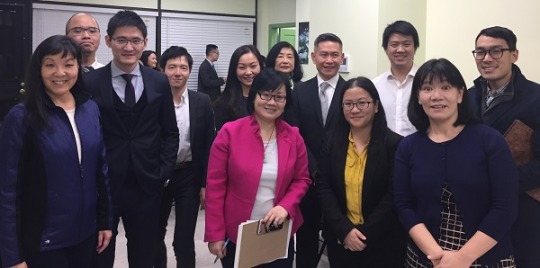
November’s Monthly Pro Bono Clinic, held on Wednesday, November 14 at 3 Bowery Street in Confucius Plaza, brought out 13 lawyers and 9 interpreters who volunteered their time to help 29 clients:
Lawyers:
Interpreters:
Special thanks to Johnny Thach and Roger Chen for coordinating the clinic, Social Worker Ann Hsu, and the Pro Bono and Community Service Committee Co-Chairs Karen Kithan Yau, Ming Chu Lee, and Asako Aiba for their leadership.
If you are interested in volunteering at next month’s Pro Bono Clinic on December 12, please contact Asako Aiba at asako.aiba@aabany.org. AABANY’s Monthly Pro Bono Clinic occurs every second Wednesday from 6:30 to 8:30 PM.



On November 14, 2018 the White House nominated Neomi Rao to the U.S. Court of Appeals for the D.C. Circuit. The nomination follows President Trump’s announcement of Rao during the White House Diwali celebration yesterday. If confirmed, Rao would be the first Asian Pacific American woman and the second South Asian American to sit on the D.C. Circuit. The National Asian Pacific American Bar Association (NAPABA) applauds the announcement and encourages the Senate to swiftly confirm her.
“Neomi Rao is an experienced public servant and legal thinker,” said Daniel Sakaguchi, president of NAPABA. “Respected amongst her peers, she has the temperament to serve on the U.S. Court of Appeals for the D.C. Circuit. Her nomination represents a historic step forward for representation of Asian Pacific Americans and women on the bench.”
Rao is currently the Administrator of the Office of Information and Regulatory Affairs. A national expert in the area of administrative law, she is a tenured professor at the Antonin Scalia Law School and founder of the Center for the Study of the Administrative State. She previously served in the Office of the White House Counsel and as a staffer for the Senate Judiciary Committee.


Super Lawyers – New York Metro 2018 Supplement
AABANY congratulates the AABANY members who
have been named Top Super Lawyers and Rising Stars in the New York Metro
2018 edition.
Both recognitions of Super Lawyer and Rising Star
involve a very selective and intense process in which the selected
attorney is nominated and approved by his or her peers in the same area
of practice.
Selections are made on an annual basis. Only 5% of
attorneys are recognized as Super Lawyers, and only 2.5% of attorneys
under 40 years of age are selected as Rising Stars. The attorney must
prove to be ethical, have excellent client records and proven results.
The 2018 digital edition of Super Lawyer and Rising Star can be found by
following the link in the title.
Congratulations to you all on your efforts and achievements!
New York Metro Super Lawyers
New York Metro Rising Stars
The National Asian Pacific American Bar Association (NAPABA), the Asian Pacific American Bar Association of South Florida (APABA-SF), and the Greater Orlando Asian American Bar Association (GOAABA) celebrate the repeal of the anti-immigrant “Alien Land Law” from Florida’s Constitution. On Election Day, Tuesday, November 6, 2018, Florida voters passed an amendment to repeal the Alien Land Law from their state Constitution. Florida added the provision to its Constitution in the 1920s, as part of an anti-Asian and anti-immigrant sentiment that legally prohibited aliens from holding real estate and real property in Florida.
“Thanks to the efforts of APABA-South Florida, GOAABA, and NAPABA, the discriminatory language of the Alien Land Law will be removed from Florida’s Constitution,” said NAPABA President Daniel Sakaguchi. “This amendment was long overdue. The Alien Land Law enshrined the second-class treatment of immigrants and Asian Pacific Americans under the law. We applaud Florida voters for repealing this vestige of discrimination and anti-immigrant sentiment from their state Constitution.”
“APABA of South Florida is proud that Florida’s voters took to the polls to repeal the Alien Land Law from the state Constitution,” said APABA-SF President Benjamin W. Dowers. “APABA of South Florida thanks NAPABA and GOAABA for working arm-in-arm in collaborating with the Florida Constitutional Revision Commission, educating voters through events and information, and reminding people that voting matters. We look forward to working with NAPABA and GOAABA to further social equality in Florida and all other states.”
NAPABA congratulates Bruce L. Ishimatsu on his election as Vice President for Finance and Development for the 2018-19 bar year. NAPABA also congratulates the newly-appointed at-large members and regional governors of the NAPABA Board of Governors for the 2018-19 bar year.
The following individuals were appointed by the NAPABA Board of Governors to serve for two-year terms as at-large board members:
The following individuals were selected by their respective regions to serve two-year terms as regional governors:
All incoming board members and newly-elected regional governors will serve with continuing elected officers, regional governors and at-large board members for the 2018-19 bar year. They will be sworn into office during the 2018 NAPABA Convention in Chicago, IL.