Contact: Rahat N. Babar, Deputy Executive Director
WASHINGTON — On the day before Thanksgiving, blocks from the offices of the National Asian Pacific American Bar Association (NAPABA), an individual shot two members of the National Guard. Army Specialist Sarah Beckstrom, 20, tragically succumbed to her injuries on Thanksgiving Day, and Air Force Staff Sergeant Andrew Wolfe, 24, remains in critical condition. NAPABA mourns the loss of Specialist Beckstrom and extends our deepest condolences to her family, friends, and colleagues. We are holding Sergeant Wolfe, his loved ones, and the military community in our thoughts as he undergoes critical care.
We unequivocally condemn this horrific act of violence. Though a full investigation is pending, government officials revealed that the alleged perpetrator, who is now detained and faces criminal charges, arrived in the United States in 2021 from Afghanistan through a federal resettlement program.
The views from leaders at all levels play a powerful role in shaping how communities such as asylum seekers, refugees, and immigrants are understood. The criminal acts of one individual should not be used to paint an entire community, especially those who have sought protection from this Nation. Casting aspersions does nothing to advance public discourse, and instead, it serves to fuel hate, a fact that is all too familiar to the Asian American, Native Hawaiian, and Pacific Islander community.
The United States has taken on an obligation under domestic and international law to provide refuge to those fleeing persecution. This has particular resonance with the Asian American community. Nearly three million refugees from Southeast Asia fled conflicts in the 1970s, and new generations have arrived since. The protections offered by the United States as a leading signatory to the International Refugee Convention and 1967 Protocol are critical to uphold.
Countless numbers of Asian Americans and others throughout history fled persecution for a better life in the United States. We need not turn our back on history or the generations seeking refuge. NAPABA has consistently supported the refugee resettlement program and this Nation’s long history of welcoming those seeking the protections of our country.
Prior to the Clinic, Vishal Chander (AABANY Board Member and Issues Committee Co-Chair), presented “Immigration Basics for Pro Bono Clinic Lawyers” (Part 1, NTA, Detention & Bond). This valuable training equipped attendees with important practice tips, such as how to assist a pro bono client who receives a Notice to Appear, how to locate a detained individual through immigration enforcement authorities, and how to obtain or request an immigration bond hearing. Vishal’s expertise was further demonstrated as he remained available to help address complex questions related to immigration issues, offering additional support to our community members.
In the training session, Vishal offered an engaging and informative introduction to the complexities of U.S. immigration proceedings, all while reminding us that knowledge can make a powerful difference for vulnerable communities. While he noted that removal defense is not his primary area of practice, his commitment to sharing essential tools spoke to a deeper truth of pro bono work: sometimes, the most meaningful contributions come not from being an expert, but from being willing to show up, learn, and guide others. He emphasized that even being able to recognize a Notice to Appear (NTA) and understanding what it means is often the first step in helping clients regain a sense of control, dignity, and direction in a system that can feel overwhelmingly confusing and intimidating.
His session also brought forward the human side of the law. When he spoke about frantic family members trying to locate loved ones across detention facilities, or clients unknowingly waiving important rights by signing English-only forms under pressure, it became clear that pro bono assistance is not just about legal procedure; it is also about compassion, advocacy, and being present for people at their most vulnerable. Volunteers do not need to solve every legal question to have an impact; even helping a client understand their A-number, guiding them to check the EOIR system, or knowing when to challenge errors in an NTA can prevent irreversible consequences. These small interventions protect not only legal rights, but also hope and humanity.
Vishal reminded us that pro bono work is about restoring access to information, to justice, and to basic fairness. The training reaffirmed that volunteers play a vital role in bridging the gap between complex legal systems and civilians, who are often confused, scared, and navigating language, cultural, and legal barriers all at once. Even a minimal understanding can open the door to critical support, and that is sometimes all it takes to change the course of someone’s life.
After Vishal’s presentation, the regular Pro Bono Clinic took place. At the clinic, our volunteers met with 15 clients and provided guidance on a range of legal issues, including housing questions, fraud concerns, and civil litigation matters. The collective efforts of our volunteers ensured that each client received personalized support and answers to their pressing legal questions. As one seasoned volunteer shared with AABANY staff, “sometimes it’s not solely about the legal issues, but about being here to listen.”
Here are some of the clients’ comments:
“Very satisfied (with the service), hope to have more of these (events/services) for me! Thanks!”
“Hope to be able to receive help again.”
“Mr. Justin was excellent.”
We are deeply grateful for everyone’s contributions and look forward to continuing this important work together!
Please join us at Part 2 of Immigration Basics for Pro Bono Clinic Lawyers: Navigating Immigration Court & Relief and future Pro Bono Clinics on December 3rd. The training will be from 6-6:30pm, followed by the Pro Bono Clinic. It will take place in Queens, at AAFE One Flushing Community Center. This training will continue the series that will prepare lawyers and law students on the fundamentals of advising Pro Bono Clinic clients who are or have family in removal (deportation) proceedings. Part 2 will focus on 1) What to expect in an immigration proceeding and 2) what kinds of relief are available in immigration court. Note: NY CLE Credit Available. Attorneys seeking CLE credits must attend both sessions to earn 1 CLE credit hour. No partial credit is available.
Upcoming Pro Bono Clinics:
December 3rd [Queens link here], from 6:30 – 8:30pm, AAFE One Flushing Community Center, 133-29 41st Ave, 2nd Floor, Flushing, NY 11355
December 17th [Manhattan link here] from 6:30-8:30pm, AAFE Community Center, 111 Norfolk Street, NY, NY 10002
January 10th [Brooklyn link here], from 12:30 – 3:30pm, CPC Brooklyn Community Services, 4101 8th Avenue, Brooklyn, NY 11232
On Thursday, November 13, 2025, the Asian American Bar Association of New York (AABANY)’s LGBTQ Committee and the South Asian Bar Association of New York (SABANY) came together to co-host the 2025 Fall LGBTQ Reception. The event was held at A&O Shearman‘s Manhattan office, bringing together attorneys, law students, and professionals to foster connections within the Asian American, South Asian, and LGBTQ communities.
The evening’s program began with a warm welcome from Dennis Quinio (he/him), Chief Inclusion Officer – Americas at A&O Shearman, who emphasized the crucial need for inclusive spaces within the legal profession.
Attendees then heard from featured speaker Priya Nair (they/them), Executive Director of the NYC Commission on Gender Equity. Priya shared valuable insights drawn from their nearly ten years working in New York City and State government, which included roles in the Governor’s Office, NYC Health + Hospitals, and the State’s first LGBTQ Fellowship. They also offered a personal reflection on their experience as a queer, non-binary individual of mixed heritage, underscoring how events like this are vital for intersectional community building.
AABANY and SABANY extend their sincere gratitude to A&O Shearman for their generous hospitality in hosting the event, and to Priya Nair for their inspiring and insightful remarks.
To learn more about AABANY’s LGBTQ Committee, click here.
On November 12, 2025, AABANY hosted another installment of its popular Dumplings & Discussion series, featuring Michelle Lee, General Counsel at MediaCo. The event drew a diverse group of attorneys and law students for an evening filled with candid conversation, career inspiration, community building, and, of course, delicious dumplings.
Moderated by AABANY Board Director Jeffrey Mok, the discussion explored Michelle’s remarkable journey through the legal profession. She reflected on her path to becoming General Counsel, sharing insights on mentorship, resilience, and embracing new challenges. Her thoughtful reflections offered both practical guidance and encouragement to aspiring legal professionals navigating their own career paths.
Following the conversation, attendees gathered for a networking reception, continuing the dialogue over plates of dumplings. The evening fostered connection, mentorship, and the exchange of shared experiences among members of the legal community.
AABANY extends its heartfelt thanks to Michelle Lee for her generosity in sharing her story, to Jeffrey Mok for leading the discussion, and to all who attended for making the event a success.
To read more about past Dumplings and Discussion chats, click here.
Consider coming to the next Dumplings and Discussion event, scheduled for December 9, 2025 with Alan Chang, General Counsel/Senior Vice President of the New York Yankees. For more information and to register by December 7, click here.
AABANY gathered 20 other associations for the 3rd Annual Pre-Holiday Multi-Association Gathering, on Tuesday, November 11, 2025, at 6:00 p.m., at the New York City Bar Association. The evening featured a potluck dinner, and a CLE Program on Wellness Resources, which included a Fireside Chat focused on veterans in the legal profession since this year’s event fell on Veterans Day.
As the evening began, guests gathered around a vibrant potluck table featuring an array of dishes representing the diverse cultures of the co-sponsoring bar associations.
The spread included scallion pancakes, lo mein, samosas, roasted pork, dumplings, pigs-in-a-blanket, fried rice, Caribbean-spiced chicken, and homemade baked goods, among other offerings.
Holidays can be emotionally and mentally challenging for many, especially those navigating identity transitions, loss, or professional pressures. This year’s CLE focused on veteran experiences, resilience, mental health, and navigating civilian legal careers after military service. Because this topic has often been neglected, it was especially meaningful to conduct this dialogue on Veterans Day.
The Fireside Chat featured a conversation between Amos Kim, Co-Chair of AABANY’s Military & Veteran Affairs Committee, litigation associate at Baker Hostetler, and Austin Cheng, U.S. Army veteran, attorney, and CEO of Gramercy Surgery Center. It was moderated by Benjamin Hsing, President of AABANY and Senior Counsel at Bayes PLLC. Meredith S. Heller, Attorney from the Law Office of Meredith S. Heller PLLC, also spoke to share wellness resources from the New York City Bar Association.
Austin described the often invisible challenges of transitioning from military life to a legal career. Reflecting on his return from service, he shared: “In the military, I knew exactly what I was responsible for. Every day had structure. There was clarity, purpose, and a team. When I returned to civilian life, I suddenly had too many choices — too much freedom. And that can be overwhelming.” Without that structure, veterans are suddenly faced with what many of us take for granted — choice. But for those used to clear orders, set routines, and defined missions, choice can feel less like freedom and more like instability.
Austin also shared that when he returned from service, the emotional weight of reintegration was immense. He reflected, “I just remember getting back on a Sunday. I was happy to get back home to my family after four years. I can see my mother, she was very different from when I saw her last.” Returning home is often imagined as a moment of relief, closure, or celebration. Yet for many veterans, the process can also be challenging and even painful. They need to rebuild identity, redefine purpose, and adjust to a life no longer shaped by military structure, urgency, or routine. Austin shared that he was suddenly faced with family responsibilities, including taking over his mother’s business, while grappling with these changes. It was during this time that he decided to pursue a J.D.
The difference in adjustment, Austin noted, is not merely about finding a new job and life, but about perspectives. While civilians may show respect and appreciation for service, understanding the mindset of military service requires more. And this goes both ways – veterans also may need to understand the perspective of the civilians, understanding that they are limited in their perspectives. As Austin stated: “I don’t think civilians ever played the role of a military person. I think what was more important at that time when I was transitioning out was me being able to understand the mindset of a civilian.” This highlights a key shift: successful reintegration does not mean expecting others to fully understand the military experience, it means understanding others’ perspectives.
Furthermore, cultural change can be difficult to get used to. Rather than operating within a single shared purpose, veterans entering the legal profession must now find purpose, build teams, and cultivate trust in a system where perspectives differ, and where collaboration is shaped not by command, but by conversation. Amos stated, “In the military we’re made to have like-minds, whereas here, in the team-building process, we have similar minds.” In the military, unity comes from sameness: same mission, same standards, same purpose. In the legal profession, unity must be built through difference: through debate, collaboration, and shared understanding.
However, they also benefited much from their time in service. Reflecting on how military training shaped his sense of purpose and discipline, Austin said: “I think being in the military gave me a certain level of resilience and perspective…. It’s war, so you have to kind of do certain things under very stressful conditions.” That sense of resilience, formed through years of training, responsibility, and operating under high-stress conditions, would anchor him in both law and leadership.
Amos added similar reflections, noting that even after transitioning into the legal field, many habits shaped by military life remain deeply ingrained. Attention to detail, strategic thinking, and discipline continue to guide his work. He shared that he still wakes up at 4:00 a.m. every day because his body and mind remain conditioned to that rhythm. The expectations in the military: precision, accountability, and intention, become part of who you are.
Amos also described the intensity of expectation, precision, and discipline expected in the military: “Operating in the military is more along the lines of what you’re doing to the right every time. There’s no room for error, and there’s no room for any other ideas on how to do it better. It’s the best way to do it, and that’s all.”
Austin’s and Amos’s experiences as service members not only shaped how they approached their mission, but how they later perceived work, purpose, and responsibility in civilian life and the legal profession.
After dinner and the Fireside Chat, attorneys, law students, judges, and professionals connected and exchanged stories during the networking time. The conversations were not just about their work, but about their families, cultural backgrounds, and personal journeys. Several attendees shared that it was refreshing to step away from case files and deadlines to connect as people, not just as professionals. The connections built between attendees of different backgrounds were personal, heartfelt, and deeply meaningful.
We thank all co-sponsoring associations for their continued support and generosity in sharing the diverse food for this event:
Events like these demonstrate AABANY’s ongoing commitment to wellness, community, inclusion, and shared storytelling within the legal profession. On this Veterans Day, we were proud to honor not only those who served, but also those who continue to serve through law, leadership, and empathy.
In addition to the associations and the speakers, we would like to thank Jonathan Nguyen, Gloria Tsui-Yip (AABANY Membership Committee Co-Chair) and Kwang Woo Andy Kim (law student from Rutgers Law School – Newark) for volunteering at this event.
“Purpose doesn’t end when service does. It simply takes a new form.” -Jade Simmons, transformational speaker, author and former concert pianist, from her book Purpose the Remix
On Saturday, November 22, 2025, AABANY members attended the 2025 Immigration Justice Conference, a full-day convening dedicated to strengthening legal and community responses to immigration enforcement. The conference was held at the Alianza Dominicana Cultural Center in Washington Heights and organized by a coalition of immigrant justice organizations alongside the Dominican Bar Association.
This year’s conference offered two parallel tracks:
(1) an Attorney Training Track focused on federal habeas corpus litigation, and
(2) a Community & Advocacy Track designed for nonprofits, CBOs, unions, and service providers preparing for rapid-response coordination.
AABANY members participated in the attorney track, which provided in-depth instruction on filing and litigating federal habeas petitions on behalf of non-citizens in immigration custody. Trainers included former Department of Justice officials, offering practitioners firsthand insight into federal court practice, litigation strategy, and recent developments in habeas jurisprudence.
From left to right: Conference organizers Yesenia Mata (Executive Director, La Colmena) and David Satnarine with Vishal Chander (AABANY Board Member and Issues Committee Co-Chair).From left to right: AABANY members Jack Hsia (Staff Attorney, Chinese-American Planning Council, Inc.) and Vishal Chander (The Chander Law Firm, PC).
Strengthening Immigrant Defense Through Collaboration
The Immigration Justice Conference emphasized collaborative preparedness across legal and community sectors during a time of evolving federal immigration enforcement. AABANY extends its thanks to the organizers—including La Colmena, Afrikana, Mixteca, and partner organizations—for hosting this vital training and for their continued leadership in expanding access to justice for immigrant communities.
For more information about future trainings, the organizing committee can be reached at immjusticeconf2025@gmail.com.
—Written by Vishal Chander, AABANY Board Member and Issues Committee Co-Chair
The Asian American Bar Association of New York (AABANY) was a prominent presence at the 37th National Asian Pacific American Bar Association (NAPABA) Convention, held at the Sheraton in downtown Denver, CO, from November 6 to 8, 2025. This year’s Convention boasted the second-largest convening in NAPABA history, with nearly 2,900 AANHPI attorneys, judges, law professionals and law students in attendance, including over 800 first-time attendees.
AABANY members presented and led various Continuing Legal Education (CLE) programs and were recognized during luncheons and social events throughout the three-day convention. Over 175 people connected with each other on the AABANY@NAPABA WhatsApp group before, during and after the conference.
AABANY Get-Together at Maggiano’s
AABANY’s well-attended gathering at Maggiano’s Little Italy on Thursday evening was a big hit on one of the first nights of the Convention. The location was conveniently steps away from the Sheraton, drawing over 120 attendees, including friends old and new, many from outside of New York. Guests enjoyed a buffet of heavy hors d’oeuvres, such as domestic and imported cheeses, crostini, ravioli, wagyu meatballs, fried calamari, fried zucchini, and crab cakes, along with drink tickets good for one drink. It proved to be a festive start to the Convention’s social calendar, filled with the spirit of camaraderie that defined the Convention.
Awardees and Recognition for AABANY Members
NAPABA Awards presented across various events, including the NAPABA Best Under 40 Awards Reception (Thursday), Welcome Reception (Thursday), President’s and Trailblazer Award Reception (Friday), and luncheon plenaries (Friday and Saturday).
AABANY members and AABANY past annual dinner honorees were honored this year at the Convention: (click the link to read more about each award and the 2025 awardees):
The 17th Annual Trial Reenactment: “Born American: United States v. Wong Kim Ark”
The AABANY Trial Reenactment Team presented its 17th production on Friday afternoon, November 7, to a capacity audience. The program, titled “Born American: United States v. Wong Kim Ark,” examined the landmark Supreme Court case. The case focused on Wong Kim Ark, born in San Francisco in 1873 to Chinese immigrants, who was denied reentry to the U.S. in 1895 under the Chinese Exclusion Act. Wong successfully argued that the Fourteenth Amendment’s guarantee of birthright citizenship applied to him. The program’s exploration of birthright citizenship was especially relevant, coming shortly after President Trump signed an Executive Order on January 20, 2025, seeking to restrict this established constitutional precedent.
Some of the photos taken from the Trial Reenactments by AABANY can be seen at this link here.
The cast included: Hon. Denny Chin, Kathy Hirata Chin, Jacob Chen, Francis Chin, Anna Mercado Clark, Hon. Peggy Kuo, Clara Ohr, Yasuhiro Saito, Professor Rose Cuison-Villazor, Andy Hahn, Yang Chen, Linda Lin, and Vince Chang. To learn more about AABANY’s Trial Reenactments, go to reenactments.aabany.org. AABANY encourages anyone interested in performing one of our reenactments to make a request through that website. The current script will be made available in 2026.
AABANY Members as Panel Experts
AABANY members showcased their expertise by serving as presenters and panelists across a variety of CLE programs throughout the Convention. Some of the programs featuring current and former AABANY members included, but were not limited to:
Thursday’s Programming:
Agentic AI: Legal and Policy Frontiers in the U.S. and China (Benjamin Hsing, AABANY President; Christopher Chan)
International Law Committee & Women’s Leadership Network Joint Luncheon (Jennifer Choe-Groves)
Navigating First Decade of Legal Career (Dan Brody)
Navigating Uncertainty with Confidence (Blossom Kan)
Friday’s Programming:
Shark Tank Part III: Live Pitch Coaching (Steve Chung; Hannah Kim; Austin So; Susan Shin, former AABANY President)
Navigating AI Integration in Legal Practice (Eric Lin)
Trump & Tariffs: Protectionism and Economic Impact (Rudy Figueroa)
Sexual Violence Against Women: From the Code of Ur-Nammu to WWII ‘Comfort Women’ and Beyond (Linny Ng)
Practicing with Bots: Training Lawyers in the AI Age (John Lee)
Advising Startups on Patent Strategy (Charles Chen)
United States v. Wen Ho Lee – 25 Years Later (Stephen Chahn Lee)
AI, Ethics & Minority Rights (Shruti Chopra)
High-Stakes Investigations & Trials (Joon Kim)
General Counsel Roundtable (Linda Lin, former AABANY President)
What We’ve Got Here Is a Failure to Communicate: Pitfalls and Best Practices for Handling Asian Language Witnesses and Evidence (Elizabeth L. Mo)
Representing Clients in the Highest Stakes Investigations and Trials (Jennifer Wu, AABANY Board Member)
Disagreeing Better: What ADR Principles Can Teach Us on How to Bridge Divides in Polarized Times (Chris M. Kwok, AABANY ADR Committee Co-Chair)
Ask an Associate: Navigating Starting Your Career at a Law Firm (Brittany Clark)
Workplace Discrimination and Arbitration (Rachel Lee, AABANY Issues Committee Co-Chair)
Birthright Citizenship Under Siege: The Fight for Asian American and Pacific Islander Belonging (Professor Rose Cuison-Villazor)
The Places You’ll Go! Careers in Specialized Fields (Ada Wang, AABANY Intellectual Property Co-Chair; Stacy Wu)
Birthright and Belonging: Who gets to be American in the 21st Century and Beyond? (Bethany Li)
Case Study: Creating a National Legal Organization (NAPABA) (Sandra Yamate)
Legal Career Paths: Partnership, In-House & Public Service (Christopher Arcitio)
There at the Beginning: Case Study on Creating a National Organization (Diane Yu, retired Chief of Staff and Deputy to the President of NYU, 2011 AABANY Annual Dinner Honoree)
Plenary Session Focus on the Portrait Project
During the Friday Plenary Lunch, discussion centered on the Portrait Project, NAPABA’s groundbreaking study of Asian Americans in the Law, supported by the American Bar Foundation and NAPABA. This research provides critical statistics demonstrating the persistent barriers to advancement and underrepresentation of the Asian American legal community in the profession’s top ranks, especially as diversity and inclusion programs face increasing national pressure. AABANY has been a financial donor to the Portrait Project.
AABANY 2010 Annual Dinner Honoree Sandra Leung, former General Counsel of Bristol Myers Squibb Company, was among the speakers, offering an in-house perspective on the representation of AANHPI attorneys. She spoke about the importance of AANHPI attorneys to be in leadership roles, stating “if you aren’t at the table, you’re on the menu.” That resonated with many attorneys who have felt not involved in the decision-making at one point or another in their careers.
Key findings highlighted by the Portrait Project indicated that while there has been progress in federal judicial appointments and General Counsel roles, underrepresentation at the highest levels persists. The research suggests Asian American attorneys would benefit from greater institutional support to counteract stereotypes, facilitate soft skills development and relationship-building, and increase leadership opportunities. Justice Goodwin Liu reinforced this theme, quoting a participant who stated, “Instead of another cooking class, talk to me about retention.”
AABANY Members Sworn into NAPABA Board
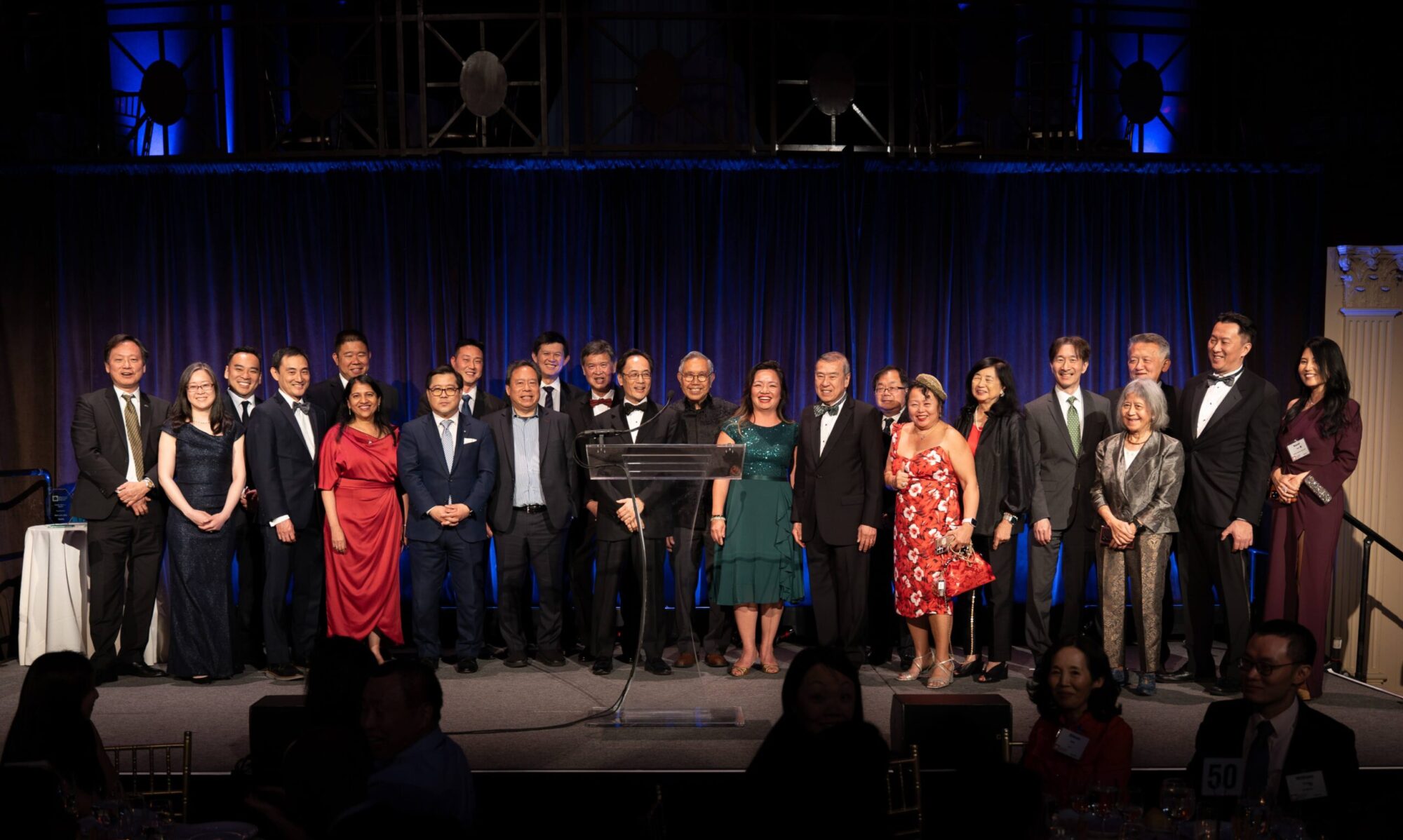
During the Premier Event, the 37th Anniversary Gala on Saturday evening, AABANY members Anushree Bagrodia (Vice President & Senior Managing Counsel, Mastercard), Sapna Palla (Past President; Trial Lawyer and Partner, White & Case LLP), and Vishal Chander (Board Member and Issues Committee Co-Chair; Managing Attorney, The Chander Law Firm, P.C.) were all officially sworn in as At-Large Members of the NAPABA Board.
AABANY congratulates and thanks Anushree, Sapna and Vishal for their service on the NAPABA Board, along with Glenn D. Magpantay (AABANY Board Member; Commissioner at the U.S. Commission on Civil Rights) for being appointed as a Northeast Alternate Regional Governor for NAPABA.
Gala Keynote
The Gala featured a fireside chat with keynote speakers Katie Phang and Rich Ting. Their conversation spanned Rich Ting’s career transition from attorney to acclaimed actor, and explored the evolving landscape of Asian American representation in Hollywood during polarizing times. Fun fact: Rich Ting has a law degree and was about to start his legal career at a prominent law firm until Hollywood called … and now he no longer has to worry about keeping up his CLE credits.
Social Activities
Beyond the formal events, AABANY members gathered for a variety of social activities, including morning yoga sessions, board game night (organized by our own Jeffrey Mok, Board Director, Issues Committee Co-Chair, and Principal at Fish & Richardson), and karaoke (separate events sponsored by Groombridge Wu and Littler, both long-time sponsors of AABANY), as well as exploring the areas around Denver!
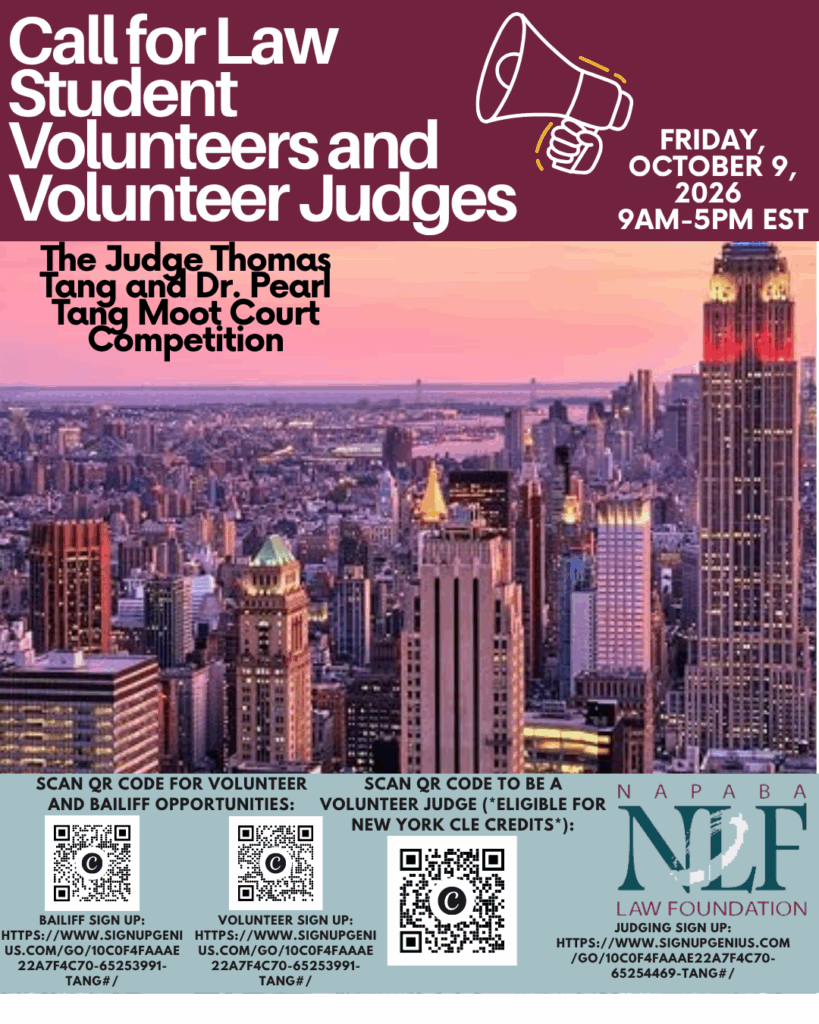
Thomas Tang Moot Court Competition
The national finals for the Thomas Tang Moot Court Competition took place during the NAPABA Convention. Law students from the New York area participated, alongside volunteer judges from AABANY. We congratulate all participants and the winning team: Audrey La and Josh Shimabukuro from Loyola University Chicago School of Law, who had previously won the regional competition round in New York in October.
A Community and a Family
Despite flight cancellations and delays experienced by many AABANY members on their return home, the spirit of mutual support endured, with members reaching out, sharing resources, and ensuring everyone arrived home safely. This supportive behavior exemplified the core takeaway from the convention: AABANY is more than just a community—it is a family that comes together to uplift and assist one another.
We look forward to the next NAPABA Convention in Los Angeles, scheduled for November 12-15, 2026 at the JW Marriott L.A. Live.
More photos, shared by various AABANY members, can be found at this album here.
While the season changes and the leaves turn colors, one thing remains constant: our volunteers and their incredibly generous support for our Pro Bono Clinics.
We give a special acknowledgement to Vishal Chander, another highly committed volunteer, Co-Chair of the Issues Committee, and a member of the AABANY Board of Directors.
As he was preparing to swear-in as a new Board Director for NAPABA in Denver, CO, Vishal generously stepped up to remotely cover immigration cases for us. We deeply appreciate his dedication and willingness to support our work even while traveling and taking on a new leadership role. Congratulations to Vishal on his new position at NAPABA. We are grateful for his integrity and commitment to the AABANY Pro Bono Clinic.
During this month’s Clinic, our volunteers provided invaluable assistance to 16 clients, addressing a range of legal matters including housing, immigration, family and matrimonial, estate and property, invasion of privacy, and employment. Our volunteer attorneys and interpreters thoughtfully addressed client concerns, offered clarity through their answers, and facilitated connections to appropriate legal resources via AABANY’s Legal Referral and Information Service (LRIS).
We are committed to offering services in both Mandarin and Cantonese to ensure continued support for individuals facing linguistic or cultural barriers when seeking guidance on substantive and procedural legal matters.
As an interpreter at this Clinic, I had the opportunity to sit in on several deeply moving cases that revealed the human stakes behind legal procedures. One immigration case involved a young woman whose father had abandoned the family years ago. She hoped to apply for a green card based on abandonment and emotional hardship. After discussion, her case appeared to fall under Special Immigrant Juvenile Status (SIJS), which provides a pathway to lawful permanent residency for minors who have been abused, neglected, or abandoned by one or both parents, and who cannot safely return to their home country. In that room, I watched not just attorneys offering legal guidance, but human beings holding space for grief, confusion, and hope. It reminded me how the law, while technical in form, carries deeply human consequences for those whose lives depend on it. The attorneys ran back and forth, trying to get them resources and help, making clear what their choices were and how they could get help.
Another case involved a Spanish-speaking mother and her children who had fallen three years behind on rent after the mother made the difficult but necessary decision to evict a roommate who had sexually assaulted her daughter. Without the financial support, and with her son refusing to contribute while still living in the home, she was unable to recover and pay rent. The attorneys carefully explained possible remedies, guiding her through how to appear in Housing Court, how to request a court-appointed attorney, and how to apply for a One Shot Deal, an emergency rental assistance program for tenants facing eviction due to financial hardship. They also discussed longer-term legal planning and referred her to additional community-based support services. What struck me most was the compassion with which they approached her situation, emphasizing not only what could be done legally, but how she could emotionally and practically navigate the process.
The pro bono work done through AABANY’s Pro Bono Clinics is not just about dealing with legal challenges – it is about the restoration of dignity, clarity amid fear, and giving structure to lives interrupted by crisis. Access to justice is not merely a legal right, but a human one.
We are grateful for all the volunteers at the November 8th Brooklyn Pro Bono Clinic for their time, professionalism, and contribution:
Volunteer attorneys:
Vishal Chander
Victoria Cheng
Megan Gao
Kwok Kei Ng
Arthur Lin
Jie Shi
Shuyao Wang
May Wong
Tiffany Wong
Gary Yeung
Alexander Yuan
Interpreters/Shadowers:
Kaila Chen
Nikita Kohli
Yiyang Shen
Wendy Zeng
Jessie Zhou
We invite you to continue supporting our community by joining us at our upcoming pro bono clinics:
December 3rd [Queens link here], from 6:30 – 8:30pm, One Flushing Community Center, 133-29 41st Ave, 2nd Floor, Flushing, NY 11355 [Immigration Law training provided. Find out more below.]
December 17th [Manhattan link here] from 6:30-8:30pm, AAFE Community Center, 111 Norfolk Street, NY, NY 10002
January 10th [Brooklyn link here], from 12:30 – 3:30pm, CPC Brooklyn Community Services, 4101 8th Avenue, Brooklyn, NY 11232
Upcoming Community Education Training Speaker and Topic Announcement
With the collaboration of the Immigration and Issues Committees, Vishal Chander, one of PBCS’s incredible volunteers and Issues Committee Co-Chair, will provide a thirty-minute Basic Immigration Training Part 2 on December 3rd at Queens Pro Bono Clinic from 6 – 6:30pm. Part 1 was conducted at the Manhattan Pro Bono Clinic on November 19, and if you missed it, the video will be made available soon.
This training series will prepare lawyers and law students the fundamentals of advising pro bono clients who are or have family in removal (deportation) proceedings.
Note: Attorneys seeking CLE credits must attend both sessions to earn 1 CLE credit hour. No partial credit is available.
We look forward to your participation in our future clinics! To learn more about how you can get involved with AABANY’s Pro Bono Clinics, visit probono.aabany.org.
The Administrative Board of the Courts is soliciting public comments on the following proposed amendments to court rules:
Artificial Intelligence: Proposal to add a new Part 161 to the Rules of the Chief Administrator of the Courts regarding the use of generative artificial intelligence in preparing court documents
Equal Rights Amendment: Proposal to amend Section 100.3(B) of the Code of Judicial Conduct, Rule 8.4(g) of the Rules of Professional Conduct, and Section 1210.1(10) of the Statement of Clients Rights, to conform those provisions to the language contained in the Equal Rights Amendment
Legal internships in the New York State Courts are programs for law students to gain experience in public service. Interns research and analyze legal issues and are responsible for drafting orders, proofreading opinions, verifying citations, preparing jury charges, and verdict forms. The internship program provides hands-on experience, professional development, and opportunities to work on projects that promote access to justice. Legal Interns, appointed in the Civil Term by Justices of the Supreme Court, are assigned to Judges designated as Acting Supreme Court Justices. This internship position is assigned to Hon. Mary Lynn Nicolas-Brewster, Supreme Court Justice in Bronx County Supreme Court – Civil Term.
This is an unpaid, in-person, eight-week legal internship program for law students interested in becoming a judge or public interest attorney. Interns are expected to participate for 12 hours weekly. Legal interns will receive rare opportunities to develop legal research, oral advocacy, and writing skills. Additional features of the program include weekly lunch-and-learn sessions with attorneys and judges across practice areas, individualized mentorship, and practical advice for law school success. The Internship program is designed to be a pipeline program for law students interested in careers in the courts and public service.
The in-person legal internship will be hosted from February 16, 2026, through April 10, 2026 (internship location – Bronx Supreme Court – Civil Term, 851 Grand Concourse, Bronx, New York). The application deadline is January 9, 2026.
Interested students should email: BXSUPCIV-IA11@NYCOURTS.GOV.
The subject line should be “Legal Internship – Spring 2026″
You must include the following documents as one attachment:
A cover letter addressed to Hon. Mary Lynn Nicolas-Brewster, Acting Supreme Court Justice, Bronx Supreme Court, Civil Term.
Please highlight previous public service work or work involving equal justice issues.
Your resume.
A writing sample – please respond to the essay prompt below:
ESSAY PROMPT: In this personal injury action involving a motor vehicle accident, Plaintiff has failed to provide responses to discovery demands and Defendant ABC Holding has moved for an order dismissing the action in accordance with the Court’s prior April 10, 2025 order. That self-executing order granted dismissal of Plaintiff’s complaint unless within sixty (60) days of the order, Plaintiff provided responses to Defendant ABC Holding’s discovery demands. The Court directed dismissal of Plaintiff’s complaint, pursuant to CPLR 3126, if there was a failure to comply with its Order. Plaintiff failed to provide the discovery contemplated by the April 10, 2025 order and Defendant ABC Holding has now moved to dismiss the complaint based on Plaintiff’s failure to comply with this Court’s self executing order of dismissal issued on April 10, 2025. Please draft the analysis and conclusion/determination section of the proposed decision and order (please limit to 500 words or less). Please limit your research to First Department case law.