
Beyond Big Law: AABANY Panel Explores Diverse Legal Career Paths at Fordham Law

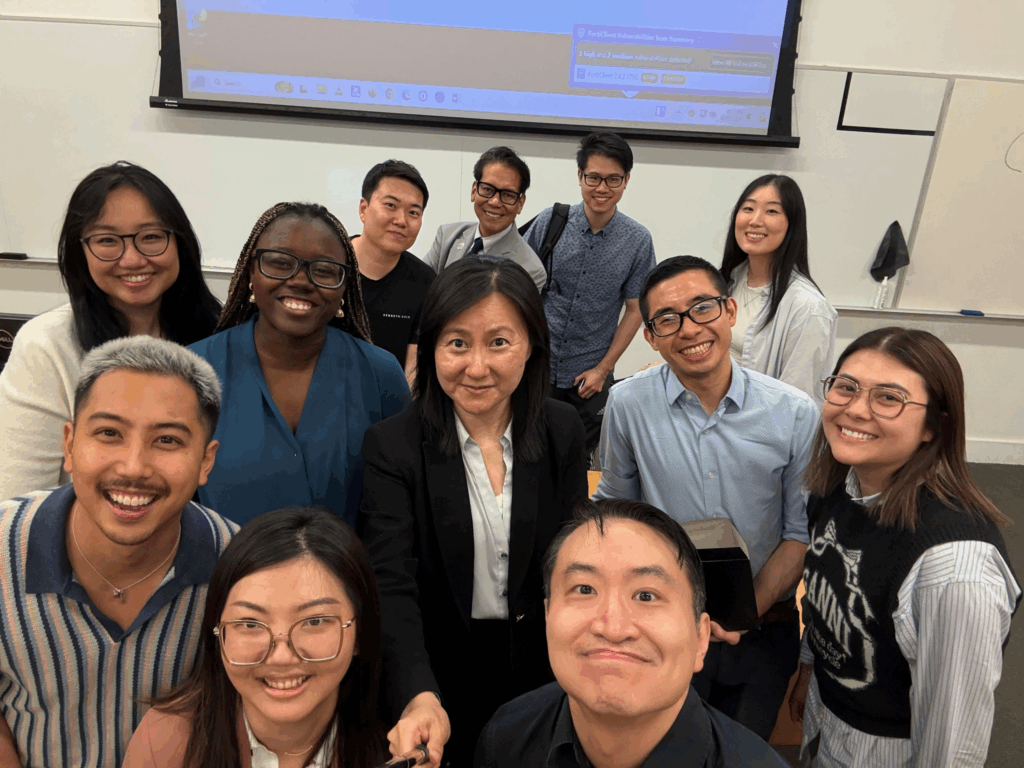
On April 15, 2026, the Asian American Bar Association of New York (AABANY)’s LGBTQ Committee, in collaboration with the Solo and Small Firm Practice Committee, hosted a dynamic and insightful panel at Fordham Law School titled “Table Talk: Careers Beyond Big Law.” Generously co-sponsored by Fordham APALSA and Fordham OUTLaws, with support from AABANY’s Student Outreach Committee, the event brought together an accomplished group of legal professionals and an engaged audience of students and early-career professionals eager to explore alternative pathways within the legal profession.

Mina Yi, a Fordham Law student representing Fordham APALSA, served as moderator and kicked off the discussion by asking the panelists to introduce themselves, their practice areas, and their current roles. Then, she asked them to share their advice on how students can pursue non-traditional or non-Big Law career paths.

The panel featured a diverse lineup of speakers, including Gregory Hom (Nixon Peabody), Kayla Lucia (Mintz), Yen-Yi Anderson (Anderson & Associates), Thomas Wu (New York State Housing Finance Agency), Daobo Wang (New York State Unified Court System), and Glenn Magpantay (U.S. Commission on Civil Rights). Almost all the speakers were AABANY leaders: Gregory is the current Co-Chair of the LGBTQ Committee. Kayla was Co Chair during the last fiscal year, and Daobo is Co-Chair this fiscal year. Yen-Yi is Co-Chair of the Solo and Small Firm Practice Committee. Glenn is a Director on AABANY’s Board.

The speakers’ careers spanned public finance, employment litigation, immigration, small law firm practice, government service, judicial clerkships, and civil rights policy. Their varied trajectories illustrated a central theme of the evening: legal careers are rarely linear. The panelists conveyed that professional fulfillment often emerges from adaptability in one’s circumstances, persistence, and meaningful relationships.

From the outset, panelists demystified the notion of a singular “Big Law path.” Gregory Hom offered a nuanced perspective on large-firm practice, noting that not all firms operate under the same high-turnover model often associated with the industry. He mentioned that instead, firms like Nixon Peabody prioritize sustained interest in specialized practice areas, such as his own work in public finance, and rely heavily on faculty recommendations and personal connections in hiring. In his daily practice, he acts as a “watchdog” for state agencies and investment banks, meticulously reviewing documents to ensure securities law disclosures are consistent and avoid SEC investigations. Gregory shared that he secured his role after heavily leaning on a professor for guidance, and he recommended that students not shy away from doing the same.

Kayla Lucia echoed this sentiment, reflecting on her own nontraditional journey, starting in Legal Aid, then moving to “Midlaw,” and eventually to a major firm specializing in employment law. She noted that she transitioned into private practice to find a more sustainable professional life and to avoid the burnout she felt in the public interest sector. Kayla encouraged students to think critically about the kind of professional and personal life they hope to build, and to consider factors like team size and environmental competitiveness, rather than defaulting to prestige-driven choices. Her current work involves bridging the gap between poorly written statutes and the concise answers employers need, while also assessing the factual viability of litigation claims.

Yen-Yi Anderson provided a compelling account of forging an independent path to starting her own small firm practice. She recounted that her career did not follow a direct route after law school, spending years in nonprofit and media work before returning to the legal field and building her own practice through relationships she had developed with foreign entrepreneurs. In a small-firm setting, she emphasized that attorneys must “wear many hats,” balancing legal work with responsibilities such as managing hiring, payroll, office management, and client development. At the same time, she noted that her practice areas in immigration and commercial litigation require constant attention to evolving laws and policies, which makes adaptability essential. Despite the challenges, Yen-Yi relished the autonomy that comes with running her own firm. She is able to choose her clients, shape her workload, and maintain flexibility in her schedule to allow her to prioritize family alongside her career. 

The discussion was further enriched by perspectives from the public sector, illustrating how legal work can directly shape public policy and address community needs. Thomas Wu detailed his role at the New York State Housing Finance Agency, where legal practice operates at the intersection of law and urban development. In this capacity, attorneys work alongside policymakers and financial institutions to structure deals that support affordable housing initiatives across the state. He described the work as both technical and mission-driven as it requires attorneys to translate legal frameworks into practical tools that enable large-scale development projects. Thomas also emphasized the importance of fellowship programs, such as the Excelsior Fellows Program, as accessible and structured entry points into government service for recent graduates seeking substantive experience and long-term pathways into public sector careers.

Similarly, Glenn Magpantay offered a broader, long-term perspective shaped by decades of experience across civil rights enforcement, nonprofit leadership, AABANY, and his current role as a Commissioner on the United States Commission on Civil Rights. Glenn encouraged students to view their careers as evolving journeys that may have uncertainty and deviation from previous expectations. Glenn advised, “Don’t worry too much about getting it right the first time—your career will evolve, and you’ll get where you want to go,” reinforcing the idea that resilience and adaptability with the legal community are often more determinative of long-term success.

The discussion also highlighted the critical role of networking and mentorship. Speakers consistently emphasized that relationships, such as those cultivated through bar associations like AABANY and broader community engagement, are often instrumental in securing opportunities. Glenn noted that in a competitive field where many candidates appear equally qualified on paper, it is frequently personal connections and trusted recommendations that set applicants apart.

During the Q&A portion, one student asked how the law is actually applied in day-to-day practice as opposed to the case-based learning emphasized in law school. Speakers responded by illustrating their actual responsibilities in vivid detail. Whether it was Gregory ensuring regulatory compliance in complex financial disclosures, Kayla interpreting ambiguous statutes to advise clients, or Daobo drafting judicial opinions grounded in meticulous legal research, each speaker illustrated how legal reasoning operates in real-world contexts. These insights helped bridge the gap between classroom learning and professional application where students were able to gather a clearer understanding of what legal work truly entails.

The evening concluded with an interactive session in which attendees also introduced themselves and shared their aspirations, followed by informal networking over pizza. Thank you to AABANY’s LGBTQ Committee and Solo and Small Firm Practice Committee for organizing and hosting this thoughtful and engaging program, as well as to Fordham APALSA and Fordham OUTLaws for their generous co-sponsorships and collaboration. Special appreciation also goes to the Student Outreach Committee for their continued support in creating meaningful opportunities for students to engage with practitioners across diverse areas of the legal profession.

NAPABA Advocacy Update

NAPABA Advocacy Update

July 2, 2025

Just over a month ago, NAPABA held its annual Lobby Day in Washington, DC. We convened our members in the Nation’s capital to support the Asian American, Native Hawaiian, and Pacific Islander (AANHPI) community, advance a fair and humane immigration system, defend the rule of law and the legal profession, and advance democracy and civil rights. With over 60 congressional meetings and over 20 states represented, NAPABA demonstrated its commitment to change the status quo for our community.

Since then, and since NAPABA’s last update to you, we have been tracking developments that impact our organization, our mission, our legal community, and the broader AANHPI community. Please find some of these updates below


I. NAPABA-Led Coalition Continues to Defend Birthright Citizenship

After our filing in the U.S. Court of Appeals for the Ninth Circuit in April 2025, NAPABA continued to lead a coalition of nearly 50 of its affiliates and national associates from across the country to defend birthright citizenship. Besides our amicus brief in the Ninth Circuit, which is available here, NAPABA filed substantially similar amicus briefs defending birthright citizenship in matters pending in the First Circuit and the Fourth Circuit. Those briefs can be viewed here and here.

Our brief explains the critical historical context behind United States v. Wong Kim Ark, 169 U.S. 649 (1898). The case was decided during an era of intense anti-Chinese sentiment, immigration restrictions, widespread violence, and mass expulsions. In Wong Kim Ark, the U.S. Supreme Court declared that birthright citizenship is automatically conferred to children born on American soil, even to those whose parents were from the most disfavored migrant group in the country at the time. NAPABA’s amicus brief underscores the importance of understanding Asian American legal history as a critical part of American history. Wong Kim Ark and other cases involving Asian American litigants in the late 19th century are foundational precedents for today’s immigration and civil rights law.  

Media outlets such as Law360 and the National Law Journal have covered NAPABA’s legal arguments.

On Friday, June 27, 2025, the U.S. Supreme Court narrowed the scope of the preliminary injunctions that can be available to pause the executive order limiting birthright citizenship. The Court did not address the constitutionality of the executive order. Thus, litigation will continue as does NAPABA’s advocacy. The question of a child’s citizenship in the United States ought not to be dependent on the stature or circumstances of their parents. Nor should it turn on whether a child is born in one state versus another. For the guarantees of the Fourteenth Amendment to be vindicated, birthright citizenship must apply to all children across the United States.  


II. NAPABA Condemns Political Violence and Hate

In recent weeks, we have witnessed incidents of hate and political violence that are antithetical to the values of our community and our country. In the early morning hours of June 14, 2025, an armed perpetrator shot two Minnesota state legislators and their respective spouses in the suburbs outside of Minneapolis in an “act of targeted political violence,” according to the Governor of Minnesota. State Representative Melissa Hortman and her husband, Mark, died. State Senator John A. Hoffman and his wife, Yvette, survived and sustained injuries from the attack.

Weeks earlier, on May 21, 2025, a deadly shooting in Washington, DC, targeted Israeli Embassy diplomats.  And on June 1, 2025, eight people in Boulder, Colorado, were injured when a perpetrator threw incendiary devices into a crowd during a demonstration intended to remember hostages in the Middle East. One of those injured died from her wounds.

On top of these horrific acts, some elected leaders have sought divisiveness rather than inclusion. In a social media post, a member of Congress expressed that it was “deeply troubling” that a Sikh faith leader, Giani Surinder Singh, led a prayer on the floor of the U.S. House of Representatives. The member, who had misidentified Giani Surinder Singh as Muslim, declared that Singh “should never have been allowed” to lead a prayer in Congress.

In the race for New York City’s mayor, some members of Congress have lodged Islamophobic comments against Zohran Mamdani, the winner of the primary election. One member of Congress posted an offensive cartoon of Mamdani, referred to Mamdani with a slur, and called on the Attorney General to institute denaturalization proceedings and remove him from the United States. Another member of Congress posted a photo on social media of Mamdani wearing a kurta and greeting others for an Eid service with the caption, “After 9/11, we said, ‘Never Forget.’ I think we sadly have forgotten.”  

Further, the U.S. Department of Justice, Bureau of Justice Statistics, revised the National Crime Victimization Survey and removed questions about gender identity and about hate crimes against transgender people. Previously, the questions on sexual orientation and gender identity allowed researchers, policymakers, and advocates to quantify the disproportionate victimization of the LGBTQ+ community. Comprehensive data collection surrounding hate crimes and hate incidents is critical in order to better combat such conduct and to take legislative action. NAPABA joined 90+ organizations opposing the decision. Following our advocacy, the Bureau of Justice Statistics reinstated the question pertaining to hate crimes involving gender identity.  

The Justice Department’s action preceded a recent decision of the U.S. Supreme Court to uphold a Tennessee law that banned hormone therapies for transgender minors.

Hate, regardless of the form, political violence, and the marginalization of vulnerable communities must be rejected. NAPABA will continue to oppose hate, support the diverse AANHPI community, and work to strengthen the rule of law and democracy.


III. NAPABA Calls for a Fair and Humane Immigration System

Fundamental to a fair and humane immigration system is one that is subject to constitutional limits, non-discriminatory, and ensures meaningful due process. Recent developments, however, brush against these values.

On May 28, 2025, the federal government announced that it would work to “aggressively revoke visas for Chinese students.”  This policy declaration has not only caused needless anxiety throughout our community, but it is also wholly misguided. While policymakers have the prerogative to address the legitimate national security concerns confronting the United States, they may not enact discriminatory policies like blanket visa revocations based only on national origin and alien land laws. Instead of measures that are tailored to an evidence-based, national security nexus, these recent policies foster an atmosphere of distrust that targets Asian Americans generally, not just the Chinese American community.

NAPABA is also concerned about the federal government’s invocation of the Alien Enemies Act. On June 2, 2025, NAPABA joined 60 other AANHPI organizations, led by the Japanese American Citizens League (JACL), in filing an amicus brief that urged the court to fulfill its role in preserving the right to due process and ensuring meaningful judicial review of executive orders. The last invocation of the Alien Enemies Act justified the incarceration of over 120,000 Japanese Americans during World War II. The amicus brief shared the stories of these Americans and their families. We urged the court to uphold the right of meaningful due process and judicial review of executive actions.

Lastly, starting on June 6, 2025, protests erupted in Los Angeles in response to federal immigration enforcement actions in the city. On June 7, 2025, for the first time in 33 years, the President deployed National Guard and military service members in Los Angeles to protect federal law enforcement and federal property. The protests continued until around June 15.

NAPABA recognizes the widespread anxiety throughout the AANHPI community and the broader immigrant community.  Whether involving the changes in immigration enforcement policy or the announcement of new immigration policies generally, the shifting landscape of immigration law has created much uncertainty. This includes a recent policy change from U.S. Immigration and Customs Enforcement pertaining to the removability of certain Vietnamese immigrants who arrived in the United States prior to 1995. Please visit the Asian Law Caucus’s website for more information.  

In the coming days, NAPABA will promote educational programming to cover many of these changes and more.  Please stay tuned.


We have a lot of work ahead of us, and the NAPABA Policy Team will do its part. But we need your partnership, too. Engage in our committees and networks and register for the NAPABA Convention in Denver, which will be held on November 6-8, 2025. We look forward to seeing you.