On June 10, the Asian American Bar Association of New York (AABANY) hosted an installment of its Dumplings & Discussion event series featuring Sandra Leung, independent Board Member of Bausch Health Companies, retired General Counsel for biopharmaceutical company Bristol Myers Squibb, and past President of the National Asian Pacific American Bar Association (NAPABA). Over delicious dumplings and other dim sum dishes, Sandra shared her extensive career experiences with a captivated audience.
In addition to her 18 years as General Counsel at Bristol Myers Squibb—the first Asian American and the first woman to serve as their General Counsel—Sandra is also the 2025 recipient of NAPABA’s highest honor, the Daniel K. Inouye Trailblazer Award. In her illustrious career, Sandra was also the first Asian American woman to serve as an Assistant District Attorney in the Manhattan District Attorney’s office. Her board service includes serving on the boards of the Minority Corporate Counsel Association (MCCA) and the Asian American Legal Defense and Education Fund (AALDEF). Furthermore, she was a founding member of the Leadership Council on Legal Diversity (LCLD).
Sandra shared her journey in conversation with moderator and event organizer Jeffrey Mok, Principal at Fish & Richardson, AABANY Board Director, and Co-Chair of AABANY’s Intellectual Property Committee. The audience learned about Sandra’s favorite type of dumpling (homemade veggie dumplings) before launching into Sandra’s career path.
Sandra offered advice for the many young lawyers present, focusing on the path to in-house work and the importance of loving the work you do. The room was spellbound by her compelling storytelling and wealth of experiences and advice, ranging from tales of microaggression to humorous stories to accounts of stressful experiences.
While winding down the discussion and taking questions, Sandra offered cogent advice to the audience to put yourself out there: “If you’re not at the table, you’re on the menu.”
Sandra’s work ethic, charisma, and initiative left a strong impression on attendees, who continued mingling at the networking reception after the discussion.
AABANY is grateful to Sandra Leung for her warmth and openness and to Fish & Richardson P.C. for graciously hosting the event. Thank you to all our attendees for joining and being part of a memorable evening!
See here to read about past Dumplings & Discussion chats.
WASHINGTON – The National Asian Pacific American Bar Association (NAPABA) congratulates Judge Reynaldo A. Aligada, Jr. on his appointment to the Minnesota Supreme Court. Judge Aligada becomes the first Asian Pacific American justice in Minnesota’s history.
“Judge Reynaldo Aligada’s historic appointment to the Minnesota Supreme Court marks a milestone for the Asian American, Native Hawaiian, and Pacific Islander (AANHPI) legal community and beyond,” said NAPABA President Joseph Yao. “As NAPABA’s Portrait Project 2.0 found, Asian American jurists are underrepresented on state high courts. Judge Aligada has broken barriers, and his appointment marks an incredible achievement for our legal community and beyond.”
Judge Aligada currently serves on Minnesota’s Second Judicial District Court. Prior to joining the bench, he served as First Assistant Federal Defender in Minneapolis and previously practiced at Robins, Kaplan, Miller & Ciresi LLP. He clerked for Judge Michael J. Davis of the U.S. District Court for the District of Minnesota and Judge Wilhelmina M. Wright of the Minnesota Court of Appeals. Judge Aligada earned his B.A. from Saint John’s University and his J.D. from William Mitchell College of Law, now the Mitchell Hamline School of Law.
“Through his many roles in the community, including with the Community Outreach Committee of the Federal Bar Association and many bar associations like the Minnesota Asian Pacific American Bar Association (MNAPABA), Judge Aligada has demonstrated a deep commitment public service,” said Priya Purandare, Executive Director of NAPABA. “His groundbreaking appointment highlights the importance of ensuring that those in the AANHPI legal community are recognized, supported, and elevated to positions of leadership across the country.”
“Judge Aligada is a brilliant and skilled jurist and, importantly, a wonderful human being. These qualities, along with his background and experience, make him a phenomenal choice to serve as a justice on the Minnesota Supreme Court,” said Valerie Narcy, President of MNAPABA. “This moment comes against the backdrop of a long and challenging history for AANHPI communities. From legislation excluding Chinese immigrants, to the incarceration of Japanese Americans during World War II, to anti-Asian hate during the COVID-19 pandemic, to the more recent actions against birthright citizenship, our community has often been left to wonder about our place in American society. Judge Aligada’s appointment is a reminder that our place is here and that our community is well-woven into the historic tapestry of Minnesota and this country.”
NAPABA extends its sincere congratulations to Judge Reynaldo Aligada and wishes him success in his service on the Minnesota Supreme Court.
Justice Karen Lin, a longtime member of AABANY and former Co-Chair of the Pro Bono and Community Service Committee (PBCS), has been appointed to the Appellate Term for the Second Department of the New York State Supreme Court. This appointment marks a historic milestone as Justice Lin is the first Asian American woman to serve in this role. As a lifelong public servant and sitting Second Department Justice, she brings decades of experience and a deep commitment to justice to one of the most impactful appellate tribunals for everyday New Yorkers.
Breaking Barriers: The Significance of “the First” Justice Lin’s appointment to the Appellate Term for the Second Department carries historic significance. Yet, for Justice Lin, the meaning of this milestone is inseparable from the community that shaped her.
Born and raised in Queens by her immigrant parents, Justice Lin’s story is rooted in the borough she now serves. At a time when Asian Americans were significantly underrepresented in both civic and professional spaces within Queens County, her early experiences acutely instilled in her a heightened awareness of the importance of being seen and heard. As a child, she recalls helping interpret for her parents who spoke limited English. She also recalls attending school events where she was one of the few Asian American faces in the room. These moments made her realize the significance of representation, or the lack thereof. Coupled with her parents’ tireless work ethic and emphasis on community, these experiences profoundly shaped her sense of justice and responsibility to her community.
Despite Asian Americans comprising more than 27 percent of the population in Queens, they have historically remained underrepresented on the bench. While precise figures vary by dataset, estimates by the Brooklyn Daily Eagle suggest that fewer than 10 percent of judges in Queens County identify as Asian. This number is even lower statewide as according to the New York State Unified Court System’s 2024 Judicial Demographics Report, only about 5 percent of judges statewide identify as Asian. These figures highlight the persistent gap between the Asian American community and their representation within the judiciary.
For Justice Lin, the awareness of this disparity came into sharper focus back in 2022, when she grappled with these demographic realities during her campaign for Queens Civil Court. She recognized both the urgency and the responsibility to step forward.
Now, in 2026, as Justice Lin assumes her role on the Appellate Term, she reflects on both the progress made and the work that remains. While her appointment marks a historic milestone, Justice Lin is candid about what the broader implications of her distinction as “the first” means.
“We shouldn’t still be talking about ‘firsts’ in 2026,” she notes. “It matters to break that ceiling—but it matters even more that we are not the only ones.” Justice Lin maintains that her appointment is part of a larger trajectory which she hopes will continue to open doors for others who will follow and ultimately surpass her.
“I may be the first,” she reflects, “but I certainly do not want to be the last. And I won’t.”
Diversity and Perspective at the Appellate Term In her run for the Queens Civil Court in 2022, Justice Lin noted, “The air in the room changes depending on who is in it.” Now, as Justice Lin assumes her seat at the Appellate Term for the Second Department, she brings her philosophy into a new and vastly different judicial environment.
The nature of judging at the appellate level is necessarily collaborative. Rather than presiding over a single courtroom, justices at the Appellate Term engage in a rigorous discussion of the law. The presence or absence of diverse perspectives can play a significant role in the nature of judicial decision-making.
“The lens through which we interpret the law is shaped by our lived experiences,” Justice Lin explains. “It matters who is in that room.”
The Appellate Term occupies a uniquely consequential position within New York’s judicial system. For many New Yorkers navigating housing disputes, consumer debt matters, and low-level criminal cases arising from the Civil Court and Criminal Court, the Appellate Term often represents the primary avenue for reviewing decisions made in those courts. As such, this court plays a critical role in ensuring public confidence in the fairness and legitimacy of the judicial process and of everyday challenges faced by many families and individuals. Justice Lin approaches this responsibility with a deep awareness of the communities served by the court. As a lifelong Queens native and an experienced legal professional, Justice Lin brings a grounded perspective to the bench and seeks to ensure that the appellate review is conducted with both rigor and awareness.
A Jurist Grounded in Care From civil rights attorney to legislative counsel, from Housing Court Judge to Court Attorney-Referee in Surrogate’s Court, Justice Lin has been guided by a single constant: care.
Justice Lin’s decade as a court attorney referee in Surrogate’s Court, where she handled sensitive guardianship matters, reinforced the centrality of due process, particularly for vulnerable individuals. In those proceedings, she understood the risks of presuming incapacity based solely on diagnosis or circumstance. Instead, she stresses that every individual is entitled to a meaningful hearing where their voice is heard.
This philosophy carried directly into Justice Lin’s work on the trial bench, where she implemented practices designed to make the courtroom more accessible. For example, she required in-person appearances in certain matters involving self-represented litigants, recognizing that virtual proceedings—while efficient—can inadvertently exclude individuals who lack access to technology or familiarity with digital platforms. In-person appearances allowed her to better assess credibility, clarify the relief being sought, provide language support, offer flexible scheduling, promote accessibility for litigants with disabilities, and ensure that litigants could express themselves in their own words. Similarly, her practice of inviting court users to indicate their preferred pronouns reinforces the principle that every individual who enters the courtroom is entitled to be treated with respect.
To illustrate, Justice Lin described a family conflict case she dealt with where a father passed away, leaving his home to only two of his children and excluding the others. Justice Lin guided the family through structured discussion by helping each member articulate concerns and expectations by meeting with them individually. This ultimately fostered a mediated resolution that balanced the legal framework with the opportunity for members of the family to retain some control over their outcome. In the end, the siblings reached an agreement to divide the home equally among all of the children.
“The court cannot advocate,” she notes, “but it can ensure fairness, dignity, and that due process is fully respected.”
A Career Defined by Purpose Long before she entered the legal field, Justice Lin was already cultivating an ethos of advocacy at the University at Buffalo. As an undergraduate, she noticed that Asian American history and experiences were largely absent from the curriculum. Determined to address this gap, she petitioned the history department to introduce a course on Asian American history which had never previously been offered. Simultaneously, she co-founded the University’s Asian American student organization, the Asian American Students Association (AASA) and served as its first president where she organized cultural programming and panel discussions to highlight the contributions of Asian Americans on campus. These initiatives included guest lectures, heritage month celebrations, and workshops that engaged the broader student body in conversations about diversity and inclusion. Reflecting on these formative years of her life, Justice Lin noted, “I wanted students like me to see themselves in the stories being told and to have a community where our voices mattered.”
A couple years later, Justice Lin championed these same values through her leadership with AABANY’s Pro Bono and Community Service Committee (PBCS), where she served as Co-Chair. During the COVID-19 pandemic, when the need for legal services increased significantly, she played an instrumental role in promoting access to legal services by expanding Pro Bono Clinics to underserved communities in Queens. Building on this work, Justice Lin highlights that meaningful legal assistance requires the ability to communicate effectively, especially with individuals who struggle to find services in a language they understand. She speaks of her time with PBCS, describing it as the “best committee ever” and her service as both a “great joy and privilege.” Additionally, she praises AABANY’s Pro Bono Clinics as an invaluable resource for individuals with limited English proficiency.
Ultimately, in each stage of her professional journey, Justice Lin has consistently asked herself: “Where can I be helpful?”
Lifting the Next Generation As a mentor and active participant in programs such as the The Sonia & Celina Sotomayor Judicial Internship Program, Justice Lin is deeply committed to cultivating the leaders of tomorrow. She suggests that a successful legal career rests on a foundation of competence and character. She encourages students and young professionals to strive for mastery in their chosen field. “Be as good at it as you can be,” she advises, because when opportunities arise, “you better be ready to hit the ground running.” Competence, she notes, is central to reputation as it ensures that professionals are prepared to perform effectively in any high-stakes environment.
Justice Lin also stresses that technical skill alone is not enough. Equally important is how one treats others. “Your competence shapes your reputation,” she explains, “but so does how you treat people.” She believes in a universal standard of decency and she encourages individuals from all paths of life to treat everyone—from the janitor to the judge—the way they would want themselves or a loved one treated. She reminds us that “people may forget what you did but they will remember how you made them feel.”
Throughout her career, Justice Lin has also rejected narrow stereotypes of what a lawyer must be. Justice Lin has challenged the notion that success requires aggression. Many assumed she was “too nice” to be an effective lawyer or justice, but she believes there are many ways to practice law successfully without abandoning one’s nature. She encourages young professionals, especially those from underrepresented backgrounds, to embrace their individuality. “What makes us different is really what makes us strong,” she says. Avoiding the temptation to contort oneself to fit an expected mold, she emphasizes that professional growth is most meaningful when it is shared: “It is purposeless to rise alone; we rise together.”
Through her guidance and example, Justice Lin seeks to create spaces where future generations can thrive with confidence and authenticity. Now at the Appellate Term, her role amplifies this impact as she continues to shape the culture of the judiciary itself. Please join AABANY in congratulating Justice Karen Lin on this historic milestone. We look forward to seeing more noteworthy contributions from her public service.
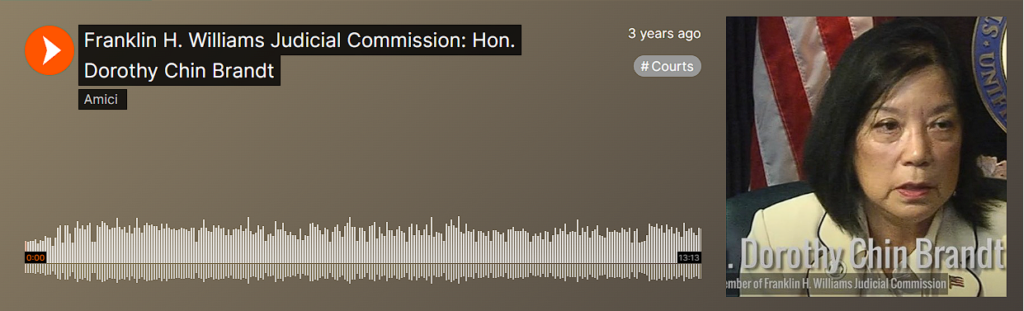
Three years ago, the Franklin H. Williams Judicial Commission (originally known as the New York State Judicial Commission on Minorities) released a series of interviews with the Commission’s founding mothers and fathers on the New York Courts Amici podcast site. The series, assembled and organized by John M. Caher, Senior Advisor for Strategic and Technical Communications, concluded with an interview of the Hon. Dorothy Chin Brandt. Justice Brandt passed away on January 27, 2025, and we take this opportunity to look back at her interview and appreciate her legacy of promoting diversity in the judiciary.
Hon. Dorothy Chin Brandt was the first female Asian American Judge to be elected in the state of New York when she was elected to the New York City Civil Court in 1987. Shortly after being elected, she became a founding member of the Franklin H. Williams Judicial Commission. Brandt said that “the [New York] courts were perceived as unfriendly or not friendly to minorities,” which paved the way for establishing the Commission, with a mission to “find out what was the perception and how it could be remedied.” Brandt was ecstatic to be part of a commission that would help eradicate racism in the courts. Her personal experiences of discrimination throughout her career would provide valuable context and information for this endeavor.
The Commission collected anecdotes from around New York state to figure out the perception of the courts rather than investigating the courts themselves, because, according to Brandt, “perception is different from reality, but in a lot of ways it’s stronger than reality because that’s what people think and feel is going on, and maybe it’s harder to counteract.”
To combat this perception, the Commission immediately put mandatory diversity and sensitivity training in place for the whole court system. They also looked towards legal education and tried to get more minorities interested in and learning about law because there was such little diversity in the courts at the time. She noted happily that now there are many more minority lawyers, talking specifically about Asian Americans by saying, “We have a lot more Asian-American lawyers. We didn’t have an Asian-American bar at that time in 1988…but now we have a full-fledged bar association, Asian American Bar [of New York], and very full force, very active.”
Lastly, Brandt attributed much of the major progress in the United States regarding equality in the courts to the work the Commission has done in New York on the perception of racism in the courts. Through the Commission’s work, they “got people’s attention and presented examples of what was not right, and everybody recognized this is not right.” She further noted that many other states followed New York and set up minority commissions of their own. Brandt ultimately emphasized the importance of the work of the Commission, remarking how if it was not for them, people might still be treated just based on their race, religion, ethnicity, etc. when they enter into the court system.
WASHINGTON – Recently, President Donald Trump named Mark T. Uyeda as the Acting Chairman of the U.S. Securities and Exchange Commission (SEC). The National Asian Pacific American Bar Association (NAPABA) congratulates Acting Chairman Uyeda. He is the first Asian Pacific American to serve as a Commissioner on the SEC and to lead the SEC.
“Over the course of two decades, Acting Chairman Uyeda has built an impressive track record of expertise and commitment to public service,” said Thy Bui, President of NAPABA. “Dedicated public servants like Mark T. Uyeda are critical to safeguarding the integrity of our nation’s financial system.”
Acting Chairman Uyeda has served as an SEC Commissioner since 2022. His distinguished service spans over fifteen years as a career public service attorney, including in senior leadership at the SEC, as Securities Counsel on detail to the U.S. Senate Committee on Banking, Housing, and Urban Affairs, roles at the U.S. Department of the Treasury and the U.S. Department of Labor, and key positions in government and private practice.
Acting Chairman Uyeda earned his undergraduate degree in business administration from Georgetown University in 1992 and his law degree with honors from Duke University in 1995, where he was a member of the Duke Law Journal. The child and grandchild of Japanese Americans incarcerated during World War II, he has been an active member of the Asian American, Native Hawaiian, and Pacific Islander legal community, including serving as a past president of the Asian Pacific American Bar Association of the Greater Washington, D.C. Area (APABA-DC). In 2023, NAPABA awarded him with the prestigious Daniel K. Inouye Trailblazer Award.
### The National Asian Pacific American Bar Association (NAPABA) represents the interests of over 80,000 Asian Pacific American (APA) legal professionals and nearly 90 national, state, and local APA bar associations. NAPABA is a leader in addressing civil rights issues confronting Asian American, Native Hawaiian, and Pacific Islander communities. Through its national network, NAPABA provides a strong voice for increased diversity of the federal and state judiciaries, advocates for equal opportunity in the workplace, works to eliminate hate crimes and anti-immigrant sentiment, and promotes the professional development of people of all backgrounds in the legal profession.
WASHINGTON – Today, the United States Senate confirmed Sharad Desai to the U.S. District Court for the District of Arizona. Mr. Desai is the first Asian American Article III judge to serve in the District of Arizona.
“NAPABA applauds the historic confirmation of Sharad Desai,” said Thy Bui, President of NAPABA. “An active member of the community and an advocate of diversity and inclusion, Mr. Desai brings experiential diversity as an in-house counsel to a District where the AANHPI population has grown over 50 percent over the last decade.”
Sharad H. Desai has been Vice President and General Counsel for Honeywell International’s Integrated Supply Chain and Information Technology divisions in Phoenix, Arizona, since 2023. He has worked in senior legal counsel roles at Honeywell since 2015. From 2007 to 2015, Mr. Desai worked as an attorney with the Phoenix law firm Osborn Maledon, P.A., first as an associate and later as a partner. He began his legal career as a law clerk for Justice Rebecca White Berch on the Arizona Supreme Court from 2006 to 2007. Mr. Desai received his J.D. from New York University School of Law in 2006 and his B.A. and B.S. from the University of Arizona in 2003.
“Nearly 20% of President Biden’s confirmed Article III judges are AANHPI,” said Priya Purandare, Executive Director of NAPABA. “Today, 40 AANHPI Article III judges have been confirmed during the Biden Administration, and 70 AANHPI active Article III judges are serving.”
NAPABA thanks President Biden for nominating and Senator Sinema and Senator Kelly for supporting Sharad Desai’s historic nomination.
### The National Asian Pacific American Bar Association (NAPABA) represents the interests of over 80,000 Asian Pacific American (APA) legal professionals and nearly 90 national, state, and local APA bar associations. NAPABA is a leader in addressing civil rights issues confronting Asian American, Native Hawaiian, and Pacific Islander communities. Through its national network, NAPABA provides a strong voice for increased diversity of the federal and state judiciaries, advocates for equal opportunity in the workplace, works to eliminate hate crimes and anti-immigrant sentiment, and promotes the professional development of people of all backgrounds in the legal profession.
WASHINGTON – Today, the United States Senate confirmed Judge Mustafa Kasubhai to the U.S. District Court for the District of Oregon. Judge Kasubhai is the first Asian American Article III judge in the District and the first American Muslim to serve within the Ninth Circuit.
“NAPABA congratulates Judge Mustafa Kasubhai on his confirmation to the U.S. District Court for the District of Oregon,” said Thy Bui, President of NAPABA. “A 2018 NAPABA Trailblazer, Judge Kasubhai represents the best and brightest of our profession and membership.”
Judge Mustafa Kasubhai has been a United States Magistrate Judge for the District of Oregon since 2018. Previously, Judge Kasubhai served as a Circuit Court Judge in Lane County, Oregon, from 2007 to 2018. Prior to his appointment to the state bench, Judge Kasubhai served on the Oregon Workers’ Compensation Board from 2003 to 2007. From 1997 to 2003, Judge Kasubhai worked in three different private practice roles—as a solo practitioner, as a partner at Kasubhai & Sanchez, and as an associate at Rasmussen, Tyler & Mundorff. Judge Kasubhai received his J.D. from the University of Oregon School of Law in 1996 and his B.S. from the University of California, Berkeley in 1992
“President Biden has nominated 42 AANHPIs to Article III courts, and 38 have been confirmed,” said Priya Purandare, Executive Director of NAPABA. “We thank President Biden for nominating and Senator Wyden and Senator Merkley for supporting Judge Kasubhai’s historic nomination.”
### The National Asian Pacific American Bar Association (NAPABA) represents the interests of over 80,000 Asian Pacific American (APA) legal professionals and nearly 90 national, state, and local APA bar associations. NAPABA is a leader in addressing civil rights issues confronting Asian American, Native Hawaiian, and Pacific Islander communities. Through its national network, NAPABA provides a strong voice for increased diversity of the federal and state judiciaries, advocates for equal opportunity in the workplace, works to eliminate hate crimes and anti-immigrant sentiment, and promotes the professional development of people of all backgrounds in the legal profession.
WASHINGTON – Yesterday, [July 31, 2024,] the United States Senate confirmed Judge Meredith A. Vacca to the U.S. District Court for the Western District of New York. Judge Vacca is the first Asian American and woman of color to serve in the Western District, which includes Buffalo, Rochester, and Elmira.
“NAPABA congratulates Judge Meredith A. Vacca on her confirmation to the U.S. District Court for the Western District of New York,” said Anna Mercado Clark, President of NAPABA. “We are pleased to have supported the 50 AANHPI judges confirmed over the past eight years, spanning two Presidents. Our bipartisan judicial nominations approach and diverse membership have resulted in greater AANHPI representation on our judiciary across the country and political spectrum.”
Judge Vacca has been a judge on the Monroe County Court since 2021 and an Acting Justice on the New York State Supreme Court since 2023. She previously served as an Assistant District Attorney in the Monroe County District Attorney’s Office in Rochester, New York, from 2007 to 2020 and as an associate at Hamberger & Weiss LLP from 2005 to 2007. Judge Vacca received her J.D. from the University of Buffalo School of Law in 2005 and her B.A. from Colgate University in 2002.
“Judge Vacca, a board member of the Asian American Judges Association of New York, is active in our community,” said Priya Purandare, Executive Director of NAPABA. “As the 37th AANHPI judge confirmed by the Biden Administration, Judge Vacca will serve a rapidly growing Asian American district in upstate New York. We thank President Biden for nominating, Senate Majority Leader Schumer, and Senator Gillibrand for supporting Judge Vacca’s historic nomination.”
###
The National Asian Pacific American Bar Association (NAPABA) represents the interests of over 80,000 Asian Pacific American (APA) legal professionals and nearly 90 national, state, and local APA bar associations. NAPABA is a leader in addressing civil rights issues confronting Asian American, Native Hawaiian, and Pacific Islander communities. Through its national network, NAPABA provides a strong voice for increased diversity of the federal and state judiciaries, advocates for equal opportunity in the workplace, works to eliminate hate crimes and anti-immigrant sentiment, and promotes the professional development of people of all backgrounds in the legal profession.
On Tuesday, June 4, 2024, AABANY’s LGBTQ Committee, thanks to the generous sponsorship of Goodwin Procter LLP, hosted a Pride Reception where guests were given a unique opportunity to be the first official viewers of the upcoming short film TAL 탈. The Committee gave the audience a chance to view a work from a group of minds diverse in both origin and ideas, in the continued effort of enhancing visibility and representation for Asian and LGBTQ groups.
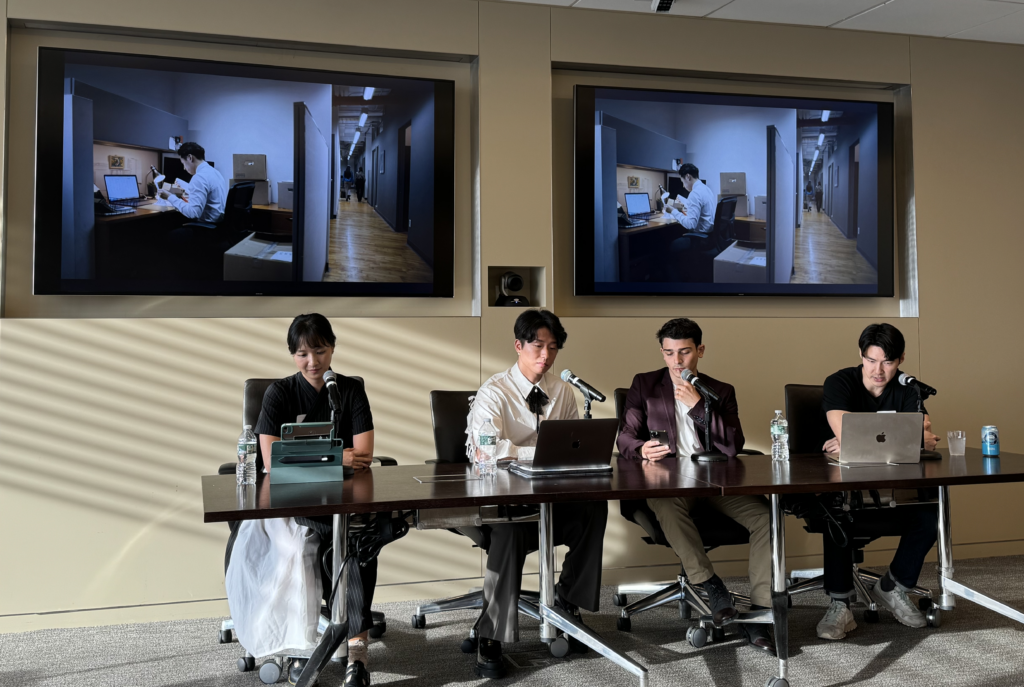
The film’s writer and lead actor Wesley Han and director Charlie Gillette, as well as a small group that worked on the piece––some actors, cameramen, and producers––presented their vision: TAL 탈 is a short horror film full of emotion and thrills, that grapples with ideas of filial piety and shame. They sought to shed overworked themes and motifs that often permeate the media that represents Asian-American culture, while incorporating Han’s own anecdotal experiences for inspiration. The result is a fright-fest where Gabriel, an ex-actor and young associate at a top litigation firm in New York City, is hunted by a literal inner demon.
After a script-reading of the film, the panel took questions from the audience. In their answers they expressed their hopes that the film would resonate with the quintessential modern Asian experience, and also shared the process of assembling the film. Han expressed that the film had a youthful energy and would hopefully be impactful for a broad audience, but especially with Asian-American second and third-generation immigrants. Gillette discussed how the film was born of friendship and the SAG-AFTRA strike––the core team had known each other from previous works and had not been working at the time of the first screenplay’s inception.
After the panel, everyone was served complementary beverages and delicious desserts from LGBTQ-Asian-owned bakery ANDO. Guests and panelists alike mingled, met new people, made new connections, and exchanged advice and experience with friends and colleagues new and old. All of this was made possible thanks to the support of Goodwin Procter LLP, our hosts for this event and program.
For everyone that attended the event we extend our profound thanks for your support. To learn more about the AABANY LGBTQ Commitee please click here. To learn more and support the upcoming short film TAL 탈 please click here. And to learn more about Goodwin Procter, please click here.
WASHINGTON – Today, President Joe Biden nominated Judge Meredith A. Vacca to the U.S. District Court for the Western District of New York. If confirmed, Judge Vacca would be the first Asian American and woman of color to serve in the Western District, which includes Buffalo, Rochester, and Elmira.
“NAPABA applauds President Biden’s historic nomination of Judge Meredith A. Vacca,” said Anna Mercado Clark, President of NAPABA. “Active in the AANHPI community, Judge Vacca, a NAPABA member, is a board member of the Asian American Judges Association of New York. If confirmed, she will serve in a District, particularly the city of Buffalo, with rapid Asian American growth where the population change surpassed New York City this past decade.”
Judge Vacca has been a judge on the Monroe County Court since 2021 and an Acting Justice on the New York State Supreme Court since 2023. Judge Vacca previously served as an Assistant District Attorney in the Monroe County District Attorney’s Office in Rochester, New York from 2007 to 2020. From 2005 to 2007, she worked as an associate at Hamberger & Weiss LLP. Judge Vacca received her J.D. from the University of Buffalo School of Law in 2005 and her B.A. from Colgate University in 2002.
“President Biden has nominated 40 AANHPIs to Article III courts, and 34 have been confirmed—more than any President in history,” said Priya Purandare, Executive Director of NAPABA. “As we celebrate Asian American, Native Hawaiian, and Pacific Islanders Heritage Month, we thank President Biden for nominating and Senate Majority Leader Schumer and Senator Gillibrand for supporting Judge Vacca’s historic nomination.”
###
The National Asian Pacific American Bar Association (NAPABA) represents the interests of over 80,000 Asian Pacific American (APA) legal professionals and nearly 90 national, state, and local APA bar associations. NAPABA is a leader in addressing civil rights issues confronting Asian American, Native Hawaiian, and Pacific Islander communities. Through its national network, NAPABA provides a strong voice for increased diversity of the federal and state judiciaries, advocates for equal opportunity in the workplace, works to eliminate hate crimes and anti-immigrant sentiment, and promotes the professional development of people of all backgrounds in the legal profession.