
Solo and Small Firm Practice & Prosecutors Committees Host a Book Reading and Discussion of Strangers in the Land with Author Michael Luo

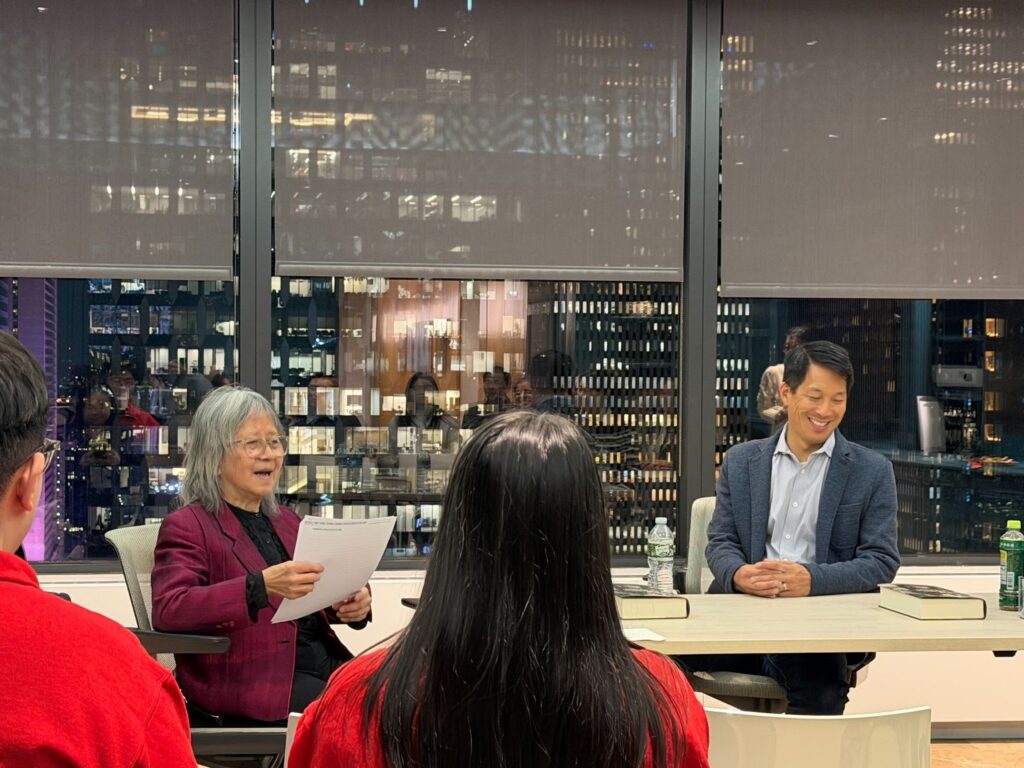
On March 2, 2026, AABANY’s Solo & Small Firm Practice Committee and Prosecutors Committee hosted a book reading and discussion featuring Strangers in the Land, the critically acclaimed 2025 book by Michael Luo, Executive Editor at The New Yorker. The event was moderated by the Honorable Marilyn Go (Ret.), the first Asian American woman to serve as a federal judge in the United States, and was hosted by Groombridge, Wu, Baughman & Stone LLP.

During the event, Luo shared stories from his book, tracing various aspects of Chinese and Chinese-American history from the Gold Rush era to the rise in anti-Asian hate during the COVID-19 pandemic. One story described an early Chinese immigrant who came to America after attending a missionary school in China, where the head of the school invited students to accompany him back to the United States. The individual later faced the harsh effects of the Chinese Exclusion Act, which barred Chinese immigrants from naturalization, and his citizenship was revoked. Despite these barriers, he managed to reenter the United States and even attempted to volunteer for the Union Army during the Civil War, though he was turned away.

Reflecting on the broader themes of the book, Luo noted, “This question of who gets to be an American is one that is going on right now – who belongs in America. I don’t know what it would take for this representation to reach that tipping point.”

During the audience Q&A, attendees raised questions about the absence of Asian American history in mainstream education and discussed how recent anti-Asian hate and geopolitical tensions continue to shape perceptions of Asian Americans today, focusing on how the People’s Republic of China is an increasingly powerful country and enemy to the United States. Luo shared similar concerns, highlighting how the history recounted in his book was during a period of weakness for China and that the historical developments are likely to impact the law dealing with the social issues raised by the audience.

We thank Michael Luo for sharing his work and insights, and the Honorable Marilyn Go (Ret.) for moderating the discussion. Please visit AABANY’s website for more upcoming events like this one, such as AABANY’s first book club meeting on March 19, 2026.  To learn more about the Solo & Small Firms Practice Committee click here.  To learn more about the Prosecutors Committee, click here.

NAPABA Condemns Passage of Bills That Would Reinstate the “China Initiative” and Plant the Seeds for a National Alien Land Law

For Immediate Release:
Date: September 12, 2024
Contact:
Rahat N. Babar, Deputy Executive Director

WASHINGTON – On September 11, 2024, the United States House of Representatives passed two bills that, if enacted, would racially profile members of the Asian American, Native Hawaiian, and Pacific Islander (AANHPI) community under the guise of national security. While policymakers have the prerogative to address the legitimate national security concerns confronting the United States, they may not enact discriminatory laws that target the AANHPI community. In no uncertain terms, the National Asian Pacific American Bar Association (NAPABA) condemns the actions of the House, which instill unwarranted fear and suspicion on individuals solely because of their national origin.
First, the House passed H.R. 1398, Protect America’s Innovation and Economic Security from CCP Act of 2024, a bill that would reinstate the disbanded and discredited China Initiative program within the U.S. Department of Justice. NAPABA has previously denounced the China Initiative, which created a chilling effect around scholars of Chinese ancestry and, at worst, countenanced impermissible racial profiling.

Second, the House passed H.R. 9456, Protecting American Agriculture from Foreign Adversaries Act of 2024, a bill that would require the Committee on Foreign Investment in the United States (CFIUS) to review any agricultural land purchases, regardless of size or scope, by any person from China, North Korea, Russia, or Iran, even if they are lawfully present in the United States, green card holders, have nothing to do with the regimes in these countries, or refugees fleeing persecution from those governments. By mandating such a referral to CFIUS, the bill would effectively designate any individual from those countries as a national security risk based solely on national origin.

NAPABA has long opposed legislation that discriminates based on national origin alone rather than on evidence of malign conduct and has worked with policymakers at all levels to avoid discriminatory policies. Such policies equate ordinary Chinese, Korean, Iranian, and other persons with governments, political parties, or state-owned enterprises even if they have no affiliation with such entities. While NAPABA recognizes the geopolitical tensions and competition with countries such as China, the passage of laws that restrict civil rights without an appropriate and legitimate, evidence-based nexus to national security creates an atmosphere of distrust that easily targets Asian Americans, not just those of Chinese descent.  As the political rhetoric rises in this election season, leaders must avoid actions that promote bigotry and racism against Asian Americans.

NAPABA objects to the passage of these bills and calls on the United States Senate to reject them.

###

The National Asian Pacific American Bar Association (NAPABA) represents the interests of over 80,000 Asian Pacific American (APA) legal professionals and nearly 90 national, state, and local APA bar associations. NAPABA is a leader in addressing civil rights issues confronting Asian American, Native Hawaiian, and Pacific Islander communities. Through its national network, NAPABA provides a strong voice for increased diversity of the federal and state judiciaries, advocates for equal opportunity in the workplace, works to eliminate hate crimes and anti-immigrant sentiment, and promotes the professional development of people of all backgrounds in the legal profession.