
Prosecutors Committee Celebrates 17th Anniversary Reception at the Daniel Patrick Moynihan United States Courthouse

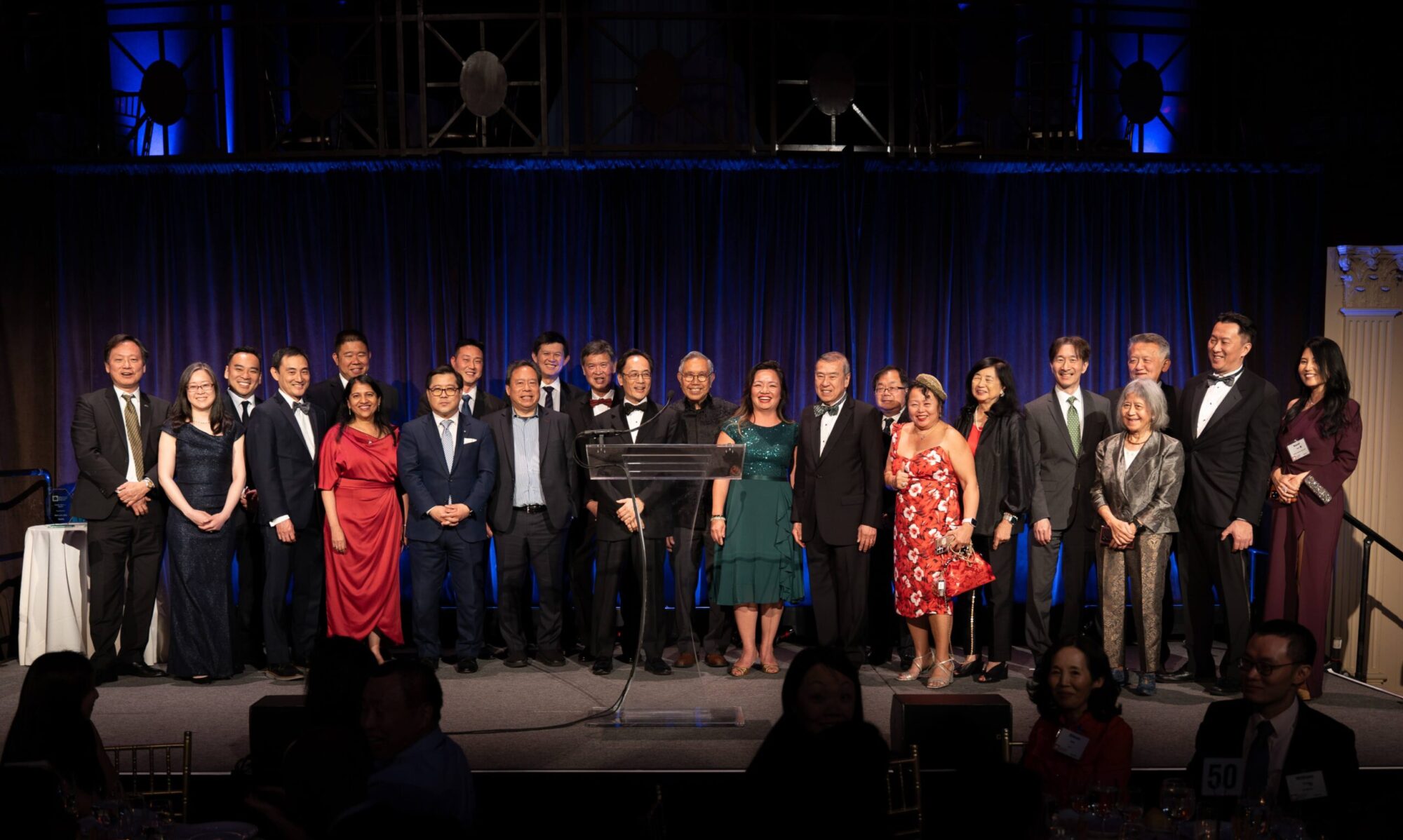
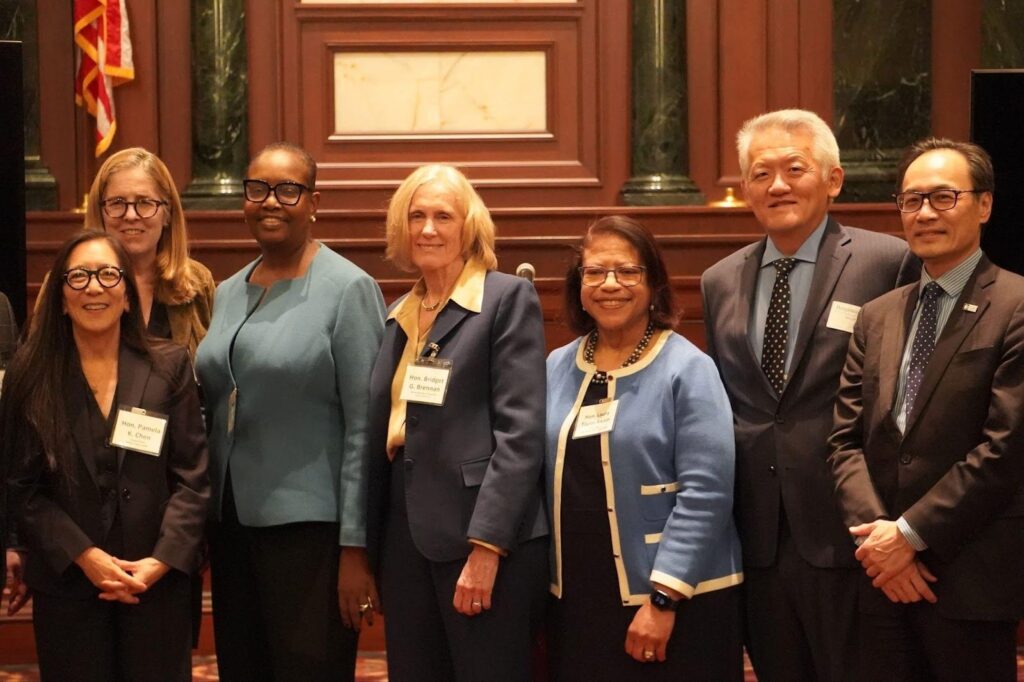
The Asian American Bar Association of New York (AABANY)’s Prosecutors Committee, together with its Judiciary Committee, celebrated the 17th Anniversary of the Prosecutors Committee on March 5, 2026, at the Daniel Patrick Moynihan United States Courthouse in Lower Manhattan. The evening honored Pamela K. Chen, United States District Judge for the Eastern District of New York, with a Lifetime Achievement Award in recognition of her exemplary service to the Federal judiciary and her longstanding dedication to justice.

Judge Chen was nominated to the Federal bench in January 2013 by President Barack Obama and confirmed by the Senate in March 2013. Since her appointment to the bench, Judge Chen has presided over a wide array of civil and criminal cases, including a civil lawsuit challenging New York’s ban on the possession of nunchuks. 

Judge Chen began her legal career at the law firm of Arnold & Porter in Washington, D.C. In 1991, she joined the Special Litigation Section of the U.S. Department of Justice’s Civil Rights Division, where she litigated matters relating to conditions of confinement for individuals in state and local institutions, as well as cases involving the enforcement of the Freedom of Access to Clinic Entrances (FACE) Act of 1994.

In 1998, Judge Chen moved to New York City and joined the U.S. Attorney’s Office for the Eastern District of New York, where she worked until March 2013, except for a brief period in 2008, when she served as Deputy Commissioner for Enforcement in the New York State Division of Human Rights. As an Assistant U.S. Attorney, Judge Chen investigated and prosecuted cases involving terrorism, gang violence, drug trafficking, human trafficking, official misconduct, and civil rights crimes. She also served as the Chief of the Criminal Civil Rights Section and oversaw the development of the Office’s anti-human trafficking program, which resulted in the investigation and prosecution of hundreds of traffickers and the identification, rescue, and restoration of hundreds of survivors of trafficking. In 2015, Judge Chen and then-Attorney General Loretta E. Lynch were honored by Sanctuary for Families for the anti-human trafficking work done by the U.S. Attorney’s Office under Attorney General Lynch’s leadership as the U.S. Attorney for the Eastern District of New York.

Judge Chen has also served for nearly ten years on the Board of the Sonia & Celina Sotomayor Judicial Internship Program where she mentors the next generation of legal professionals. 
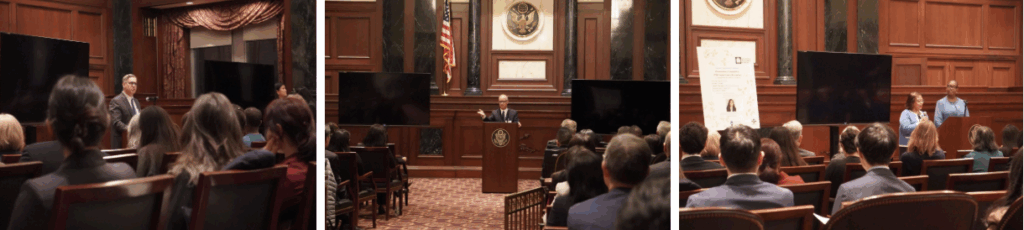
The evening began in the courthouse’s Ceremonial Courtroom, where approximately 150 attendees from across the legal community gathered. The event brought together a wide range of members from our shared communities, including state and Federal judges and prosecutors, government attorneys, private practitioners, law students, law clerks, professors, community advocates, and supporters of AABANY.

The formal program commenced at approximately 6:15 p.m., with opening remarks from the evening’s Masters of Ceremonies, Teri Chung, Major Case Assistant District Attorney at the Bronx County District Attorney’s Office, and Eun Bi Kim, Assistant District Attorney at the Manhattan District Attorney’s Office. Distinguished heads of the Federal judiciary offered warm greetings and reflections on Judge Chen’s career, including Hon. Laura Taylor Swain, Chief Judge of the United States District Court for the Southern District of New York, and Hon. Margo K. Brodie, Chief Judge of the United States District Court for the Eastern District of New York.

Following Chief Judges Swain and Brodie, additional remarks were delivered by Benjamin Hsing, President of AABANY; Hon Joseph Nocella Jr., United States Attorney for the Eastern District of New York; Hon Bridget G. Brennan, Special Narcotics Prosecutor for the City of New York; Joseph P. Alexis, Chief of the Trial Division at the Kings County District Attorney’s Office; and Karl Metzner, Associate United States Attorney for the Southern District of New York. During the program, each speaker highlighted the breadth and significance of Judge Chen’s judicial and prosecutorial careers. Their words were a tribute to her leadership and dedication to public service.

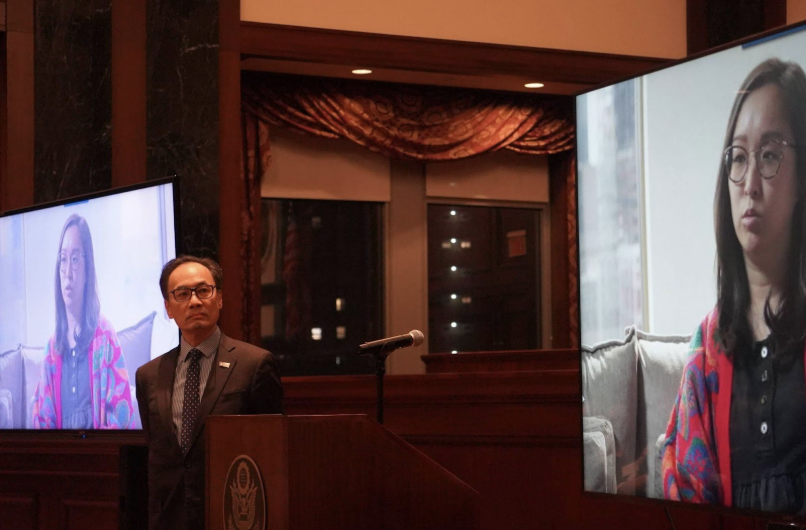
After the array of accolades was given from many who have worked with Judge Chen, she was formally introduced by Hon. Ann Donnelly, United States District Judge for the Eastern District of New York, who described Judge Chen as the embodiment of a trailblazer.
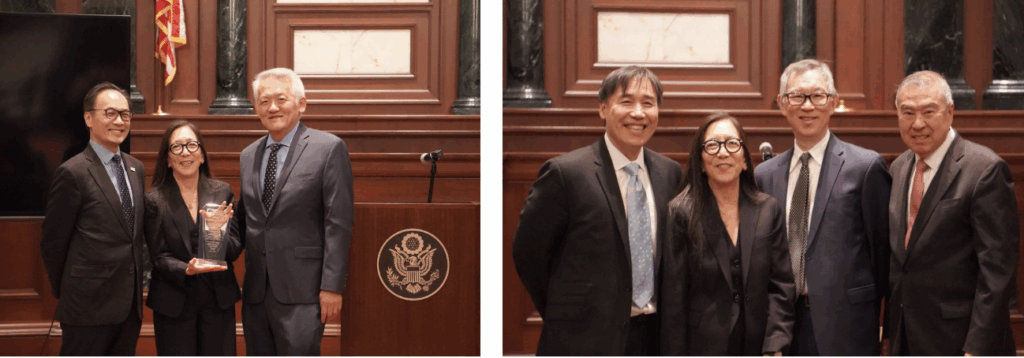
In her acceptance remarks, Judge Chen delivered a thoughtful and compelling reflection of her career and the importance of representation in public service within the legal profession. Citing data on Asian American participation in public service roles, she observed that “by the end of 2022, approximately 7.5% of Asian American lawyers entered government service directly from law school,” while noting similarly modest percentages entering law school and prosecutorial offices. She posed a critical question: “Why does it matter that Asian Americans are not fully represented in public service?”

Judge Chen explained that the answer lies not only in numbers, but in perception and belonging. She remarked that in this country, there remains an undercurrent that views Asian Americans as perpetual foreigners. Such perceptions have, at times, surfaced most painfully during moments of national hardship, including the COVID-19 pandemic, when anti-Asian sentiment manifested in acts of violence.

Emphasizing the importance of visibility in public roles, Judge Chen reflected on the symbolic power of serving as a prosecutor: “When you stand up in court and say, ‘I represent the People of New York’ or ‘I represent the United States of America,’ you are affirming, every day, that Asian Americans are part of this nation—not outsiders to it.” Judge Chen emphasized how greater participation in public service, specifically institutions of justice, helps achieve equity for all, and simultaneously challenges stereotypes and reinforces the fundamental truth of belonging.

These themes of representation and belonging were echoed in the broader program. Before its conclusion, AABANY Executive Director Yang Chen introduced a trailer for Voices Against Anti-Asian Hate, an AABANY documentary highlighting the surge in anti-Asian hate incidents during the pandemic and the community’s response. The trailer highlighted the importance of continued vigilance and advocacy against anti-Asian violence and hate crimes and described the ongoing work of AABANY’s Anti-Asian Violence Task Force. Yang Chen further expressed gratitude for the role played by members of the Task Force in producing the documentary. In particular, Yang called up St. John’s University School of Law Professor Elaine Chiu, past Chair of the Task Force, and James Lin, retired veteran prosecutor of the Manhattan and Brooklyn DA’s Offices, as well as Daphne Mei, Program Manager for the Task Force, for their contributions to AABANY’s work combatting anti-Asian violence and hate. 
The program concluded with closing remarks from Kin Ng before guests proceeded to a networking reception in suite 850. The reception featured an array of delicious food including a variety of kimbap, samosas and dumplings, and provided an opportunity for attendees to connect and celebrate Judge Chen and the continued impact of the Prosecutors Committee within the legal community. 
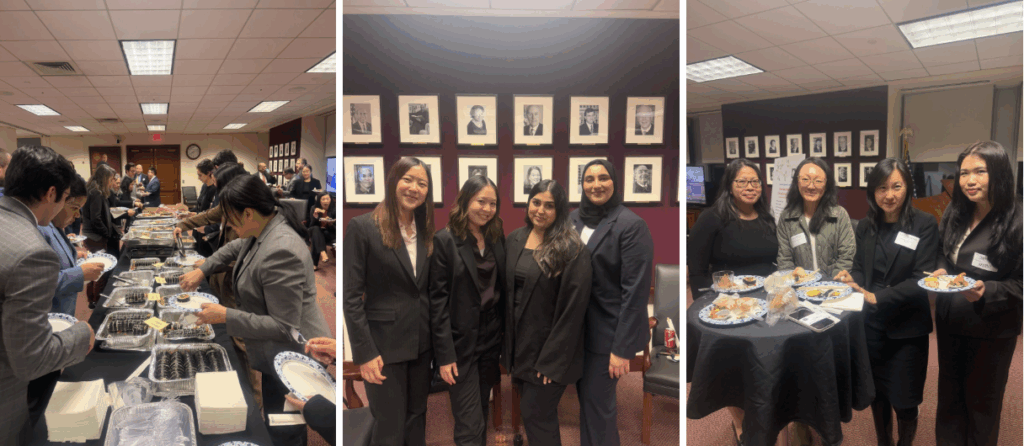
A Second Circuit Judge who attended the event described it as “warm, informative, and fun,” a sentiment that captured the spirit of collegiality and shared purpose that defined the celebration.

AABANY thanks Prosecutors Committee Co-Chairs Grace Vee, Appeals Division Civil Litigation Unit Chief and Associate General Counsel at the Manhattan District Attorney’s Office, and Kin Ng, Bureau Chief at the Kings County District Attorney’s Office, as well as Judiciary Committee Co-Chairs David Mou, founding attorney of Mou Legal PLLC, and Mark Son, Vice President of the Central Investigations Function at Deutsche Bank, for their leadership in organizing this memorable evening. AABANY also thanks the United States District Court for the Southern District of New York for graciously hosting the celebration at the SDNY courthouse. To view photos from the event, click here.
AABANY Co-Sponsors: The Rise in Anti-AAPI Violence and a Portrait of Asian Americans in the Law 2.0, a Fireside Discussion with Justice Goodwin Liu

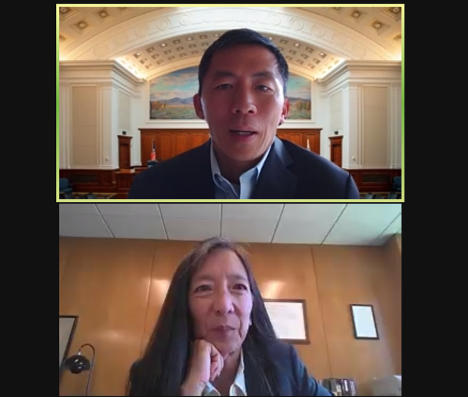
On August 24, the Asian American Bar Association of New York (AABANY), the National Asian Pacific American Bar Association (NAPABA), the Asian American Bar Association of Silicon Valley (APABA-SV) and Cooley LLP co-sponsored “The Rise in Anti-AAPI Violence and a Portrait of Asian Americans in the Law 2.0,” a discussion held on Zoom with Associate Justice Goodwin Liu of the California Supreme Court. The conversation was moderated by United States District Court Judge for the Eastern District of New York Pamela Chen, who made history as the first openly LGBTQ+ Asian American judge to serve in federal court. Both speakers were introduced by Matt Nguyen, a Litigation and Investigations Associate at Cooley LLP and a former law clerk of Justice Liu’s. This discussion was prompted by two trends: The dramatic rise in anti-Asian violence during the COVID-19 pandemic and the lack of AAPI representation in senior leadership roles in the legal profession.

Justice Liu opened the discussion by giving attendees an overview of A Portrait of Asian Americans in the Law (“The Portrait Project”), an analysis of trends related to Asian Americans in the legal profession that was published by Yale Law School and NAPABA in 2017. Notably, the Portrait Project found that there has been a persistent lack of Asian American representation in senior leadership, managerial, and governmental positions, roles with decision-making capabilities, and other prestigious positions in the legal profession, such as clerkships, despite a dramatic increase of Asian Americans pursuing the law in the 1990’s and 2000’s. Respondents in the Portrait Project’s study also reported that they faced many barriers in their professional life, most notably inadequate access to mentors and contacts and a lack of formal leadership training programs. When asked how their colleagues thought of them, respondents said they were frequently perceived as hard-working, responsible, logical, careful, introverted, and awkward, but not as empathetic, creative, or assertive. Justice Liu pointed out that these descriptors could indicate implicit bias towards Asian Americans in the legal profession, as many of them align with stereotypes of Asian Americans as passive, hard-workers who lack social capital. Justice Liu also noted that lawyers and judges should conduct outreach to Asian American students in high school or earlier in college, as AAPIs have the largest declining percentage change in law school enrollment of any ethnic group, and AAPI undergraduates considering an advanced degree are less likely than those of other ethnic groups to think of pursuing a JD.

When asked by audience members why fewer Asian American students are pursuing careers in the law, Justice Liu answered that while the authors of the Portrait Project did not have a definite answer, he believed that negative perceptions about the legal profession during the Great Recession could have dampened interest in the law among AAPI students. In addition, Justice Liu also said that Asian Americans in the law suffer from a continued lack of visibility, as there are few Asian judges, prosecutors, district attorneys, and there have never been any Asian American justices on the United States Supreme Court. According to Justice Liu, increased representation of Asian Americans in government positions, elected office, and in the federal and state judiciaries would bring more attention to issues facing the AAPI community.

AABANY Executive Director Yang Chen also discussed AABANY’s Hate Eradication Active Response Team (HEART), which AABANY launched early in the COVID-19 pandemic to help Asian American community members report potential hate crimes. HEART assists community members who may have difficulty reporting anti-Asian violence due to cultural and linguistic barriers to bring reports to the police or to their local prosecutor’s office. If you would like to learn more about the HEART program or get involved, please follow the link here. Chen also mentioned generally that the AAPI community has come forward to report bias incidents and hate crimes but have not been taken seriously by law enforcement, and the anecdotal evidence for this trend is disconcerting and disappointing.

Justice Liu described this trend as illustrative of the dual challenge faced by Asian American lawyers; while they are responsible for advocating for the AAPI community, they are also victims of anti-AAPI violence and casual racism themselves. He also described such challenges as intersectional, as he discussed how female Asian American lawyers are frequently mistaken for paralegals, defendants, support staff, or almost every other position aside from a lawyer when they are in the courtroom, as the idea of a female Asian American lawyer is seemingly unimaginable. Justice Liu also said that representation is important in ensuring that the public understand the obstacles facing the AAPI community and the severity of the recent increase in hate crimes. In addition, Liu advocated for the increased use of data, as data can illustrate the widespread nature of such violence and can add credibility, while anecdotes can be dismissed as statistically insignificant. Liu also said that it may be wise to recruit those with law enforcement or prosecutorial experience in helping community members make reports, as these individuals would have a strong understanding of reporting procedure and how to work with law enforcement.

When asked about how courts should protect victims of anti-AAPI violence, while also ensuring that courts and the criminal justice system are not contributing to systemic racism targeting Black and Indigenous People of Color (BIPOC), both Justice Liu and Judge Chen said that they did not view these as zero-sum issues. They encouraged Asian, Black, and Brown communities to engage in conversations about these issues, while also saying that anti-Blackness and racism towards Brown and Asian people are all indicative of a larger trend of othering people.

Justice Liu was also asked about ways to reduce partisanship in appointments to higher level positions in government. However, Justice Liu responded by saying that he never believed Asian American representation in judiciaries and district attorneys’ offices to be political, as Asian Americans span the range of the political spectrum in the United States and many Asian community organizations are non-political.

An audience member also asked how Asian American partners and leaders can advocate for themselves and the AAPI community while also ensuring that the law is race-blind and neutral. Justice Liu responded that he viewed advocacy as a way to address implicit bias and negative perceptions that disadvantage people, instead of as a call to give individuals special treatment based on their race. He also called for leaders to re-examine processes and criteria for hiring and promotions, as many of them rely heavily on interviews or other forms of evaluation that could convey implicit biases.

AABANY would like to thank Justice Liu, Judge Chen, and Matt Nguyen for taking the time to lead such a thoughtful, relevant discussion. AABANY would also like to express its gratitude to NAPABA, APABA-SV, and Cooley LLP as co-sponsors for this event, as well as all of the attendees who came to this event. If you are interested in learning more about the Portrait Project 2.0, which is set to be published in 2022, please follow the link here.

Historical Society of the New York Courts and the Asian American Judges Association of New York Sponsor a Panel about AAPIs in the Judiciary, May 20

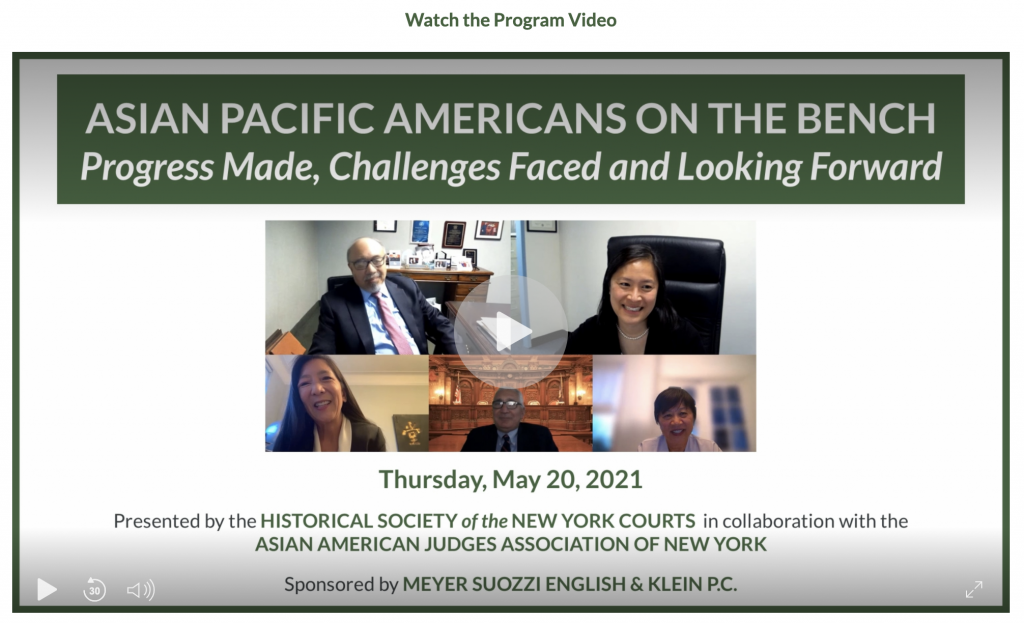
On May 20, the Historical Society of the New York Courts, the Asian American Judges Association of New York, and Meyer Suozzi English & Klein P.C. co-sponsored a panel discussion on the role of Asian Americans in the federal and state judiciary. The panelists of the event were Hon. Pamela K. Chen, U.S. District Judge for the Eastern District of New York and AABANY member; Hon. Toko Serita, New York State Acting Supreme Court Justice, Presiding Judge of the Queens Human Trafficking Intervention Court, and AABANY member; and Hon. Anil C. Singh, Associate Justice of the Appellate Division, First Department. Hon. Lillian Wan, New York State Acting Supreme Court Justice and AABANY member, moderated the panel.

New York State Court of Appeals Chief Judge Janet DiFiore opened the event with a few remarks, thanking the panelists and acknowledging their trailblazing careers as Asian-Americans. Chief Judge DiFiore also emphasized the importance of remembering AAPI history and the United States’ legacy of racial exclusion against Asians. She then turned the program over to Judge Randall T. Eng. Judge Eng, Of Counsel at Meyer Suozzi and former Presiding Justice of the Appellate Division, Second Department, welcomed the attendees and shared his experiences as the first Asian American appointed to the bench in New York.

Judge Wan then introduced the panelists for the event, opening the discussion with a brief presentation on AAPI history from Hong Yen Chang and the Chinese Exclusion Act to the present day. After the presentation, each of the panelists introduced themselves and shared their backgrounds and paths to becoming judges. Judge Wan began the panel discussion, asking the panelists about their experiences as Asian Americans at the times of their confirmations. Many of the panelists recounted how there were very few, if not any, Asian American judges when they were appointed. Judge Chen recalled how her appointment was facilitated by Obama’s attempts to diversify the federal bench, while Judge Serita recounted her experiences as the first Japanese American appointed to her court.

Judge Wan moved on to the reasons behind the underrepresentation of AAPIs in the state and federal judiciary. All of the panelists cited lack of political engagement, the lack of a pipeline, and the general tendency of Asian lawyers to seek employment at corporate law firms. Judge Chen also brought up cultural barriers, touching on how Asians tend not to promote themselves and do not seek help even when needed.

Judge Wan shifted the topic to Asian stereotypes and its effects on day-to-day legal practice. The judges all expressed how Asians are frequently lumped together, being viewed as a monolithic group. Judge Serita pointed out that the term “Asian” itself perpetuates invisibility, as it smothers the diverse experiences that individuals of different Asian cultures experience. Judge Chen also mentioned how women of color tend to face more microaggressions than men of color.

Judge Wan then asked the panelists if they had experienced any incidents of anti-Asian assault during the COVID pandemic. Judge Serita shared that during the height of the pandemic, she would wear a hat and sunglasses on the subway in order to hide her Asian identity. She also mentioned how women make up 70% of bias incident victims due to being stereotyped as meek and docile. Judge Serita also emphasized the importance of continuing the conversations about Asians and race in light of the rise in anti-Asian incidents. Judge Chen also shared a story, where an Asian female jury member had to be excused from jury duty because she feared being assaulted on the subway commute to the courthouse.

Judge Wan then directed the conversation towards the role of diversity in the judiciary. All the judges emphasized the importance of having a judiciary that reflects the diversity of the people it serves. Judge Chen also cited Supreme Court Associate Justice Sonia Sotomayor’s dissenting opinion in the Schuette v. Coalition case, pointing out how race does matter in the judiciary due to the long history of minorities being excluded in the United States.

Judge Wan then asked the panelists their thoughts on building a pipeline for Asians to enter the judiciary. All the judges expressed how important it was to reach out to the community to inspire young people to consider a public service career. Judge Chen identified a number of internships and programs for students aspiring to become judges while also noting how increasing Asian political representation in federal and state positions would afford aspiring AAPI lawyers the support needed to get through the confirmation process. Judge Chen also mentioned the role of bar associations like AABANY and the South Asian Bar Association of New York in sponsoring candidates for the bench. Judge Serita finished by encouraging young lawyers to be more proactive and to overcome Asian cultural humility.

Judge Wan moved to the topic of judicial screening panels, asking the judges their thoughts on the role of diversity on the panels. All the judges agreed on the vital role of diversity on screening panels. Judge Serita recounted one instance where an Asian woman being reviewed by the New York State Association of Criminal Defense Attorneys was given a low qualification score, due, in part, to the fact that only one out of the 30 committee members was Asian.

To close the panel, Judge Wan asked the judges if they had any advice to give to young attorneys aspiring to the bench. Judge Chen and Judge Serita both encouraged the attendees to enjoy their work, be passionate about it, but also, to not plan their careers rigidly around becoming a judge. All the judges also expressed the importance of flexibility and of keeping options open.

At the end of the event, Judge Eng shared photographs and a newspaper clipping documenting his long and distinguished career in the judiciary. Judge Wan then thanked the panelists for their time and the attendees for coming to the event.

To watch the full event, click here.

//photos.gstatic.com/media/slideshow.swf

On June 18, 2014, the Prosecutors’ Committee celebrated its 6th Annual Reception at the New York County Lawyers Association with over 100 state and local prosecutors, law enforcement partners, and friends. The Committee was pleased to honor two Asian American women trailblazers in law enforcement: Wen Ting Cheng, NY ICE Chief Counsel, US Department of Homeland Security and Belle Chen, Assistant Special Agent in Charge NY FBI, US Department of Justice. Congratulations to these extremely deserving recipients.

Some of the city’s best prosecutors and law enforcement agents gathered to honor their fellow colleagues. US Attorney Preet Bharara, Bronx District Attorney Robert Johnson, Richmond County District Attorney Daniel Donovan, New York County District Attorney Cyrus Vance, Special Narcotics Prosecutor Bridget Brennan and Queens Executive Assistant District Attorney Jesse Sligh also attended and delivered uplifting and inspiring remarks. Each speaker delved into the importance of having a diverse staff, one that reflected the community of which they had dedicated their lives to serving. We were also grateful that The Honorable Pamela Chen, The Honorable Doris Ling-Cohan and The Honorable Gilbert Hong were among the dignitaries to join us for this joyous occasion. 

Thank you to Co-Chairs Rosemary Yu & Brian Lee, Monica Huang, Sabrina Thanse, and the rest of the Prosecutors’ Committee for organizing this wonderful event.