
AABANY and AALDEF Present Webinar on TPS in Transition, Offering Options to Assist Affected Immigrants

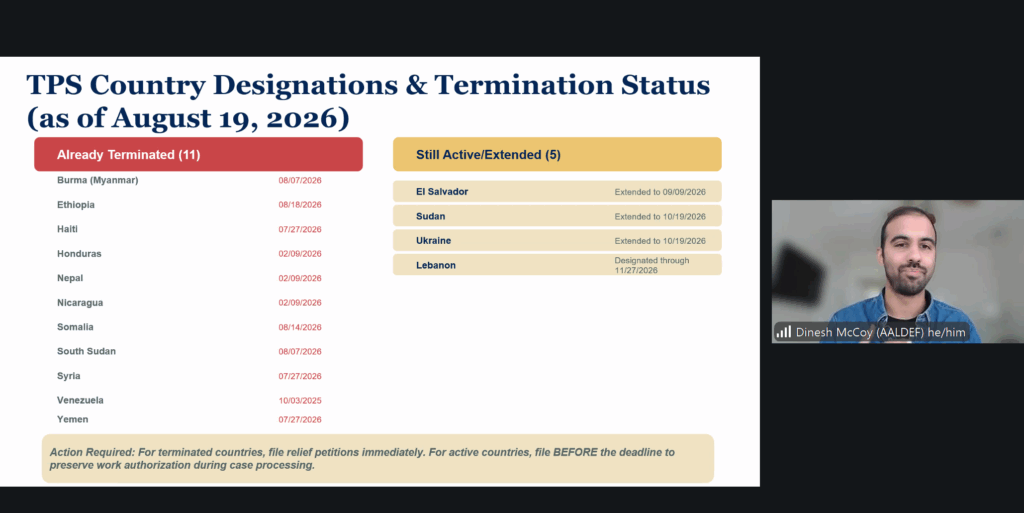
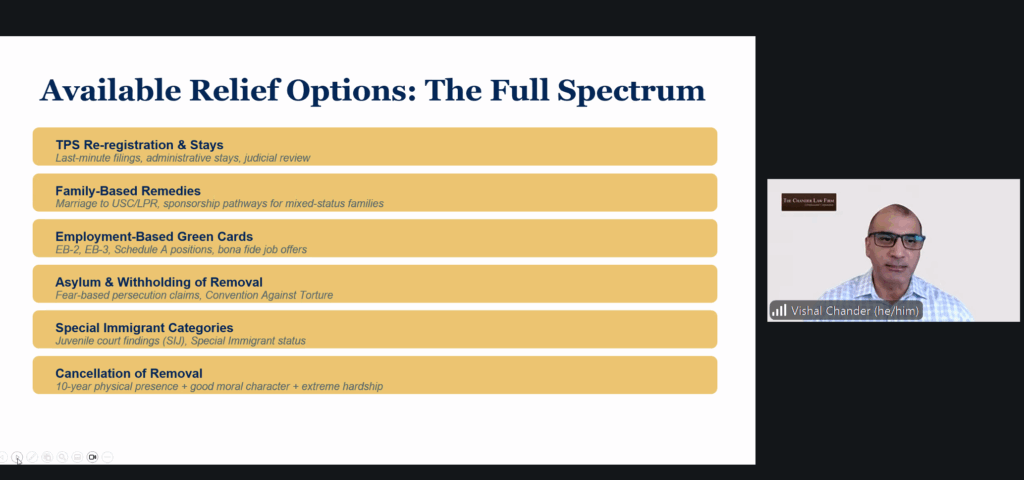
On August 27, 2026, almost 20 attendees joined AABANY and the Asian American Legal Defense and Education Fund (AALDEF) for a critical webinar on Temporary Protected Status (TPS) terminations. The panelists—Nicole Fink (Ogletree Deakins, AABANY Immigration Law Committee Chair ), Vishal Chander (The Chander Law Firm, AABANY Issues Committee Co-Chair, AABANY Board Director), and Dinesh McCoy (AALDEF)—walked participants through relief pathways for the 1.3 million people losing status: family-based sponsorship, employment-based green cards (EB-2, EB-3), asylum, withholding of removal, cancellation of removal, and special immigrant categories.

The comprehensive panel discussion went beyond individual legal remedies to examine broader systemic impacts. Presenters addressed the severe operational challenges facing employers who must navigate complex workforce transitions as valued employees risk losing their authorization. Furthermore, the speakers explored active federal litigation challenging the administration’s TPS termination decisions, highlighting ongoing legal battles aimed at protecting impacted populations. 

Throughout the webinar, the experts underscored a critical tactical takeaway: affected individuals must proactively file for alternative relief options prior to their official status termination date. Doing so is essential to preserving uninterrupted work authorization while their legal petitions undergo administrative processing. With multiple country designations already terminated or approaching imminent expiration deadlines, the panel warned that time is of the essence and the window to take corrective legal action is rapidly closing.
To mitigate these urgent challenges, attendees were strongly encouraged to get involved directly in community defense efforts. AALDEF is actively recruiting legal volunteers and community advocates for its Rapid Response Task Force. This initiative is designed to provide robust, on-the-ground assistance to vulnerable populations through comprehensive screening clinics, direct legal case representation, individual consultations, and broad community outreach. In parallel, AABANY’s Immigration Law and Issues Committees are expanding their collaborative initiatives by coordinating substantive community education webinars, legal advice clinics, and specialized professional development programs scheduled for later this year.

Whether you are an experienced attorney, a paralegal, a law student, or a dedicated community advocate, your skills are urgently needed. Regardless of whether you can commit one hour a month or ten, there is a vital role for you to make a meaningful difference in the lives of impacted individuals. We invite you to reach out and volunteer your time today to support our ongoing advocacy efforts. Please consider becoming a member of AABANY to support our work in support of vulnerable communities.

Written by Nicole Fink, Chair of AABANY’s Immigration Law Committee

NAPABA APPLAUDS ADMINISTRATIVE RELIEF ON IMMIGRATION AND CALLS FOR LEGISLATIVE ACTION

FOR IMMEDIATE RELEASE
November 21, 2014

Contact: Emily Chatterjee
(202) 775-9555

WASHINGTON – The National Asian Pacific American Bar (NAPABA) welcomes President Barack Obama’s decision to take executive action and provide immigration relief—an important step towards fixing our broken immigration system. A key part of the President’s executive action is providing temporary relief from deportation to an estimated 4.9 million undocumented immigrants, of which an estimated 1.3 million are Asian Pacific American immigrants.

“NAPABA has long supported the need for commonsense immigration reform and applauds the President’s efforts to take action and provide relief,” said George C. Chen, president of NAPABA. “We recognize that President Obama’s actions are only temporary and continue to stress the need for legislative action and call on Congress to pass legislation to fully address the problems within the immigration system.”

Of the 1.3 million undocumented Asian Pacific Americans, an estimated 400,000 will benefit from this temporary relief. However, Asian Pacific American immigrants who have been waiting for decades to reunite with family members due to the visa backlogs in the family immigration system will not obtain any relief. It is estimated that 1.8 million people from Asian countries are waiting for a family-sponsored visa to join loved ones in the United States.

Supporting the need for comprehensive immigration reform has long been a priority for NAPABA. For many years, the NAPABA Board of Governors has passed policy resolutions on immigration, and immigration reform has been a focus of advocacy efforts for NAPABA members on the Hill and across the country within NAPABA’s state and local affiliates. A few weeks ago, NAPABA was proud to present Jose Antonio Vargas, an Asian Pacific American undocumented immigrant and Pulitzer-prize winning activist, as the keynote speaker of the 2014 NAPABA Convention in Arizona. In light of the administrative relief announced last night, Mr. Vargas may, after more than 20 years, finally be able to return home to the Philippines to see his mother.

###

The National Asian Pacific American Bar Association (NAPABA) is the national association of Asian Pacific American (APA) attorneys, judges, law professors, and law students. NAPABA represents the interests of over 40,000 attorneys and approximately 70 national, state, and local bar associations. Its members include solo practitioners, large firm lawyers, corporate counsel, legal services and non-profit attorneys, and lawyers serving at all levels of government. NAPABA engages in legislative and policy advocacy, promotes APA political leadership and political appointments, and builds coalitions within the legal profession and the community at large. NAPABA also serves as a resource for government agencies, members of Congress, and public service organizations about APAs in the legal profession, civil rights, and diversity in the courts.