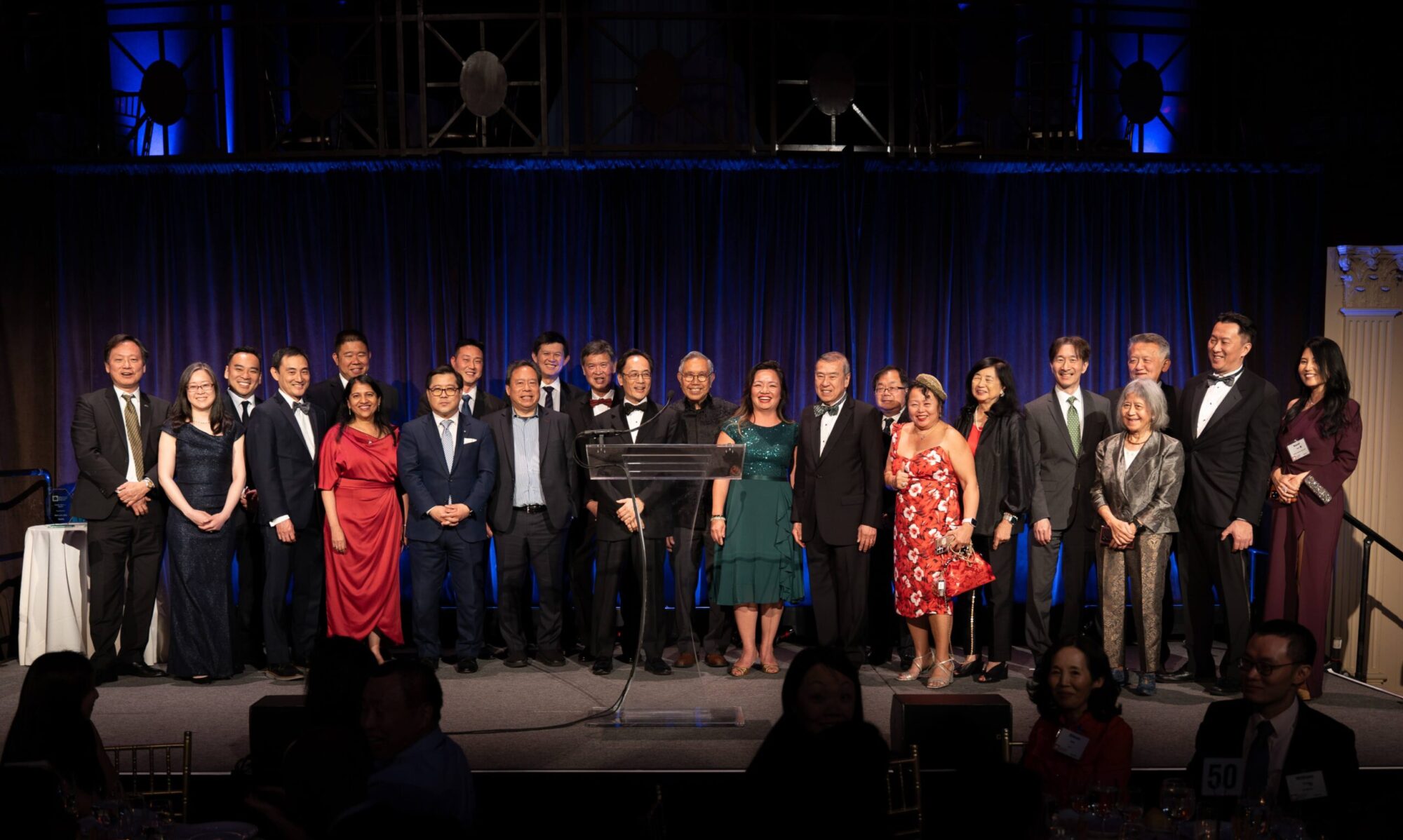
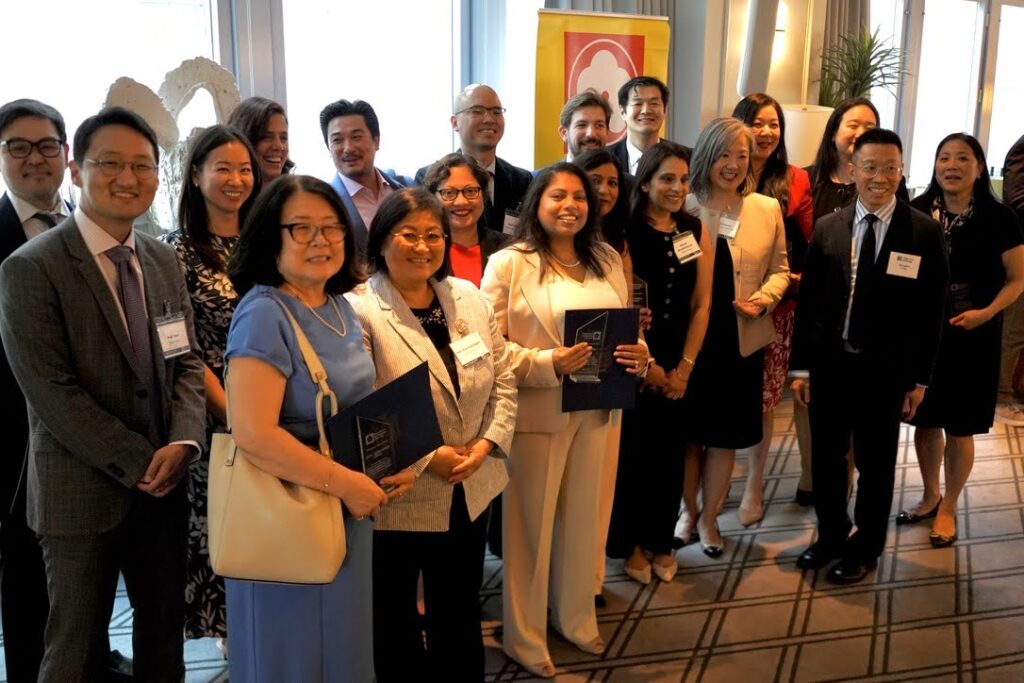
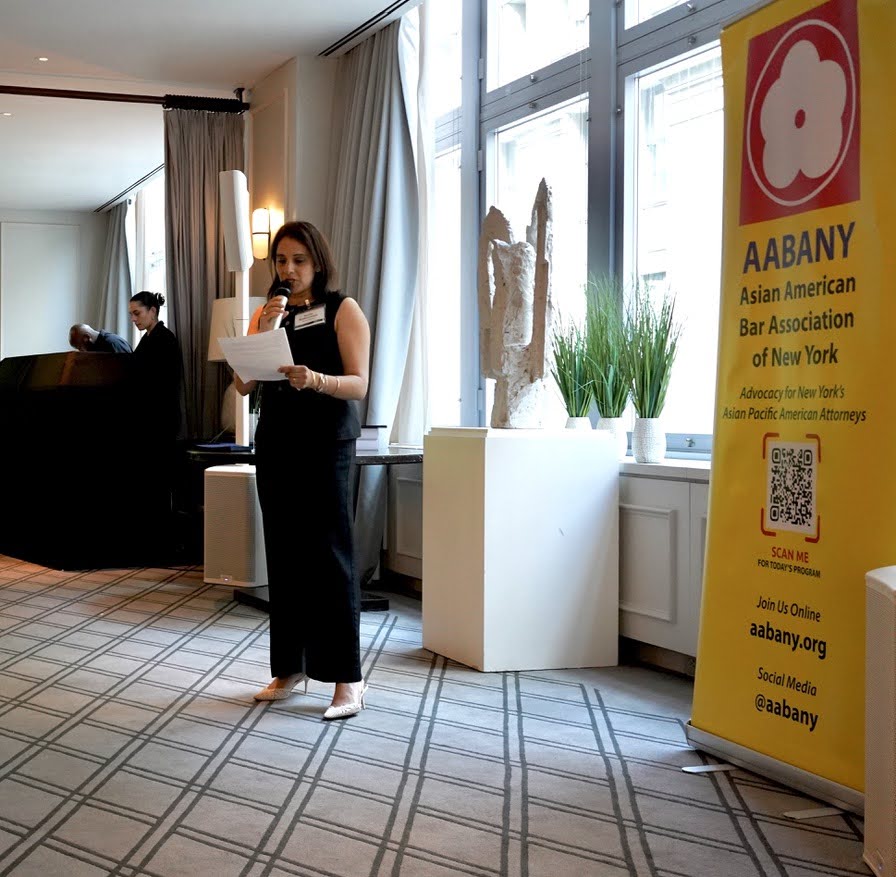
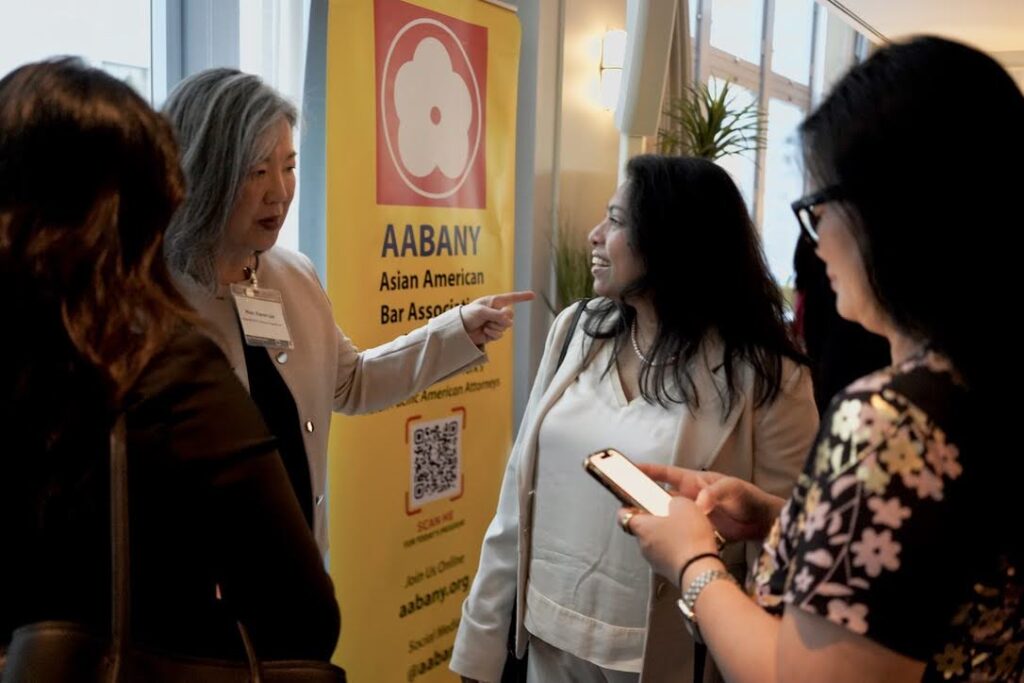
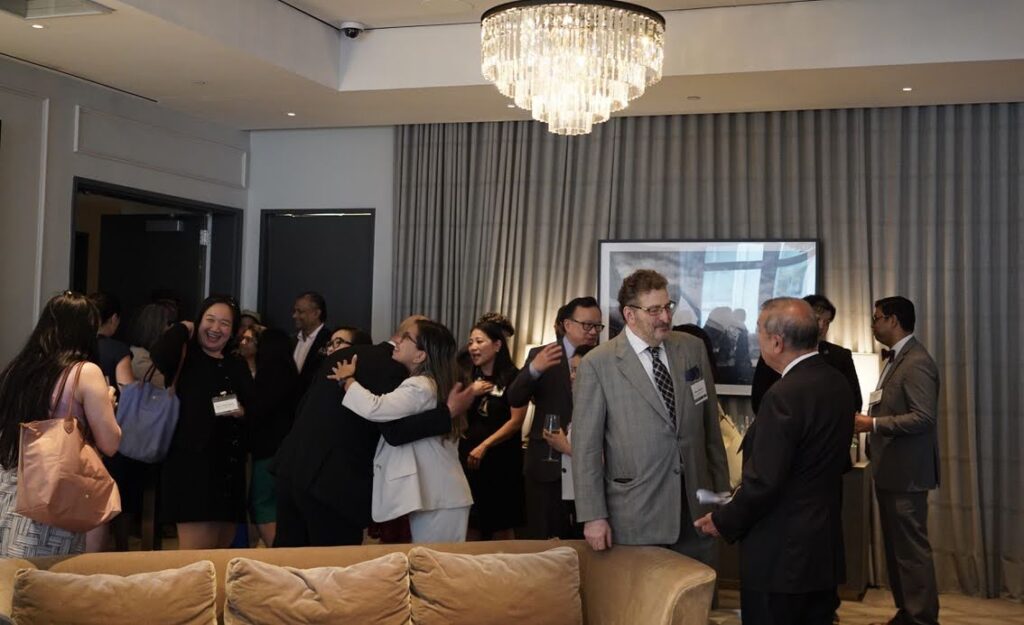
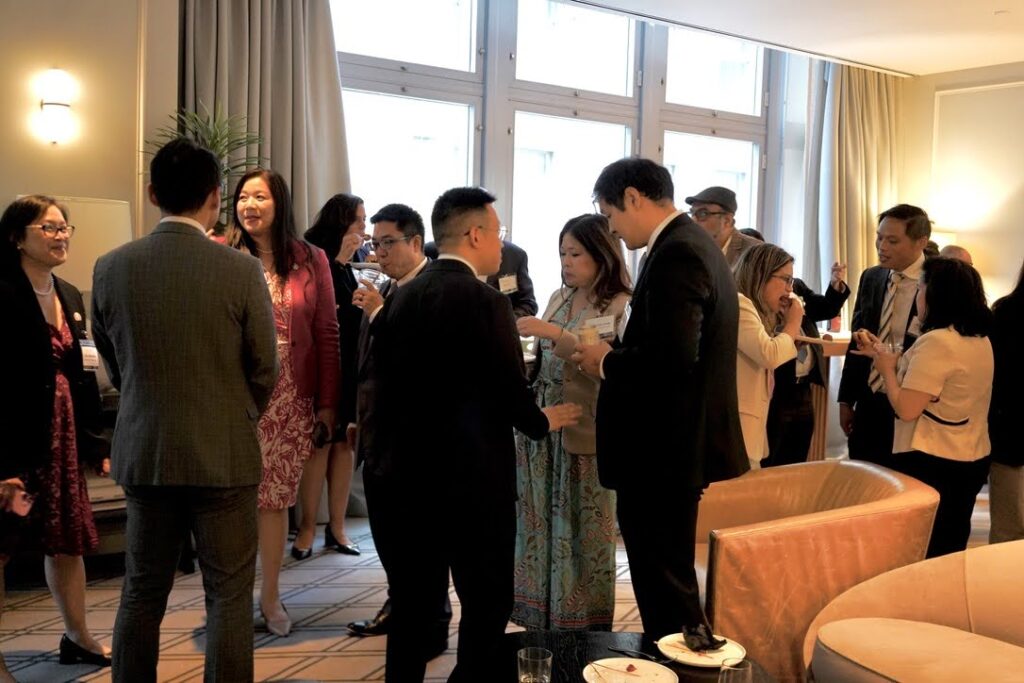
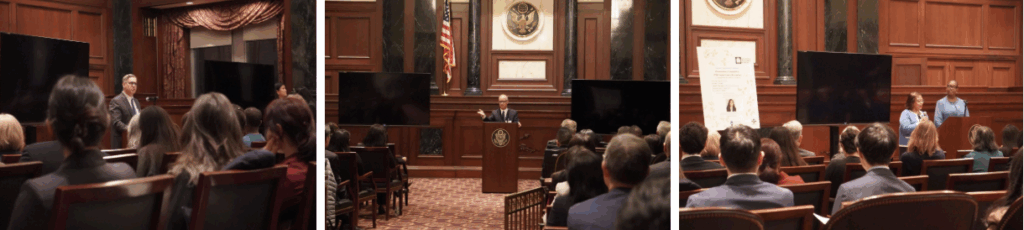
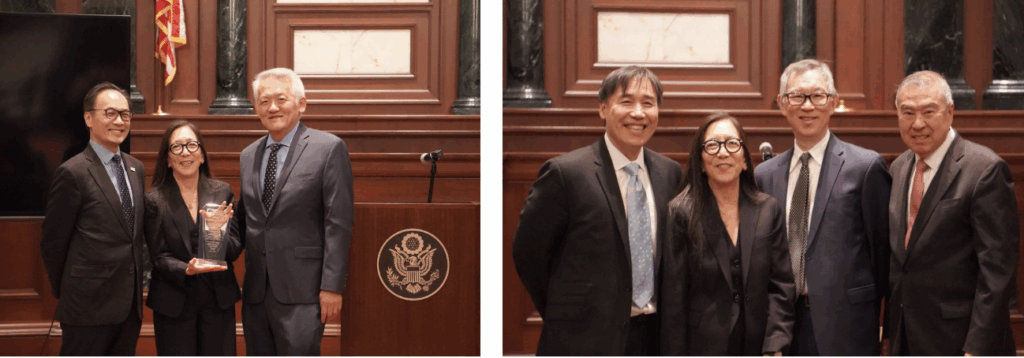
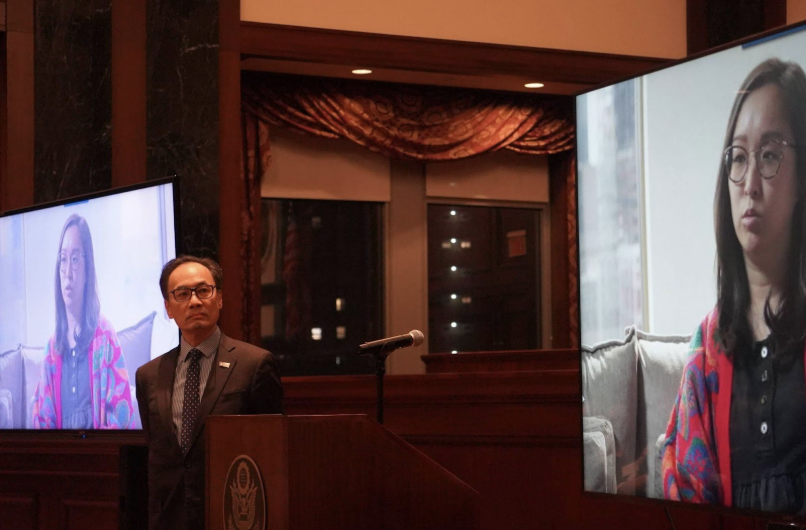
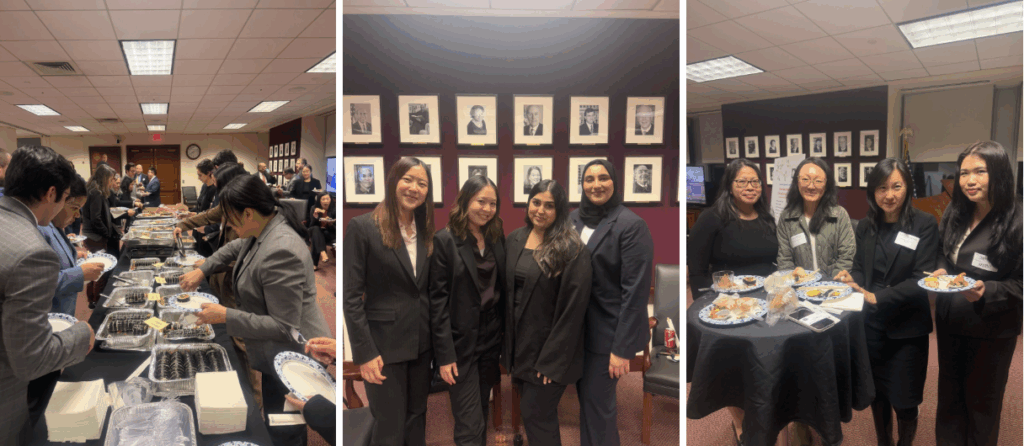
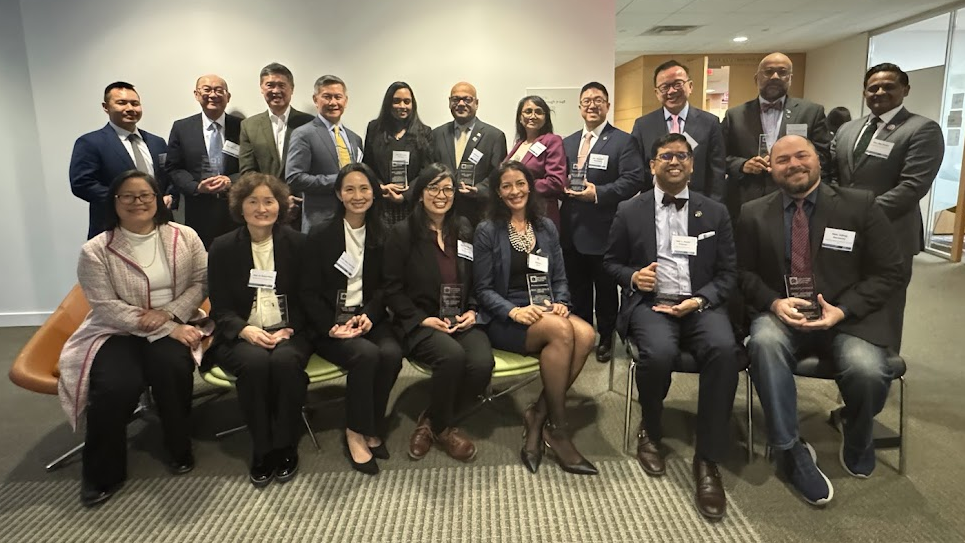
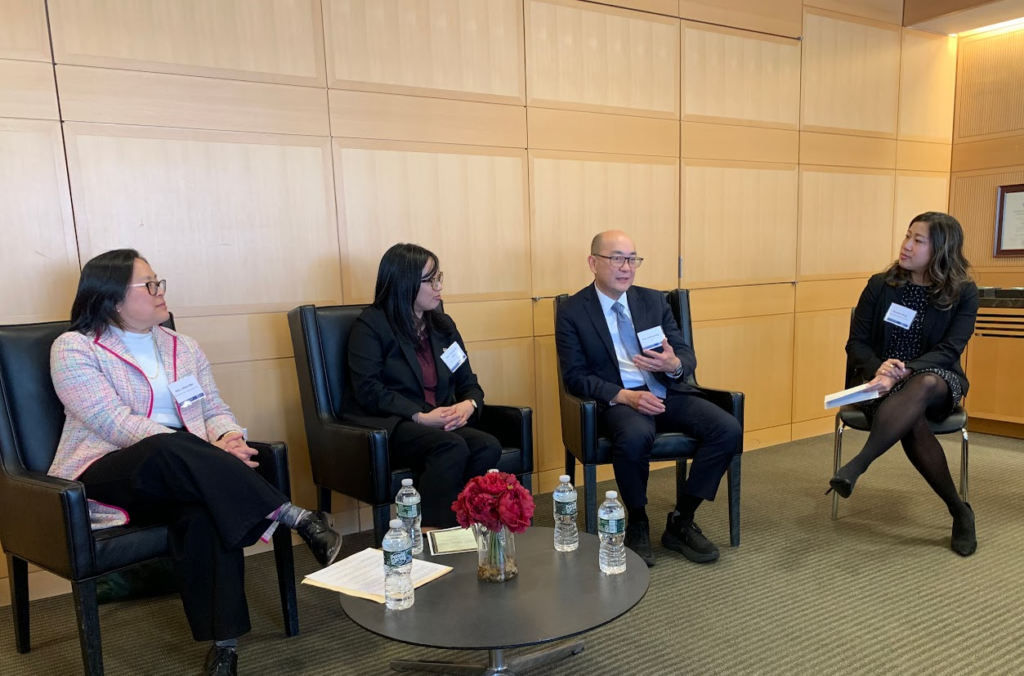
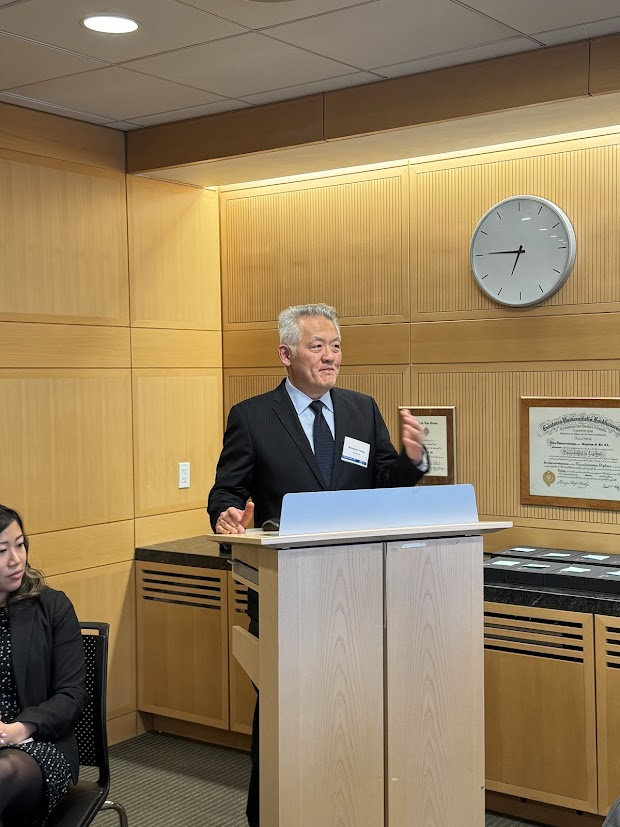
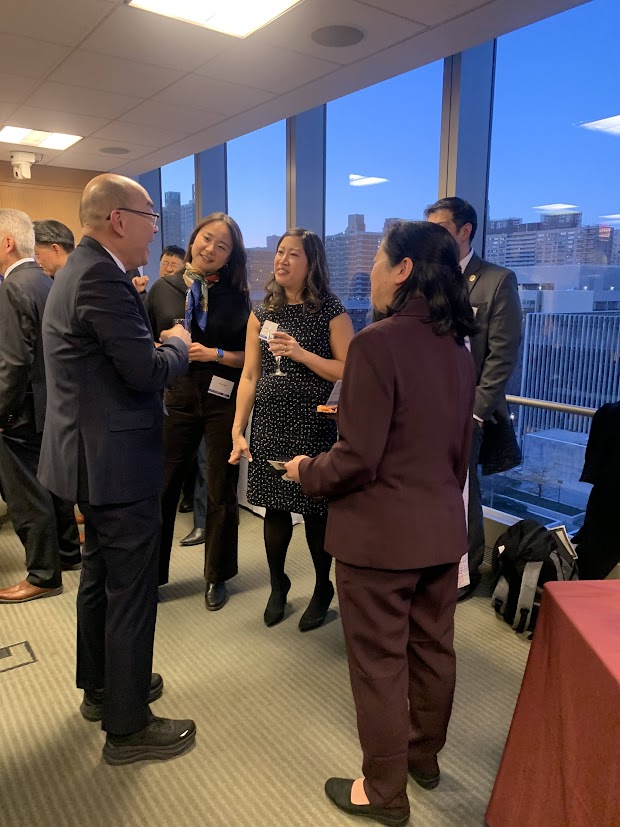
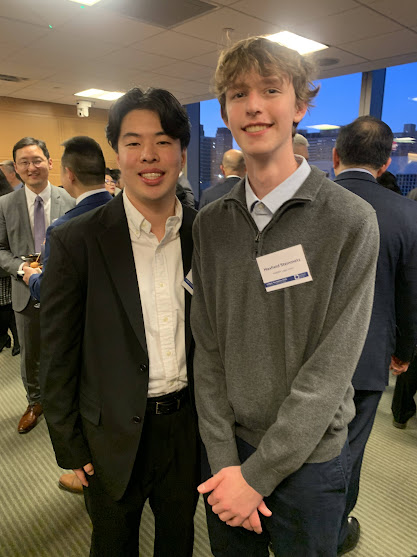
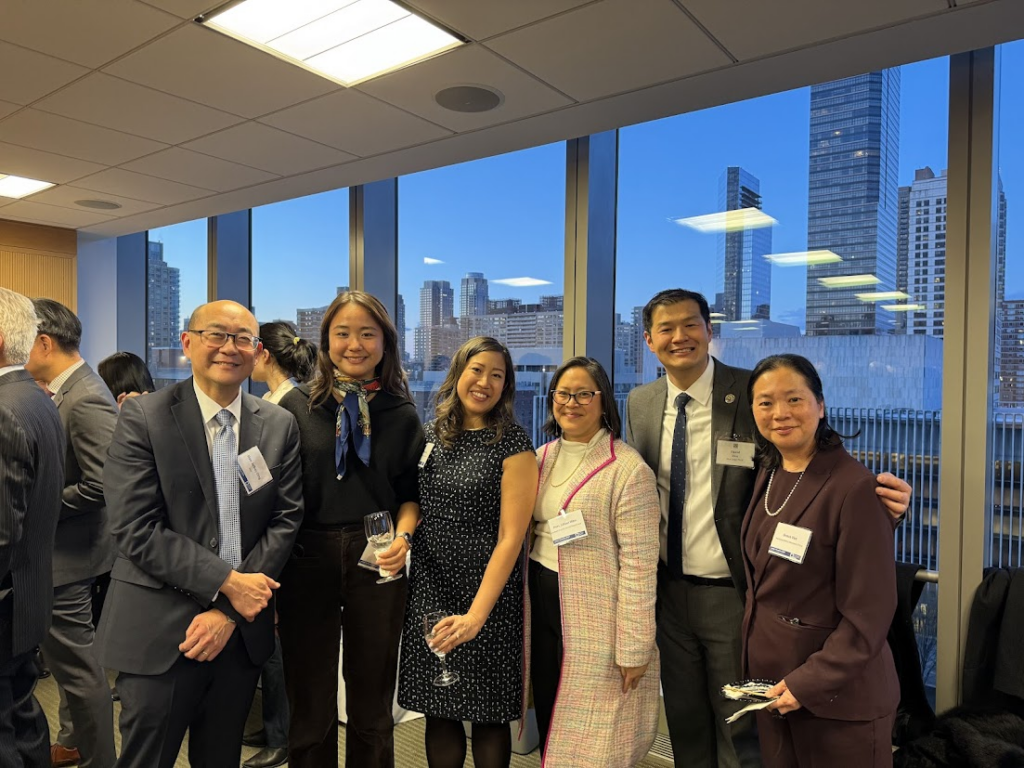
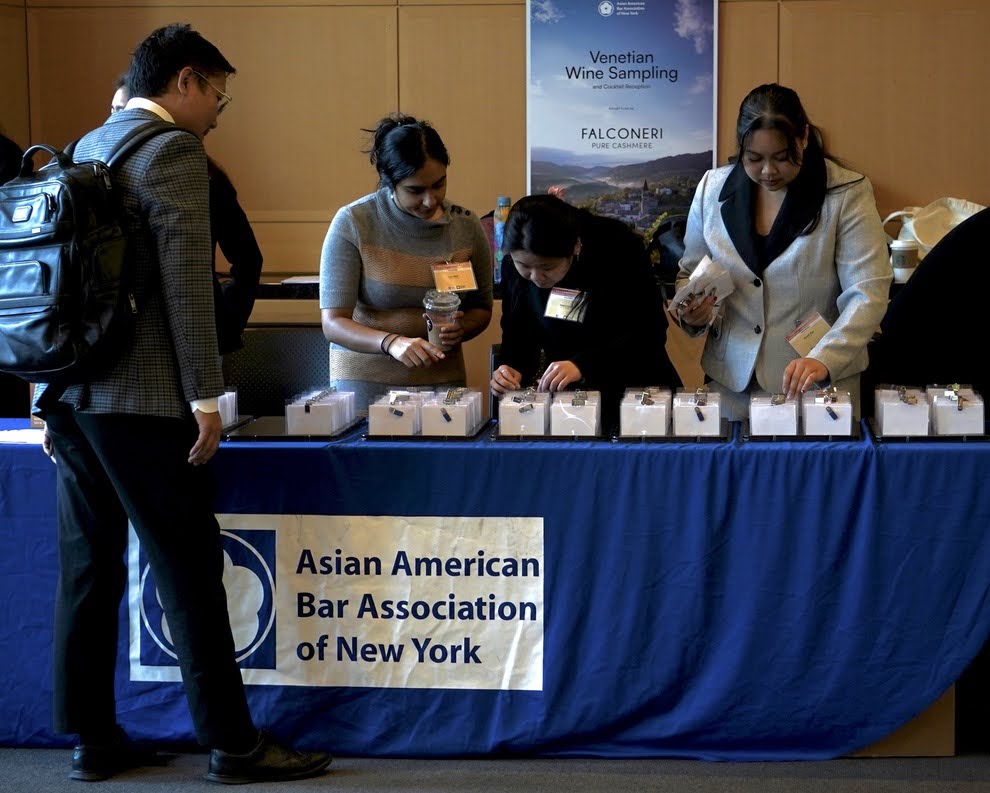
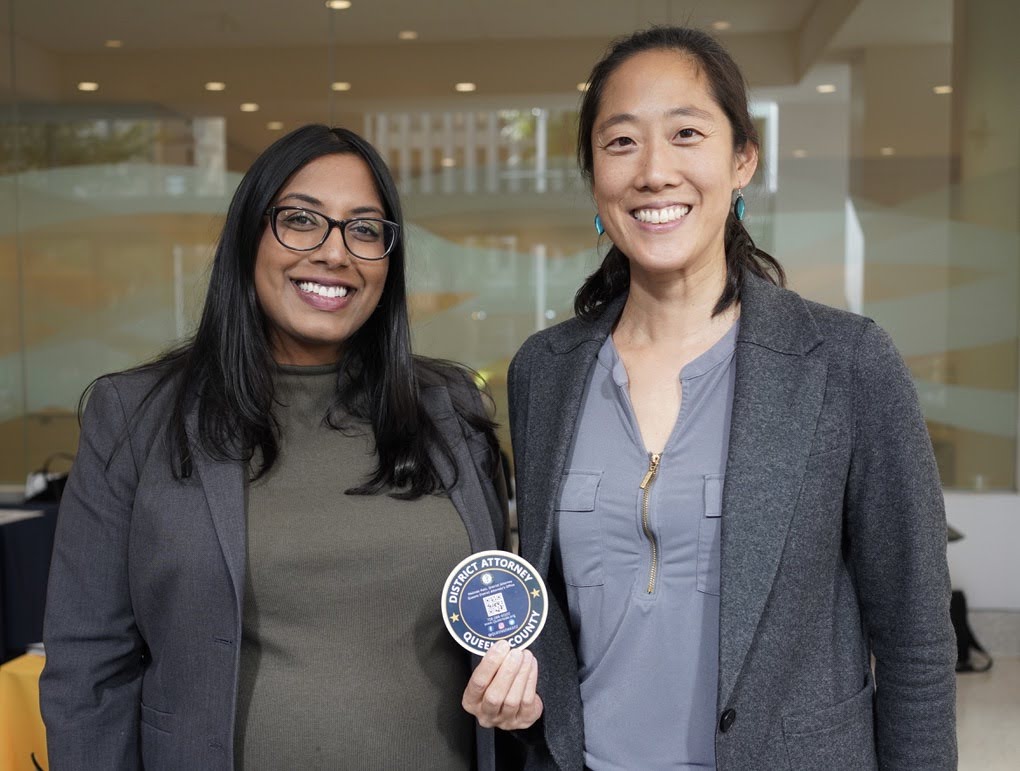
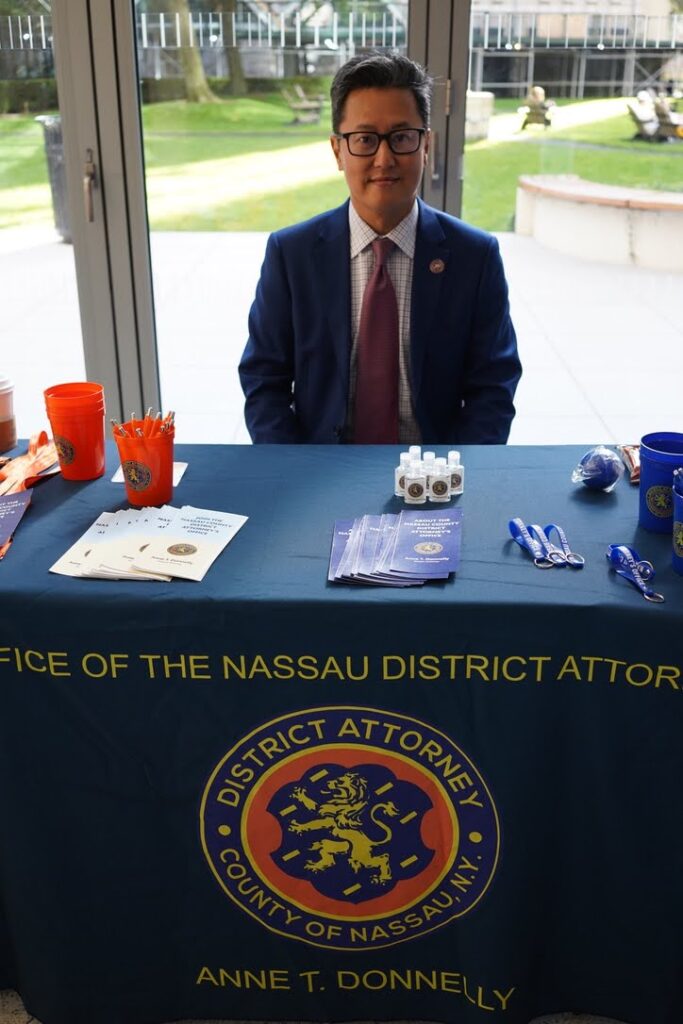
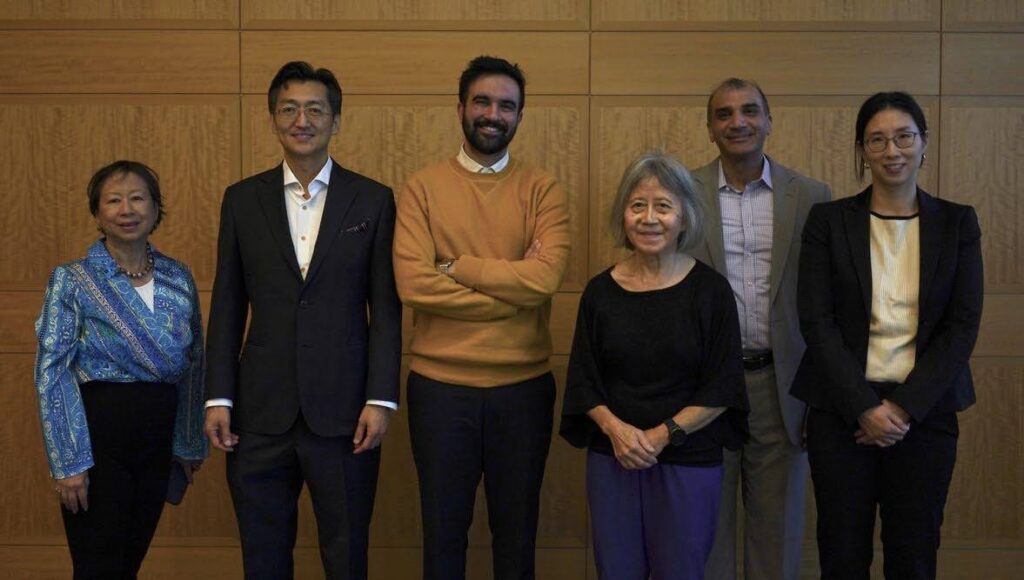
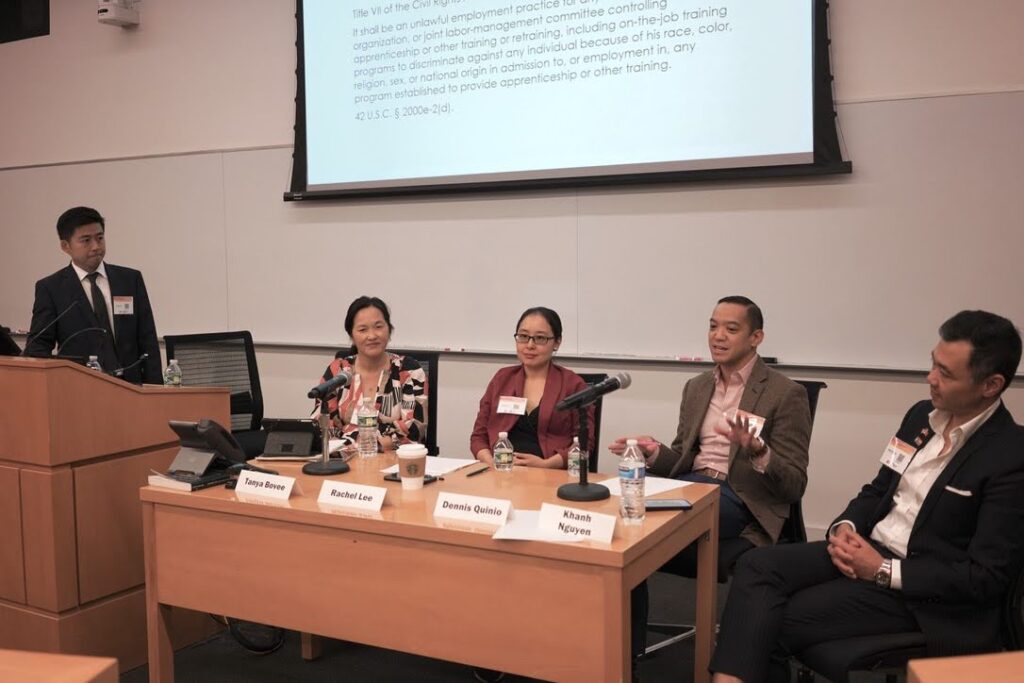
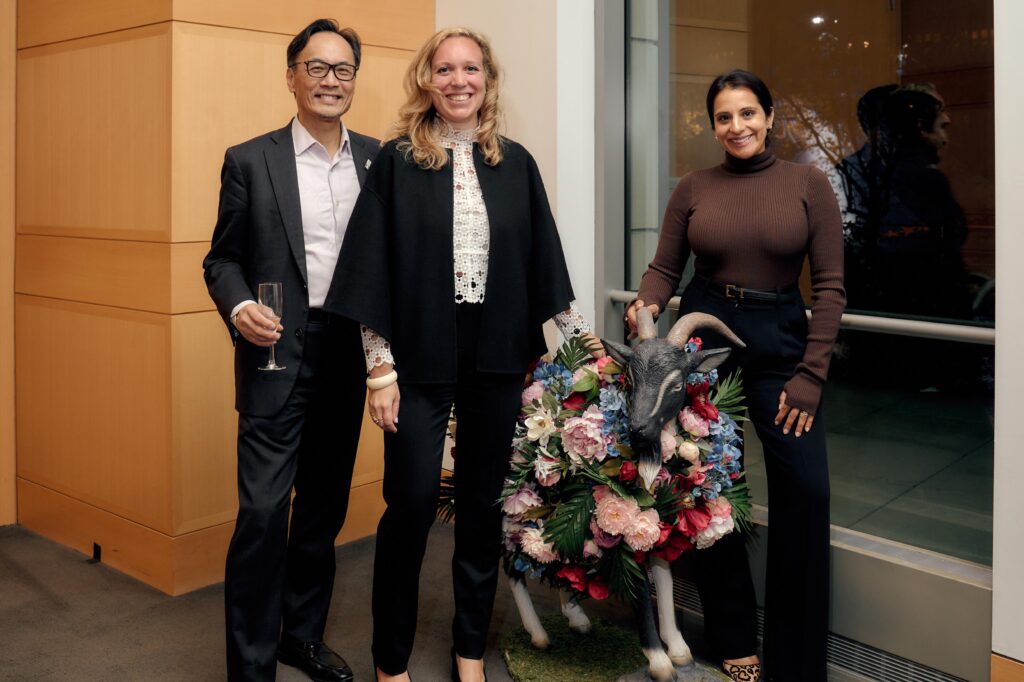
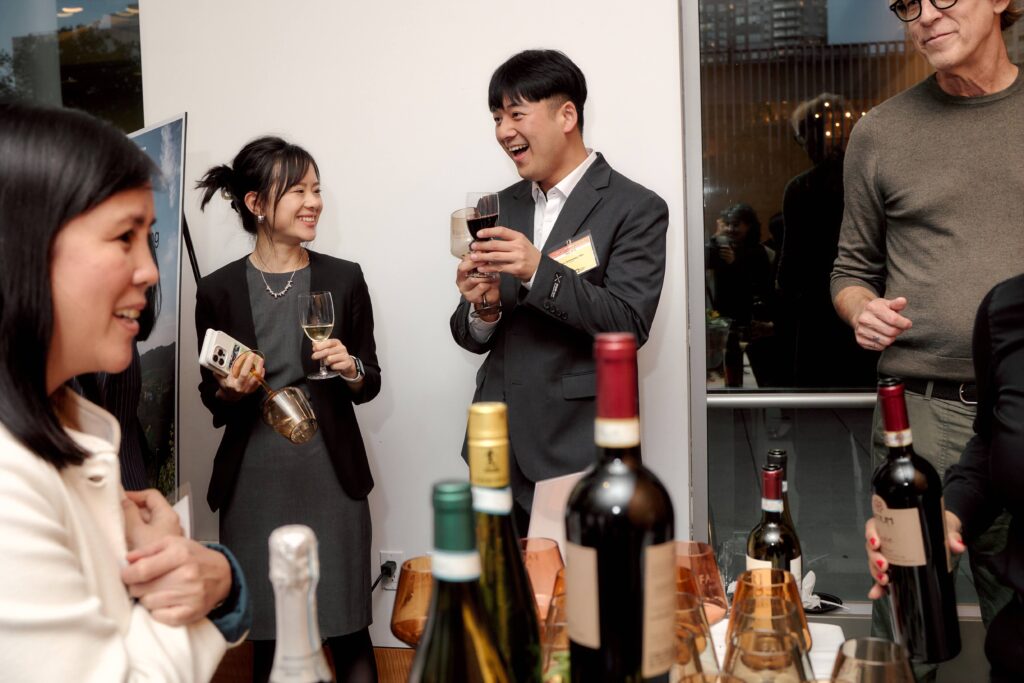
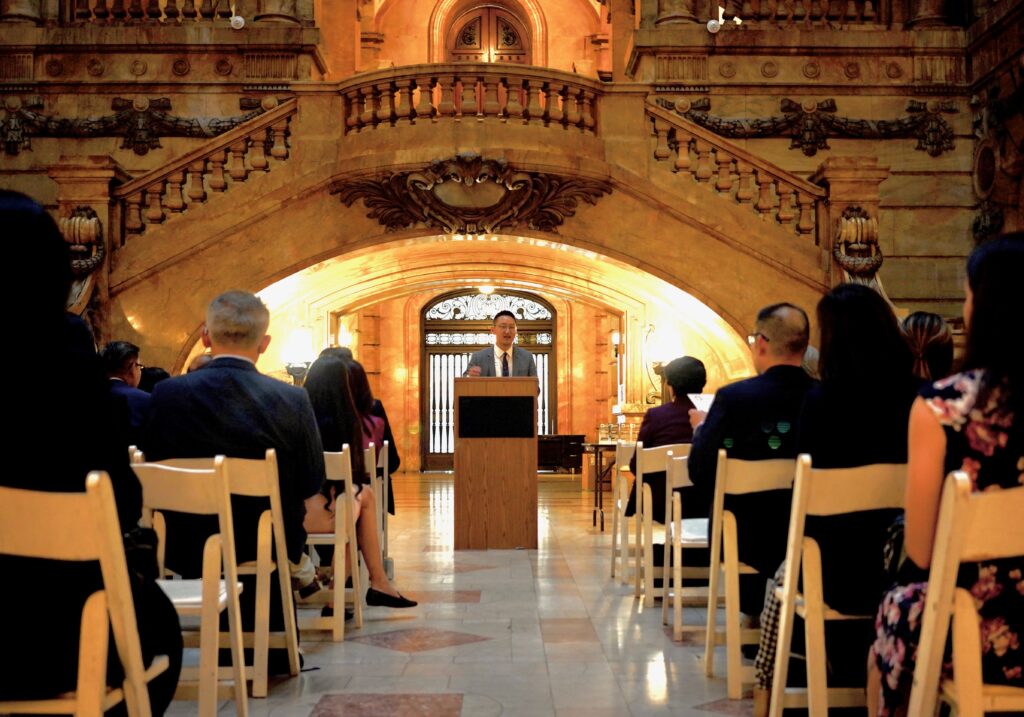
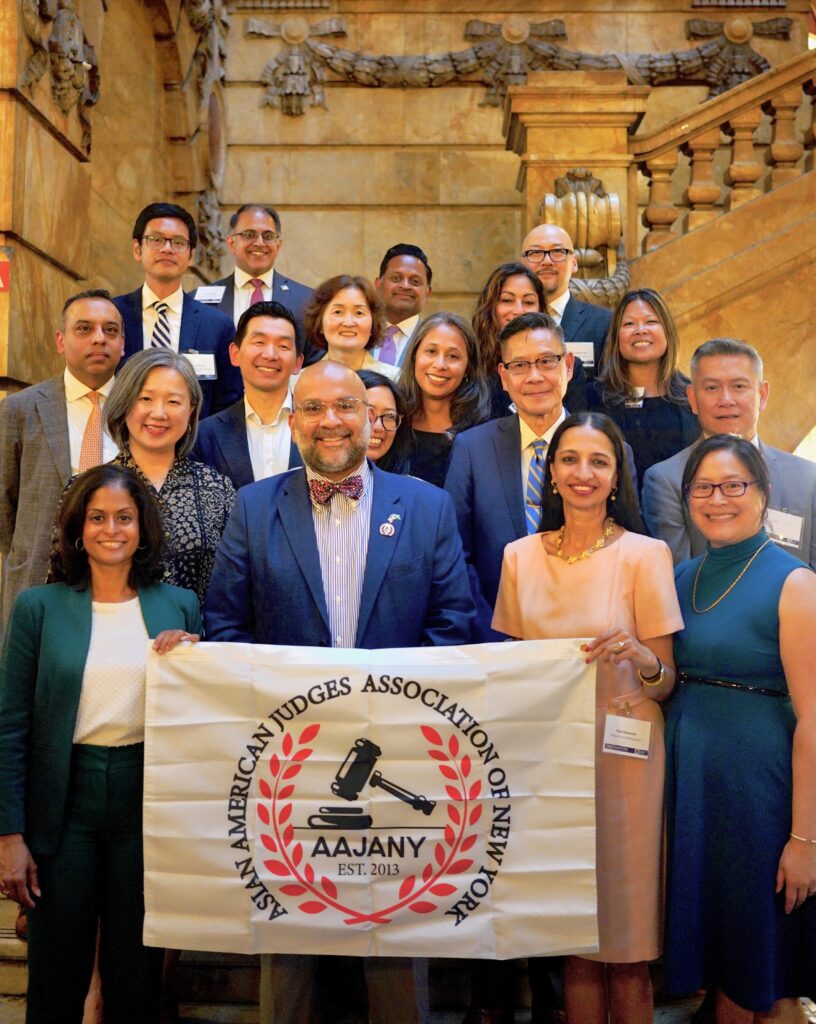
On Tuesday, May 19, 2026, the Judiciary Committee of the Asian American Bar Association of New York (“AABANY”) welcomed over 90 guests to its Annual Judges’ Reception at The Nexus Club located at 100 Church Street, New York, NY 10007.
The event brought together members of the judiciary, attorneys, government officials, law students, and community leaders to celebrate judges who were appointed, elected, or elevated within the past year.
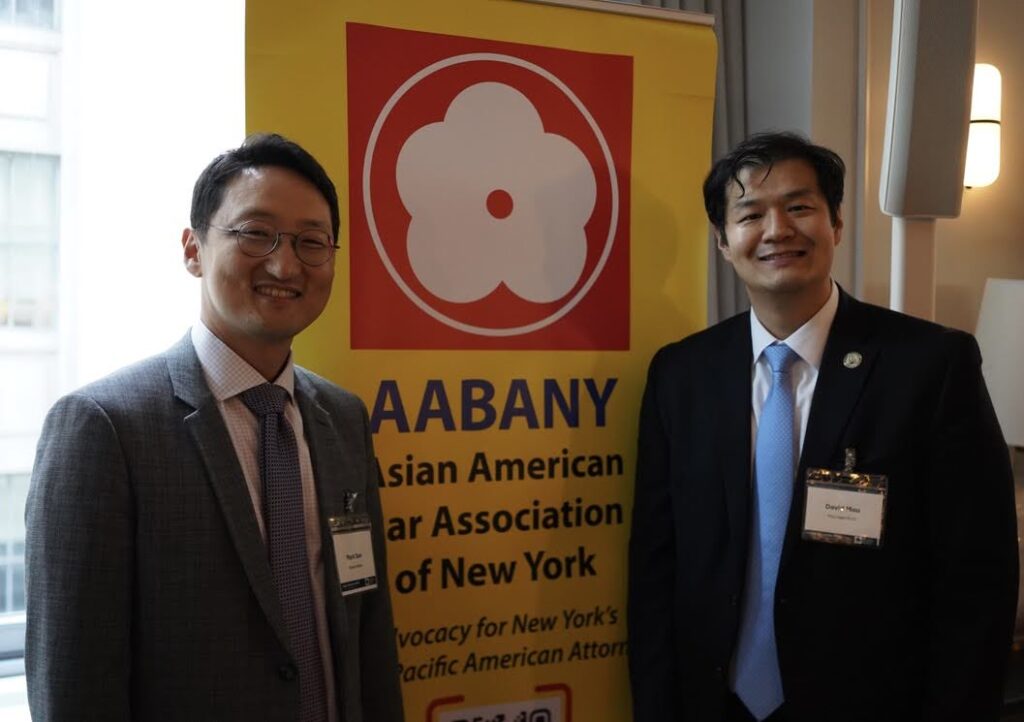
Organized by AABANY’s Judiciary Committee, co-chaired by Mark Son and David Mou, the evening highlighted AABANY’s continued commitment to diversity, mentorship, and advancement within the legal profession and in the judiciary.
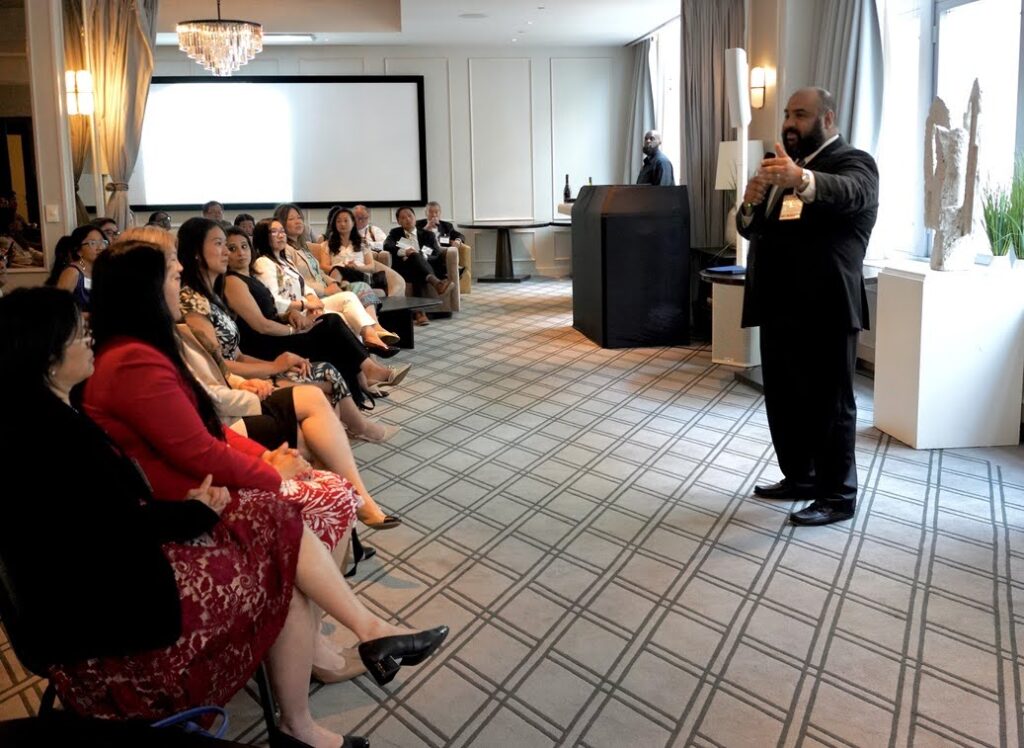
The program began with opening remarks from Judiciary Committee Co-Chair Mark Son, followed by remarks from distinguished leaders representing the bench, government, and the bar.
Featured speakers included AABANY President Varuna Bhattacharyya and Hon. Frances Wang, Justice of the New York State Supreme Court. Justice Wang, who is also Vice President of the Asian American Judges Association of New York, spoke about the importance of building a judiciary that reflects the diversity of the communities it serves and emphasized the impact of representation on public confidence in the legal system.
Additional remarks were delivered by Ali Najmi, Chair of New York City’s Mayor’s Advisory Committee on the Judiciary, and Kenan Kurt, Assistant Counsel for Judiciary and Ethics for the New York State Governor’s Office. Mr. Najmi underscored the Mayor’s commitment to create a more a diverse judiciary and stated that he is ready to work hard. Mr. Kurt compared the pioneer judges to the first athlete who broke the four-minute mile, shattering barriers and inspiring others to follow. Just as that achievement opened the door for future runners to accomplish the same feat, we celebrate the judges whose leadership and perseverance are making “four-minute miles” possible for those who come after them.
Hon. Karen Lin, Associate Justice of the Appellate Term for the Second, Eleventh, and Thirteenth Judicial Districts, reflected on the progress Asian Americans have made within the legal community while encouraging continued mentorship and support for future generations seeking judicial office.
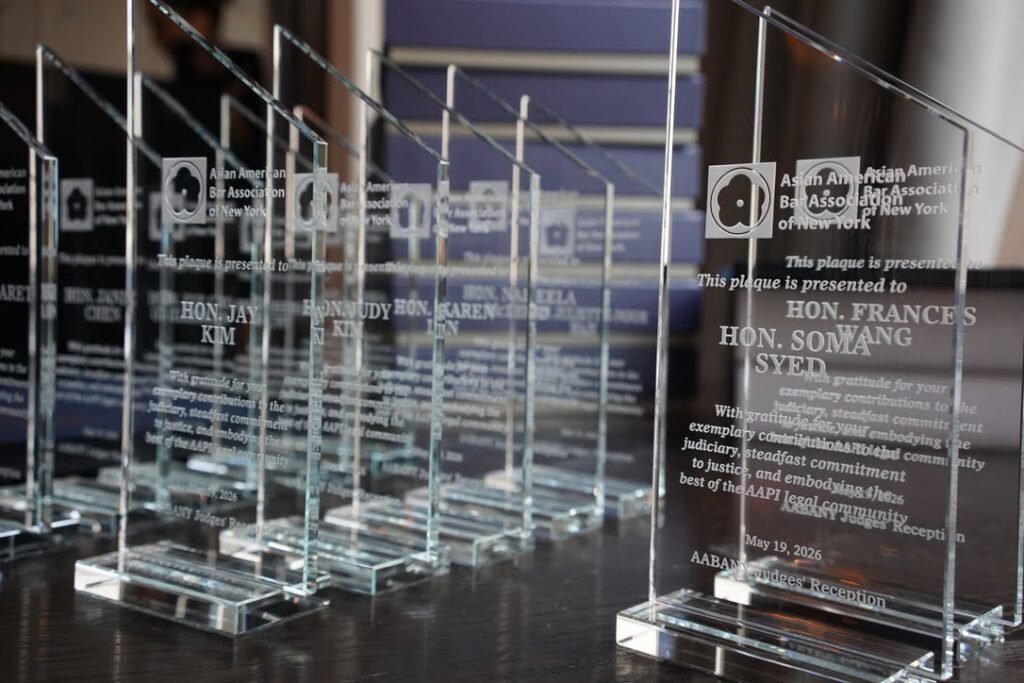
The evening also featured a Presentation of Awards by event co-chairs Lisa Lin and Kwok Ng, along with citations presented by Mr. Kurt on behalf of the Governor’s Office. Honorees recognized during the reception included:
Hon. Margaret Chan
Hon. Janice Chen
Hon. Eve Cho Guillergan
Hon. Sheridan Chu
Hon. Indira Khan
Hon. Jay Kim
Hon. Judy Kim
Hon. Karen Lin
Hon. Nabeela McLeod
Hon. Juliette-Noor Haji
Hon. Oma Phillips Deonarine
Hon. Soma Syed
Hon. Kris Singh
Hon. Frances Wang
Following the formal program, guests gathered for a dinner reception that provided an opportunity for judges, attorneys, students, and community leaders to connect and celebrate the honorees.
The Annual Judges’ Reception remains one of AABANY’s signature events and reflects the organization’s longstanding dedication to judicial diversity, professional mentorship, public service, and the advancement of Asian American attorneys and judges throughout New York.
A special acknowledgement to the organizers of this year’s program: Mark Son, David Mou, Douglas Tang, Kwok Ng, Pei Pei Cheng De Castro, Yang Chen, Carrey Wong, Apollo Baltazar, and Lisa Lin.
The panel featured two sitting Federal Magistrate Judges: Hon. Ona T. Wang of the Southern District of New York (SDNY) and Hon. James Cho of the Eastern District of New York (EDNY). Both judges shared candid reflections on their paths to the bench and practical advice for prospective applicants looking to apply.
Judge Wang, the first Asian Magistrate Judge in the history of the SDNY, opened by describing how Magistrate Judges work within the federal judiciary. Magistrate Judges are Article I judges who serve eight-year renewable terms and their authority is derived primarily from 28 U.S.C. § 636 and Rule 72 of the Federal Rules of Civil Procedure. On the civil side, they can exercise the full authority of a District Judge when all parties consent to their jurisdiction. On the criminal side, they handle initial appearances, bail and detention hearings, and search warrant applications, though they are not authorized to preside over Federal felony jury trials.
Judge Wang described criminal duty in the SDNY as being “on call in the ER” because for approximately one week once a quarter, a Magistrate Judge handles every Federal arrest, presentment, and search warrant application arising out of Manhattan. This can include complex multi-jurisdictional investigations reaching across the globe. At the same time, she manages a civil docket of approximately 200 to 300 cases, handling scheduling, discovery disputes, settlement conferences, and reports and recommendations on dispositive motions.
Judge Cho, who has served in Brooklyn since 2021, highlighted several important distinctions between the two districts. In the EDNY, Magistrate Judges are assigned to nearly every civil case filed and handle all pretrial supervision from the outset and with a direct consent track that allows parties to proceed without a District Judge entirely. In the SDNY, by contrast, Magistrate Judges only begin to work on a civil case once a District Judge issues a referral order. The scope of that referral may be for general pretrial matters, settlement only, or specific motions, and fundamentally shapes the Magistrate Judge’s involvement.
Judge Cho also noted that EDNY Magistrate Judges conduct jury selection for other judges and take guilty pleas which are tasks generally not performed by SDNY Magistrate Judges. Meanwhile, SDNY Magistrate Judges handle a higher volume of Social Security and habeas corpus cases.
Judge Cho and Judge Wang provided a detailed roadmap of the selection process. The written application includes a 11-page fillable form on the SDNY website and asks candidates to identify significant cases from the past five years, along with adversaries who may be contacted as references. Both Judge Wang and Judge Cho advised candidates to be selective in listing cases and to choose matters that were meaningful and that demonstrate the breadth of their experience. They also recommended giving adversaries a professional heads-up that they may receive a call because the committee is also evaluating professional conduct.
The selection process unfolds in two rounds. First, a Merit Selection Panel of practicing lawyers reviews applications and conducts interviews lasting typically 20 to 30 minutes in length. This Selection Panel then recommends five finalists per vacancy to the Board of Judges. In the SDNY, these interviews are conducted strictly in person. Second, the five finalists interview with the full Board of Judges. Both rounds move quickly and are tightly scheduled.
Judge Cho emphasized that the interview can be decisive, even for candidates who may not appear to be frontrunners on paper. He advised candidates to use the first question, invariably some version of “Why do you want to be a Magistrate Judge?” as an opportunity to tell their authentic story and to weave together themes of their relevant experience to public service and personal motivation. His own opening, for example, drew on his background as the son of immigrants, his experience teaching legal writing, and his years as a Federal civil litigator and Assistant United States Attorney.
Judge Wang offered a note of calibration for SDNY interviews specifically. Given that the Panel moves on time, a lengthy opening is not feasible. She recommended a focused, one-to-two-minute answer that signals a clear theme and invites follow-up questions. Her own theme was being a “helper,” a thread she drew through her clerkship and her extensive settlement and mediation experience.
Both Judges stressed that no candidate is a perfect fit on paper. In fact, Judge Wang had not conducted a trial before joining the bench and Judge Cho had no criminal experience. The Board of Judges is not administering a knowledge test. They are evaluating the candidates’ temperament and genuine motivation for public service. Candidates should acknowledge any gaps in their backgrounds honestly and then redirect toward their strengths.
Judge Cho and Judge Wang were also candid about the value of professional networks at key stages in the process. Once a candidate gains traction after securing a first-round interview, they encourage applicants to reach out to well-connected mentors and colleagues who might be willing to speak on their behalf to members of the Selection Panel or the Board of Judges. Judge Wang shared a memorable lesson from her own process when a close personal contact who was a sitting District Judge learned of her application through a reference call for another candidate and independently volunteered a strong endorsement. She advised candidates not to leave that kind of advocacy to chance.
For those who may feel their background does not fit a traditional mold or who did not succeed in a prior application cycle, both judges offered genuine encouragement. Judge Wang noted that it is not unusual for candidates to apply more than once and that a changed political environment may make the current cycle particularly competitive. Yet, this should not deter anyone from applying. The advice is to focus on each stage as its own challenge, prepare thoroughly for interviews with mock sessions – Judge Wang mentioned AABANY as a great source that can help candidates coordinate these – lean into your network, and to approach the process with the utmost authenticity and confidence.
To learn more about the AABANY Judiciary Committee, gohere.
The United States District Court for the Southern District of New York is accepting applications for a full-time Magistrate Judge position at New York, NY. The duties of the position are demanding and wide ranging and will include: (1) conduct of preliminary proceedings in criminal cases; (2) trial and disposition of misdemeanor cases; (3) conduct of various pretrial matters, including settlement proceedings, and evidentiary proceedings on delegation from the judges of the district court; (4) trial and disposition of civil cases upon consent of the litigants; (5) inquests and reports and recommendations on dispositive motions and evidentiary matters on reference from the judges of the district court; and (6) assignment of additional duties not inconsistent with the Constitution and laws of the United States.
The basic jurisdiction of the United States Magistrate Judge is specified in 28 U.S.C., Section 636. To be qualified for appointment, an applicant must: (a) be a member in good standing of the bar of the highest court of a State, the District of Columbia, the Commonwealth of Puerto Rico, or the U.S. Virgin Islands for at least five years; (b) have been engaged in the active practice of law for a period of at least five years (with some substitutions authorized); (c) be competent to perform all the duties of the office, of good moral character, emotionally stable and mature, committed to equal justice under the law, in good health, patient and courteous, and capable of deliberation and decisiveness; (d) be less than 70 years old; and (e) not be related to a judge of the district court.
A Merit Selection Panel composed of attorneys and other members of the community will review all applications and recommend in confidence to the judges of the district court five persons whom it considers best qualified. The Court will make the appointment(s) following an FBI and IRS investigation of the appointee(s). Each individual selected must comply with the financial disclosure requirements of the Ethics in Government Act of 1978 and the Courthouse Ethics Act (CETA) of 2021. The Court seeks a wide range of highly qualified candidates. The current salary of the position is $229,908 per annum (effective 1/1/2026).
Candidates should submit hard copies of the applications to the physical address below and email a copy to: [email protected].
Edward A. Friedland District Court Executive United States Courthouse 500 Pearl Street, Room 820 New York, NY 10007-1312 Tel: 212-805-0500
An original plus fifteen (15) copies of a cover letter, resume and application must be received by May 1, 2026. Application forms are available on the Court’s web site: www.nysd.uscourts.gov.
If you are interested in this opportunity, please note that the AABANY Judiciary Committee is hosting the “Pathway to the Bench: Federal Magistrate Judges” event on Wednesday, April 22, 2026, from 6:00 pm – 7:00 pm, virtually on ZOOM. This program will provide valuable insight into the process of becoming a Federal Magistrate Judge, including practical guidance, application tips, and firsthand perspectives from the bench. Please register by April 21, 2026.
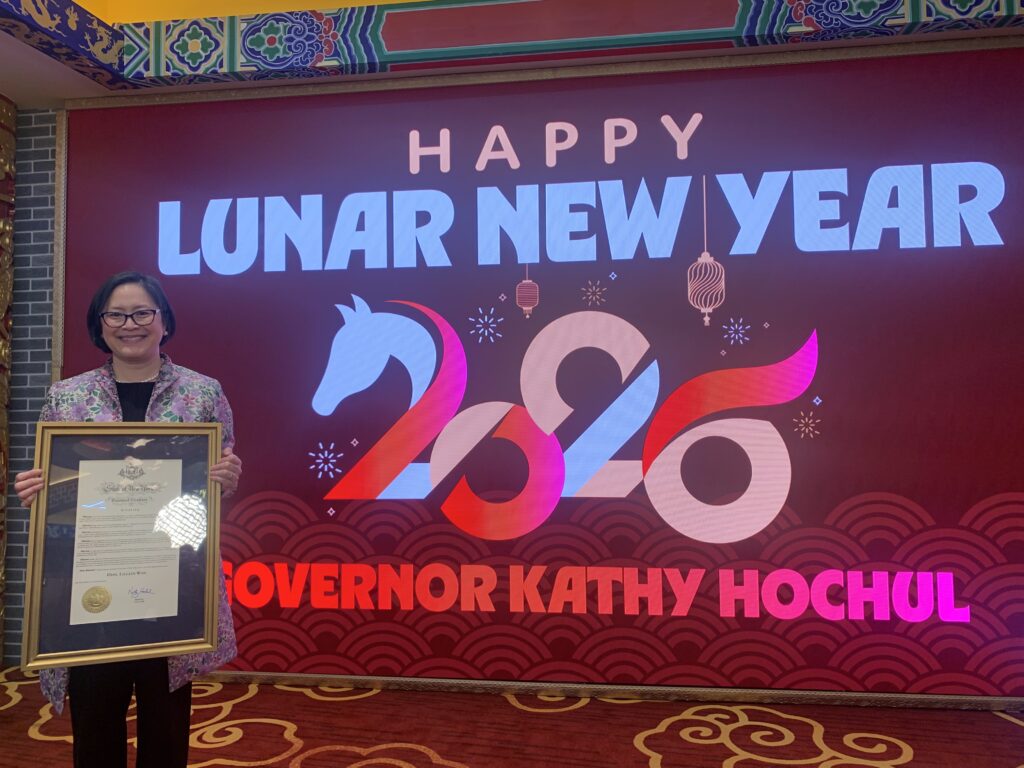
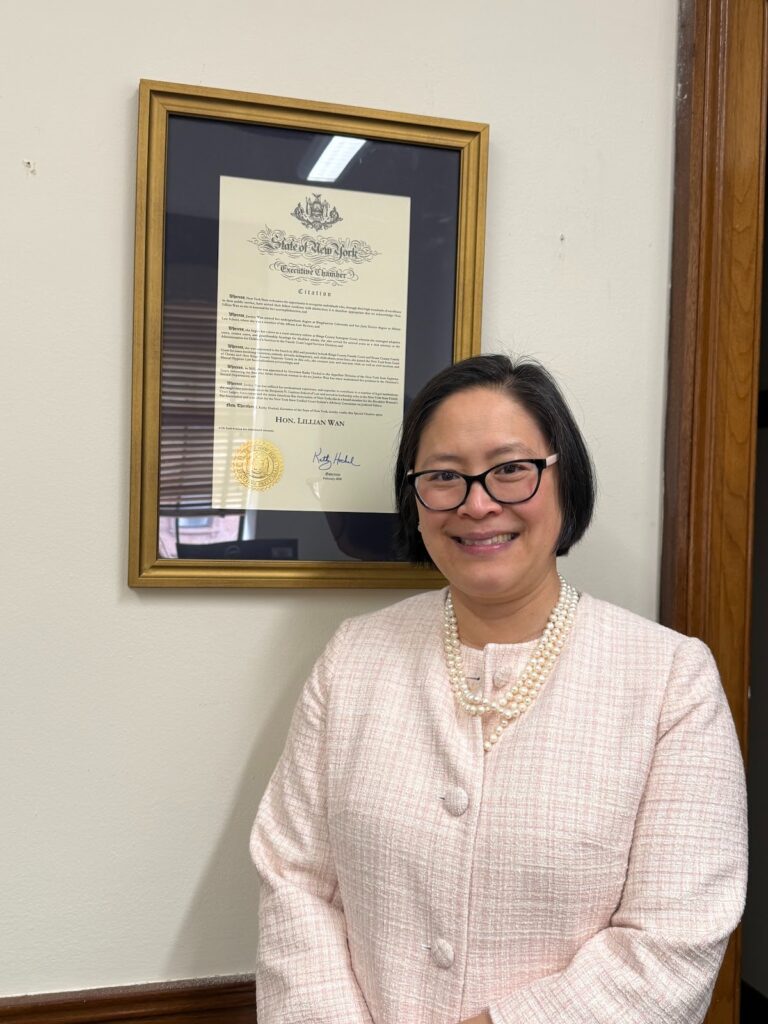
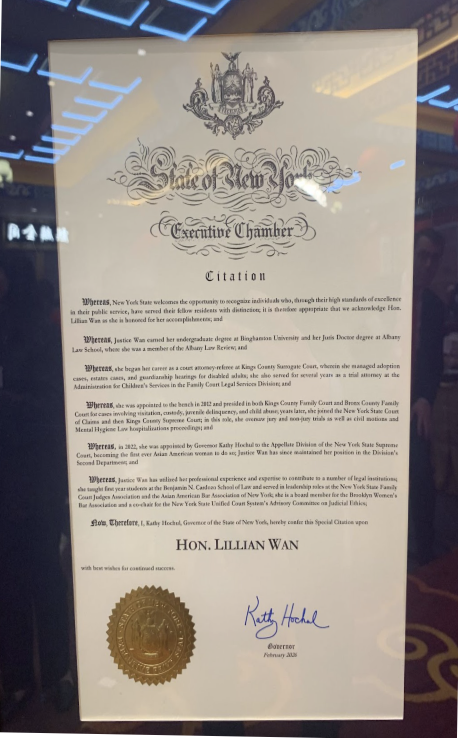
On February 18, 2026, at the Governor’s Lunar New Year celebration in Manhattan Chinatown, Justice Lillian Wan received a Special Citation from Governor Kathy Hochul. This recognition commemorates Justice Wan’s work in serving fellow New Yorkers with distinction and upholding the highest standards of excellence in public service. Justice Wan expressed deep gratitude for receiving the Special Citation from Governor Hochul, made all the more meaningful by being honored alongside Asian American Federation (AAF) CEO Catherine Chen and Coalition for Asian American Children and Families (CACF) Co-Executive Director Vanessa Leung, two leaders whose contributions to the Asian-American community have been noteworthy and impactful.
In 2022, Governor Hochul appointed Justice Wan to the Appellate Division, Second Department, making her the first Asian American woman to sit in the Appellate Division in New York State. Despite achieving this milestone in the New York State courts, Justice Wan’s path to the bench was not one she originally envisioned for herself. As a practicing attorney, she never appeared before a judge who looked like her, so she never considered it a possibility. That changed when she began working closely with Surrogate Judge Margarita López Torres, the first Latina Surrogate Judge in New York State. Judge López Torres became her mentor and encouraged her to apply for a mayoral appointment to the family court bench, where her experience was strongest, and that the City of New York would benefit from having her as a judge. “She saw something in me that I didn’t see in myself,” Justice Wan reflected.
Since being appointed to the bench in 2012, Justice Wan has witnessed a remarkable shift in representation. When she started, Asian American judges across New York State made up under 2% of the judiciary. Today, that number has grown to about 5% of the approximately 1,300 sitting New York state judges.
Governor Hochul, who awarded Justice Wan the special recognition, has played a meaningful role in that progress. Since taking office in August 2021, the Governor has appointed nine Asian American judges, six of whom have been appointed to the New York State Court of Claims, a higher number than any Governor in the State’s history. She has also appointed three Asian American judges to the Appellate Division, the mid-level appellate court in New York State. Justice Wan was appointed to the Appellate Division, Second Department in May 2022. Justice Philip Hom was appointed in 2024. Most recently, Justice Margaret Chan was appointed to the Appellate Division, First Department. Justice Wan, Justice Hom, and Justice Chan are all members of the Asian American Bar Association of New York.
Justice Wan’s own path was shaped not only by Judge López Torres but also by the Honorable Randall T. Eng, former Presiding Justice of the Appellate Division, Second Department, and now practicing attorney who holds a truly historic distinction: he was the first Asian American judge in the entire state of New York, appointed to the Criminal Court by Mayor Ed Koch in 1983. Justice Eng mentored Justice Wan early in her career and instilled in her a philosophy she carries to this day: visibility matters. Your job is essential, but you need to do more. Asian American attorneys and judges must be active in bar associations, judicial organizations, their law schools, their universities, and their communities. They should embrace leadership roles and ensure people know who they are.
Justice Wan has made it her personal mission to be for others what Judge López Torres and Justice Eng were for her. She remains accessible, attends various events to stay visible, and holds leadership positions in organizations that uplift the Asian-American legal community. As a mentor, Justice Wan sees talented attorneys routinely talking themselves out of applying for judicial positions, convinced that others are more qualified, that they haven’t been around long enough, or that it simply isn’t their turn. Her advice to students and legal professionals who want to follow her footsteps is direct: apply anyway. Often, the only difference between the person who gets the position and the person who doesn’t is that the latter didn’t second-guess themselves.
Besides individual efforts, Justice Wan points to the power of community organizations in building a stronger pipeline. The Asian American Bar Association of New York runs a robust Judiciary Committee that vets judicial candidates, provides letters of endorsement, conducts mock interviews, and hosts educational programs about the path to becoming a judge. The Asian American Judges Association of New York, of which Justice Wan is a past president and current board member, works to support judges and grow their numbers. The organization is open to everyone, not just Asian American judges, and its mission is rooted in the belief that a bench that reflects the full population it serves is stronger and more just.
The Special Citation from Governor Hochul captures both the breadth of Justice Wan’s career and the philosophy that has defined it, recognizing her historic appointment to the Appellate Division, Second Department, alongside her leadership in the organizations that uplift Asian American attorneys, women in law, and the broader legal community. It is a recognition that spans decades of work, from her earliest years on the bench to the mentorship and visibility efforts she continues today. Justice Wan has spent her career being the judge she did not see when she was a young attorney, and in doing so, has made sure that fewer people will have to wonder whether someone like them belongs on the bench.
Please join AABANY in congratulating Justice Wan on receiving this recognition from Governor Hochul.
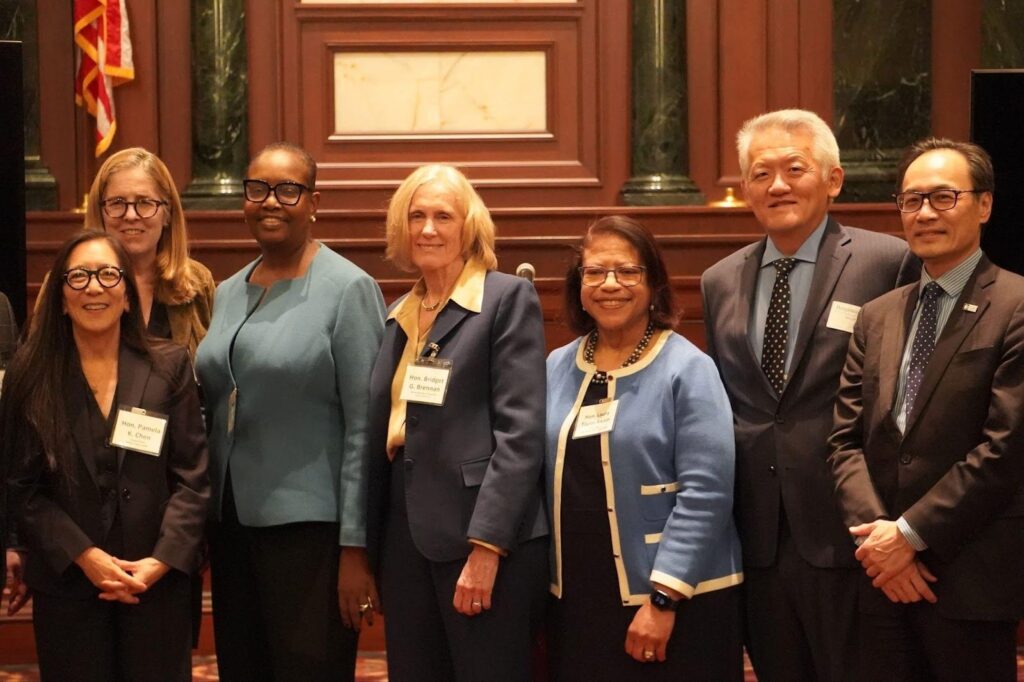
The Asian American Bar Association of New York (AABANY)’s Prosecutors Committee, together with its Judiciary Committee, celebrated the 17th Anniversary of the Prosecutors Committee on March 5, 2026, at the Daniel Patrick Moynihan United States Courthouse in Lower Manhattan. The evening honored Pamela K. Chen, United States District Judge for the Eastern District of New York, with a Lifetime Achievement Award in recognition of her exemplary service to the Federal judiciary and her longstanding dedication to justice.
Judge Chen was nominated to the Federal bench in January 2013 by President Barack Obama and confirmed by the Senate in March 2013. Since her appointment to the bench, Judge Chen has presided over a wide array of civil and criminal cases, including a civil lawsuit challenging New York’s ban on the possession of nunchuks.
Judge Chen began her legal career at the law firm of Arnold & Porter in Washington, D.C. In 1991, she joined the Special Litigation Section of the U.S. Department of Justice’s Civil Rights Division, where she litigated matters relating to conditions of confinement for individuals in state and local institutions, as well as cases involving the enforcement of the Freedom of Access to Clinic Entrances (FACE) Act of 1994.
In 1998, Judge Chen moved to New York City and joined the U.S. Attorney’s Office for the Eastern District of New York, where she worked until March 2013, except for a brief period in 2008, when she served as Deputy Commissioner for Enforcement in the New York State Division of Human Rights. As an Assistant U.S. Attorney, Judge Chen investigated and prosecuted cases involving terrorism, gang violence, drug trafficking, human trafficking, official misconduct, and civil rights crimes. She also served as the Chief of the Criminal Civil Rights Section and oversaw the development of the Office’s anti-human trafficking program, which resulted in the investigation and prosecution of hundreds of traffickers and the identification, rescue, and restoration of hundreds of survivors of trafficking. In 2015, Judge Chen and then-Attorney General Loretta E. Lynch were honored by Sanctuary for Families for the anti-human trafficking work done by the U.S. Attorney’s Office under Attorney General Lynch’s leadership as the U.S. Attorney for the Eastern District of New York.
Judge Chen has also served for nearly ten years on the Board of the Sonia & Celina Sotomayor Judicial Internship Program where she mentors the next generation of legal professionals.
The evening began in the courthouse’s Ceremonial Courtroom, where approximately 150 attendees from across the legal community gathered. The event brought together a wide range of members from our shared communities, including state and Federal judges and prosecutors, government attorneys, private practitioners, law students, law clerks, professors, community advocates, and supporters of AABANY.
The formal program commenced at approximately 6:15 p.m., with opening remarks from the evening’s Masters of Ceremonies, Teri Chung, Major Case Assistant District Attorney at the Bronx County District Attorney’s Office, and Eun Bi Kim, Assistant District Attorney at the Manhattan District Attorney’s Office. Distinguished heads of the Federal judiciary offered warm greetings and reflections on Judge Chen’s career, including Hon. Laura Taylor Swain, Chief Judge of the United States District Court for the Southern District of New York, and Hon. Margo K. Brodie, Chief Judge of the United States District Court for the Eastern District of New York.
Following Chief Judges Swain and Brodie, additional remarks were delivered by Benjamin Hsing, President of AABANY; Hon Joseph Nocella Jr., United States Attorney for the Eastern District of New York; Hon Bridget G. Brennan, Special Narcotics Prosecutor for the City of New York; Joseph P. Alexis, Chief of the Trial Division at the Kings County District Attorney’s Office; and Karl Metzner, Associate United States Attorney for the Southern District of New York. During the program, each speaker highlighted the breadth and significance of Judge Chen’s judicial and prosecutorial careers. Their words were a tribute to her leadership and dedication to public service.
After the array of accolades was given from many who have worked with Judge Chen, she was formally introduced by Hon. Ann Donnelly, United States District Judge for the Eastern District of New York, who described Judge Chen as the embodiment of a trailblazer.
In her acceptance remarks, Judge Chen delivered a thoughtful and compelling reflection of her career and the importance of representation in public service within the legal profession. Citing data on Asian American participation in public service roles, she observed that “by the end of 2022, approximately 7.5% of Asian American lawyers entered government service directly from law school,” while noting similarly modest percentages entering law school and prosecutorial offices. She posed a critical question: “Why does it matter that Asian Americans are not fully represented in public service?”
Judge Chen explained that the answer lies not only in numbers, but in perception and belonging. She remarked that in this country, there remains an undercurrent that views Asian Americans as perpetual foreigners. Such perceptions have, at times, surfaced most painfully during moments of national hardship, including the COVID-19 pandemic, when anti-Asian sentiment manifested in acts of violence.
Emphasizing the importance of visibility in public roles, Judge Chen reflected on the symbolic power of serving as a prosecutor: “When you stand up in court and say, ‘I represent the People of New York’ or ‘I represent the United States of America,’ you are affirming, every day, that Asian Americans are part of this nation—not outsiders to it.” Judge Chen emphasized how greater participation in public service, specifically institutions of justice, helps achieve equity for all, and simultaneously challenges stereotypes and reinforces the fundamental truth of belonging.
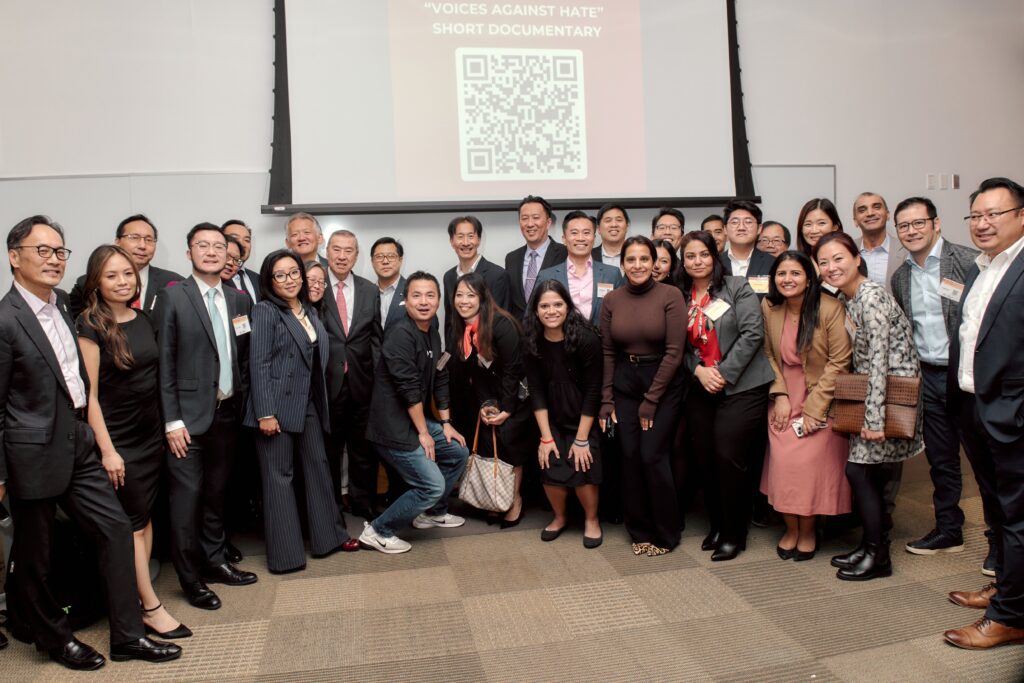
These themes of representation and belonging were echoed in the broader program. Before its conclusion, AABANY Executive Director Yang Chen introduced a trailer for Voices Against Anti-Asian Hate, an AABANY documentary highlighting the surge in anti-Asian hate incidents during the pandemic and the community’s response. The trailer highlighted the importance of continued vigilance and advocacy against anti-Asian violence and hate crimes and described the ongoing work of AABANY’s Anti-Asian Violence Task Force. Yang Chen further expressed gratitude for the role played by members of the Task Force in producing the documentary. In particular, Yang called up St. John’s University School of Law Professor Elaine Chiu, past Chair of the Task Force, and James Lin, retired veteran prosecutor of the Manhattan and Brooklyn DA’s Offices, as well as Daphne Mei, Program Manager for the Task Force, for their contributions to AABANY’s work combatting anti-Asian violence and hate.
The program concluded with closing remarks from Kin Ng before guests proceeded to a networking reception in suite 850. The reception featured an array of delicious food including a variety of kimbap, samosas and dumplings, and provided an opportunity for attendees to connect and celebrate Judge Chen and the continued impact of the Prosecutors Committee within the legal community.
A Second Circuit Judge who attended the event described it as “warm, informative, and fun,” a sentiment that captured the spirit of collegiality and shared purpose that defined the celebration.
AABANY thanks Prosecutors Committee Co-Chairs Grace Vee, Appeals Division Civil Litigation Unit Chief and Associate General Counsel at the Manhattan District Attorney’s Office, and Kin Ng, Bureau Chief at the Kings County District Attorney’s Office, as well as Judiciary Committee Co-Chairs David Mou, founding attorney of Mou Legal PLLC, and Mark Son, Vice President of the Central Investigations Function at Deutsche Bank, for their leadership in organizing this memorable evening. AABANY also thanks the United States District Court for the Southern District of New York for graciously hosting the celebration at the SDNY courthouse. To view photos from the event, click here.
On Tuesday, April 8, 2025, the Judiciary Committee of the Asian American Bar Association of New York (AABANY) hosted its 2025 Annual Judges’ Reception at Fordham Law School. About 70 attendees gathered for this annual celebration of newly elected/appointed, elevated, and retired Asian American and Pacific Islander (AAPI) judges across New York. It was an evening filled with reflection, gratitude, and hope for the future of AAPI representation in the judiciary.
This year’s event was co-sponsored by Fordham Law School’s Center on Asian Americans and the Law, and featured a panel discussion, an inspiring awards ceremony, and a lively light dinner reception.
The reception began at 5:30 PM with the “Art of Judging” panel, moderated by Referee Vanessa Kong (Kings County Family Court) and featuring distinguished panelists:
Hon. Lillian Wan, Appellate Division, Second Department
Hon. Jeffrey Oing (ret.), Appellate Division, First Department
Hon. Denny Chin, U.S. Court of Appeals for the Second Circuit
Hon. Melissa De Jesus, New York State Court of Claims
The judges spoke about the heavy responsibilities they carry and the importance of listening with an open mind of applying no personal agenda but rather approaching each case on its merits. Judge De Jesus, who presides over a drug treatment part in Kings County, reflected on managing a busy courtroom while ensuring each party feels heard and making sure to take the extra time if needed to make the best decision with all the information.
When asked what qualities are most undervalued in a judge, all panelists agreed on the importance of patience and humility. Justice Wan reminded the audience that judges “wear a robe, not a crown,” emphasizing the human side of the role and the need to treat litigants and practitioners with compassion and dignity. Justice Wan shared a powerful anecdote: she issued her decision in court, then proceeded to go home where she continued to think about her decision, and the next day returned and recalled the parties and attorneys because she came to the conclusion that she wanted to change her decision. It served as a reminder that judges are not only thoughtful but also human, capable of growth and change even after issuing a decision.
Judge Chin emphasized the need to think about the different audiences a judge must consider when writing a decision. Judge Oing described a particularly moving case where he dismissed fraud charges and took special care to write a decision that cleared the defendant, who had hugely suffered from the accusations.
The panel concluded on a hopeful note. Justice Wan shared how she cherishes attorney swearing-in ceremonies, making it a point to connect with young AAPI attorneys. Judge Chin spoke on the privilege of presiding over naturalization ceremonies, including one where his son attended with his granddaughter, who waved a small American flag in the audience.
Justice Oing concluded with a powerful reflection on the need for continued progress. He noted the absence of any AAPI judges currently sitting in the First Department, Appellate Division, and echoed Judge Chin’s remark that no person of AAPI heritage has ever served on the New York Court of Appeals or the United States Supreme Court. Despite the joyful atmosphere, the panel reminded us all of the ongoing work required to achieve full representation.
At 6:30 PM, the awards ceremony commenced, featuring opening remarks from David Mou, Co-Chair of the AABANY Judiciary Committee, followed by speeches from:
Ben Hsing, AABANY President
Professor Thomas Lee, Center on Asian Americans and the Law
Hon. Biju Koshy, President, Asian American Judges Association of New York (AAJANY)
This year’s honorees included:
Hon. Shahabuddeen Ally
Hon. Giyang An
Hon. Christopher Chin
Hon. L. Austin D’Souza
Hon. Melissa De Jesus
Hon. Amish Doshi
Hon. Jeffrey Gershuny
Hon. Phillip Hom
Hon. Melissa T. Lewis
Hon. Masateru Marubashi
Hon. Jeffrey K. Oing (ret.)
Hon. Kyu Young (Mike) Paek
Hon. E. Grace Park
Hon. Hemalee Patel
Hon. Christine Perumal
Hon. Alice Tam Tien
Hon. Meredith Vacca
Following the presentation of awards, Justice Jeffrey Oing delivered remarks on behalf of all honorees, reflecting on the evolving presence of AAPI judges and calling attention to the collective responsibility of continuing to pave the way for the next generation.
At 7:30 PM, guests gathered for a light dinner reception, where laughter and conversations flowed. Judges, attorneys, law students, and guests had the opportunity to connect and share stories.
We thank the Judiciary Committee for organizing such an impactful and meaningful event, and our co-sponsor, the Center on Asian Americans and the Law, for their partnership. We also thank all the attendees who helped make the night special.
Congratulations once again to our honorees. Your leadership, integrity, and perseverance continue to inspire us all.
To learn more about AABANY’s Judiciary Committee, click here. To see more photos from the event, click here.
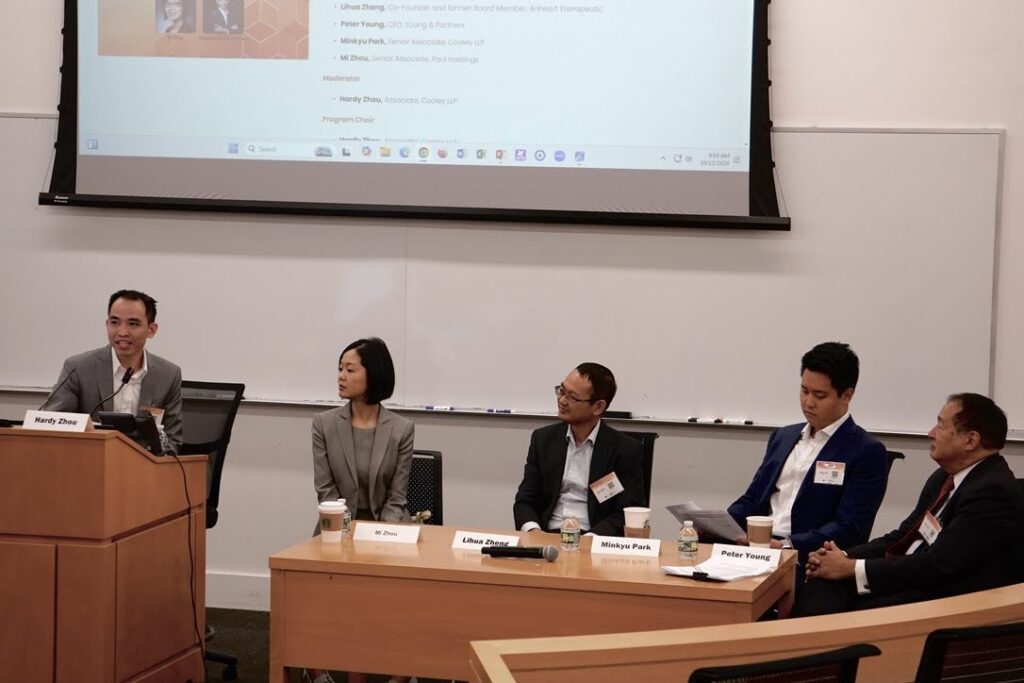
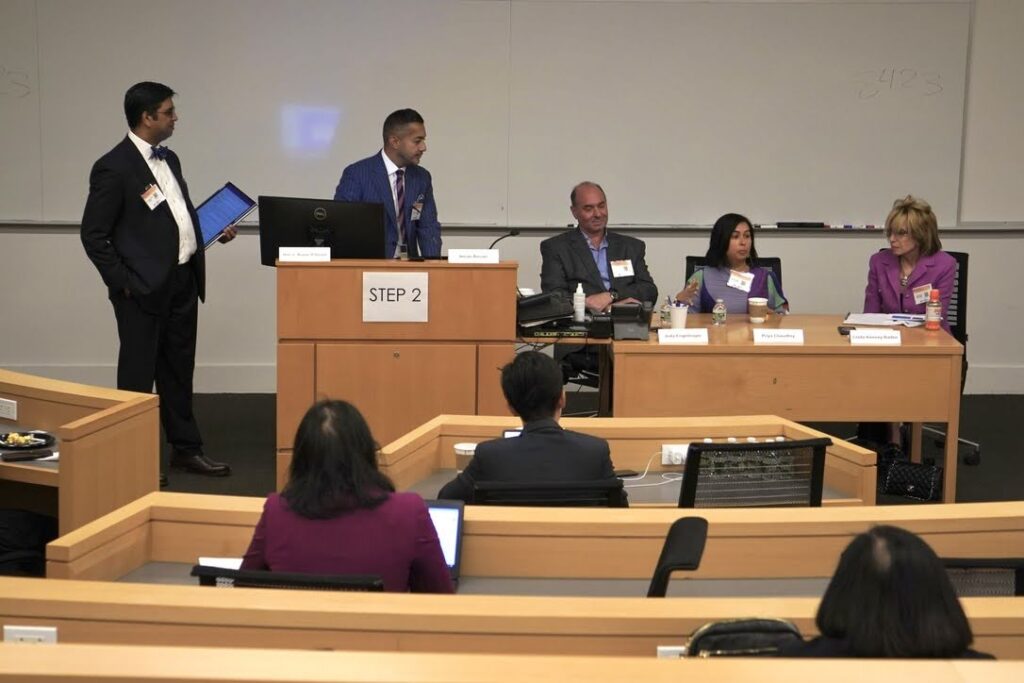
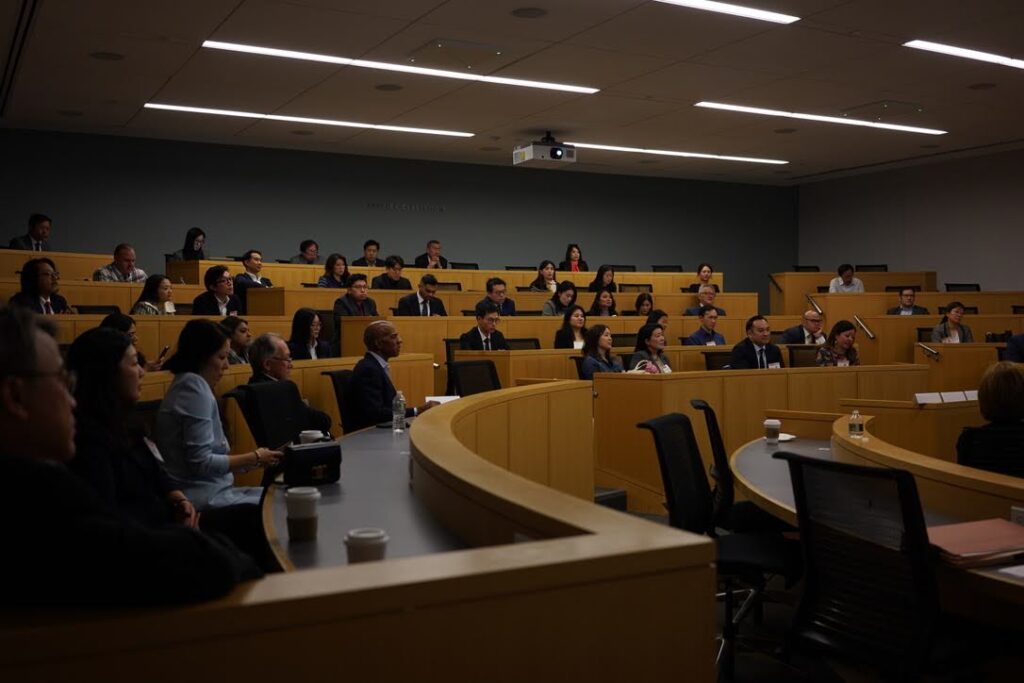
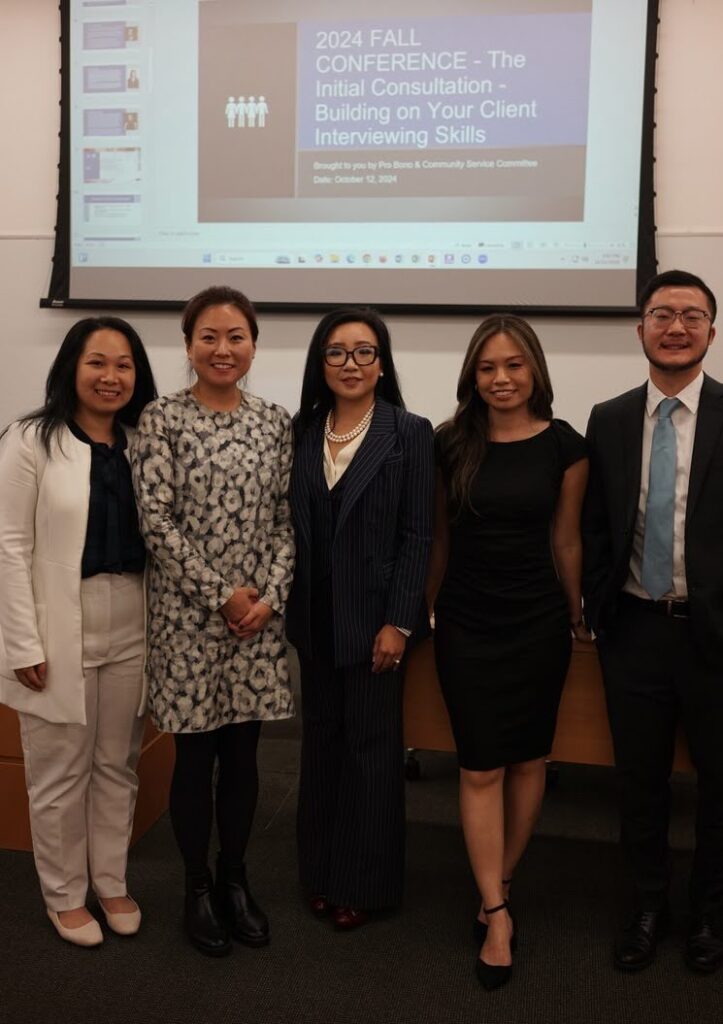
On Saturday, October 12, 2024, AABANY hosted its 15th Annual Fall Conference, “Building a Strong Foundation for a Brighter Future,” at Fordham University of Law. The Conference was co-sponsored by Fordham Law School’s Center on Asian Americans and the Law, and AABANY greatly appreciates Fordham’s support of this event.
The conference began with a buffet-style breakfast. Attendees chatted over pastries, coffee, bagels, and other assorted breakfast items, reconnecting with colleagues, while also introducing themselves to unfamiliar faces.
The first part of the morning programs began at 9:00am and ran until 10:30am, presenting upon a diversity of topics, including:
This year’s conference theme was “Building a Strong Foundation for a Brighter Future,” and the morning programs explored this topic in great detail. “Problem-Solving Courts and Person-Centered Justice,” for example, discussed the emergence and proliferation of problem-solving courts within the New York judiciary, their impacts on recidivism, and the judiciary’s vision to further expand the breadth of problem-solving courts within New York. Another program, “Artificial Intelligence in the Legal Profession: Transforming Practices and Future Trends,” considered the impact of AI and Generative AI on the legal profession. By promoting innovation, adaptability, and responsible use of AI, the program sought to foster a forward-thinking legal community.
After a 15 minute break, the second part of the morning programs, scheduled between 10:45am and 12:15pm, commenced, exploring the following topics:
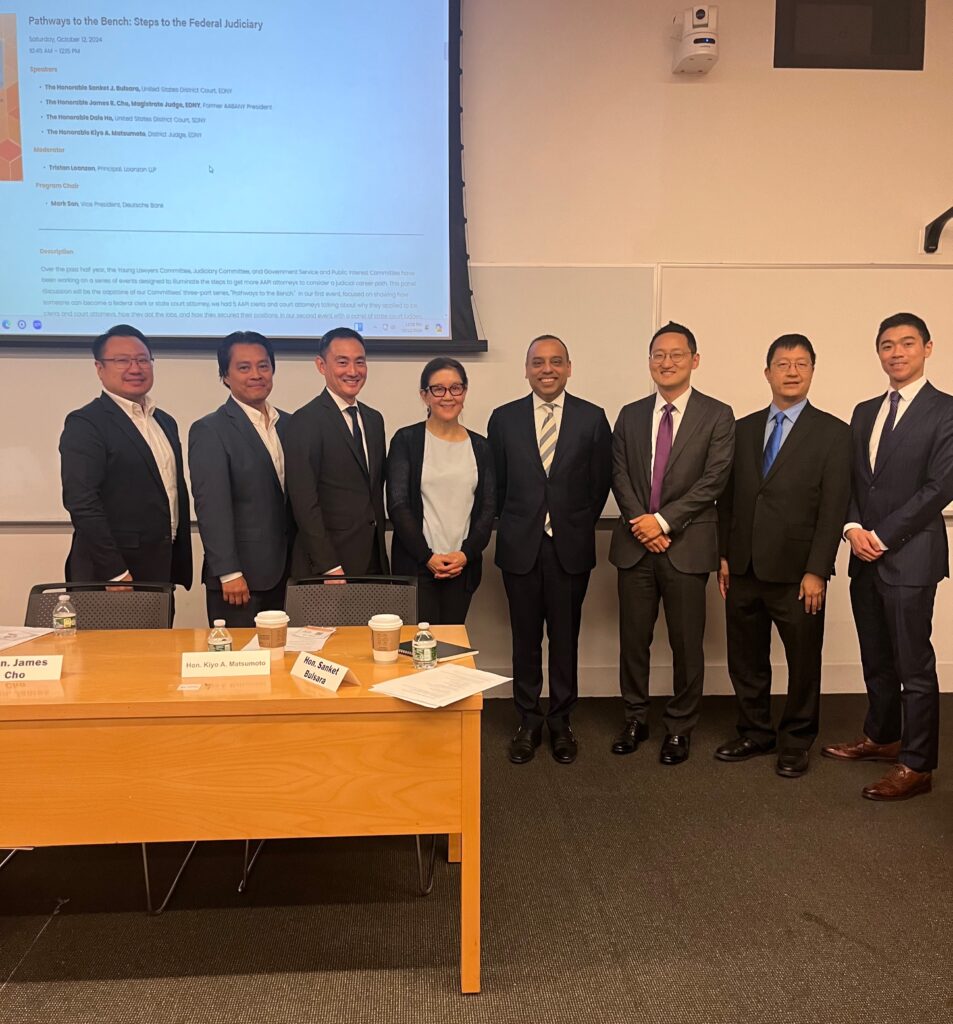
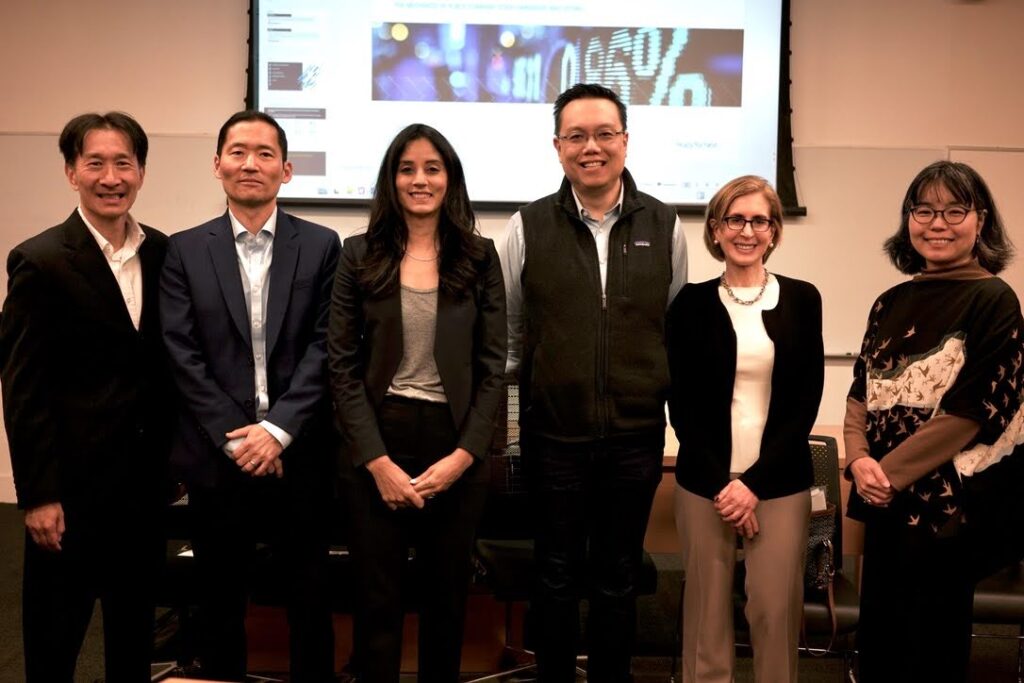
The third and final installation of AABANY’s “Pathways to the Bench” series, coordinated by the Young Lawyers Committee, Judiciary Committee, and Government Service and Public Interest Committee, was also held during the latter half of the morning session. While the first two segments of the series had focused on showing how someone can become a federal clerk or state court attorney and explaining the nuances of landing on the bench, this capstone program, titled “Pathways to the Bench: Steps to the Federal Judiciary,” centered around four AAPI judges, who each shared their particular pathways to the bench, hoping to inspire others to follow in their footsteps and to give them the tools to do so.
To see photos from the morning session please click here.
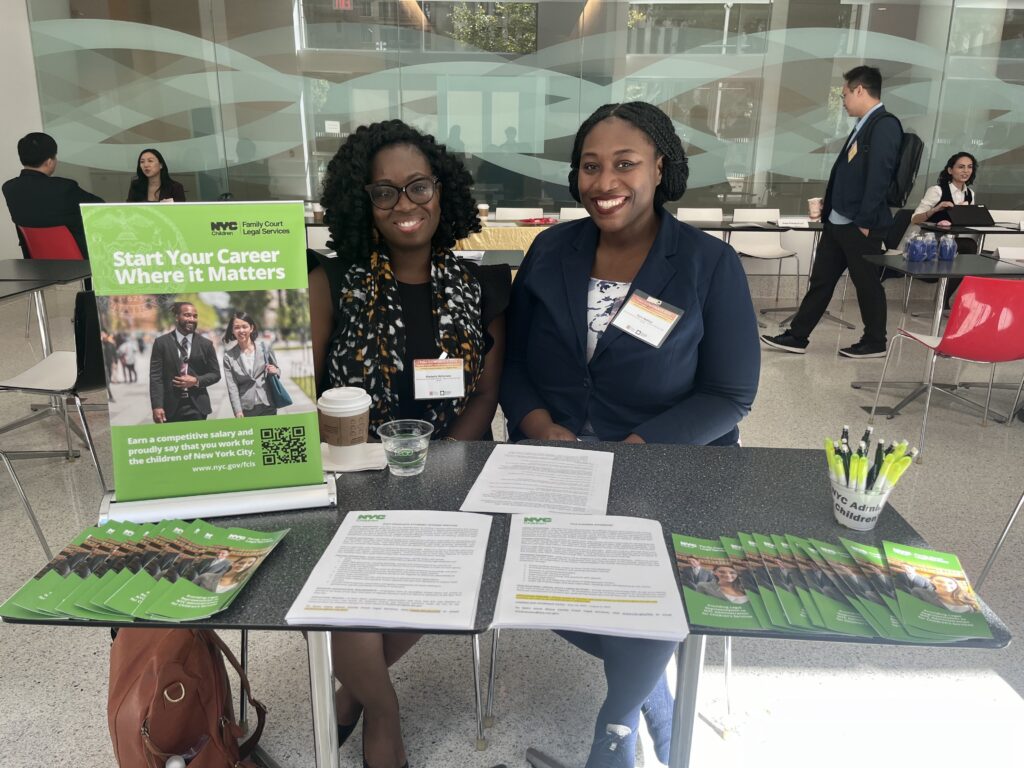
Opening at 10:30am, the Fall Conference offered its annual Diversity Career Fair, organized by the Career Advancement Committee, featuring public sector, corporate, and law firm employers, each hosting informational sessions, meet-and-greets, and more. Participating employers included the Law Firm of Hugh H. Mo, P.C., the Office of the New York State Attorney General, Rupp Pfalzgraf LLC, the U.S. Securities and Exchange Commission, and several District Attorneys’ offices. Employers and prospective employees conversed extensively, exchanging questions and learning more about one another. Some employers also collected resumes and conducted on-site first round interviews, allowing candidates to express their interest in working for participating employers. To see photos from the Diversity Career Fair, please click here.
Throughout the day, AABANY also hosted Link-Up Sessions, organized by the In-House Counsel Committee and Corporate Law Committee, which provided an opportunity for participants to engage in live meetings with in-house counsel who had indicated a current or future need for outside legal services. Applicants were pre-screened by in-house counsel based on their needs, and selected participants were then invited to join one or more Link-Up Sessions at the Fall Conference. These sessions facilitated connections between corporate law firm attorneys and in-house counsel.
After the morning programs concluded, attendees grabbed lunch boxes and headed to the Costantino Room, where the Plenary Lunch Session began at 12:30pm. The program, titled “Organizing to be Heard: The Importance of Redistricting and Coalition Building in the NYC Asian American Community,” featured five speakers:
Hon. Marilyn D. Go (Ret.), Commissioner, New York City Districting Commission
Zohran Kwame Mamdani, Assemblymember, New York State Assembly
Elizabeth R. OuYang, Coordinator, APA VOICE Redistricting Task Force
Grace Pyun, Acting Executive Director and General Counsel, New York City Districting Commission
John Park, Executive Director, MinKwon Center
Vishal Chander, Managing Attorney, the Chander Law Firm PC, moderated this timely and important discussion.
Attendees listened attentively as the panelists discussed the impacts of congressional, state, and local district lines on communities, ranging from their influence on election results to the distribution of government funds. They then discussed the 2020 Redistricting Cycle and how it brought into attention the importance of redistricting due to the significant growth of Asians in New York, laying out the legal framework of districting and the impacts of voting rights laws on redistricting. Being that many of the panelists played influential roles within the 2020 Redistricting Cycle, they also shared personal anecdotes and experiences from that time. With preparations for the 2030 Redistricting Cycle beginning soon, the speakers emphasized the importance of continuing to educate the community on this topic and how the AAPI community can be heard in that process. To see photos from the Plenary Lunch Session, please click here.
The afternoon session began at 2:30pm, running in two segments. The first segment went from 2:30pm to 4pm and included the following programs:
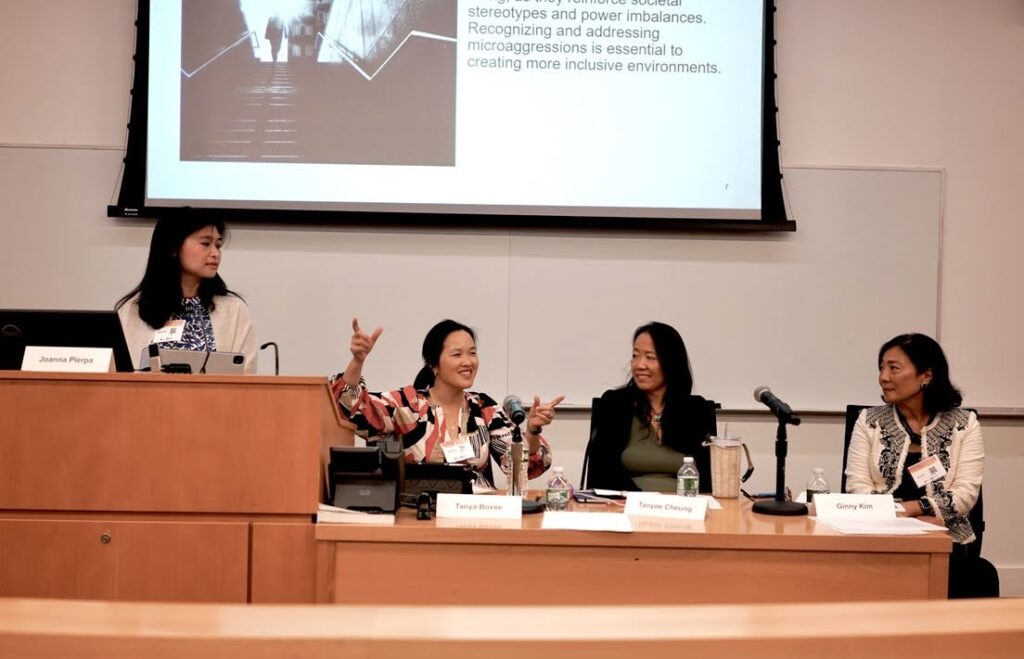
Topics covered included diversity, equity, and inclusion within the legal profession, how to interview clients, and how to understand implicit biases in the workplace. These programs exemplified the diversity of discourse that the Fall Conference sought to facilitate, providing crucial insights and exposing attendees to a broad range of ideas and perspectives. To see photos from the afternoon session, please click here.
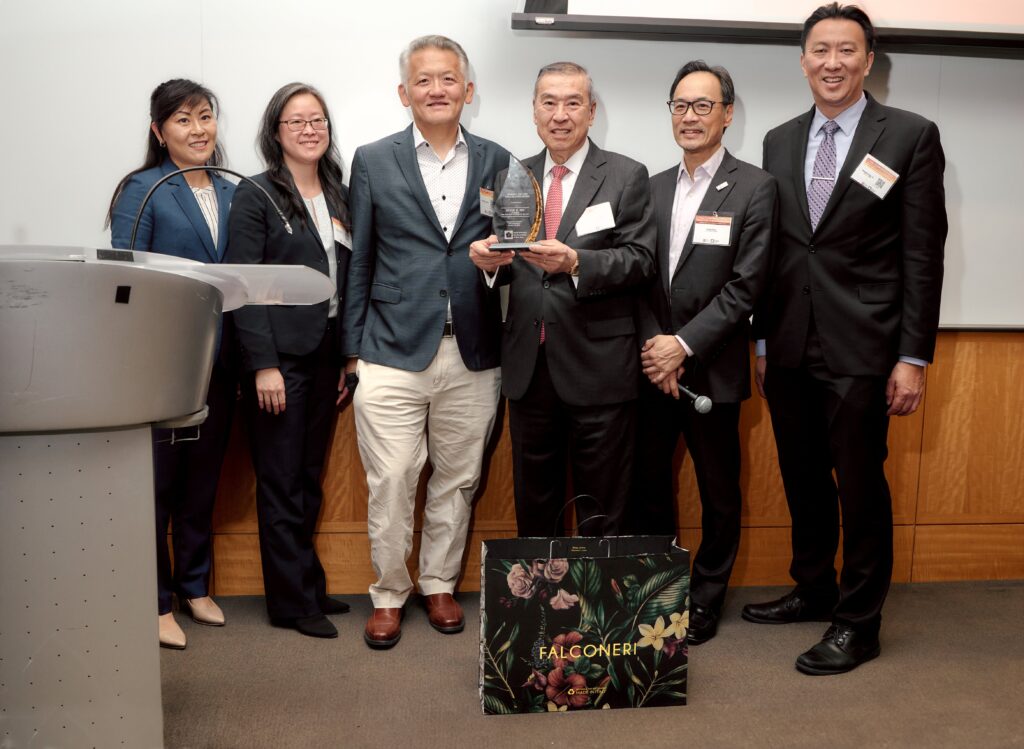
After a packed day of learning, the Fall Conference concluded with a Cocktail Reception, sponsored by Falconeri, held in the Soden Lounge and Bateman Room. Attendees networked with one another, connecting over drinks and hors d’oeuvres.
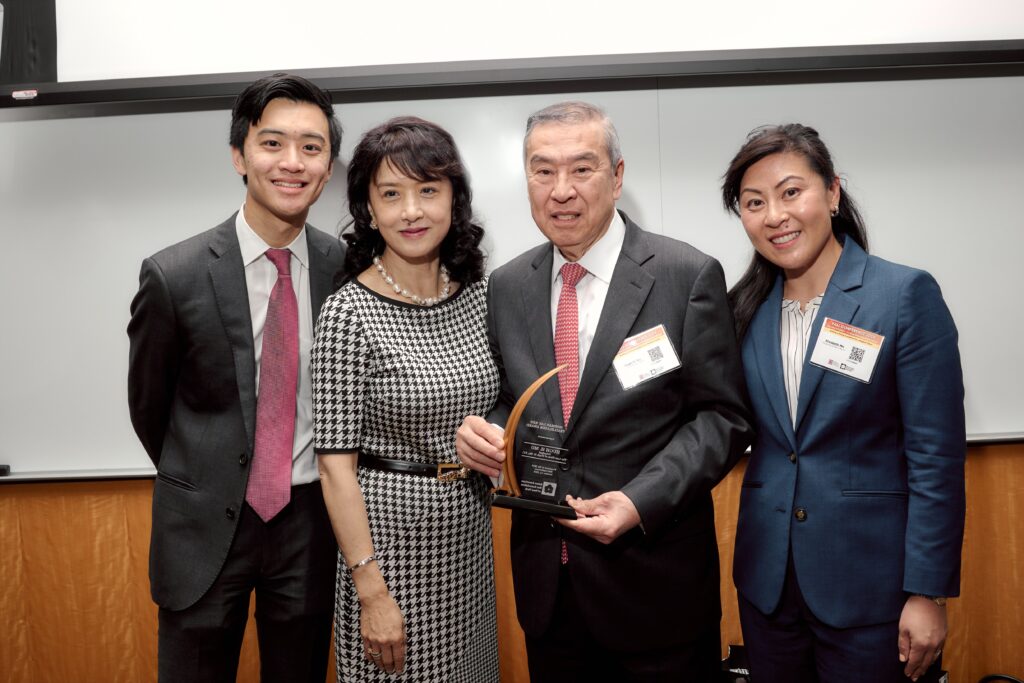
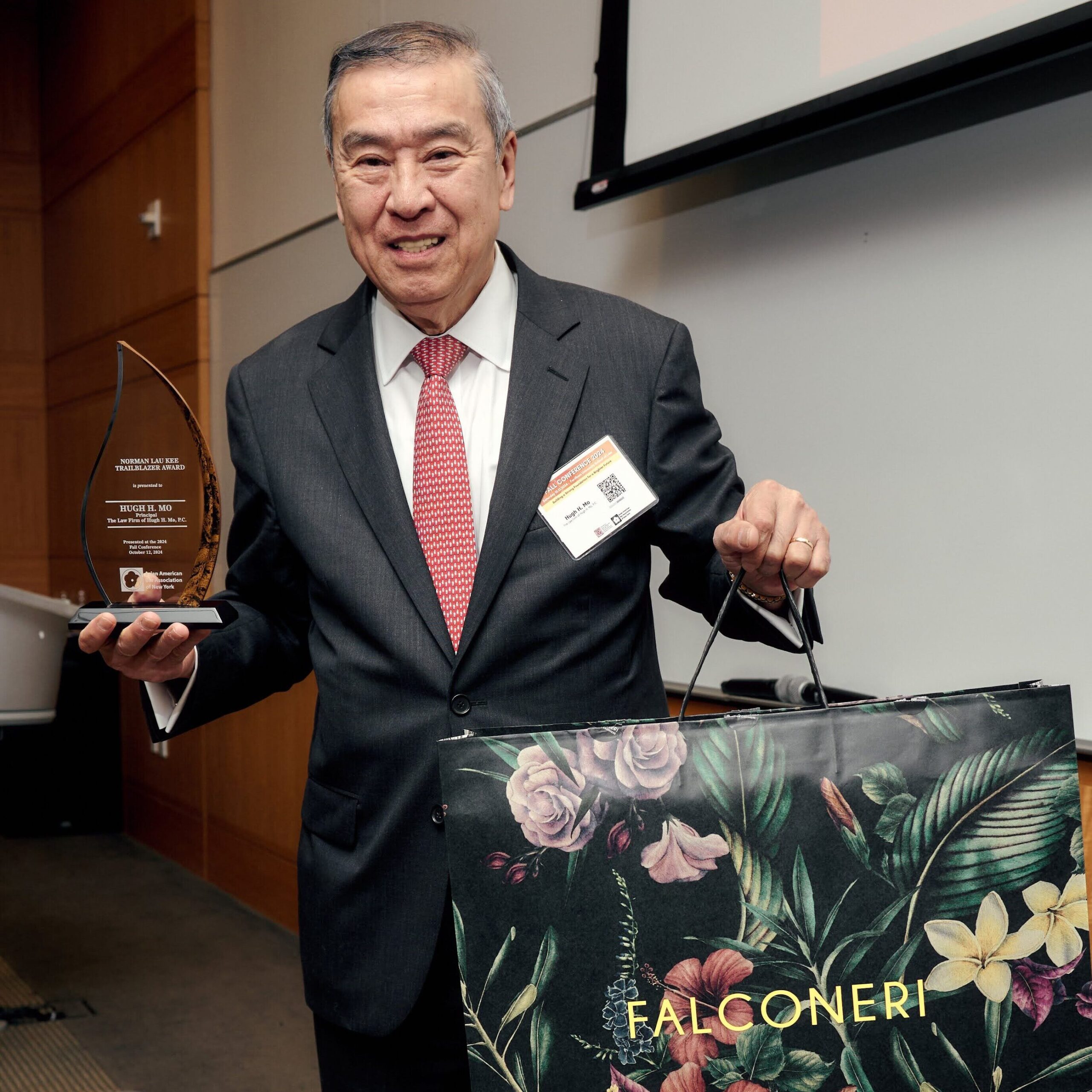
During the Cocktail Reception, AABANY honored Hugh H. Mo with the 2024 Norman Lau Kee Trailblazer Award, bestowed annually to “an individual who has carved a path for others to follow, served the community as a mentor and role model, and made a lasting impact on the AAPI community through his or her dedication and commitment.” Hugh H. Mo, Founder and Principal of Mo Law and a co-founder of AABANY, perfectly exemplifies the award’s mission, having been a leader in the AAPI community and legal profession for nearly five decades. To read the full press release about Mr. Mo receiving this honor, please click here.
To see photos from the Cocktail Reception, go here and here.
AABANY thanks several groups for making the Fall Conference possible. First, we would like to thank the approximately 40 student volunteers who ensured that the CLE programs ran smoothly and without delay. They hailed from schools all across New York City and the northeast region, including:
Brooklyn Law School
Cardozo School of Law
Columbia Law School
CUNY School of Law
Fordham College at Lincoln Center
Fordham School of Law
Hunter College
New York Law School
Northern Highlands Regional High School
Rutgers Law School
Seton Hall Law School
St. John’s University School of Law
Syracuse University College of Law
Tufts University
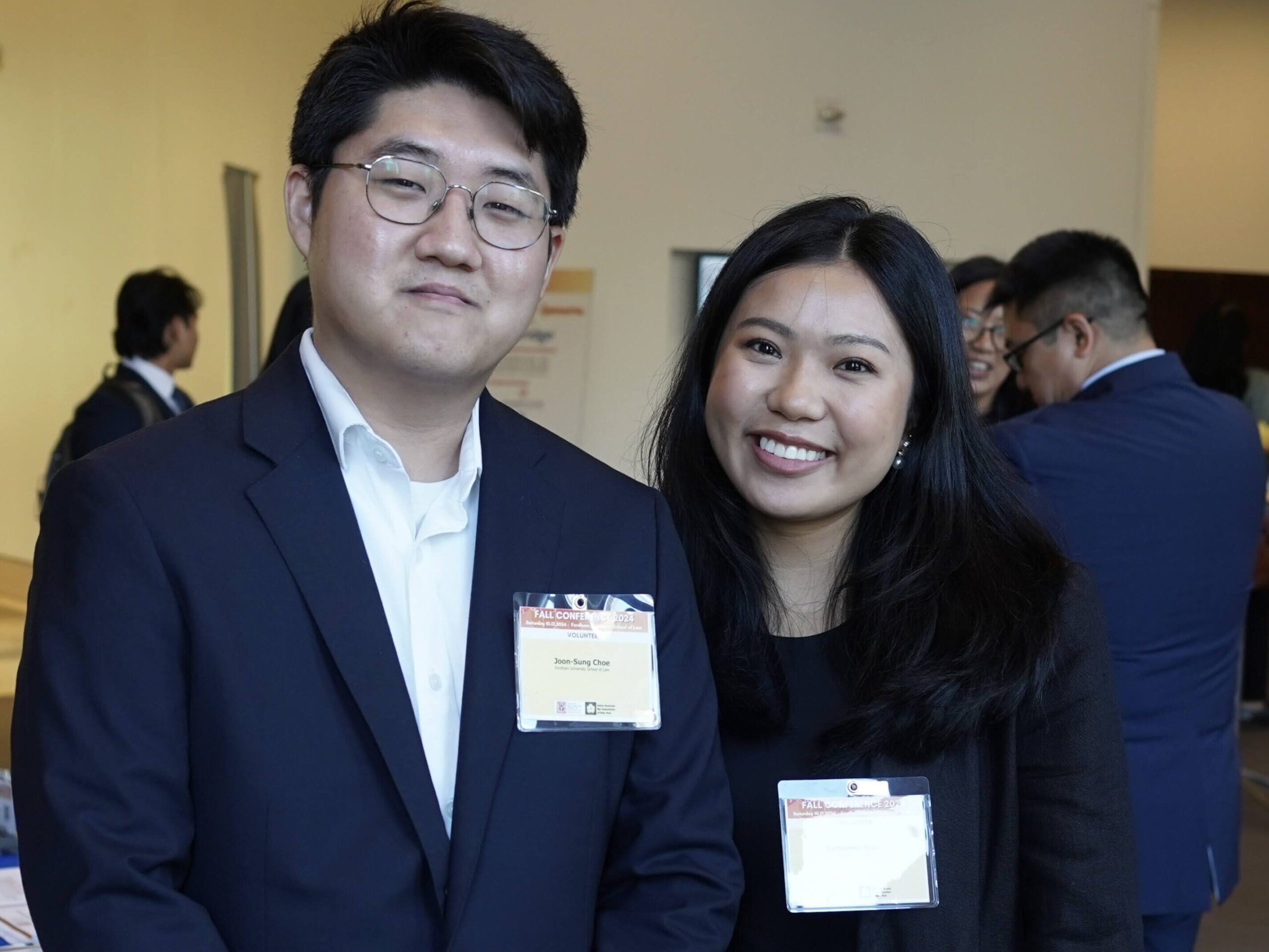
The volunteers assisted with registration, handled inquiries, and checked-in and checked-out attendees for CLE credits. Their support was instrumental in making the Fall Conference a success, and AABANY extends our heartfelt appreciation. We also thank Catherine Tran and Joon Choe, co-chairs of the Student Outreach Committee, for their efforts in recruiting and coordinating these volunteers.
AABANY also thanks our generous sponsors, without whom the Fall Conference would not have been possible:
We would also like to acknowledge our 2024 Annual Dinner Sponsors for their generous year-round support of AABANY. In particular, we would like to recognize Broadridge Financial Solutions, our Diamond Sponsor, and Groombridge, Wu, Baughman & Stone LLP, our General Counsel Reception Sponsor. For a full list of the 2024 Annual Dinner Sponsors, please click here. Thanks again for your continued support and commitment to AABANY; it empowers us to fulfill our mission and produce events like the Fall Conference.
Furthermore, AABANY thanks all of our esteemed moderators and panelists for their time and participation in this year’s Fall Conference. We also extend our gratitude to the Program Chairs for organizing such an excellent lineup of programs. And, finally, we sincerely appreciate all the attendees for making this such a special and enlightening experience for the entire AABANY community. We hope to see you at upcoming AABANY events.
WASHINGTON – Today, the National Asian Pacific American Bar Association (NAPABA) submitted a written statement for the record to the United States Senate Judiciary Committee that highlighted the dangers of divisive, reckless rhetoric and called on leaders to guard against the continuing demonization of immigrants and communities of color. During the Committee’s hearing on September 17, 2024, entitled, “A Threat to Justice Everywhere: Stemming the Tide of Hate Crimes in America,” a senator baselessly accused one of the witnesses, Maya Berry, an Arab American civil rights leader, of supporting foreign terrorist organizations. Despite the witness clearly and repeatedly stating that she did not support such organizations, the senator continued to interrogate her relentlessly.
“We have seen this playbook before, unfortunately, and members of the Asian American, Native Hawaiian, and Pacific Islander (AANHPI) community are no stranger to such offensive, differential treatment solely because of their national origin or religion,” observed Anna Mercado Clark, President of NAPABA. “For example, in this same Committee nine months ago, Adeel Mangi, a nominee to be a judge of the U.S. Court of Appeals for the Third Circuit, also endured hostile treatment based solely on his religion. Our national leaders must do better to avoid dangerous rhetoric, which can lead to horrific results in our communities if left unchecked.”
Especially in this political season, NAPABA’s statement called on leaders to “avoid the reckless rhetoric” and on all Americans to “unite in common cause to tackle our Nation’s problems together.”
### The National Asian Pacific American Bar Association (NAPABA) represents the interests of over 80,000 Asian Pacific American (APA) legal professionals and nearly 90 national, state, and local APA bar associations. NAPABA is a leader in addressing civil rights issues confronting Asian American, Native Hawaiian, and Pacific Islander communities. Through its national network, NAPABA provides a strong voice for increased diversity of the federal and state judiciaries, advocates for equal opportunity in the workplace, works to eliminate hate crimes and anti-immigrant sentiment, and promotes the professional development of people of all backgrounds in the legal profession.
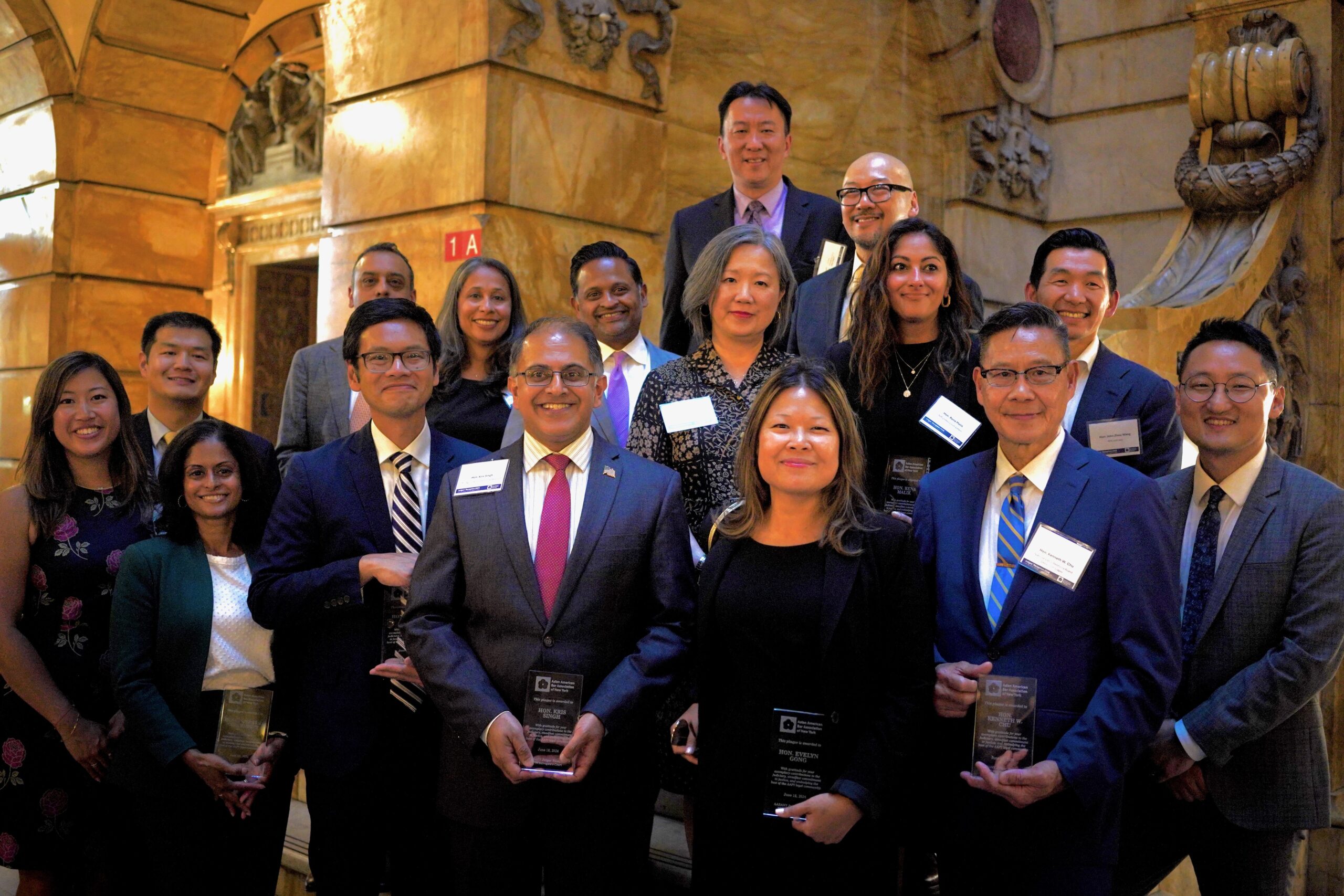
On Tuesday, June 18th, 2024, at the 2024 Annual Judges’ Reception,AABANYs Judiciary Committee honored eighteen newly elected, elevated, or retired AAPI judges, each of whom are incredible trailblazers and represent continuing progress in the ongoing effort to increase AAPI representation in our courts.
The Judiciary Committee’s flagship event was hosted in the main hall of New York City’s Surrogate’s Court. Between sky-reaching pillars, and under the vaulted arch-ceiling the following eighteen judges were recognized and celebrated for their work, effort, and example:
Hon. Deepa Ambekar (Kings Co. Sup. Ct.)
Hon. Sanket J. Bulsara (United States District Court, EDNY)
Hon. Nusrat J. Choudhury (United States District Court, EDNY)
Hon. Kenneth W. Chu (ret. ALJ, NLRB)
Hon. Christopher J. Exias (Rockland Co. Fam. Ct.)
Hon. Evelyn Gong (Queens Co. Civ. Ct.)
Hon. Dale E. Ho (United States District Court, SDNY)
Hon. Phillip Hom (App. Term, 2d Dept)
Hon. Gilbert C. Hong (ret. NY Co. Sup. Ct.)
Hon. Biju J. Koshy (Supervising Judge, Richmond Co. Crim. Ct.)
Hon. Karen Lin (Queens Co. Sup. Ct.)
Hon. Rena Malik (Kings Co. Civ. Ct.)
Hon. Kim Parker (Court of Claims)
Hon. Kris Singh (Admin. Judge, 4th Jud. Dist.)
Hon. Rantideva Singh (NYC Fam. Ct.)
Hon. Richard Tsai (NY Co. Sup. Ct.)
Hon. Vikram S. Vilkhu (Brighton Town Justice)
Hon. John Zhuo Wang (NY Co. Sup. Ct.).
The night began with introductory remarks by Committee Co-Chair Mark Son, who thanked elevated and retired judges for their service and congratulated new judges for their work which allowed them to advance to their new positions. He first praised several judges whose work has had a long-term effect and was substantially significant in making the AAPI voice in the justice system grow and prosper. He then acknowledged all other judges in attendance and expressed regret for being unable to share the breadth of their contributions in the short time allotted.
Next to take the podium was AABANY’s current President, Joseph Eng, Jr. He began by reiterating Mark’s congratulatory sentiments, then introduced the eighteen honorees. Each in turn stood up and received warm applause from the audience. President Eng stressed the significance of hosting a Judges’ Reception as far more than an isolated single annual moment, but a day of celebration culminating from decades of work, a day to remind everyone of the great strides that have been made, and all the work that lays ahead in the continued struggle for diversity, equity, and inclusion. President Eng lauded the growth of AAPI representation, while also focusing on the milestones yet to be reached for true representation, drawing attention to the lack of any AAPI judges in the state’s highest court, the Court of Appeals, and in the United States Supreme Court.
Once all the judges present came up to the front of the room to receive their awards, they gathered for a group photo with President Eng and the Judiciary Committee leadership. The deserving honorees were regaled with cheers and applause from everyone.
Hon. Shahabuddeen Ally, President of the Asian American Judges Association of New York (AAJANY), then stepped up to the podium to present final remarks. He reiterated the main points of the evening, and celebrated the effort involved in organizing this event. He congratulated the judges being honored and praised the growth of AAPI representation, even as he considered the work that remains ahead and the necessity of diligence and focus to achieve progress. He verbalized the goal of reaching 100 AAPI judges in New York State in the near future as an aspirational challenge. Finally, Committee Vice-Chair Vanessa Kong thanked everyone for attending and invited everyone to partake in the complimentary food and drink catered by Nom Wah. Laughter and stories filled the room, reflecting the camaraderie and mutual respect among the attendees.
As the evening drew to a close, it was evident that this reception was more than just an event; it was a celebration of progress, diversity, and the indomitable spirit of the AAPI community within the judiciary. The honorees left with not only memories of a joyous evening but also with the knowledge that their contributions are making a lasting impact.
We thank the Judiciary Committee for their tireless effort in making this annual event happen, as well as all the guests who attended. We thank AAJANY and Judge Ally for their participation. Once again, congratulations to all the honorees. To learn more about the Judiciary Committee please click here. To see more photos from the event, go to the album here.
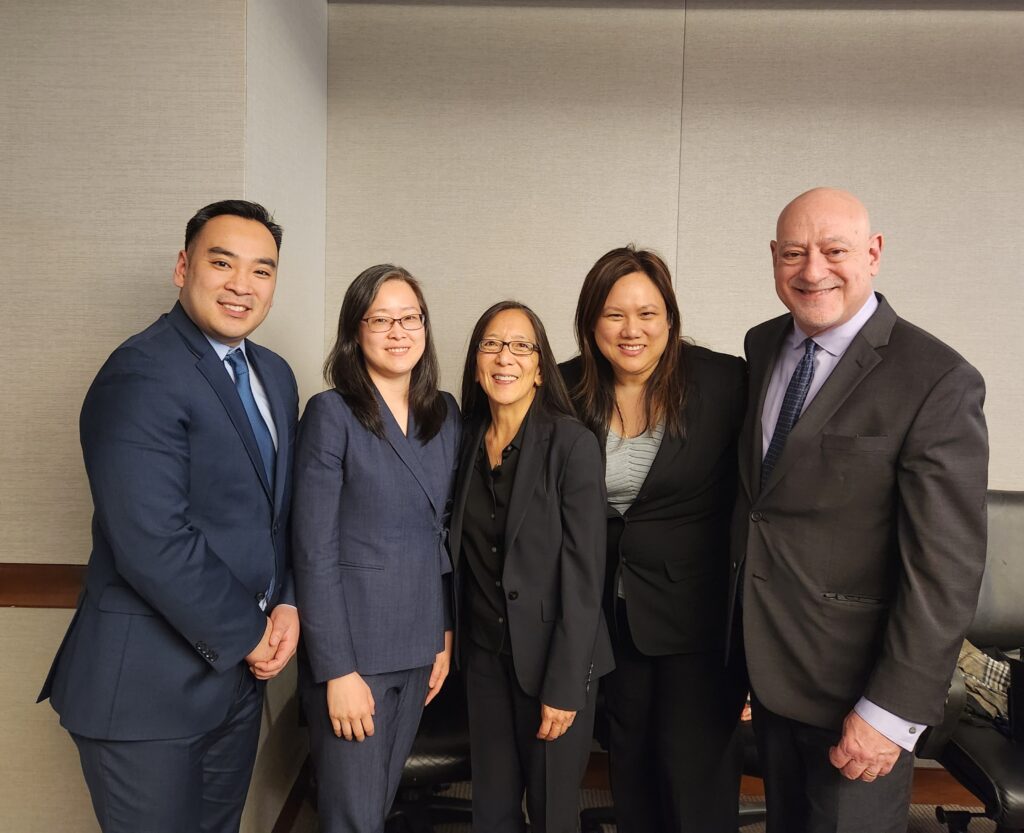
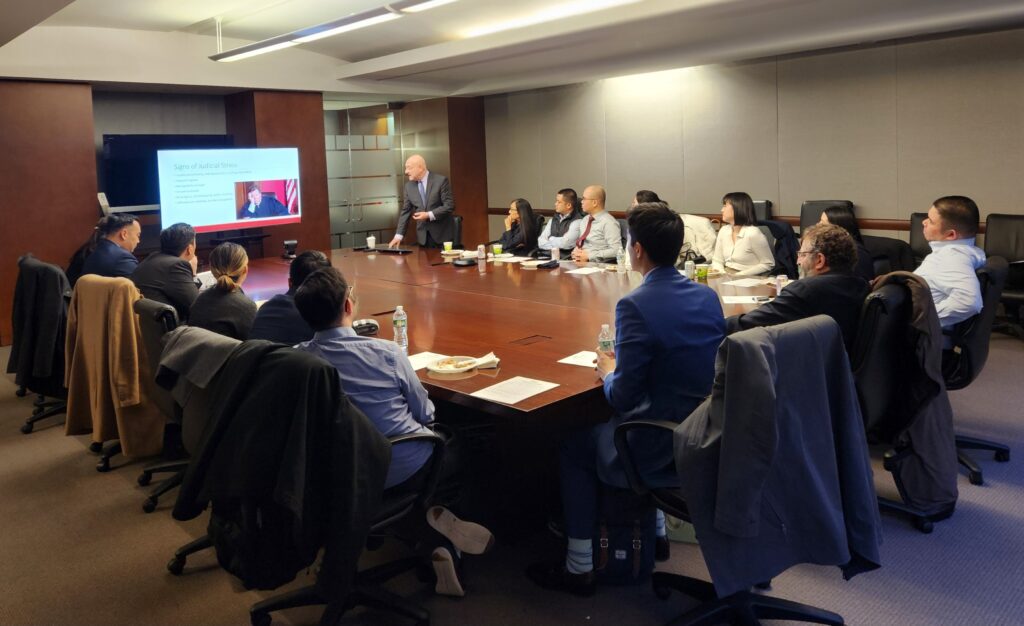
On March 20, 2024, AABANY, with thanks to AAJANY for their co-sponsorship, hosted a CLE entitled “Why Can’t We Just Get Along?” covering how judicial and attorney wellness – as well as civility and professionalism – promote good bench-bar relations, in and out of court.
Thank you to our distinguished panel for sharing their time, experiences, and perspectives:
Hon. Gerald Lebovits, New York Supreme Court, 1st Judicial District
Hon. Pamela Chen, United States District Court for the Eastern District of New York
Karen R. King, Partner, Morvillo Abramowitz Grand Iason & Anello PC
William H. Ng, Shareholder, Littler Mendelson P.C. (Immediate Past President of AABANY, FY24)
Recognizing the stress and responsibilities of judges, as well as litigators, the panel discussed why some judges and attorneys are difficult and what can be done about it. The panel explored judicial and attorney preferences and pet peeves and offered strategies for judges and attorneys to enhance their litigation experience, personal well-being, and professional happiness. This program was organized in line with the theme for this fiscal year, “Embracing Wellness and Well-Being: Strengthening the Legal Profession by Investing in Ourselves.”
Thank you to AABANY’s Judiciary and Litigation Committees for co-presenting this event and to Karen King and Morvillo Abramowitz Grand Iason & Anello PC for hosting. Attendees enjoyed lively discussions and networking, together with great food from Joe’s Shanghai. To learn more about the Judiciary Committee go here. To learn more about the Litigation Committee go here.
If you have ideas for programs or speakers on the topic of wellness and well-being, please contact Immediate Past President Karen Kim at [email protected]. AABANY’s Wellness Resources Guide provides a variety of information, including links to free assistance programs, trainings and hotlines, which can be accessed here.