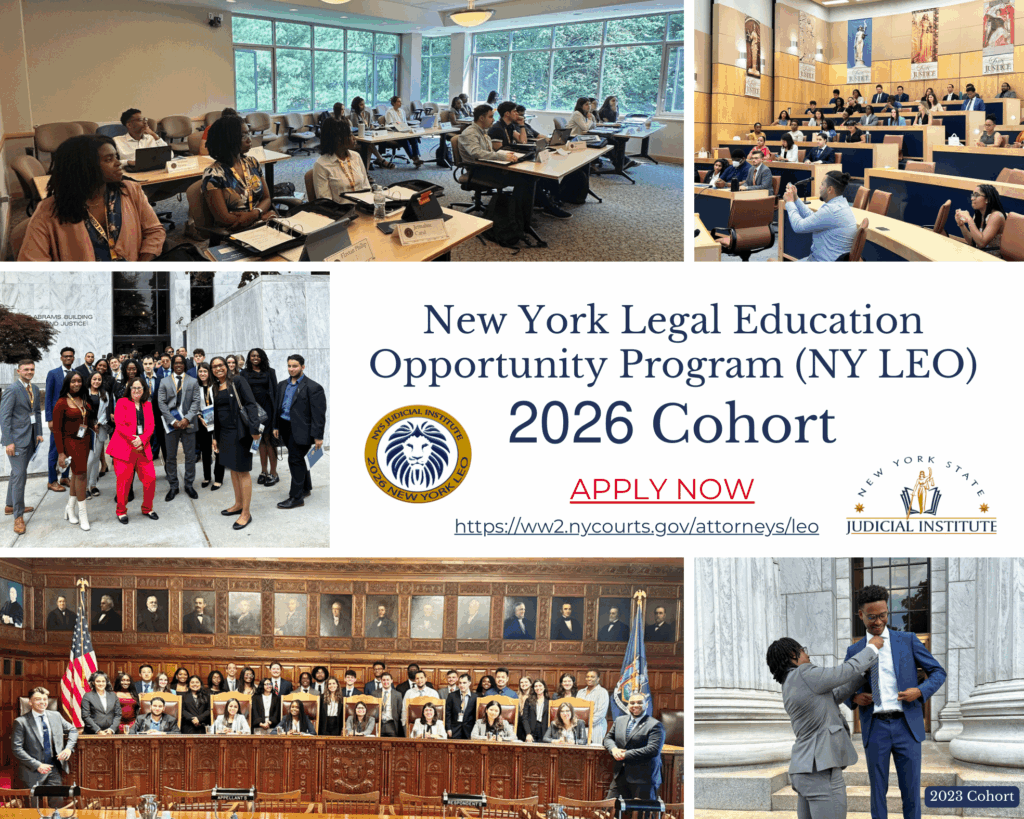
The New York Legal Education Opportunity Program is designed to prepare students entering law school with the tools needed for academic success in law school. Through an intense five-week summer program, NY LEO assists college graduates in acquiring the fundamental and practical skills necessary to succeed in law school. The NY LEO Program is administered by the Honorable Kathie E. Davidson, Dean of the New York State Judicial Institute and Salihah R. Denman, J.D., LL.M., Director of NY LEO. All classes and activities are administered and implemented at the New York State Judicial Institute. Students live on the Judicial Institute’s campus and participate in the program full-time. Experienced law professors provide instruction in first-year law school core courses as well as in legal research, writing and analysis. As part of the program, NY LEO Fellows will also have the opportunity to visit courts in session and meet with members of the judiciary and other legal professionals.
Since 2007, the NY LEO Program has assisted college graduates who are from groups traditionally underrepresented in the law in acquiring the fundamental and practical skills necessary to succeed in law school. The program is available to qualified candidates who are residents of New York State.
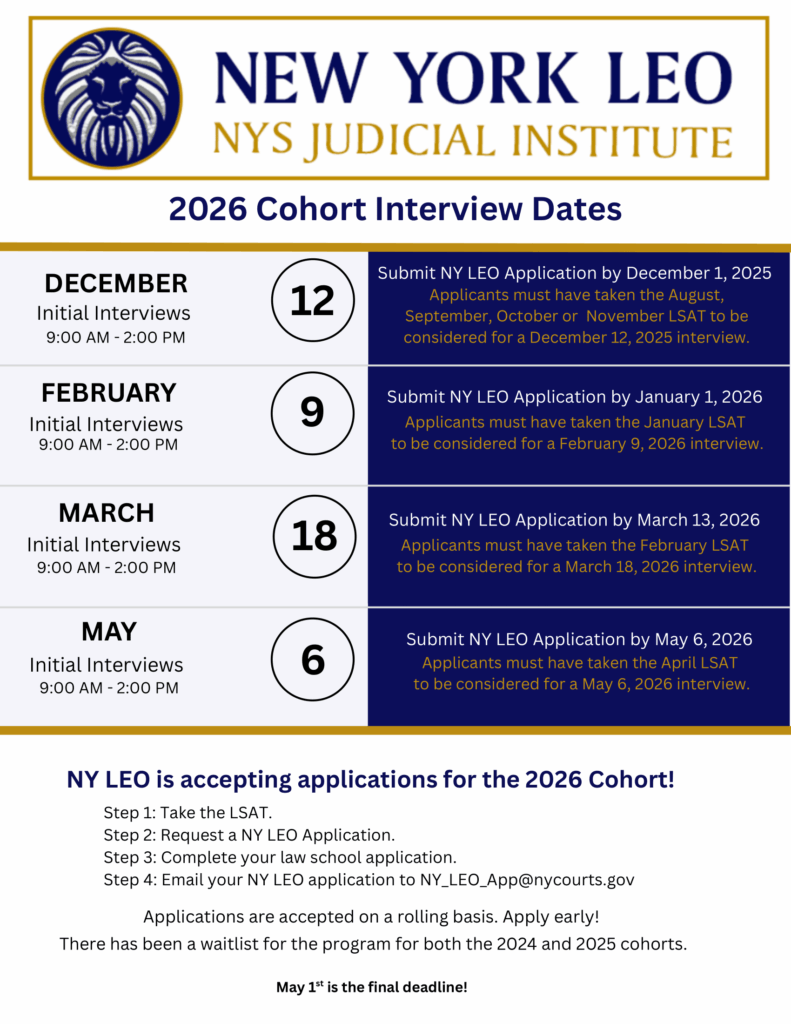
The December 1st and January 1st deadlines have passed, but please see below for the spring dates of Cohort Interviews and their application deadlines:
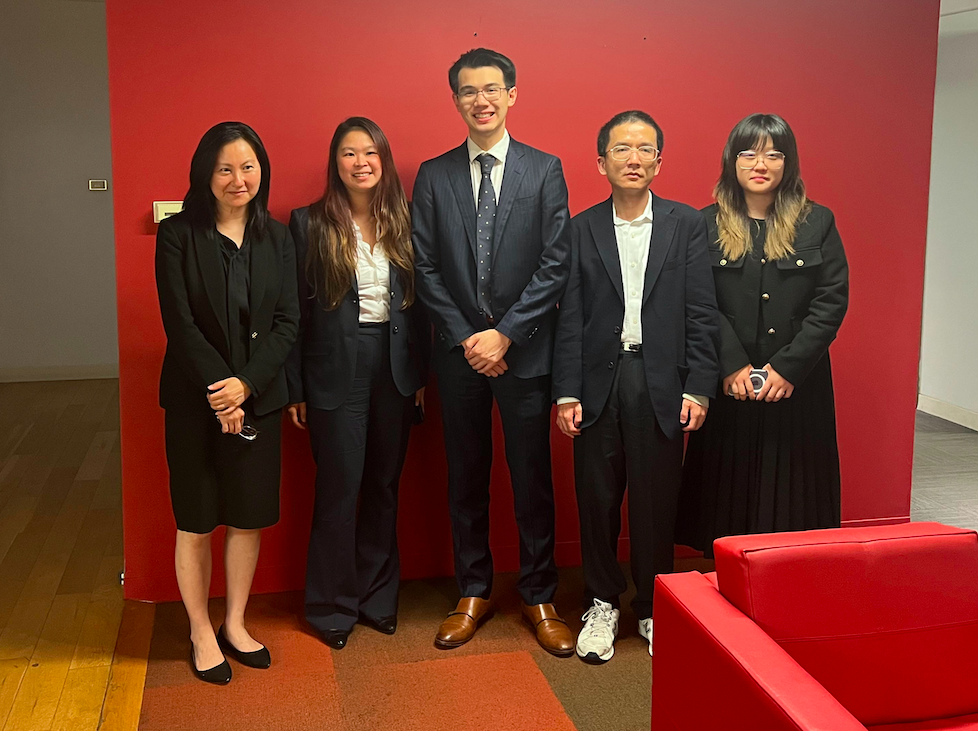
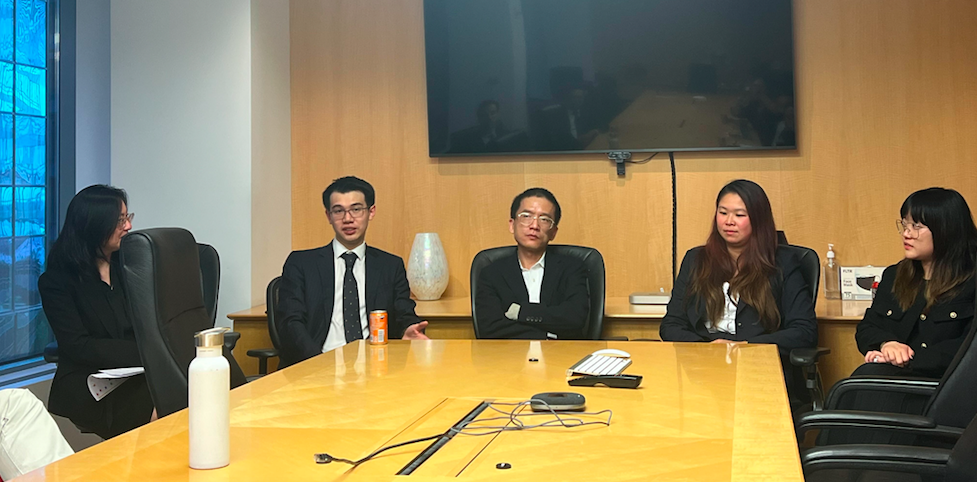
On Thursday, June 6, 2024, AABANY’s Solo & Small Firm Practice Committee held a panel on how to thrive as a first generation lawyer. Moderated by Committee Co-Chair Yen-Yi Anderson, panelists Michelle Yang, Jasper Wong, Karen Eng, and Minyao Wang shared their experiences in choosing law school, preparing for the LSAT and bar exams, as well as detailing the struggles and victories that arose from their individual circumstances.
Before the panel discussion began, guests enjoyed delicious complimentary Korean food and various beverages.
When discussing how they first dreamed of becoming attorneys, panelists’ answers varied from as simple as wanting to make their parents––who often held grueling jobs with long hours and little pay––understand that their sacrifice was indeed worth it, to as lighthearted as having really enjoyed Phoenix Wright: Ace Attorney, a law video game. Mr. Wang mentioned the stability he hoped being a lawyer would bring, and both he and Ms. Eng discussed having explored related subjects like history, government, international relations, and social sciences that eventually led them to pursuing law. Despite all of the panelists’ shared identity as first-generation lawyers, the variety of motivations, choices, and experiences that inspired each of them to enter the industry was most striking.
When answering how to succeed in studying for the LSAT and within law school after it, panelists were admirably honest and treated the guests, mostly college students or recent college graduates, to a real picture of what their future could be. The panelists generally agreed that law school had been difficult in a way they had each never experienced, especially during 1L, and how they had to change their habits to succeed. Ms. Yang and Mr. Wang began to study independently without peers and friends, while Mr. Wong altered his time management and developed new skills to focus and study, and Ms. Eng recommended taking classes where students would have a high level of motivation and passion.
The panel then ended with a short Q & A with guests. Asked about the pressure of being part of a family adjusting to a new country, Ms. Eng and Mr. Wong agreed that their parents’ determination and steadfast intent had been integral in instilling a certain grit that helped them persevere through the challenges of law school and the legal profession. During the Q & A, Ms. Yang recommended investing in paid tutoring for LSAT and bar exams, though Mr. Wang shared that it was indeed possible to self-study given enough time and focus. Ms. Yang and Mr. Wong had both attended law school for periods during the Covid pandemic and discussed how it had been incredibly isolating, and Ms. Eng mentioned the feelings of imposter syndrome that developed during times of struggle in law school, each emphasizing to the attendees that these feelings were valid and common.
Thank you to the Solo and Small Firm Practice Committee for organizing this event, Ms. Anderson for moderating, and thank you to all the panelists for their wonderful insight and candor. To learn more about AABANY’s Solo & Small Firm Practice Committee please click here.
This series, co-sponsored by more than a dozen leading test prep companies, was created to provide prospective law students with information on everything from preparing for the LSAT through being successful in the first year of law school. The program includes LSAT Preview Classes by five leading test prep companies – as well as panels with admissions representatives and law students from regional law schools and a Networking Fair with free classes and material giveaways.
Scholarship assistance will be provided as needed.