
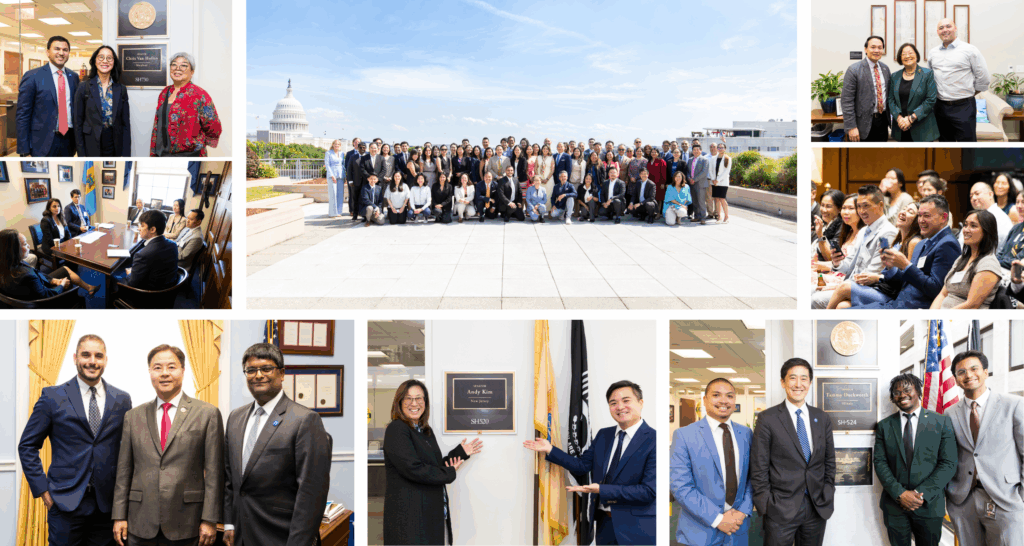
NAPABA Annual Lobby Day and Congressional Reception on May 19-20 in Washington, D.C.

NAPABA hosted its annual Lobby Day on May 19-20, 2026, bringing together members of their community from across the country to Washington, DC in a celebration and demonstration of the power of their bar during AANHPI Heritage Month. In meetings with congressional representatives and their staffers, attorneys, law students, and leaders from the NAPABA community advocated for advancing the civil rights of the AANHPI community, a fair immigration system, and defending the rule of law.
Highlights of Lobby Day Include:

Robust Representation

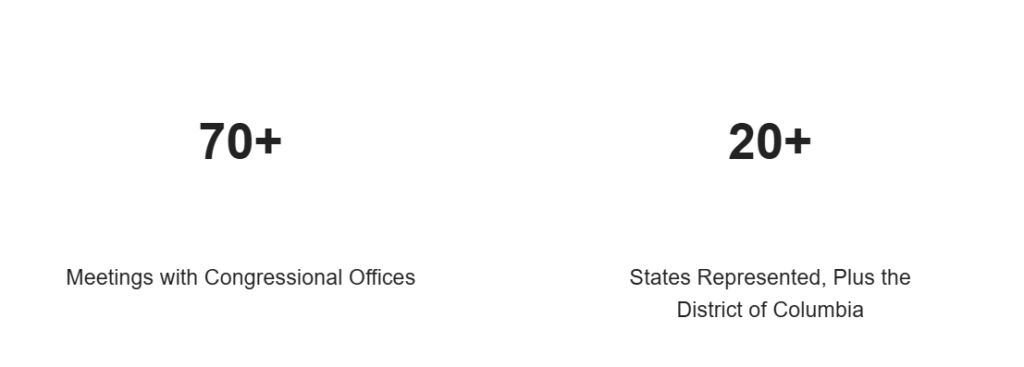
With participants hailing from over 20 states, and the District of Columbia, taking part in over 70 meetings with congressional offices on both sides of the aisle, NAPABA demonstrated its strength and its commitment to amplifying AANHPI voices in the halls of power.

Advocacy Training
Prior to the meetings, NAPABA held a training session featuring congressional staffers from both sides of the aisle who spoke with both expertise and passion about the bills their members have introduced or sponsored.  Attendees also heard from advocacy veterans on strategies and techniques to more effectively communicate NAPABA’s priorities and the needs of AANHPI communities and the legal profession.

Policy Priorities
Throughout multiple meetings, participants advocated for issues of importance to AANHPI communities and the legal profession. They focused on codifying longstanding language access protections for the millions of limited English proficient persons in the United States, including the significant portions of the Asian American immigrant populations, as documented by the U.S. Commission on Civil Rights. NAPABA stood up for access to counsel at various stages of the immigration and entry processes to the United States, and for judicial security in order to better support the rule of law.

Meaningful Engagements
Attendees met with numerous lawmakers and their staff, fostering meaningful dialogues, and building relationships that will be instrumental in advancing policy objectives. NAPABA Lobby Day participants skillfully articulated their positions, presented compelling arguments, and shared personal stories to humanize the issues that they face. On the evening before their training at their Congressional Reception on Capitol Hill, participants heard from leaders in their community directly, including NAPABA Trailblazers Sen. Mazie Hirono (HI) and S.E.C. Commissioner Mark T. Uyeda.

In a time of great uncertainty and a rapidly shifting policy landscape, NAPABA demonstrated the power of its members during a Lobby Day built around a unifying agenda of language access, a sensible and fair immigration system and support for the rule of law. Member-constituents braved the heat to visit engage with key Congressional offices across the Capitol complex and called on their elected representatives to support policies that advance their communities.  Lobby Day is another great reminder that NAPABA is the national voice of the AANHPI legal community, and that we can stand together for the betterment of our communities, for the rule of law we have dedicated our livelihoods to, and for the nation we cherish.

Visit NAPABA’s Advocacy Page here.

View NAPABA’s Organizational Statements here.

Organizational Statement | NAPABA Offended by Fox News Segment in Chinatown – National Asian Pacific American Bar Association

Organizational Statement | NAPABA Offended by Fox News Segment in Chinatown – National Asian Pacific American Bar Association

Organizational Statement | NAPABA Denounces Donald Trump’s Racist Attacks on Judges


Organizational Statement

For Immediate Release
June 7, 2016

                                                  For More Information, Contact:
                                                  Brett Schuster, Communications Manager
                                                  bschuster@napaba.org, 202-775-9555

NAPABA Denounces Donald Trump’s Racist Attacks on Judges

The National Asian Pacific American Bar Association (NAPABA) denounces Donald Trump’s recent remarks accusing Judge Gonzalo Curiel of partiality because he is of Mexican descent. Judge Curiel, who was born in Indiana to Mexican immigrant parents, currently serves on the United States District Court of the Southern District of California. Mr. Trump has claimed that Judge Curiel should be disqualified from adjudicating a case to which Mr. Trump is a party because Judge Curiel is “Mexican” and because Mr. Trump believes that his support of the building of a wall along the U.S.-Mexico border creates “an inherent conflict of interest” with the judge. Mr. Trump later expanded his position to include Muslim judges, whom Mr. Trump believes would be unable to preside fairly over cases to which he is a party because of his public policy positions.

Judges should not be accused of unfair bias because of their race, ethnicity, national origin, or religion. When Donald Trump questions the independence, fairness, and impartiality of a judge simply because he is the son of immigrants or adheres to a particular religion, he sends a strong message to the American people against diversity in the judiciary and he undermines public trust in the rule of law.

“NAPABA has never endorsed a Presidential candidate, and does not intend to do so this year,” said NAPABA President Jin Y. Hwang. “We speak out against Donald Trump because his remarks calling into question the ability of judges to be fair and impartial based on their ethnic background or religion are contemptible. This critique is not about politics — it is about fundamental respect for the judicial branch and those who serve in it. The fact that the comments came from a Presidential campaign podium only serves to make the comments even more disturbing — and dangerous.”

Unfortunately, similar charges have been made against respected Asian Pacific American jurists. In MacDraw Inc. v. CIT Group Equipment Financing Inc., 138 F.3d 33 (2d Cir. 1998), lawyers criticized Judge Denny Chin for alleged bias due to his ethnicity. Fortunately, the reviewing court condemned the charges and Chief Judge Ralph Winter of the Second Circuit Court of Appeals — one of the most respected jurists ever appointed to the federal bench by President Ronald Reagan — made clear that the race of a judge is an impermissible basis for attacking a judge’s impartiality, and even went so far as to approve sanctions against the attorneys by forbidding them from ever appearing again in federal court in New York.

As the national representative of Asian Pacific American lawyers and judges, NAPABA strongly rejects the notion that judges of diverse backgrounds are unable to fulfill their Constitutional duties in a fair and impartial manner. Asian Pacific American judges from varied and different backgrounds ably serve as fair and impartial jurists who are dedicated to the fair application of the rule of law in the United States and they should not be subjected to speculative and unfounded attacks based on their race, ethnicity, national origin, or religion.

For more information, the media may contact Brett Schuster, NAPABA communications manager, at202-775-9555 or bschuster@napaba.org.


The National Asian Pacific American Bar Association (NAPABA) is the national association of Asian Pacific American attorneys, judges, law professors, and law students. NAPABA represents the interests of approximately 50,000 attorneys and approximately 75 national, state, and local Asian Pacific American bar associations. Its members include solo practitioners, large firm lawyers, corporate counsel, legal services and non-profit attorneys, and lawyers serving at all levels of government.

NAPABA continues to be a leader in addressing civil rights issues confronting Asian Pacific American communities. Through its national network of committees and affiliates, NAPABA provides a strong voice for increased diversity of the federal and state judiciaries, advocates for equal opportunity in the workplace, works to eliminate hate crimes and anti-immigrant sentiment, and promotes the professional development of people of color in the legal profession.

To learn more about NAPABA, visit www.napaba.org, like us on Facebook, and follow us on Twitter (@NAPABA).