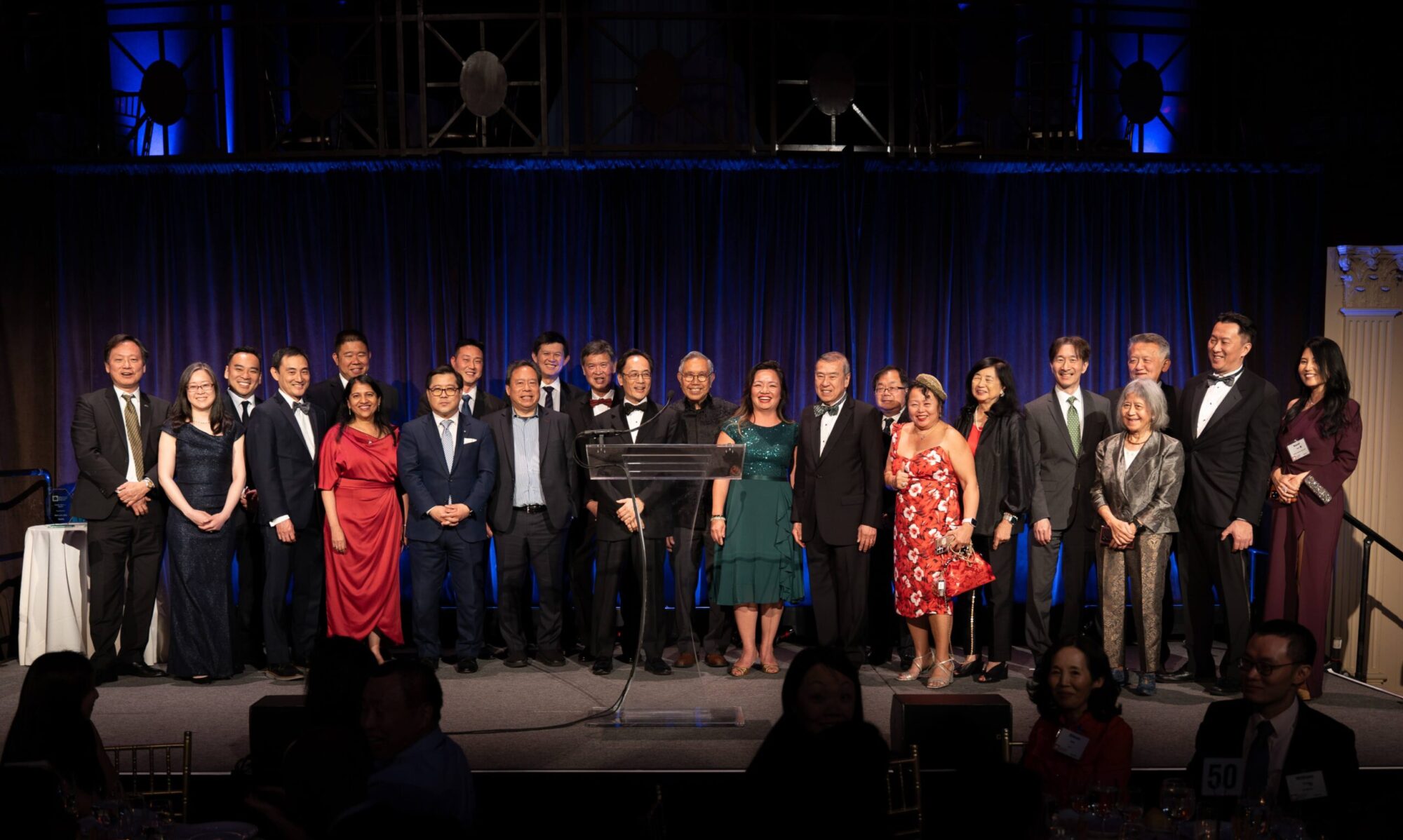

AABANY Presents “Born American: United States v. Wong Kim Ark” at Cadwalader, Wickersham & Taft LLP

As Asian American, Native Hawaiian, and Pacific Islander Heritage (AANHPI) Month wound down, attendees gathered on May 27, 2026 in downtown Manhattan to watch the latest historical trial reenactment produced by the Asian American Bar Association of New York (AABANY) entitled Born American: United States v. Wong Kim Ark.

United States v. Wong Kim Ark, which established birthright citizenship as a Constitutional right in 1898, is AABANY’s 17th trial reenactment. This project brings to life notable cases involving Asian Americans, Native Hawaiians and Pacific Islanders, to spotlight significant ways that AANHPI individuals contributed to the legal, social, and political history of the United States. Reenactments are first performed at the National Asian Pacific American Bar Association (NAPABA) Convention in November, then again in May during AANHPI Heritage Month in New York. 

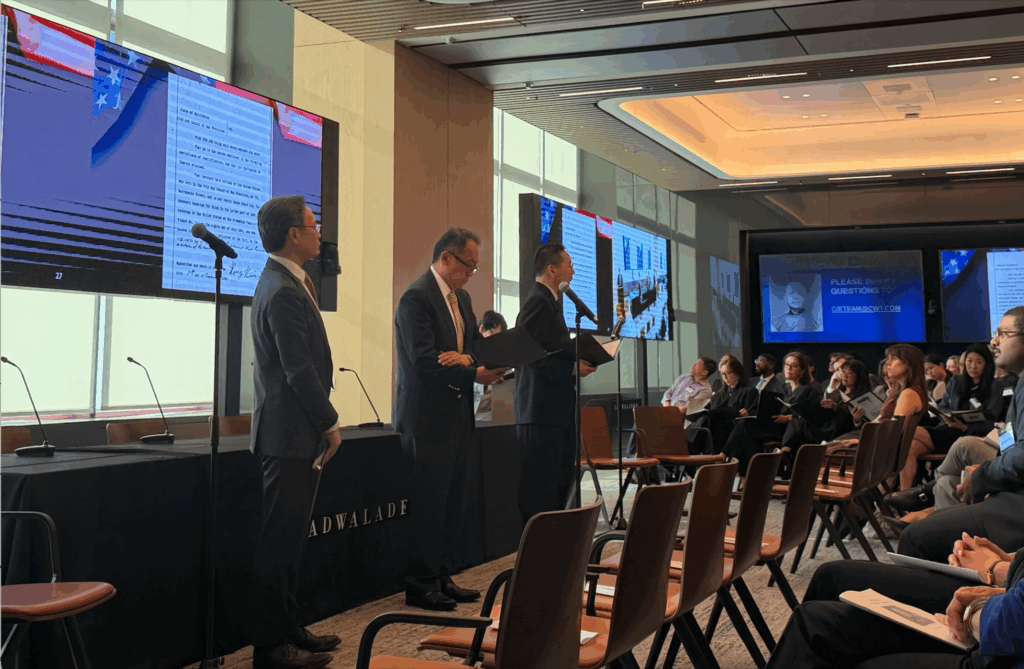
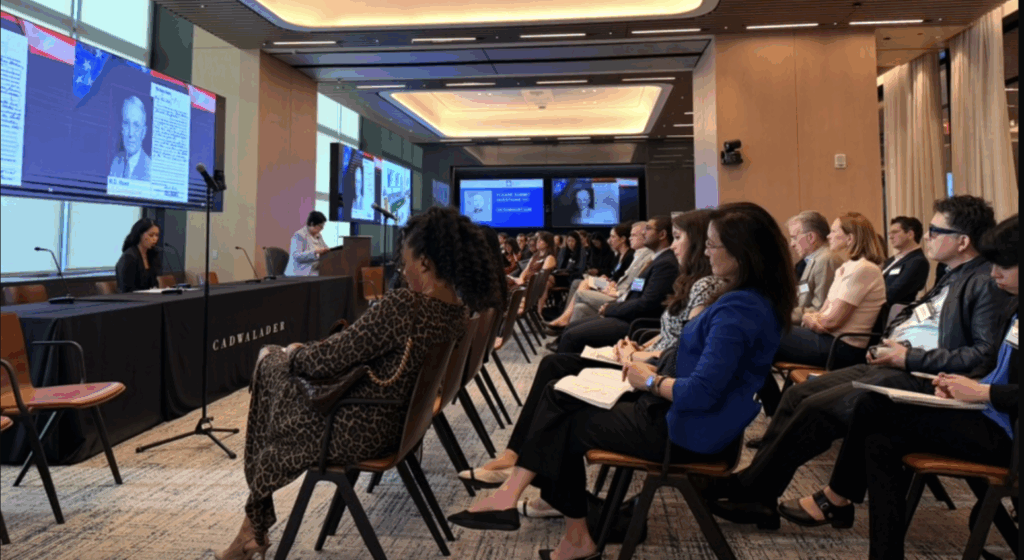
AABANY’s latest trial reenactment made its New York debut at Cadwalader, Wickersham & Taft LLP. Attendees settled in to watch a cast of 37 characters played by some 17 lawyers, including many AABANY members.

The reenactment had two narrators, who are also the writers, producers, and leaders of the AABANY Trial Reenactment team: Hon. Denny Chin, Senior United States Circuit Judge for the U.S. Court of Appeals for the Second Circuit, and Kathy Hirata Chin, a retired Partner of Crowell & Moring LLP and previously a retired Cadwalader Partner.

Other cast members included:

Anna Mercado Clark, Phillips Lytle LLP, Partner and Chief Information Security Officer (past NAPABA President, former AABANY Board Officer)

Vincent T. Chang, Law Clerk for Hon. James d’Auguste, Supreme Court, New York County, Commercial Division (former AABANY President)

Andrew T. Hahn, Hawkins, Delafield & Wood LLP, General Counsel (former AABANY, KALAGNY, and NAPABA President)

Yasuhiro Saito, Saito Law Group PLLC, Managing Partner

Francis H. Chin, Opensity Solutions, Senior Systems Engineer (AABANY Membership Director)

Yang Chen, Asian American Bar Association of New York, Executive Director (former AABANY President)

Pamela K. Chen, United States District Judge, Eastern District of New York

Concepcion A. Montoya, Hinshaw & Culbertson, Partner

Lauren U.Y. Lee, Korean American Family Service Center, Board of Directors; Cadwalader, Wickersham & Taft LLP, former Special Counsel

Kiyo A. Matsumoto, Senior United States District Judge, Eastern District of New York

Rose Cuison Villazor, Rutgers Law School, Professor of Law and Chancellor’s Social Justice Scholar

Jacob Chen, DGW Kramer LLP, Litigation Partner

Jane Kim, Wigdor LLP, Partner; former clerk for Hon. Denny Chin

Janicelynn Asamoto Park, Proskauer Rose LLP, Partner; former clerk for Hon. Denny Chin

Jessica C. Wong, Cadwalader, Wickersham & Taft LLP, Special Counsel
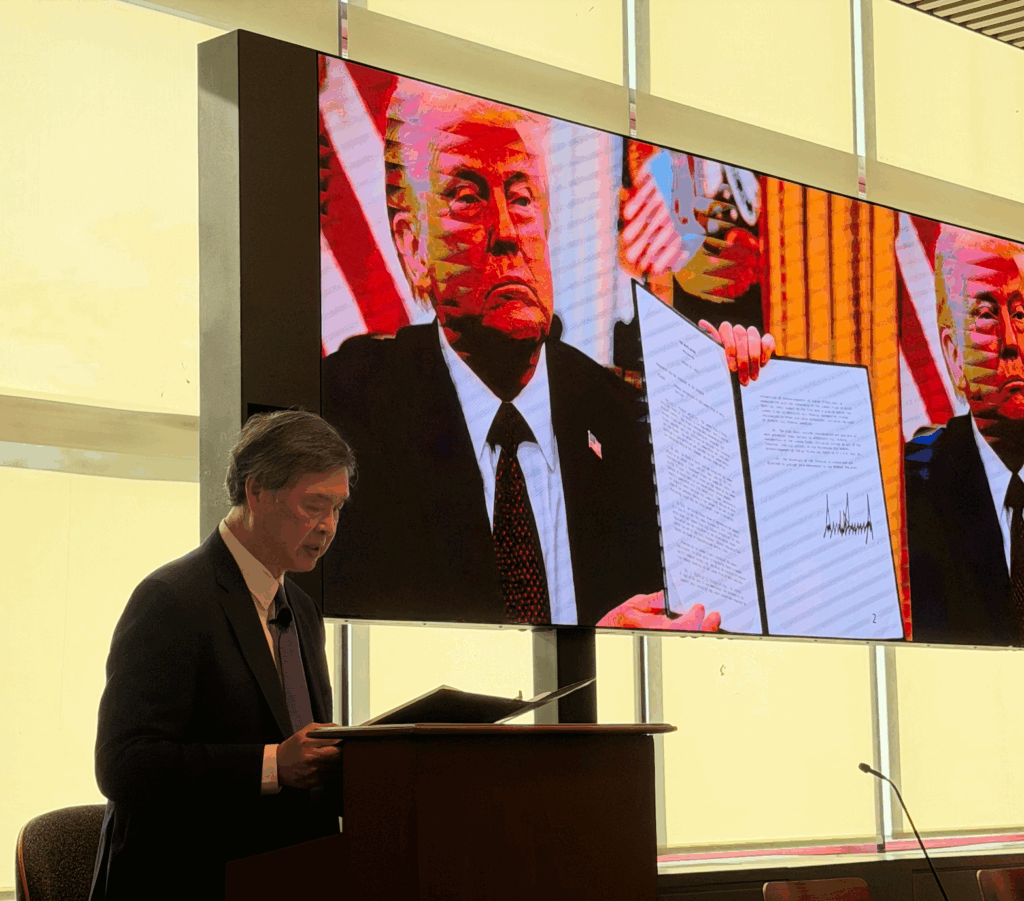
This reenactment was bookended by the case’s connection to current events. The narrators described President Donald Trump’s January 2025 Executive Order 14160, “Protecting the Meaning and Value of American Citizenship,” which sought to remove birthright citizenship from US-born children of parents who are undocumented or in the country temporarily. 

This case follows the story and life of Wong Kim Ark, who was born in San Francisco to Chinese immigrant parents in 1870, one of only 518 ethnic Chinese born in the United States that year. Wong took multiple trips back to China, before returning to America in 1894, at which point he was denied entry on the grounds of not being a citizen. 

That denial was appealed all the way to the United States Supreme Court. The question before the Court was whether Wong should follow the citizenship of his parents or of where he was born. The reenactment reconstructed the Supreme Court argument, for which no transcript exists, using the briefs, the resulting court opinions, news reports, and other historical documents. Arguments revolved around whether children born in the U.S. are “subject to the jurisdiction thereof,” under its plain meaning as stated in the Fourteenth Amendment. The original intent of Congress with regard to children born to foreign-born parents, as well as the implications of barring Wong Kim Ark’s birthright citizenship upon existing immigrant communities—European immigrants—and children of other nationalities, were also explored in the reenactment.

United States v. Wong Kim Ark affirmed Wong’s citizenship in a 6-2 decision in 1898, setting a legal precedent for more than a century. The majority ruling held that the 14th Amendment’s “ancient and fundamental rule of citizenship by birth within the territory” and its “peremptory and explicit language” all made Wong an American citizen.

However, Wong’s immigration troubles did not stop there, for either himself or his children. He lived in a time when anti-Chinese sentiment was rampant. Even within the decision itself, Justice John Marshall Harlan, for the dissent, wrote that “There is a race so different from ours that we do not permit those belonging to it to become citizens of the United States.” This captures the discrimination that society had at the time towards Chinese immigrants in America.

The reenactment further explored Wong’s life, as well as his family’s, after the Supreme Court’s ruling. Wong was later arrested in 1901 upon crossing the US-Mexico border, though the case was eventually dismissed—because of United States v. Wong Kim Ark. His four sons, born in China, faced intense scrutiny when they sought to come to the United States seeking citizenship as sons of a U.S. citizen. They faced heightened suspicion and interrogation that stretched over weeks or months of detention and aimed to determine their familial relationship to Wong, a form of scrutiny common to Chinese immigrants in the early 20th century. 

The end of the reenactment returned to Trump’s executive order. The many lawsuits and preliminary injunctions that responded to Trump’s January order make frequent reference to United States v. Wong Kim Ark as well-settled precedent for birthright citizenship. The reenactment shares the responses to Trump’s Executive Order, including one from Judge Deborah Boardman in Maryland, who said that the executive order “conflicts with the plain language of the 14th Amendment [and] contradicts 125-year old binding Supreme Court precedent.”

In this context, it becomes vitally important to revisit Wong Kim Ark’s life and times. Amid the prevalence of anti-immigrant rhetoric during the 1890s, United States v. Wong Kim Ark set precedent for generations of immigrants, including Asian Americans, and was reaffirmed throughout a series of 20th century Supreme Court cases, including INS v. Errico, 385 U.S. 214 (1966) and Plyler v. Doe, 457 U.S. 202 (1982).

A discussion panel and Q&A session followed the reenactment, where questions of relevance to current times were at the forefront. Attendees questioned and discussed how America would change if birthright citizenship gets overturned. Mere months ago, the Supreme Court heard oral arguments for Barbara v. Donald J. Trump, the class action against President Trump’s executive order banning birthright citizenship. It was especially enlightening to hear Judge Chin talk about how putting together this reenactment made him understand his own family’s immigration history better and shined a light on often unspoken parts of the Chinese immigrant experience.

The reenactment highlighted the reaction from Wong Kim Ark’s great-grandson Norman Wong. Norman said in an interview for a documentary, “We thought [birthright citizenship] was a dead issue. These were rights we did not have to fight for anymore. It wasn’t something that anybody would have to worry about. … Now I’m glad [my great-grandfather] stood up.” 
Following the reenactment, guests and participants enjoyed a networking and dinner reception, which included hors d’oeuvres, a dinner buffet, and a delicious handroll bar. Attendees mingled as they ate, reflecting on the reenactment and congratulating the actors for a job well done.

AABANY’s reenactment of United States v. Wong Kim Ark will be made available on AABANY’s trial reenactment website, where the script and materials can be shared upon request. AABANY’s past trial reenactment scripts are also available upon request. In fact, our most popular reenactment, “The Murder of Vincent Chin,” has been performed over 30 times globally. 

We are grateful to all of the participants in the reenactment for dedicating their time to this project. To learn more about the other trial reenactments AABANY has organized, please visit our reenactments website.

NAPABA Applauds the Confirmation of Judge John Truong to the Superior Court of the District of Columbia

For Immediate Release: January 15, 2026
Contact: Rahat N. Babar, Deputy Executive Director

WASHINGTON – The National Asian Pacific American Bar Association (NAPABA) congratulates Judge John Truong on his confirmation to serve as an Associate Judge on the Superior Court of the District of Columbia.

“Judge John Truong is a talented and experienced litigator who has deep ties to the D.C. legal community,” said Joseph Yao, President of NAPABA. “With a long career in public service, coupled with his leadership in the community – including as a former president of the Asian Pacific American Bar Association of the Greater Washington, D.C. Area (APABA-DC) and a recipient of the NAPABA Best Under 40 Award in 2009 – Judge Truong will be an exceptional addition to the court that serves the Nation’s capital city.”

Prior to his confirmation, Judge Truong was Deputy Chief in the Civil Division of the U.S. Attorney’s Office for the District of Columbia, where he prosecuted fraud and misconduct cases. He has previously represented federal officials and agencies in civil litigation, prosecuted criminal offenses, and practiced at Morgan, Lewis & Bockius LLP. Judge Truong also taught as an Adjunct Professor at George Washington University Law School. He clerked for Judge Ricardo M. Urbina of the U.S. District Court for D.C. and holds a B.A. from the University of Southern California, an M.A. from American University, and a J.D. from American University’s Washington College of Law.

“Judge Truong is a role model for our legal community. His professional achievements reflect the values that NAPABA works to advance every day,” said Priya Purandare, Executive Director of NAPABA. “We are confident that Judge Truong will continue to serve the community with distinction in this important role.”

NAPABA thanks President Trump for the nomination and the U.S. Senate for its confirmation of Judge Truong.

NAPABA Congratulates Eric Tung on His Confirmation to the U.S. Court of Appeals for the Ninth Circuit

For Immediate Release:
November 7, 2025
Contact:
Rahat Babar
Deputy Executive Director

WASHINGTON — The National Asian Pacific American Bar Association (NAPABA) proudly congratulates Eric Tung on his confirmation to the United States Court of Appeals for the Ninth Circuit. His elevation to the federal appellate bench marks a significant achievement—both for Eric Tung and for the Asian American, Native Hawaiian, and Pacific Islander (AANHPI) legal community.

“We are pleased to see Judge Tung ascend to the Ninth Circuit,” said NAPABA President Joseph Yao. “His extensive record as a public servant, appellate litigator, and former Department of Justice official demonstrates a deep commitment to the administration of justice. Having qualified AANHPI attorneys in lifetime judicial roles helps ensure our judiciary reflects the diversity of our nation and benefits from the full range of talent in our community.”

Eric Tung is a partner in the Los Angeles office of Jones Day, where he focuses on appeals and motions practice in commercial litigation. He has briefed and argued matters in federal and state courts nationwide, including the Ninth Circuit, D.C. Circuit, Seventh Circuit, Florida Supreme Court, and the California Court of Appeals. His clients span a range of industries, including telecommunications, energy, banking, real estate, construction, entertainment, and digital currency.

“Judge Tung is the first AANHPI nominated and confirmed during President Trump’s second term,” said Priya Purandare, Executive Director of NAPABA. “Judge Tung joins the bench at a time when representation of AANHPI jurists on the federal bench remains a vital goal for NAPABA. During his first term, President Trump confirmed 13 AANHPI Article III judges. We look forward to continuing our work to advance AANHPI representation on the federal judiciary.”

Eric Tung previously served as an Assistant United States Attorney in the Central District of California and held positions at the U.S. Department of Justice in Washington, D.C., including serving as a Bristow Fellow in the Office of the Solicitor General. He also clerked for U.S. Supreme Court Justices Neil M. Gorsuch and the late Antonin Scalia.

NAPABA thanks President Trump for the nomination and the U.S. Senate for confirming him swiftly.

NAPABA Statement in Response to Justice Department Guidance Following Revocation of Language Access Guarantees

For Immediate Release:
July 18, 2025
Contact:
Rahat N. Babar, Deputy Executive
Director

NAPABA Statement in Response to Justice Department Guidance Following Revocation of Language Access Guarantees

WASHINGTON — Over four months ago, President Trump revoked Executive Order 13166 and purportedly designated English as the official language of the United States.  It marked a dramatic setback for LEP individuals, and Asian American, Native Hawaiian, and Pacific Islander (AANHPI) communities will bear the brunt of such misguided action. The National Asian Pacific American Bar Association (NAPABA) immediately condemned the revocation.

For nearly 25 years, Executive Order 13166 served as a cornerstone of the federal government’s commitment to civil rights. It required that every federal agency meet the needs of limited English proficient (LEP) individuals when it delivers critical services. It similarly required those that received federal funding, such as non-profit organizations as well as state and local governments, to guarantee that LEP individuals had meaningful access to their services.  

On July 14, 2025, the U.S. Department of Justice released guidance to implement the revocation of Executive Order 13166. It has rescinded all prior guidance to recipients of federal funding pertaining to the protections of Title VI of the Civil Rights Act of 1964 and suspended all existing LEP guidance. It emphasizes English-only operations without accounting for the need for LEP individuals to access critical, life-sustaining services.

The new guidance further deepens the harm caused by the revocation of Executive Order 13166. It undermines decades of progress to make government and federally funded programs more accessible. Rather than a core requirement for non-discriminatory compliance, the new guidance weakens the legal framework to combat national origin discrimination, which is prohibited by Title VI, and treats language access as merely discretionary.

We continue to call on Congress to engage in appropriate oversight over the Administration’s unwarranted actions and pursue legislative actions to strengthen and expand the protections of Title VI.

###

The National Asian Pacific American Bar Association (NAPABA) represents the interests of over 80,000 Asian Pacific American (APA) legal professionals and over 90 national, state, and local APA bar associations. NAPABA is a leader in addressing civil rights issues confronting Asian American, Native Hawaiian, and Pacific Islander communities. Through its national network, NAPABA provides a strong voice for increased diversity of the federal and state judiciaries, advocates for equal opportunity in the workplace, works to eliminate hate crimes and anti-immigrant sentiment, and promotes the professional development of people of all backgrounds in the legal profession.

NAPABA Condemns President Trump’s Revocation of Language Access Guarantees for Federal Programs and Activities

NAPABA Condemns President Trump’s Revocation of Language Access Guarantees for Federal Programs and Activities

For Immediate Release:Date: March 2, 2025Contact:
Rahat N. Babar, Deputy Executive Director

WASHINGTON – For nearly 25 years, Executive Order 13166 required that every federal agency meet the needs of limited English proficient (LEP) individuals when it delivers critical services. It similarly required those that received federal funding, such as non-profit organizations as well as state and local governments, to guarantee that LEP individuals had meaningful access to their services. EO 13166 brought the full import of Title VI of the Civil Rights Act of 1964, which prohibits entities that receive federal funding from discriminating based on national origin, to life. This meant that a Mandarin-speaking LEP individual, for example, could access life-sustaining government entitlement programs or a Vietnamese speaker could receive legal services from a non-profit organization. Those guarantees are now called into question.

Yesterday, President Donald Trump revoked EO 13166 through an executive order. The brunt of setting aside EO 13166 will be borne by the Asian American, Native Hawaiian, and Pacific Islander (AANHPI) community. NAPABA unequivocally condemns this action.

The majority of the Asian American community are immigrants. Nearly 32% of the community is limited English proficient. The Asian American population is comprised of over 50 different ethnicities and speak over 100 different languages. NAPABA has long championed linguistic access for AANHPI communities in the legal system, including through our groundbreaking report, which highlighted and provided recommendations on the state of language access in federal and state courts and agencies.  

The executive order, which also purports to designate English as the official language of the United States without the consent of Congress, places an unnecessary obstacle for LEP individuals within the AANHPI community who need and deserve to access critical, federally funded services. We call on Congress to engage in appropriate oversight over the Administration’s unwarranted action and strengthen the protections of Title VI.

###

The National Asian Pacific American Bar Association (NAPABA) represents the interests of over 80,000 Asian Pacific American (APA) legal professionals and nearly 90 national, state, and local APA bar associations. NAPABA is a leader in addressing civil rights issues confronting Asian American, Native Hawaiian, and Pacific Islander communities. Through its national network, NAPABA provides a strong voice for increased diversity of the federal and state judiciaries, advocates for equal opportunity in the workplace, works to eliminate hate crimes and anti-immigrant sentiment, and promotes the professional development of people of all backgrounds in the legal profession.