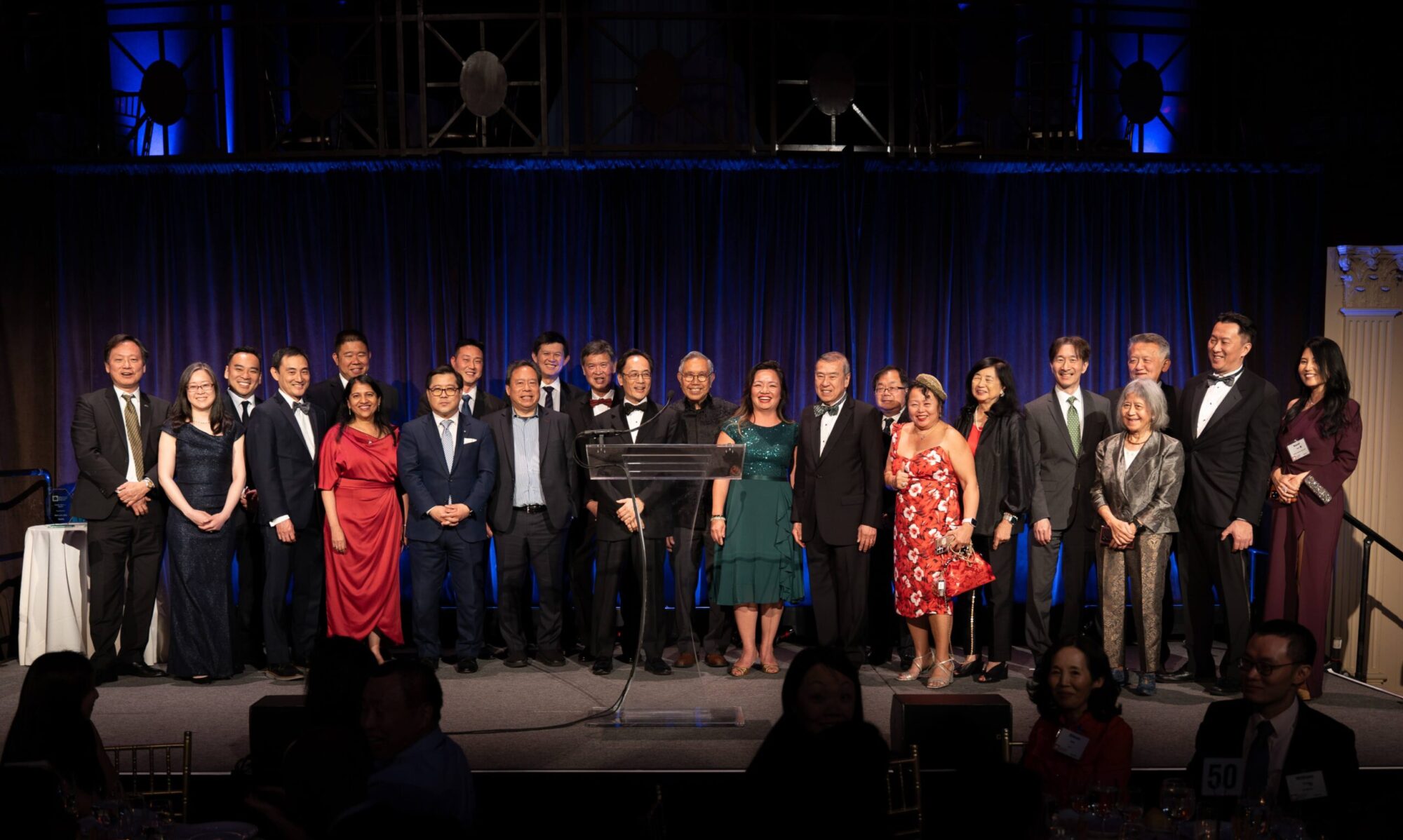
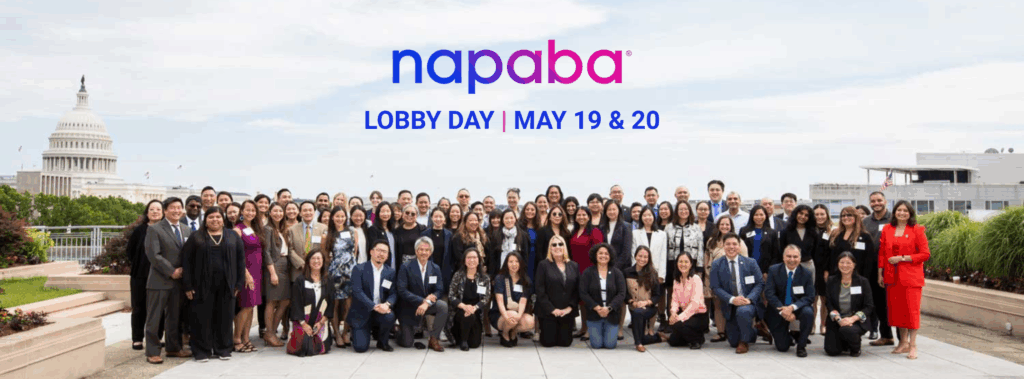
Join NAPABA, NAPABA members, and community leaders from across the country to celebrate Asian Pacific American Heritage Month at NAPABA’s Congressional Reception!
This widely attended event will bring together Members of Congress, their staff, and leaders in the AANHPI community. Previous speakers have included Sen. Mazie Hirono, Rep. Judy Chu, and CAPAC Chair Grace Meng.
This event is free and open to the public!
Don’t miss this opportunity to network with peers and connect directly with policymakers from both the Senate and the House.
For Immediate Release: January 23, 2026 Contact: Rahat N. Babar, Deputy Executive Director
WASHINGTON – The National Asian Pacific American Bar Association (NAPABA) applauds the introduction of the Language Access for All Act of 2026 in Congress. The bill, if enacted, would ensure that all individuals have meaningful access to critical Federal services, regardless of English proficiency.
In March 2025, President Donald Trump revoked Executive Order 13166 and designated English as the official language of the United States. For nearly 25 years, EO 13166 required that every federal agency meet the needs of individuals with limited English proficiency when it delivers critical services. EO 13166 brought the full import of Title VI of the Civil Rights Act of 1964, which prohibits entities that receive federal funding from discriminating based on national origin, to life. NAPABA objected to the revocation of EO 13166 at the time and called on Congress to act in response. Following our advocacy efforts, NAPABA welcomes the introduction of the Language Access for All Act of 2026, which would restore the key guarantees of EO 13166.
Language access is particularly important for the Asian American, Native Hawaiian, and Pacific Islander (AANHPI) community. The majority of the Asian American community are immigrants. Nearly 32% of the community is limited English proficient. The Asian American population is comprised of over 50 different ethnicities and speak over 100 different languages. NAPABA has long championed linguistic access for AANHPI communities in the legal system, including through our groundbreaking report, which highlighted and provided recommendations on the state of language access in federal and state courts and agencies. Every individual deserves access to critical, federally funded services.
NAPABA is grateful to Rep. Grace Meng, the Chair of the Congressional Asian Pacific American Caucus, along with Rep. Judy Chu, Rep. Juan Vargas, Rep. Daniel Goldman, for their leadership and introducing the Language Access for All Act of 2026. This action coincides with the anniversary of the U.S. Supreme Court’s historic decision in Lau v. Nichols, 414 U.S. 563 (1974), which recognized the right of English learners to participate meaningfully in public school education and served as a catalyst for language access throughout the Nation. We call on Congress to advance this legislation swiftly.
WASHINGTON – The National Asian Pacific American Bar Association (NAPABA) and the Asian Pacific American Bar Association of Tampa Bay (APABA Tampa Bay) joined the Fred T. Korematsu Center for Law and Equality, the Hispanic National Bar Association, the South Asian Bar Association of North America, and other partners to oppose the Florida Conveyances to Foreign Entities Law (“SB 264”), a new statute that would prohibit individuals from purchasing real property in Florida based on national origin. The coalition filed an amicus brief, which can be found here, with the United States District Court for the Northern District of Florida in support of the plaintiffs’ motion for a preliminary injunction in Yifan Shen v. Wilton Simpson. The motion seeks a preliminary injunction barring the enforcement of SB 264.
The amicus brief continues the advocacy efforts of NAPABA and our Florida affiliates in opposing SB 264 during the legislative process. In yesterday’s brief, the coalition argued that laws such as SB 264 are “stains on American history” and that alien land laws have “historically and consistently been struck down as invidiously discriminatory.” They promote discrimination against the Asian American, Native Hawaiian, and Pacific Islander community and endanger these populations under the guise of national security concerns.
The opposition to SB 264 coincides with the leadership of NAPABA and its affiliates in combatting similar efforts across the nation. Beyond Florida, NAPABA has opposed similar legislation introduced in Texas, Louisiana, and Alabama that targeted the AANHPI community. During NAPABA Lobby Day last month, our members demanded that Congress act in response to state actions restricting our communities’ ability to pursue a livelihood. Days later, Rep. Judy Chu of California, who chairs the Congressional Asian Pacific American Caucus, and Rep. Al Green of Texas introduced the Preemption of Real Property Discrimination Act in the United States House of Representatives. The bill, which NAPABA endorsed the same day, would nullify any state law that prohibits or otherwise restricts an individual’s right to purchase real property based only on that individual’s citizenship.
NAPABA President Sandra Leung denounced state efforts to enact such discriminatory policies, which “eerily recall ancient alien land laws, which were enacted over a hundred years ago, that barred Asian immigrants from owning land. Such laws belong in the dustbin of history, and they have no place in our nation today. While policymakers are free to address the legitimate national security concerns of the United States, they may not enact discriminatory laws on the backs of the Asian American, Native Hawaiian, and Pacific Islander community.”
“Unless enjoined, SB 264 will be applied in discriminatory ways and inflict lasting damage on Asian Pacific American communities in Florida and beyond,” said SeungEun April Lee, President of APABA Tampa Bay.
NAPABA extends its thanks and appreciation to Professor Robert S. Chang of the Fred T. Korematsu Center for Law and Equality, the entire legal team at Foley Hoag LLP, and the NAPABA Amicus Committee, chaired by Radha Pathak and Albert Giang, for their work and leadership.
Contact:Rahat N. Babar, Deputy Executive Director for Policy