
NAPABA Statement in Response to Second Executive Order Restricting Birthright Citizenship

For Immediate Release:Contact:
August 7, 2026press@napaba.org

WASHINGTON – The National Asian Pacific American Bar Association (NAPABA) strongly opposes the Administration’s renewed effort to undermine the constitutional guarantee of birthright citizenship.  In an executive order issued yesterday, and just over a month after the U.S. Supreme Court struck down a previous executive order limiting birthright citizenship, the Administration purports to create additional categories of children born on American soil who would be denied birthright citizenship based solely on the status of their parents.

The law is clear. Under Trump v. Barbara, 609 U.S. ____ (2026), children born in the United States—even to parents unlawfully or temporarily present—are subject to the jurisdiction of the United States and are citizens at birth.  The Supreme Court recognized longstanding yet narrow exceptions to this rule, which include those born to foreign diplomats or invading armies. In reaffirming birthright citizenship, the Court upheld United States v. Wong Kim Ark, 169 U.S. 649 (1898), which rejected consideration of the status of the parents outside of the narrow exceptions.

Yesterday’s executive order attempts to unilaterally expand the categories of children ineligible for birthright citizenship.  It would, among other things, deny citizenship to children born to parents employed by a foreign government or designated as an “alien enemy,” a term that invokes the spectrum of historical injustices during World War II when the federal government removed and incarcerated approximately 120,000 individuals of Japanese ancestry.

Since last year, NAPABA and a large coalition of its affiliated bar associations from across the country defended birthright citizenship in the lower federal courts and the Supreme Court. In several amicus briefs, we highlighted how the past generations of Asian Americans faced discrimination, exclusion, and loyalty-based suspicion, yet their American-born children—including, as another amicus curiae argued, children of parents designated as “enemy aliens”—were nonetheless recognized as citizens at birth.

NAPABA will remain vigilant and stands ready to ensure that the Fourteenth Amendment’s promise of citizenship to all persons born in the United States, regardless of the stature or circumstances of their parents, is kept.
NAPABA to Host Webinar Previewing Supreme Court Case on Birthright Citizenship

The National Asian Pacific American Bar Association (NAPABA) will host a webinar titled “SCOTUS Oral Argument Preview: Who is Allowed to be a U.S. Citizen? Defending Birthright Citizenship and the Role of Asian American History” on Thursday, March 26 at 3:00 p.m. ET.

The program will preview the upcoming U.S. Supreme Court oral arguments in Trump v. Barbara, a case addressing the scope of birthright citizenship under the Fourteenth Amendment. On April 1, 2026, the Court is scheduled to hear arguments concerning Executive Order 14160, which declared that only children born to U.S. citizens or lawful permanent residents would automatically receive citizenship at birth. The executive order immediately faced legal challenges across the country.

NAPABA joined a broad coalition of bar associations in filing amicus briefs opposing the order. The March 26 webinar will discuss NAPABA’s role in defending birthright citizenship in the lower federal courts and before the Supreme Court, as well as the broader legal and historical context surrounding the issue.

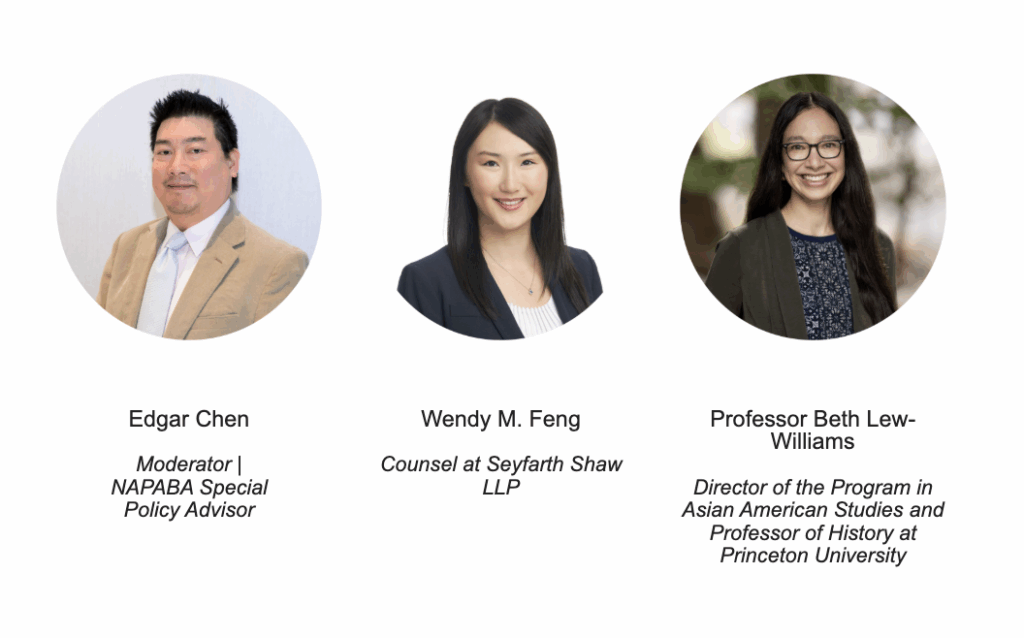
The panel will feature Professor Beth Lew-Williams, Director of the Program in Asian American Studies and Professor of History at Princeton University. Professor Lew-Williams is the author of The Chinese Must Go: Violence, Exclusion, and the Making of the Alien in America (Harvard University Press, 2018), a widely acclaimed work examining the history of anti-Chinese violence and exclusion in the United States.

Also joining the discussion is Wendy M. Feng, Counsel at Seyfarth Shaw LLP and lead outside counsel for the legal team representing NAPABA in the litigation. The program will be moderated by Edgar Chen, NAPABA Special Policy Advisor.

Together, the panelists will examine the legal arguments in Trump v. Barbara, the historical foundations of birthright citizenship, and the role Asian American legal history plays in shaping contemporary constitutional debates.

Registration for the webinar is free and open to the public. Click here to learn more and register for the event.

NAPABA Applauds the Confirmation of Arun Subramanian to the U.S. District Court for the Southern District of New York

For Immediate Release: 
Date: March 10, 2023
Contact:  Priya Purandare, Executive Director

WASHINGTON – March 10 – On Wednesday, Arun Subramanian was confirmed to the U.S. District Court for the Southern District of New York. Subramanian is the first South Asian American to serve on the Southern District of New York.

“NAPABA congratulates Arun Subramanian on his historic confirmation,” said Sandra Leung, president of NAPABA. “A child of immigrants, Mr. Subramanian is the first lawyer in his family, and this week, he became the first South Asian American judge to serve on the Southern District of New York. Like his family, we are proud to see him represent us.”

“The Southern District of New York is one of the most influential and active federal trial courts in the U.S.,” said Priya Purandare, executive director of NAPABA. “In addition to overseeing America’s largest financial institutions, it is also the location of one of the largest populations of AAPIs in the nation. We urge the Senate to continue confirming candidates that are representative of our nation.”

Subramanian was a partner at Susman Godfrey LLP where he chaired the firm’s pro bono practice and focused on consumer protection, antitrust, commercial class actions, and contract and tort litigation. In 2021, Subramanian was appointed by Chief Justice John Roberts to serve on the Advisory Committee for the Federal Rules of Evidence. Subramanian clerked on the U.S. Supreme Court for Justice Ruth Bader Ginsburg, on the U.S. Court of Appeals for the Second Circuit for Judge Dennis Jacobs, and on the U.S. District Court for the Southern District of New York for Judge Gerald E. Lynch. He is a graduate of Columbia Law School and Case Western Reserve University.

NAPABA thanks President Biden for nominating Arun Subramanian and Senate Majority Leader Schumer and Senator Gillibrand for recommending and supporting his nomination.

###
The National Asian Pacific American Bar Association (NAPABA), represents the interests of over 60,000 Asian Pacific American (APA) legal professionals and nearly 90 national, state, and local APA bar associations. NAPABA is a leader in addressing civil rights issues confronting APA communities. Through its national network, NAPABA provides a strong voice for increased diversity of the federal and state judiciaries, advocates for equal opportunity in the workplace, works to eliminate hate crimes and anti-immigrant sentiment, and promotes the professional development of people of all backgrounds in the legal profession.