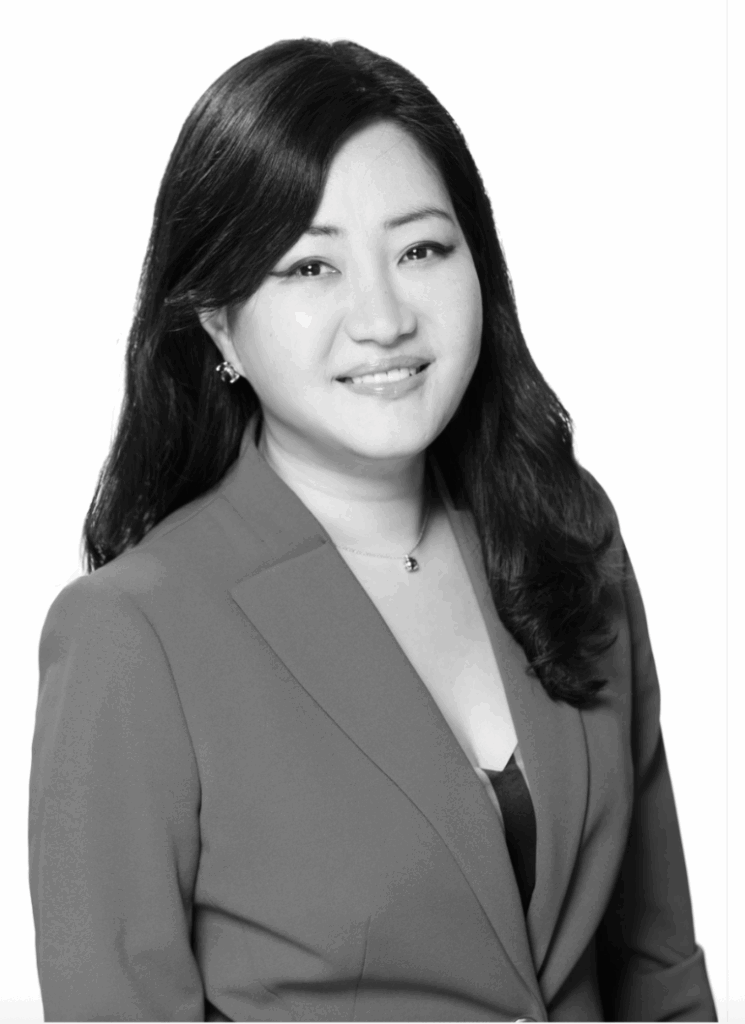
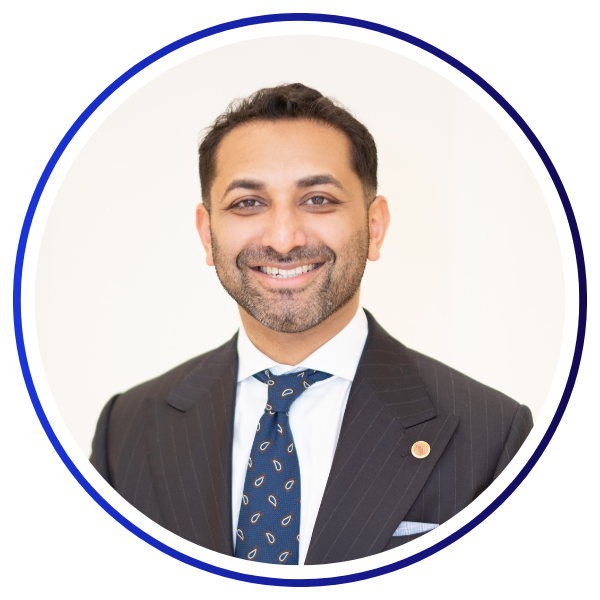
Rachel is the founding partner of Yoo Law Group, LLC, which specializes in immigration law, family mediation, and international dispute arbitration. In addition to her guidance in cross-border and mediation matters, she serves as the Co-Chair of the Asian American Bar Association of New York’s (AABANY) Alternative Dispute Resolution Committee. Rachel is also General Counsel of the Asian & American Art Foundation, and Mediator with the New York County Supreme Court.
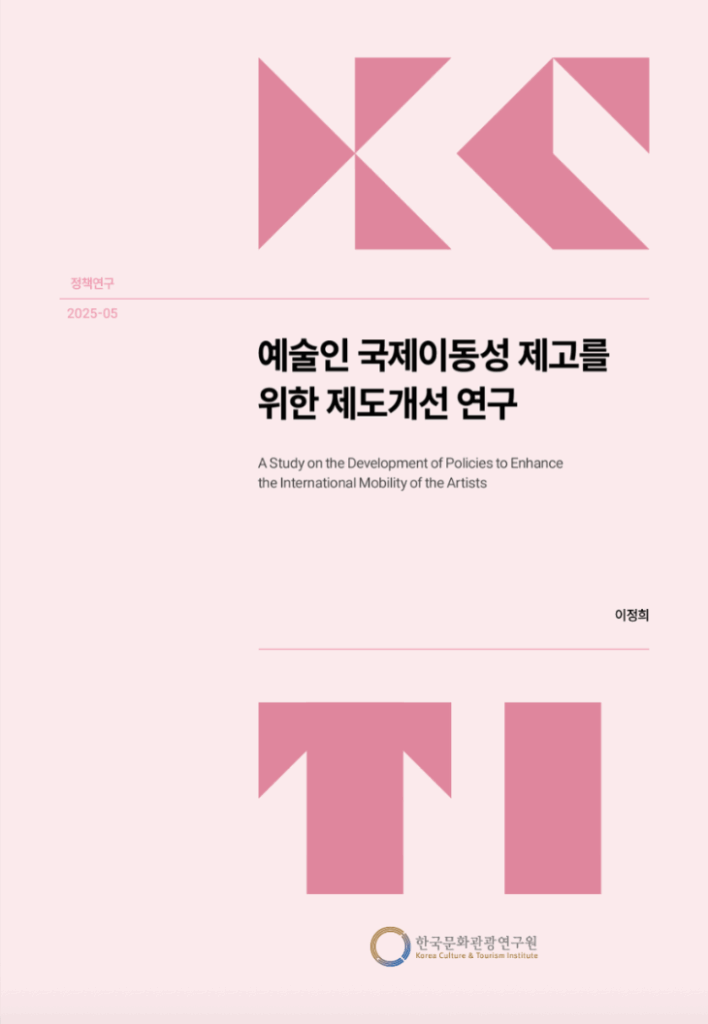
On this project, Rachel was invited to serve as a U.S. immigration adviser to the Ministry of Culture, Sports and Tourism of the Republic of Korea. Her involvement grew out of her immigration practice and prior work advising Korean artists and cultural organizations, including the Korean Cultural Center New York, on U.S. visa issues.
As an official contributor on matters related to U.S. immigration law, Rachel aided in examining how Korea’s institutional framework can be improved to better support the international mobility of artists.
Drawing on interviews and comparative policy analysis, the project uses insights from both Korea and major countries, surveying artists, agencies, and legal/administrative experts with direct experience navigating the visa process to evaluate Korea’s artist‑visa systems. By identifying key issues, strengths, and weaknesses across countries, the report proposes recommendations to strengthen Korea’s artist‑visa policies and promote smoother global artistic exchange.
For Rachel, the experience was particularly meaningful as it represented a continuation of her work in “bridging two legal systems and two cultural frameworks” and “broadened [her] perspective on how national‑level policy decisions shape the practical realities artists face,” something that strengthens her commitment to aiding her individual clients through U.S. immigration pathways.
Rachel’s work on this project is a testament to the impact that dedicated legal expertise can have beyond the courtroom in shaping policy, building bridges between nations, and advocating for the communities she serves. We are proud to have her as a valued member of AABANY, and please join AABANY in congratulating Rachel on this important achievement.
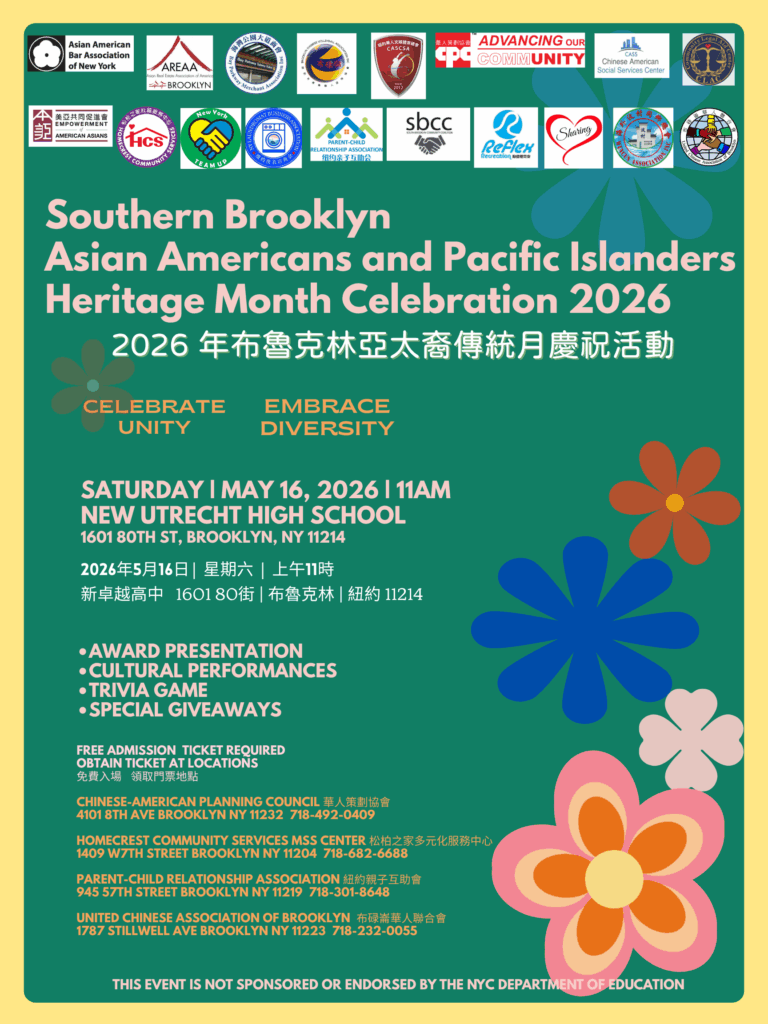
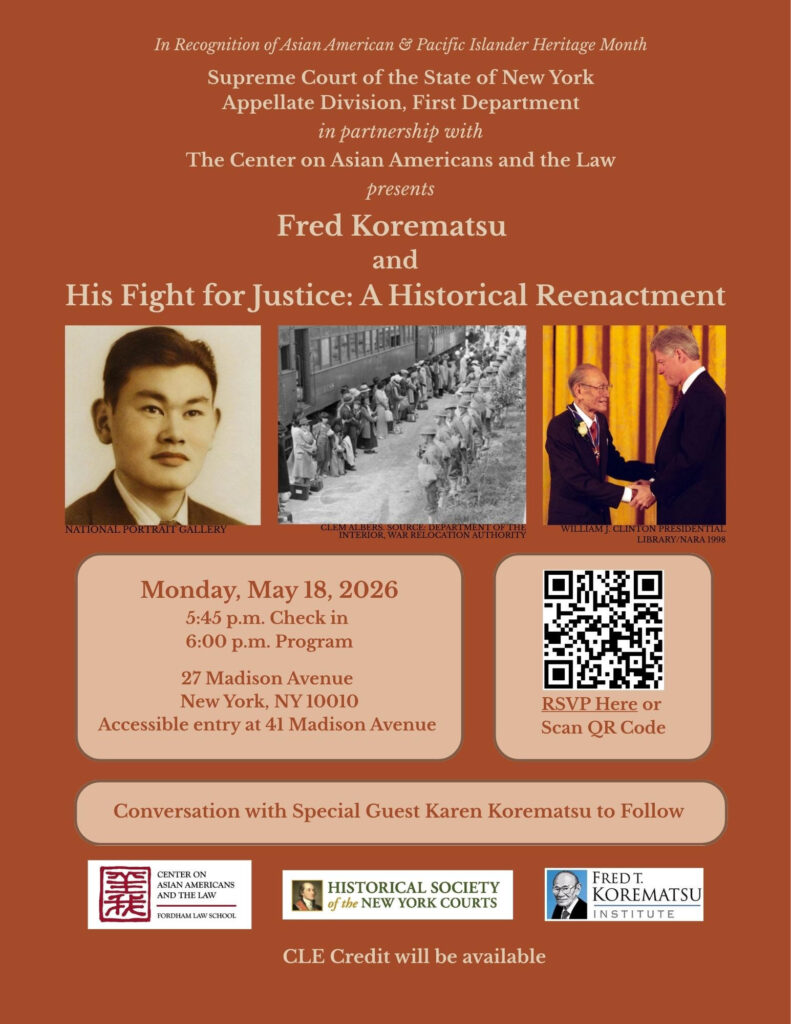
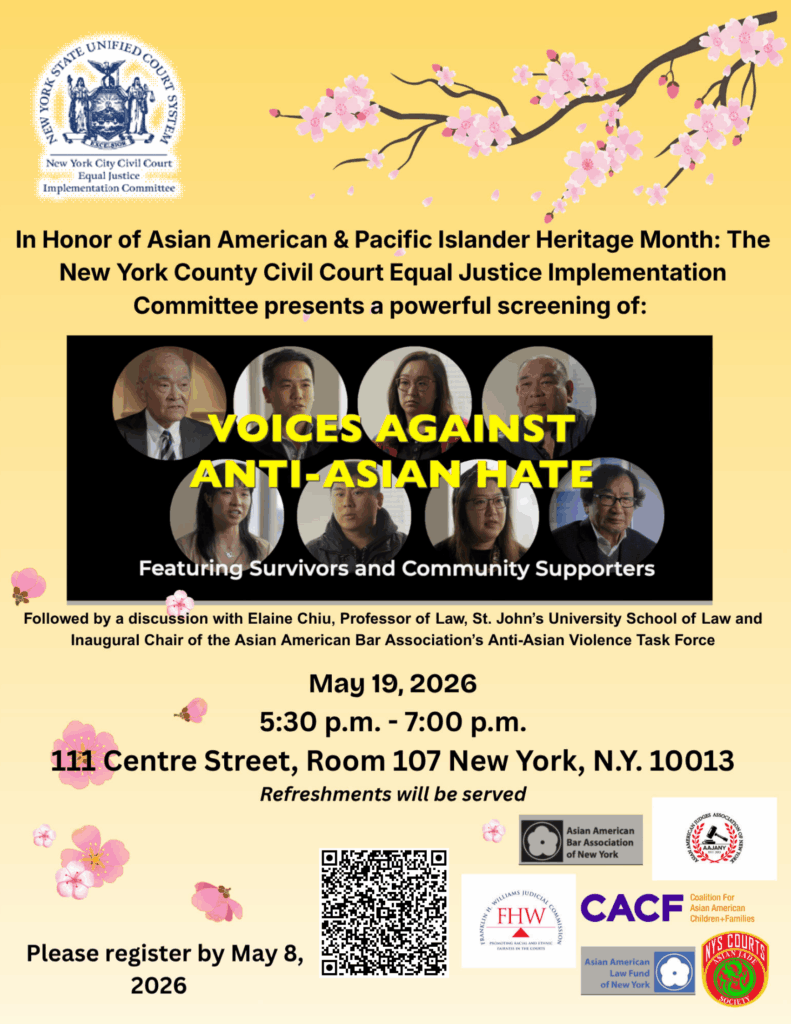
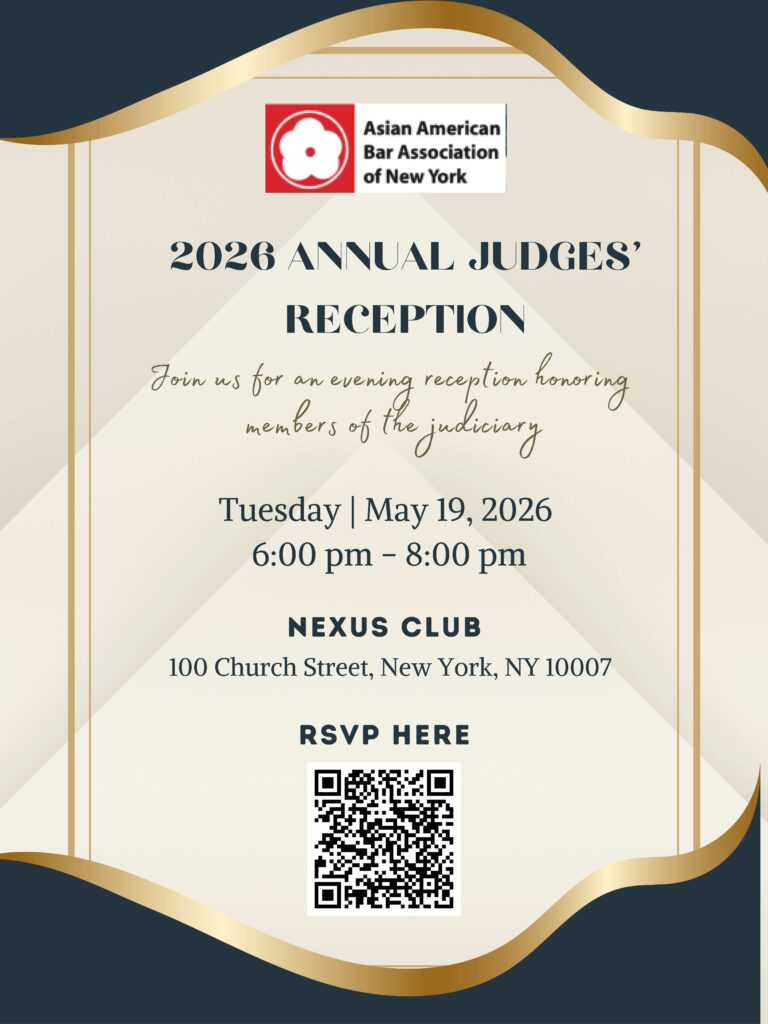
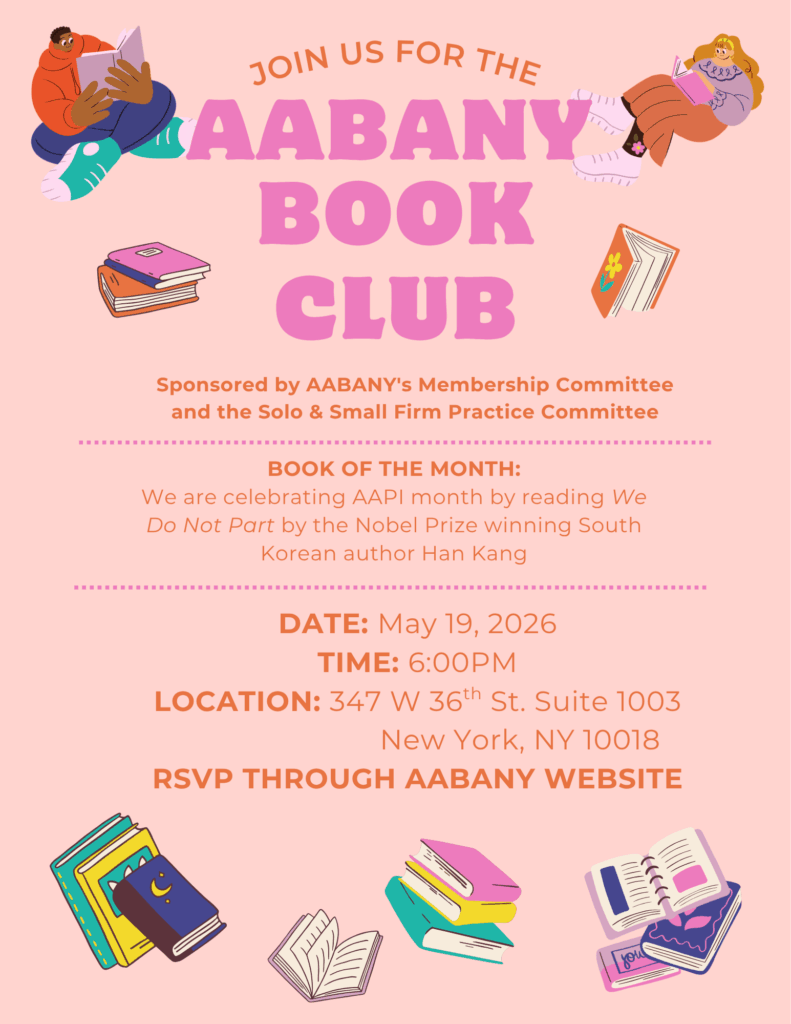
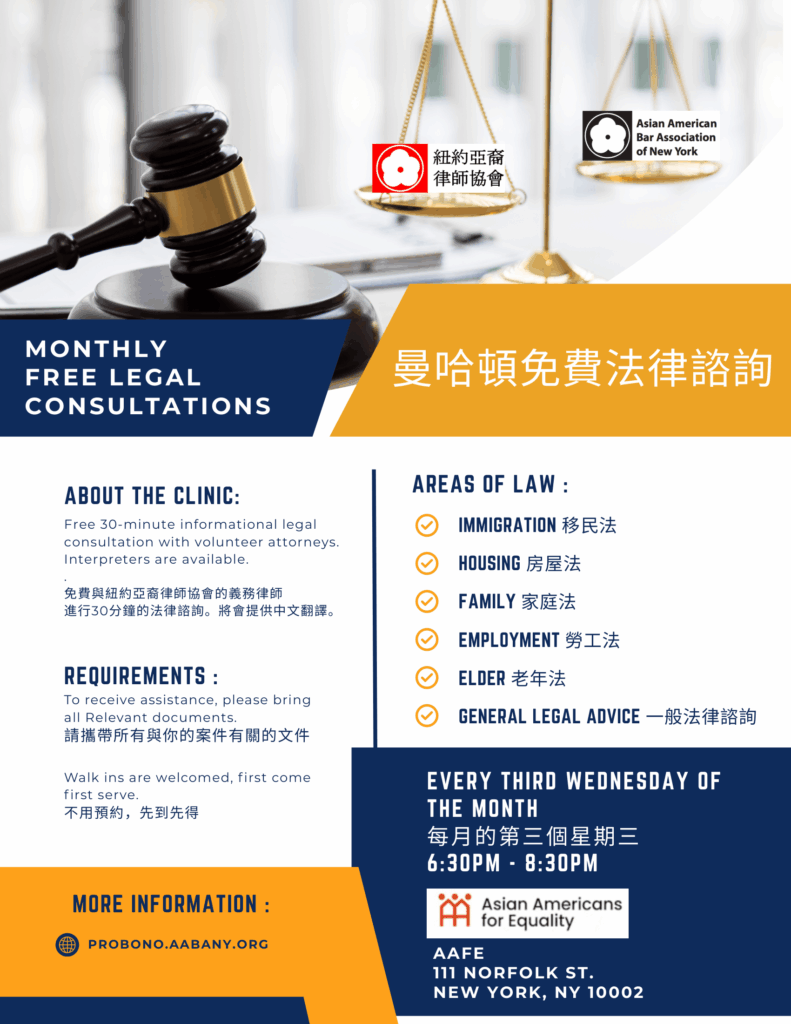
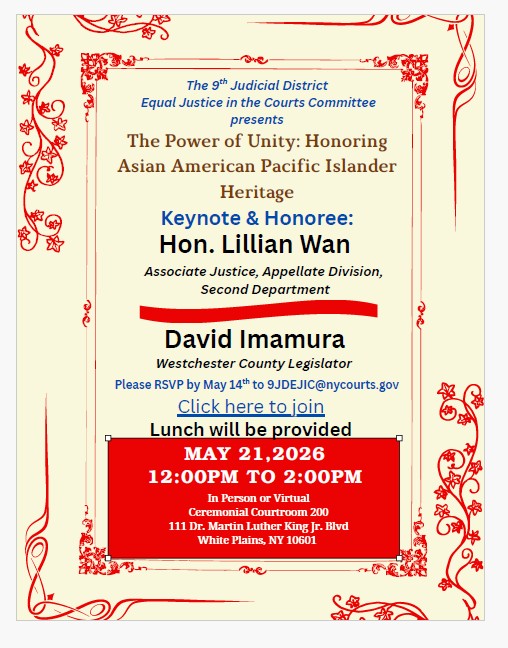
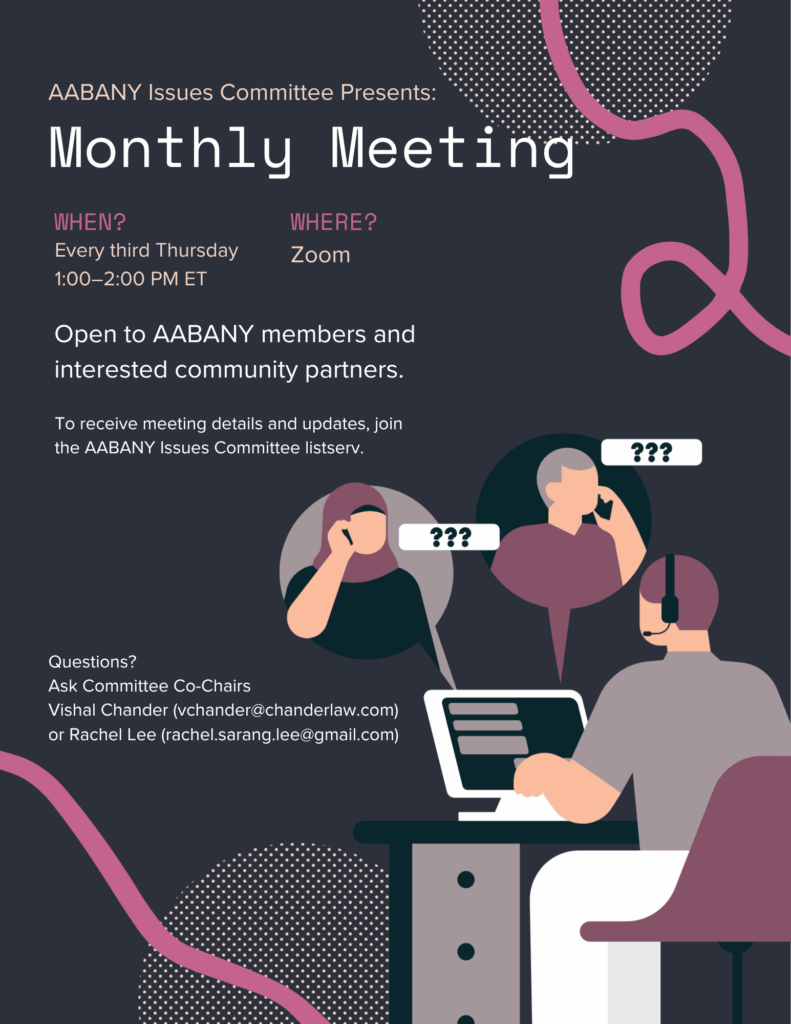
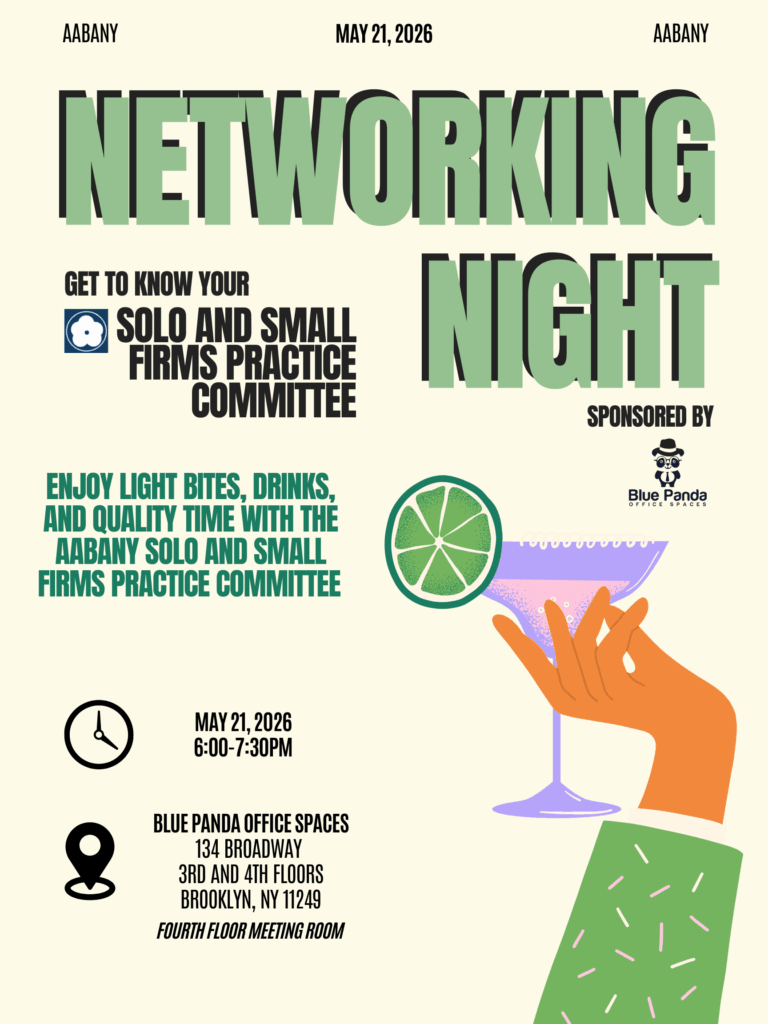
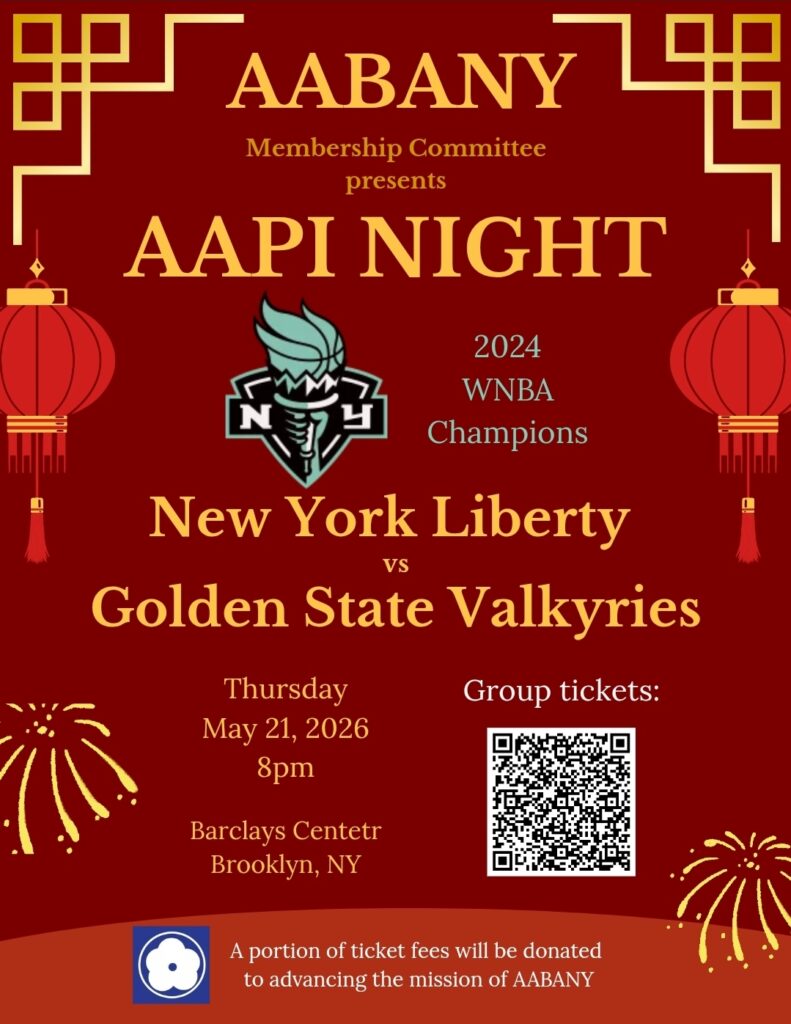
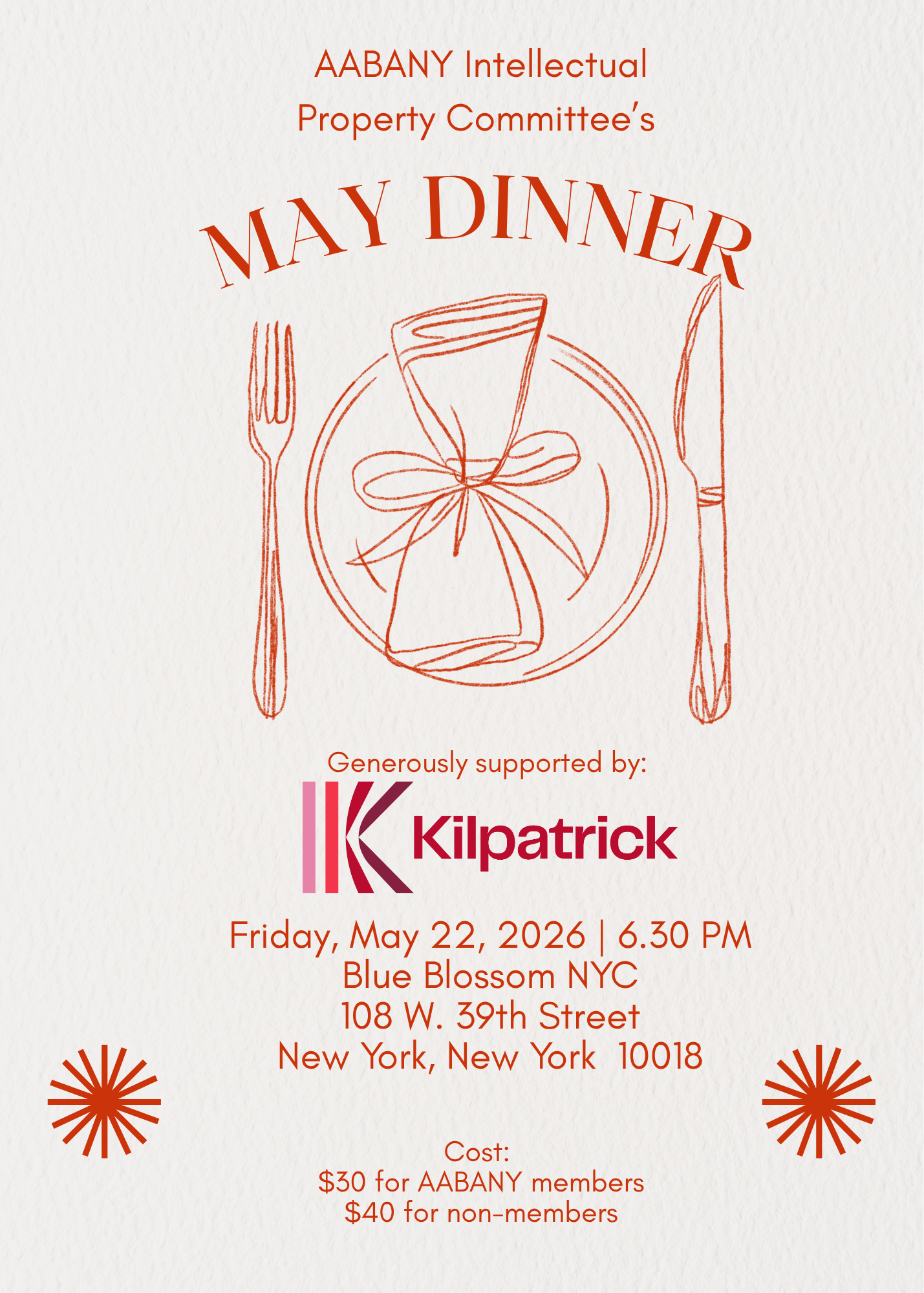
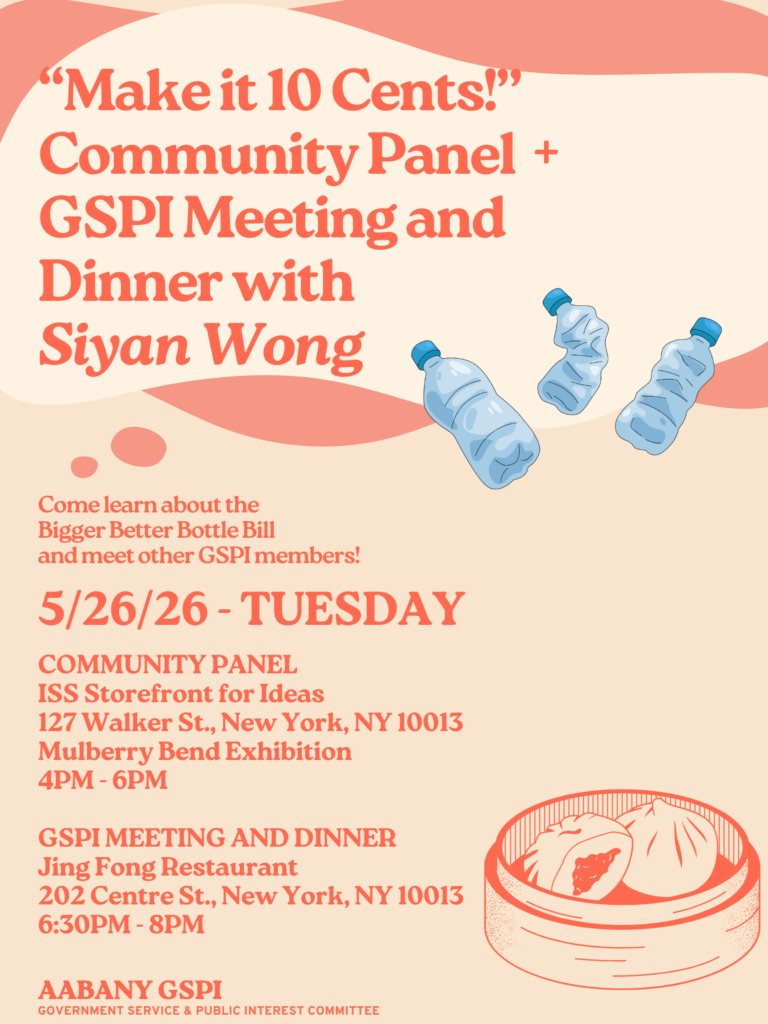
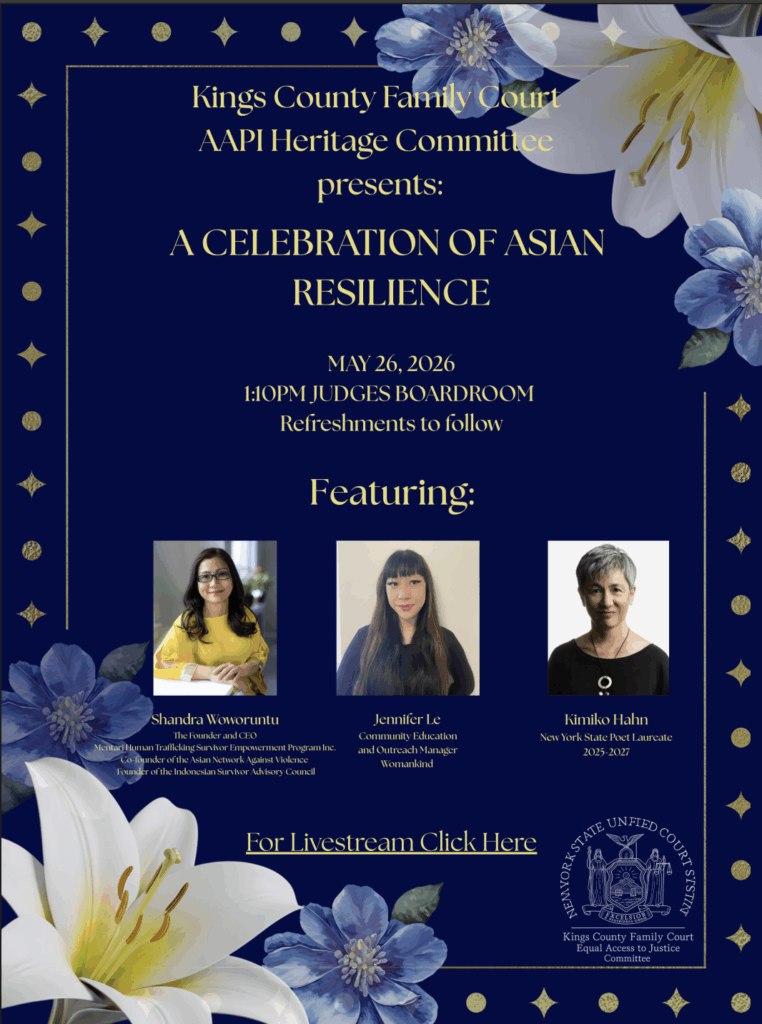
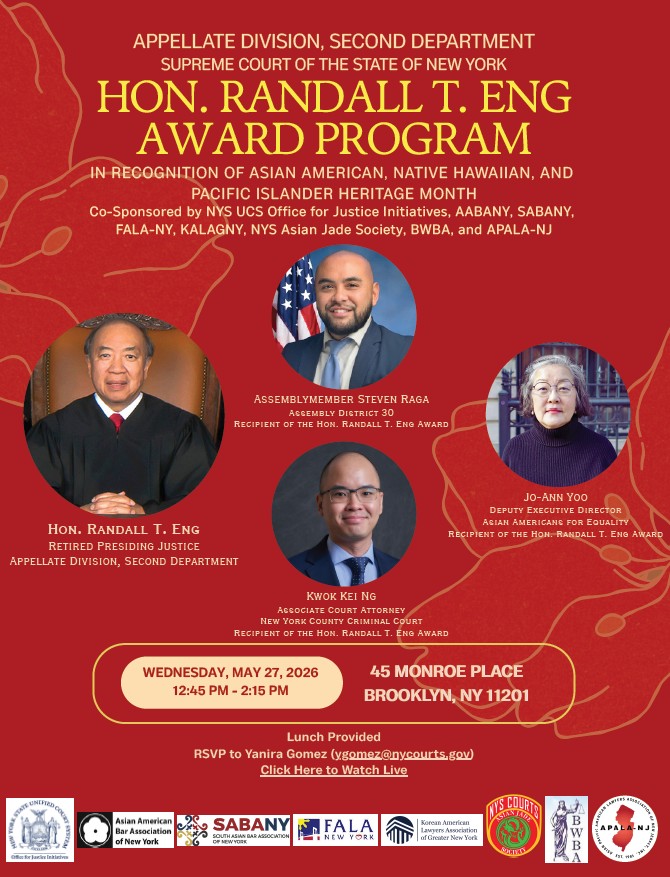
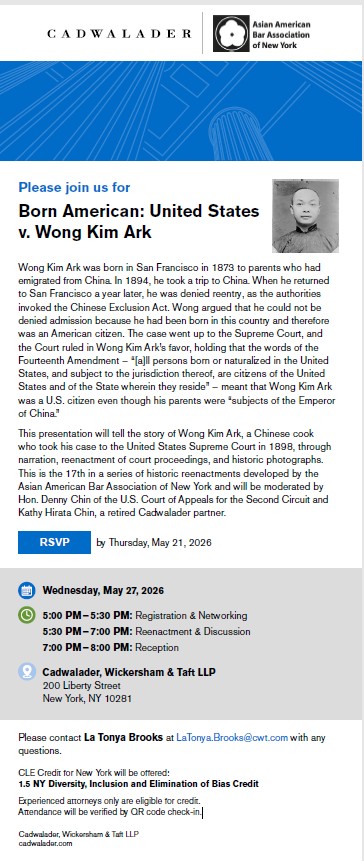
In celebration of AAPI Heritage Month this year, AABANY is presenting or co-sponsoring several events this month. We hope to see you all there! Follow the links for more details, and please note the registration deadlines. This blog post will be updated throughout the month, as new events get added on, so check back for any updates.
May 2, 2026
AABANY Co-Sponsors: Korean Hat Day at Yankee Stadium
1:35pm – Yankees Stadium, 1 E. 161 E. 161st Street
This event has already occurred.
May 3, 2026
AABANY Sunday Run Day
11:00 am – Start at Bedford Ave (L); End at Canal St. & Chrystie St. This event is preparation for the May 23 AAPI 5k run.
This event has already occurred.
May 5-7, 2026
Asian Comedy Fest 2026: AABANY Discount Available
7pm and 9pm – Sugar Mouse NYC, 47 3rd Avenue, Lower Level, New York, NY 10003
This event has already occurred.
May 6, 2026
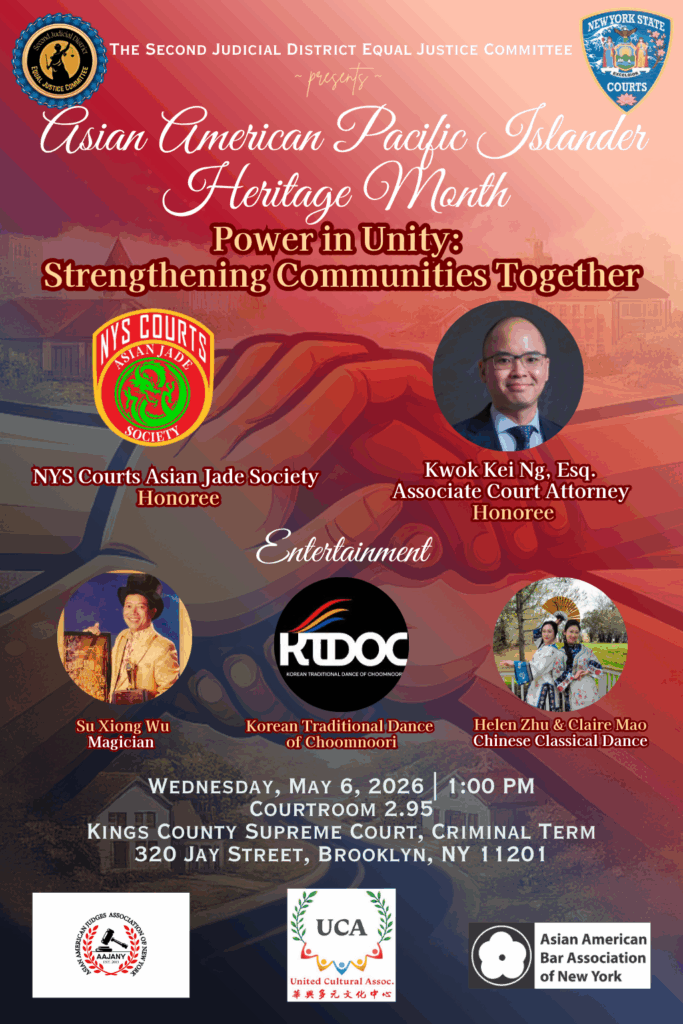
AABANY Co-Sponsors: Power in Unity: Strengthening Communities Together
1:00 pm – Kings County Supreme Court, Criminal Term, Courtroom 2.95, 320 Jay Street, Brooklyn, New York 11201
This event has already occurred.
May 6, 2026
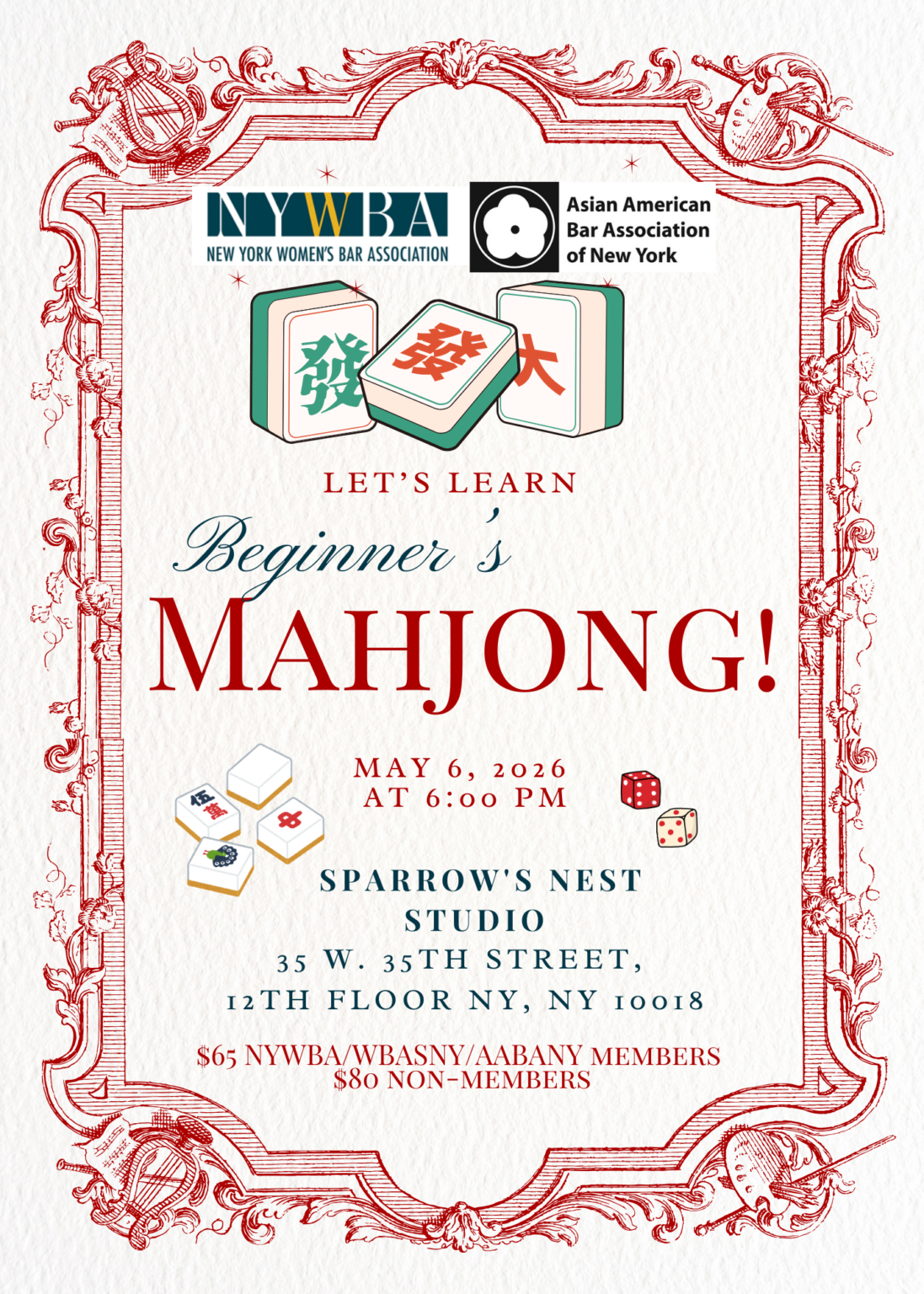
AABANY Co-Sponsors: Beginner’s Mahjong
6:00pm – Sparrow’s Nest Studio, 35 W. 35th Street, 12th Floor, New York, NY 10018
This event has already occurred.
May 6, 2026
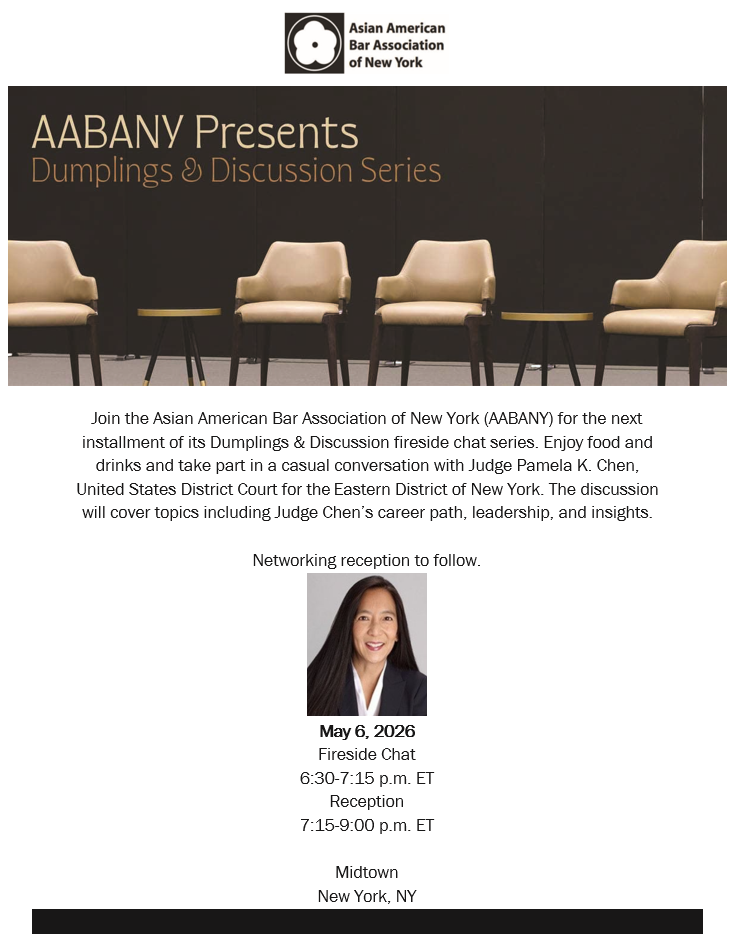
AABANY Presents: Dumplings & Discussion Series Featuring Judge Pamela K. Chen
6:00pm -Midtown location – to be emailed to registrants.
This event has already occurred.
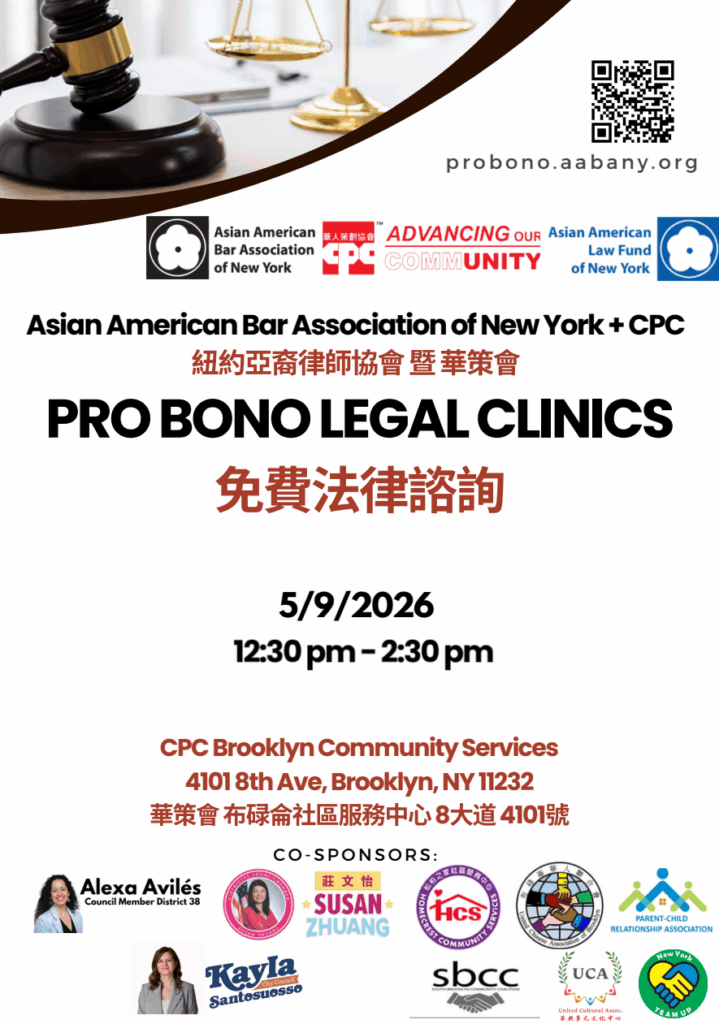
May 9, 2026
AABANY Bi-Monthly Brooklyn Pro Bono Legal Clinic
12:30 pm – 2:30 pm – CPC Brooklyn Community Services, 4101 8th Ave, Brooklyn, New York 11232
This event has already occurred.
May 10, 2026
AABANY Sunday Run Day
11:00 am – Start at Bedford Ave (L); End at Canal St. & Chrystie St. This event is preparation for the May 23 AAPI 5k run.
This event has already occurred.
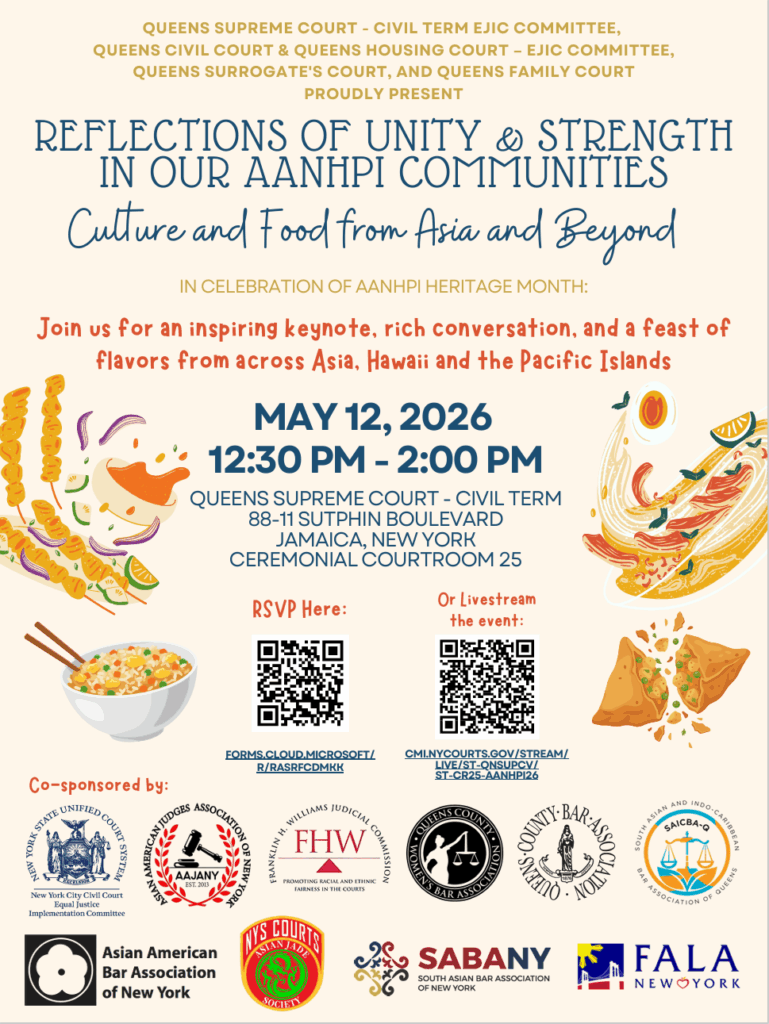
May 12, 2026
AABANY Co-Sponsors: Reflections of Unity and Strength in our AANHPI Communities
12:30pm – Queens Supreme Court – Civil Term, 88-11 Sutphin Boulevard, Ceremonial Courtroom 25, Jamaica, New York 11435
This event has already occurred.
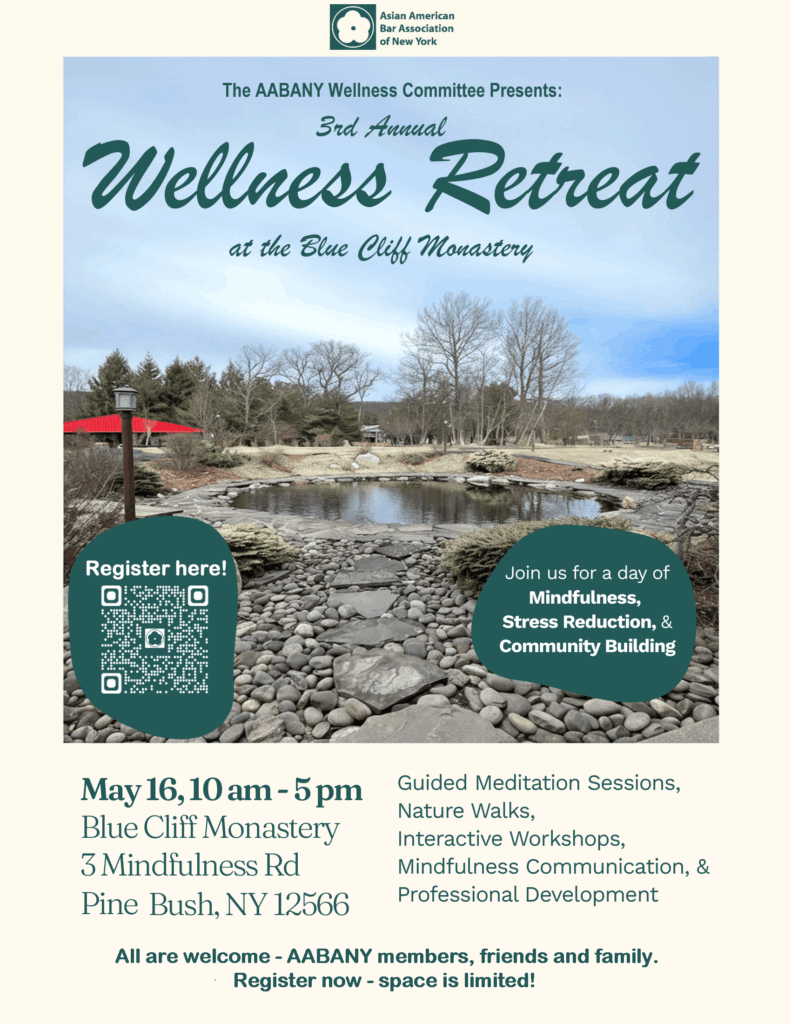
May 16, 2026
AABANY Presents: 3rd Annual Wellness Retreat
10:00 am – 5:00 pm – Blue Cliff Monastery, 3 Mindfulness Rd, Pine Bush, New York 12566
This event has already occurred.
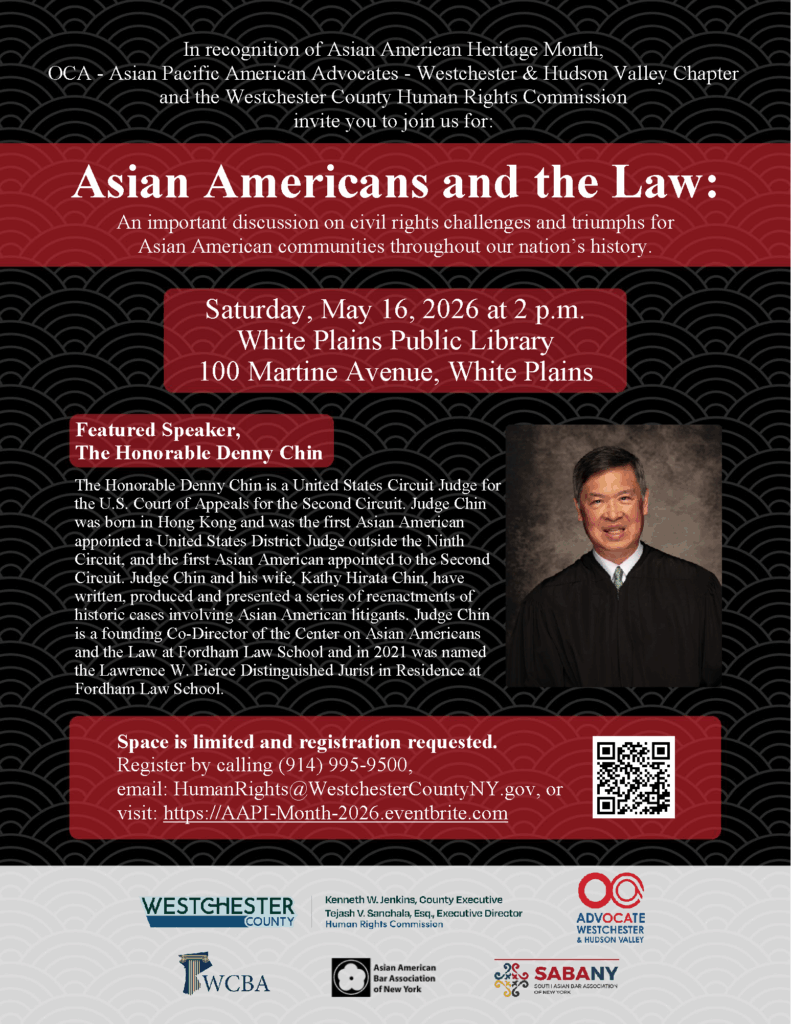
May 16, 2026
AABANY Co-Sponsors: Asian Americans and the Law, Featuring Hon. Denny Chin
2pm – White Plains Public Library, 100 Martine Avenue, White Plains, New York 10601
On March 26, 2026, the Pro Bono & Community Service Committee and the Government Service & Public Interest Committee continued their tradition of hosting a Volunteer Appreciation Dinner to recognize the volunteer attorneys, law students, AABANY staff, AALFNY board members, and community partners who make our Pro Bono Clinics possible. Together, we celebrated our shared mission of serving the public and promoting access to justice for those who cannot afford legal services.
The backbone of AABANY’s public service initiatives is its dedicated volunteers. We extend our deepest gratitude to the attorneys who generously devote their time and expertise to assisting members of the community. These Pro Bono Clinics also serve as valuable learning opportunities for law students, providing hands-on experience across various areas of law while allowing them to give back through direct service.
We also express our sincere appreciation to the Asian American Law Fund of New York (AALFNY) for its continued support, as well as to the AABANY staff, whose administrative efforts are essential to making this work possible.
Join us in honoring the 2025 Best Under 40 honorees—remarkable leaders who are making their mark in law, business, academia, public service, and beyond. These rising stars have distinguished themselves in their fields and demonstrated a strong commitment to uplifting the Asian American, Native Hawaiian, and Pacific Islander community.
Celebrate their achievements at the NAPABA Convention, November 6-8.
Qiaojing Ella Zheng Managing Partner of San Francisco and Palo Alto Offices of Sanford Heisler Sharp McKnight, LLP; Chair of Asian American Litigation and Finance Practice
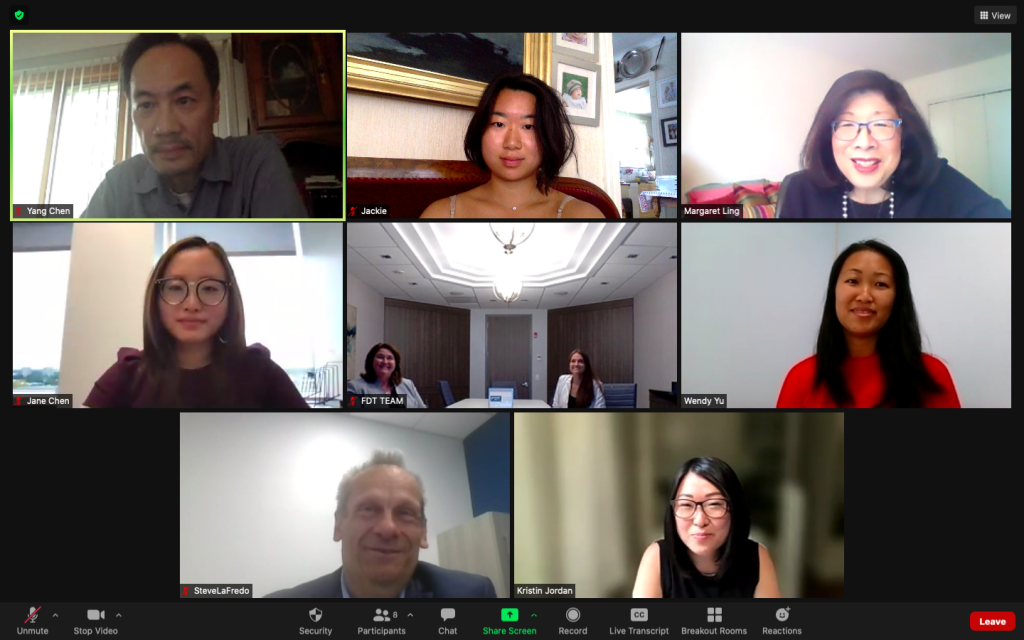
On August 3, the AABANY Real Estate Committee presented a “Cannabis Law and Real Estate” CLE, which explored the current state of real estate in New York State, within the context of recent cannabis legalization and a growing cannabis industry. Real Estate Committee Co-Chair Margaret Ling moderated the webinar, welcoming four speakers to introduce and explain current cannabis law and real estate practices, before opening the floor for a Q&A session.
Kristin Jordan spoke first, giving a broad overview of New York State’s adult use cannabis bill, the Marijuana Regulation and Taxation Act (“MRTA”), which was passed on March 31, 2021. Kristin is the Executive Director of Asian Cannabis Roundtable, a NYC-based professional networking community for those engaged in the cannabis industry, and Founder of Mannada. She explained how the bill positioned the state’s new cannabis regulatory body under the State Liquor Authority, because developing an entirely new agency would take too long. The new body comprises three agencies, the Office of Cannabis Management, the Cannabis Control Board, and the Cannabis Advisory Board. She also enumerated the different kinds of cannabis licenses available under the MRTA:
Cultivator,
Processor,
Cooperative (non-profit),
Distributor,
Retail,
Microbusiness,
Delivery,
Nursery, and
On-site consumption.
In terms of New York real estate, Kristin noted that cannabis legalization and its budding industry would exact the most tangible effect on leases for retail stores, warehouses, and distribution facilities, because they provide the brick and mortar for cannabis businesses. Finally, she emphasized that since cannabis legalization is so recent, cannabis law and best practices promise a steep learning curve, with so much uncharted territory.
Steve LaFredo, Chief Banking Officer at Piermont Bank, discussed cannabis and real estate specifically as it relates to banking. He emphasized that “banks are safety, soundness, and risk organizations first”; in other words, banking is a slow industry, and it would take time for banks to adapt to the growing cannabis industry. He underscored the difficulty of navigating often differing state and federal law when dealing with cannabis businesses, though he noted that New York State has been relatively progressive, as the first state to create cannabis banking guidelines under the Department of Taxation and Finance. These guidelines aim to preserve the safety, soundness, and security of businesses involved with cannabis. Steve explained that in states that have legalized cannabis, the banking industry tiers cannabis businesses into 3 categories: Tier A, those with direct contact (e.g. growing, producing, selling); Tier B, those that derive more than 25% of their business from the cannabis space; and Tier C, those that derive 25% or less of their business from the cannabis space. Banks are most likely to be receptive to working with Tier C cannabis businesses.
Since they lie precariously between state and federal regulators, most banks have a zero tolerance policy for cannabis. Disclosure and transparency are critical for finding a financial institution with which cannabis businesses can safely operate; smaller, private banks and credit unions will be most likely to open their doors to cannabis businesses. Unfortunately, cannabis businesses are still largely relegated to cash transactions, and since mechanisms for depositing and delivering cash are scarce and expensive, banks are hesitant to get involved. After the federal decision to stand down in states that have legalized cannabis, however, banks have slowly begun entering the cannabis space. Steve expressed optimism about the future of cannabis banking.
Kathleen Deegan Dickson and Danielle Tricolla of Forchelli Deegan Terrana spoke last, focusing on the role of the law firm in the cannabis space. Kathleen is a Partner and Co-Chair of the Cannabis Group at Forchelli Deegan Terrana, and Danielle is an Associate and Co-Chair of the Cannabis Group at Forchelli Deegan Terrana. They underscored the importance of “knowing what you don’t know,” since cannabis legalization not only means new legislation but also changes to existing legislation. Specifically, cannabis legalization involves changes to Public Health Law, Penal Law, Criminal Procedure Law, Civil Practice Law and Rules, Labor Law, Vehicle and Traffic Law, and General Business Law. Like Steve, they touched on the interplay between state legalization and federal prohibition of cannabis. Devoting special attention to law firm clients interested in cannabis, they explained that “cannabis law” is a multidisciplinary practice area, since it affects real estate transactions, leasing, land use, zoning, banking, labor, and employment, among other areas.
The intersection of cannabis law and real estate presents a new and exciting business area, and AABANY thanks the Real Estate Committee Co-Chairs Margaret Ling, Wendy Yu, and Jane Chen for putting together such an informative and current event. To learn more about the Real Estate Committee, visit https://www.aabany.org/page/120.
The National Asian Pacific American Bar Association (NAPABA) opposes the proposed changes to “public charge” published Wednesday by the Department of Homeland Security (DHS). We urge our members and affiliated bar associations to join NAPABA in submitting public comments opposing the proposed policy.
Public charge policy has roots in long-time efforts to limit the admission of ‘undesirable immigrants,’ such as Chinese in the 19th century. The proposed rule would re-define a public charge as an immigrant who would be likely to receive government benefits from an expanded list of programs, including nutrition and housing assistance programs for children. The proposed rule will make it easier to designate an applicant as a public charge, and deny their admission to the United States or reject their permanent resident application. DHS also proposes stricter guidance for weighing certain factors when reviewing visa applications, such as age, income, health, English proficiency, and employability. NAPABA is greatly concerned with how these changes will negatively impact Asian and Pacific Islander immigrants, working families, and children’s health.
The proposal has already had a chilling effect on Asian Pacific American communities. Due to reports of these proposed changes, some immigrant families—including those with eligible U.S. citizen members—have unenrolled from important public services for which they qualify. If implemented, the new public charge rules would undermine the safety, health, and security of immigrant families by denying them the support historically provided to new Americans. Asian Pacific American communities will be particularly hard hit, as over 31% of new green card recipients are from Asian and Pacific Island nations and as there is significant variation in average income amongst Asian ethnic groups.
Take charge by submitting a comment on the proposed rule before the DHS proceeds with its final rulemaking by the deadline, December 10, 2018. NAPABA will be submitting comments as an organization, but individuals are encouraged to submit unique comments here. To see available resources, please click here. For more information, contact Oriene Shin, NAPABA Policy Counsel, at 202-775-9555 or [email protected].
The National Asian Pacific American Bar Association Law Foundation presents its 2018 Thomas Tang Northeast Regional Moot Court Competition, and is in need of volunteers. This competition provides a unique and memorable experience for student appellate advocates. The event allows law students to showcase their writing and oral advocacy skills, and also to compete for scholarships totaling $10,000. In summary, this year’s problem is on whether a state university has the right to impose disciplinary sanctions on a student for non-curricular expressive conduct, and if it may expel a law student for off-campus expressive activity. For more information on this year’s problem, click here.
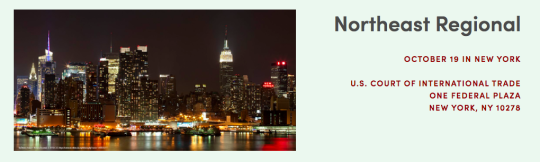
The event will be held on Friday, October 19, 2018, from 9:00 A.M. to 5:00 P.M. at the United States Court of International Trade, One Federal Plaza, New York, New York. NAPABA seeks volunteers for grading briefs and for day-of. Brief graders will review and score briefs submitted by the student teams before the competition, and the time commitment is flexible. Day-of volunteers are welcome to assist for either part of the event or the entire day, and will serve as bailiffs or judges for the oral argument rounds. For a complete schedule of the day’s events, click here. If you are interested in volunteering, please contact Zoe Wong, the Northeast Regional Coordinator, at T[email protected]. For more information, please visit NAPABA’s website here.
WASHINGTON — The National Asian Pacific American Bar Association (NAPABA) is proud to present the 2017 NAPABA President’s Award to Goodwin Liu, associate justice of the California Supreme Court. The NAPABA President’s Award is given to NAPABA members who demonstrate an exceptional commitment to NAPABA, the legal community, and the greater Asian Pacific American community.
The 2017 NAPABA President’s Award will be presented at the 2017 NAPABA Convention in Washington, D.C., on Nov. 3, 2017.
“Justice Liu has been an exemplary leader in the legal profession and in the Asian Pacific American community,” said NAPABA President Cyndie M. Chang. “In addition to his frequent engagement with Asian Pacific American lawyers and law students throughout the country, Justice Liu’s recent publication, ‘A Portrait of Asian Americans in the Law,’ has been a game-changer for awareness within and beyond our community of the successes and ongoing challenges that Asian Pacific Americans have experienced in the legal profession.”
The Portrait Project — a two-year study — revealed that Asian Pacific American lawyers have increased in number from 10,000 in 1990 to over 50,000 today, but they face challenges reaching the top ranks of the profession. For example, although Asian Pacific Americans are the largest minority group in big law firms, they have the highest attrition rates and the lowest ratio of partners to associates.
The son of Taiwanese immigrants and the first in his family to become a lawyer, Justice Liu was appointed to the California Supreme Court in 2011. He was previously a law professor and associate dean at the UC Berkeley School of Law. An influential scholar and acclaimed teacher, he received UC Berkeley’s Distinguished Teaching Award in 2009. He clerked for Justice Ruth Bader Ginsburg on the U.S. Supreme Court and Judge David Tatel on the U.S. Court of Appeals for the D.C. Circuit. He has also worked as special assistant to the deputy secretary of the U.S. Department of Education, as a litigation associate at O’Melveny & Myers in Washington, D.C., and as senior program officer for higher education at the Corporation for National Service (AmeriCorps).
Justice Liu serves on the Council of the American Law Institute; the National Academy of Sciences Committee on Science, Technology, and Law; and the board of directors of the James Irvine Foundation. He has previously served on the Stanford University Board of Trustees and the governing boards of the American Constitution Society, National Women’s Law Center, and Public Welfare Foundation.
NAPABA congratulates Justice Goodwin Liu as the 2017 NAPABA President’s Award recipient.
For more information, the media may contact Brett Schuster, NAPABA communications manager, at 202-775-9555 or [email protected].
The National Asian Pacific American Bar Association (NAPABA) is the national association of Asian Pacific American attorneys, judges, law professors, and law students. NAPABA represents the interests of over 50,000 attorneys and over 80 national, state, and local bar associations. Its members include solo practitioners, large firm lawyers, corporate counsel, legal services and non-profit attorneys, and lawyers serving at all levels of government.
NAPABA continues to be a leader in addressing civil rights issues confronting Asian Pacific American communities. Through its national network of committees and affiliates, NAPABA provides a strong voice for increased diversity of the federal and state judiciaries, advocates for equal opportunity in the workplace, works to eliminate hate crimes and anti-immigrant sentiment, and promotes the professional development of people of color in the legal profession.
WASHINGTON —
Asian Americans have been the fastest-growing minority group in the
legal profession for the past three decades, but they have made only
limited progress in reaching the top ranks of the profession, according
to a new report released today by the National Asian Pacific American
Bar Association and Yale Law School.
According
to the study, there are over 50,000 Asian American lawyers today,
compared to 10,000 in 1990. Asian Americans comprise almost 5 percent of
lawyers in America and roughly 7 percent of law school enrollment.
Asian Americans are the largest minority group in big law firms, but
they have the highest attrition rates and the lowest ratio of partners
to associates.
Asian
Americans comprise 3 percent of federal judges and 2 percent of state
judges, compared to nearly 6 percent of the U.S. population. Only three
out of 94 U.S. Attorneys in 2016 were Asian American, and only four out
of 2,437 elected district attorneys nationwide in 2014 were Asian
American.
The
two-year study — authored by California Supreme Court Justice Goodwin
H. Liu, recent Yale law graduates Eric Chung, Xiaonan April Hu and
Christine Kwon, and Yale law postgraduate associate Samuel Dong —
included a dozen focus groups and a national survey of over 600 Asian
American lawyers.
The
survey revealed that Asian Americans identify lack of access to mentors
and contacts as a primary barrier to career advancement. They also
report being perceived as careful and hard-working, but not assertive or
creative. “Whereas Asian Americans are regarded as having the ‘hard
skills’ required for lawyerly competence, they are regarded as lacking
many important ‘soft skills,’” the study found. More than half of the
Asian American lawyers surveyed said they “sometimes” or “often”
experience implicit discrimination in the workplace.
“Our
study shows that Asian Americans have a foot in the door in every
sector the legal profession,” said Justice Liu. “The question now is how
wide the door will swing open. Despite much progress, Asian Americans
still face significant obstacles to reaching the leadership ranks.”
“The
Portrait Project shines a light on the obstacles and challenges faced
by Asian American lawyers every day,” said Cyndie M. Chang, president of
the National Asian Pacific American Bar Association. “While incredible
strides have been made over the past 25 years, much work remains to be
done to push past the stigmas and assumptions associated with Asian
Americans. The insights gleaned from this report will unquestionably lay
the groundwork for the road ahead.”
“This
project is timely and important — a must-read for anyone who teaches or
practices law,” said Heather Gerken, dean and Sol & Lillian Goldman
professor of law at Yale Law School. “Justice Liu is a trailblazer, and
it’s a testament to him that he is trying to ensure that other Asian
Americans have a chance to pursue their dreams going forward.”
“This
path-breaking project literally changes the face of Asian American law.
For too many centuries, Asian Americans have been the objects, not the
subjects, of American law: victims and litigants, not activists,
lawyers, or judges,” said Harold Hongju Koh, Sterling professor of
international law at Yale Law School and former legal adviser of the
U.S. Department of State. “This indispensable report finally provides
the facts behind the stereotypes, the deeply felt feelings behind the
faces.”
“The
Portrait Project provides important and necessary data on the advances
and areas for further improvement for Asian Americans in the legal
profession,” said Michelle K. Lee, former undersecretary of commerce and
director of U.S. Patent and Trade Office. “Much progress has been made,
but much work remains ahead. Particularly noteworthy are the
differences highlighted by the data along gender lines, which illustrate
the challenges faced by Asian Americans in the legal profession are
even more pronounced for Asian American women.”
“This
first-ever study of its kind is significant not only for its breadth
and the insights it provides on the so-called ‘bamboo ceiling’ in the
legal profession, but also because it provides a roadmap for how Asian
American attorneys can continue to break through and advance within the
profession,” said Ivan K. Fong, senior vice president and general
counsel of 3M, and former general counsel of the U.S. Department of
Homeland Security.
“This
new empirical study is a significant contribution to our understanding
of the challenges faced by Asian Americans in the legal profession,”
said Ajay K. Mehrotra, director of the American Bar Foundation and
professor of law at Northwestern University Pritzker School of Law. “It
is only by first identifying the factors that have impeded the long-term
leadership success of Asian Americans that we can find potential
solutions to this vexing problem.”
“The
Portrait Project has confirmed the existence of the bamboo ceiling. It
also shows that the future success of the Asian American legal community
requires more leadership and mentoring,” said Don Liu, executive vice
president and chief legal officer of Target Corp. “The study will be
tremendously helpful in removing the professional obstacles that exist
for Asian American lawyers.”
“The
Portrait Project not only points out the flaws of the hiring and
promotion system of workplaces toward Asian Americans, but also shows
what Asian Americans can do to succeed,” said Bijal Vakil, partner,
White & Case. “Change requires both mentoring Asian American lawyers
on strategies to effectively navigate the status quo of law firms in a
manner as personally authentic as possible and to continue pressuring
law firm leaders for inclusive leadership.”
The
National Asian Pacific American Bar Association (NAPABA) is the
national association of Asian Pacific American attorneys, judges, law
professors, and law students. NAPABA represents the interests of almost
50,000 attorneys and over 80 national, state, and local Asian Pacific
American bar associations. Its members include solo practitioners, large
firm lawyers, corporate counsel, legal services and non-profit
attorneys, and lawyers serving at all levels of government.