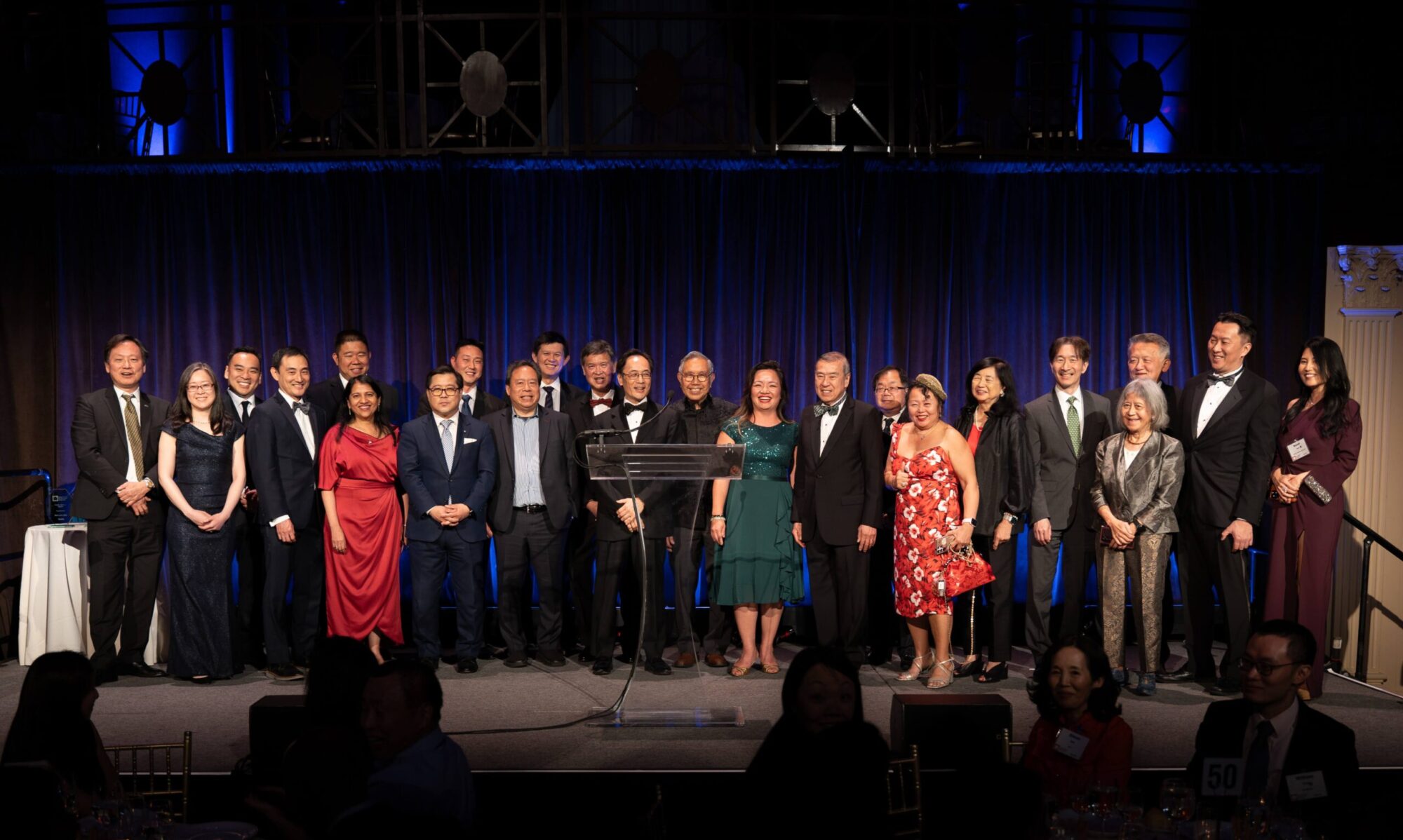

Congratulations to Linda Lin on Receiving NAPABA’s 2026 In-House Counsel Leadership Award

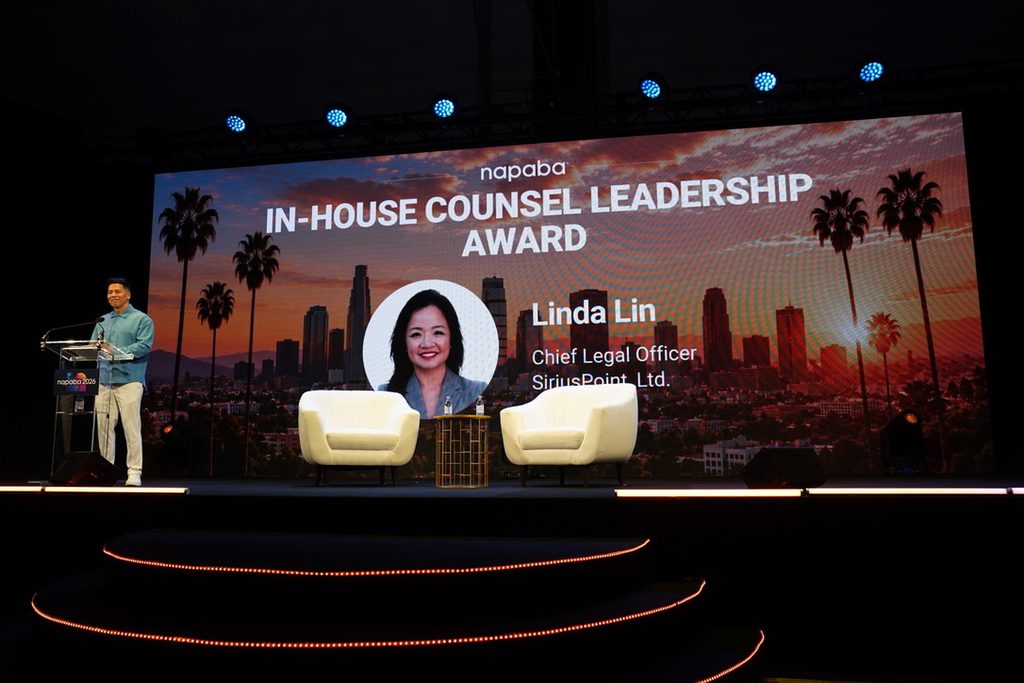
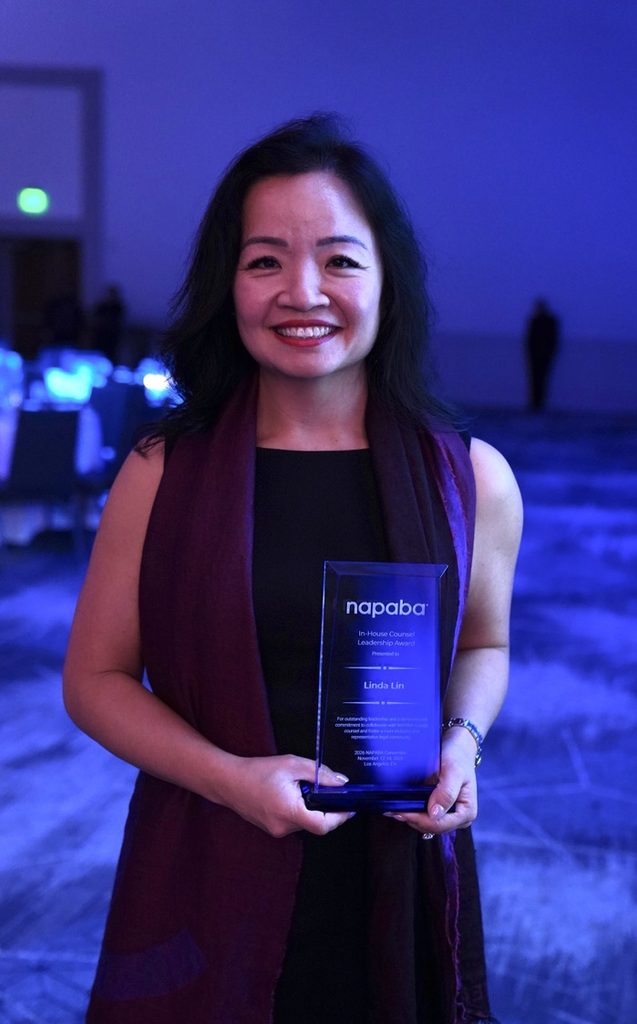
Linda Lin, Chief Legal Officer and Corporate Secretary at SiriusPoint Ltd, was recognized with NAPABA’s prestigious In-House Counsel Leadership Award for 2026.

Her initial reaction reflected a lifelong characteristic: grounded humility. Nominated by her colleague Susan Shin, the honor came as a surprise to her.

“It means a lot because I’m not someone who is always thinking about awards,” she admits. “I didn’t expect to get it—in fact, there are other people I think deserve it more. But to be recognized by your community is a tremendous honor.”

The connection to her community has been a defining thread throughout Linda’s career. Her involvement with the Asian American Bar Association of New York (AABANY) began when she was still a law student at Brooklyn Law School. Over the years, AABANY served as an anchor while she rose through the ranks, eventually serving as the organization’s President in 2011. From participating annually with the Honorable Denny Chin and Kathy Hirata Chin in historical trial reenactments to mentoring the next generation of Asian American lawyers, Linda’s journey has been inextricably linked to community elevation.

Embracing a Meandering Path

Looking at an executive bio that features senior roles at industry giants like Berkshire Hathaway, QBE, Coaction Global, and now SiriusPoint, it is easy to assume Linda followed a carefully scripted, linear climb to the C-suite. However, as Linda explained, success rarely follows a straight line.

“Success can be a meandering road—it can go sideways and zig-zag,” Linda observed. “You often have to take opportunities as they come, even if they don’t initially look like traditional upward moves.”

Linda’s career began on a classical legal track, clerking for the Honorable Dora L. Irizarry in the U.S. District Court for the Eastern District of New York (EDNY), followed by her time as a litigation associate at Willkie Farr & Gallagher. After working as a litigator, Linda made the bold choice to move into an insurance claims function. To some, the move may have looked like a lateral step or even a step down. She saw it differently. At its core, an insurance policy is a legal contract, and working in claims allowed her to understand the business from the product level up.

Moreover, while managing intense firm demands during the mortgage financial crisis, she suffered the devastating loss of her father. It was a profound, life-changing moment that forced her to step back and re-evaluate her personal priorities, family needs, and long-term goals. She realized that while she had applications pending for trial attorney roles at two U.S. Attorney’s Offices, her priorities were shifting toward building a more sustainable work-life balance, spending time with her mother, and eventually starting a family. Observing a scarcity of female partner role models balancing BigLaw practice with family life, she made the deliberate decision to transition in-house.

Linda drafted policy language, navigated regulatory frameworks alongside the General Counsel, and dove headfirst into complex emerging areas like transactional liability, a topic she had no prior experience with, but researched tirelessly so she could speak intelligently about it on industry panels.

That willingness to step into uncharted territory caught the attention of leaders around her. A General Counsel turned key mentor gave her advice that would reshape her career trajectory: “I’m offering you a job offer that would take you 10 years to get at where you are now. You can take the challenge or stay comfortable.” She took the challenge, immersing herself in M&A, corporate governance, board management, and leading business legal teams—a toolkit that paved the way to her first General Counsel role.

Linda’s career followed the path that was most well-suited to her needs and abilities. Choosing a legal career means making measured decisions, and understanding how career and personal facets of life will overlap. Reflecting on the advice often given to young lawyers about achieving work-life balance, she offered a candid perspective: “I don’t know that I’ve ever found a perfect balance, because it’s a constant balancing act. Something has got to give at all times, and you have to determine what and when that will be.”

Helping to Diversify the Bench 

Her early clerkship in the EDNY, covering Brooklyn, Queens, and Long Island, left a lasting impression on how justice is delivered. Recognizing that the district court served one of the most culturally diverse populations in the country, she was struck by the lack of diversity on the bench: “I saw how impactful judges were in people’s lives,” she recalled. “They make decisions that directly affect your community, and it is so important to have a bench that represents the community it serves.”

Driven to address the pipeline, nearly two decades ago she co-founded the Joint Minority Bar Judicial Internship Program. The initiative later evolved into the Sonia & Celina Sotomayor Judicial Internship Program (SCSJIP), where she currently serves as Chair of the Board. Through hands-on involvement in judicial selection processes, candidate panels, and mentorship, she helped transform the EDNY into one of the most diverse federal judicial districts in the nation.

Leading a Global Team

SiriusPoint operates globally from Bermuda today, and Linda leads SiriusPoint’s cross-border legal and compliance teams. Managing global teams across multiple time zones in a post-pandemic, virtual environment brings unique operational hurdles. “There is a lack of human component in virtual work, and nothing can replace face-to-face connection,” she notes. Yet, seeing her team members grow, navigate regulatory landscapes, and succeed globally remains the single most rewarding aspect of her executive leadership.

Throughout her career, public service—from AABANY leadership to serving on the New York City Districting Commission—has served as a supportive testing ground. “My community lets me grow, experiment, and learn,” she remarked. “Without those opportunities, I wouldn’t be where I am today.”

When asked about the current state of diversity in the legal profession, Linda emphasized that true progress is about leveling the playing field, not lowering standards. When organizations claim they cannot find qualified diverse candidates, her response is direct: “Maybe you’re not looking hard enough.”

Words of Wisdom

Reflecting on her trajectory from Binghamton University and Brooklyn Law School to the executive C-suite, Linda’s core advice for rising attorneys—especially women—is grounded in authenticity and emotional intelligence:

  • Owning your personal brand and taking measured risks is important. Career growth is never one-size-fits-all.
  • High EQ, especially with women, can be a strategic asset in the C-suite. “I’m not always the smartest person in the room, but I am the one working the hardest, paying the closest attention, and keen on how things make people feel and look.”
  • Stay curious and never let grades or setbacks dictate your potential:  “If you want it, you will make it happen.”

Please join AABANY as we congratulate Linda Lin on being honored with NAPABA’s prestigious In-House Counsel Leadership Award.  The award was presented at the NAPABA Awards Luncheon on Saturday, November 14, 2026 at the NAPABA Convention in Los Angeles.
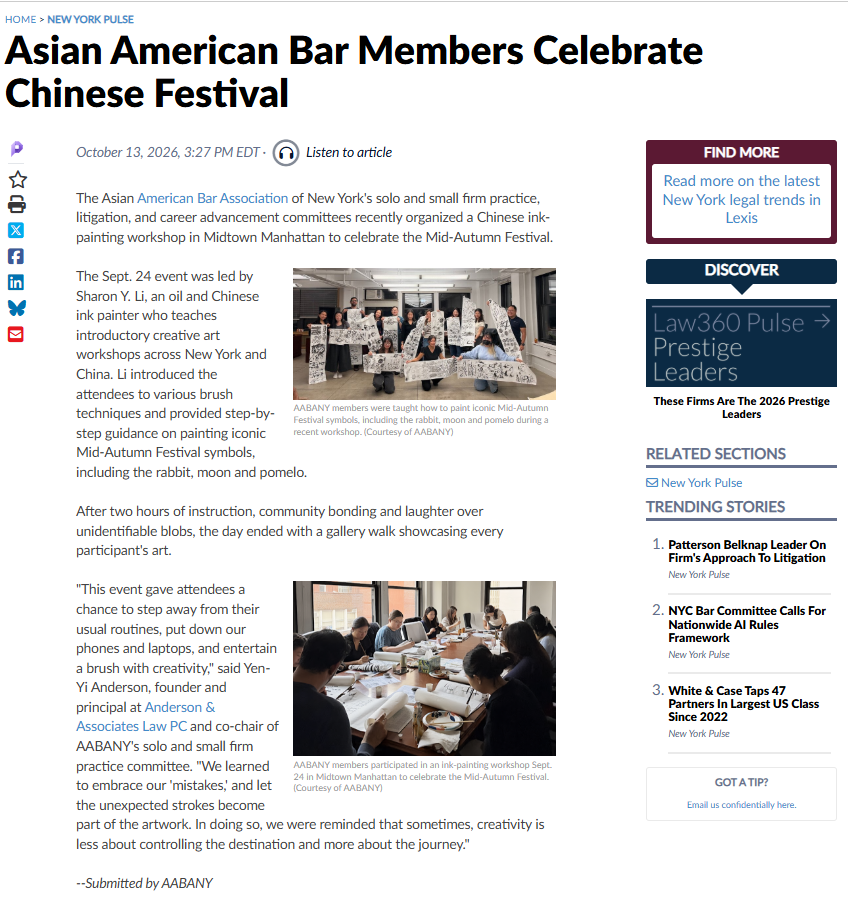
In the News: Law 360 Publishes Article on AABANY Chinese Ink-Painting Workshop

On October 13, 2026, Law 360 published an article about the Chinese ink-painting workshop organized by AABANY’s Solo & Small Firm Practice Committee, Litigation Committee, and Career Advancement Committee, which took place on Sept. 24.

Attendees at the event learned how to grip a traditional Chinese brush properly and practiced various brush techniques. and were provided step-by-step instruction on how to paint iconic Mid-Autumn Festival symbols, including the rabbit, moon, and pomelo.

To read the full article by Law 360, see screenshot above.

Thank You to the Volunteers at the October Queens Pro Bono Clinic

Many thanks to the Asian American Law Fund of New York (AALFNY), Asian Americans for Equality (AAFE), and AABANY’s Pro Bono & Community Service (PBCS) Committee, as well as our dedicated volunteers for joining our Queens Pro Bono Clinic on October 7, 2026.

PBCS volunteers, comprising volunteer attorneys and law students, met with 16 clients and provided guidance on a range of legal issues, including housing, immigration, real property, trusts & estates, family & matrimonial, litigation and civil claims.

One client commented: “Very helpful. Passionate in helping.”

Great thanks to our small but mighty team of volunteers for attending the Queens Pro Bono Clinic and for their dedicated service:

Attorneys: 

  • Jingjuan (Max) Guo
  • Kevin Hsi
  • Carmen Huang
  • Arthur Lin
  • Sinbay Tan
  • May Wong
  • Gary Yeung
  • Meng Zhang

Interpreters/shadowers:

  • Helen Ding
  • Renato Pangan
  • Jingjing Wang
  • Suzie Yu
  • Wendy Zeng

We invite you to continue supporting our community by joining us at our upcoming Pro Bono Clinics:
– October 21st [Manhattan link here] from 6:30-8:30pm, AAFE Community Center, 111 Norfolk Street, NY, NY 10002

– November 14th [Brooklyn link here], from 12:30 – 3:30pm, CPC Brooklyn Community Services, 4101 8th Avenue, Brooklyn, NY 11232 

– November 18th [Manhattan link here] from 6:30-8:30pm, AAFE Community Center, 111 Norfolk Street, NY, NY 10002

– December 2nd [Queens link here], from 6:30 – 8:30pm, AAFE One Flushing Community Center, 133-29 41st Ave, 2nd Floor, Flushing, NY 11355

Thanks to all our volunteers for attending the Pro Bono Clinic.

We look forward to your participation in our future clinics!

To learn more about the Pro Bono & Community Service Committee, visit probono.aabany.org.

AABANY’s Asia Practice Committee Presents: 2026 Legal Careers Panel at NYU School of Law

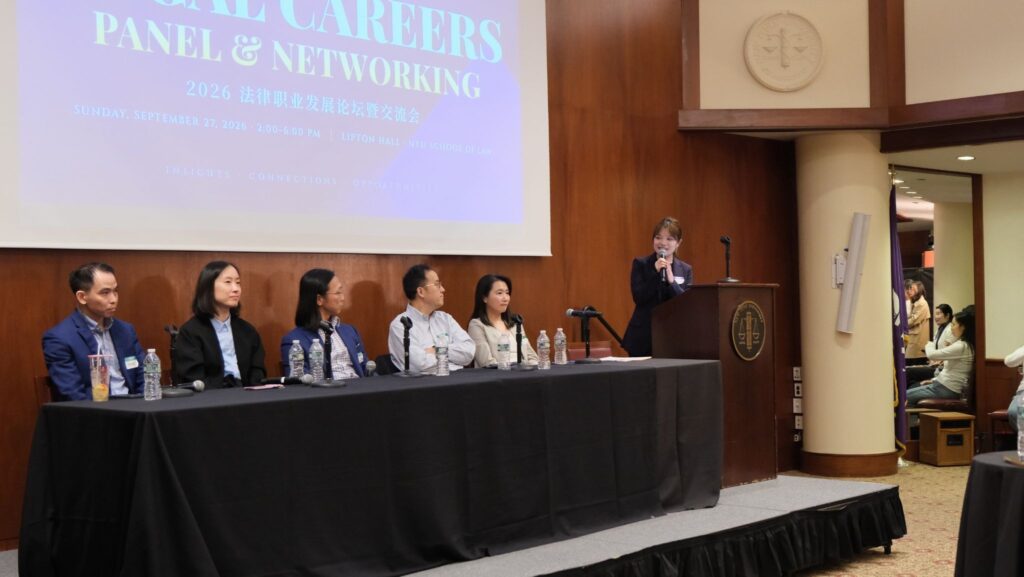
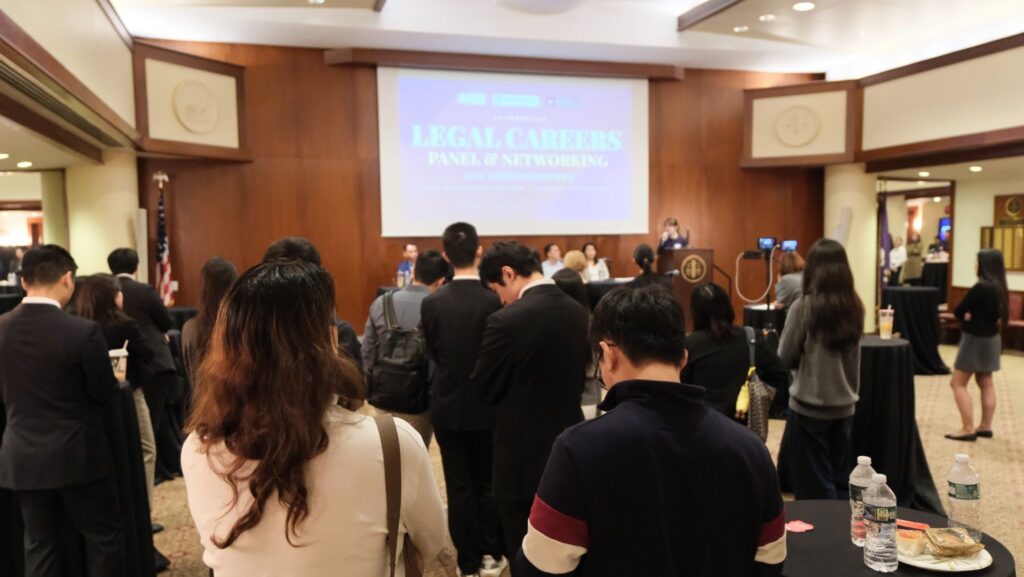
On Sunday, September 27, 2026, AABANY’s Asia Practice Committee (APC), together with the NYU Chinese Law Students Association (CLSA) and the Chinese American Lawyers Forum (CALF), hosted “Career Panel Insights from the Bar: 2026 Legal Careers Panel & Networking” at Lipton Hall, New York University School of Law. The afternoon brought together more than 100 law students, LL.M. candidates, recent graduates, and practicing attorneys for a candid conversation about launching and building a legal career in New York.

The panel featured:

The panelists reflected on the paths that led them to their current roles, from in-house practice at a global financial institution (Lian Duan) and partnership at an international law firm (Jonathan Zhou), to co-founding a law firm (Angus Ni) and practicing litigation (Simona Xu) and tax at a national law firm (Hardy Zhou). Their stories showed that legal careers are rarely linear and that the skills, relationships, and reputation built early on carry forward across very different settings.

The conversation also addressed questions of particular interest to the audience, including choosing a practice area, making the transition from law school to practice, cross-border and China-related work, and considerations facing internationally trained lawyers and LL.M. graduates entering the U.S. legal market. Panelists also shared practical advice on mentorship, networking, and professional development.

After the panel, attendees put their own questions to the speakers in an open Q&A before the event moved into a networking reception. Over refreshments and mooncakes – a nod to the Mid-Autumn Festival just days earlier – students and attorneys continued the conversation, exchanged contacts, and connected with the panelists one-on-one.

AABANY and the Asia Practice Committee thank Lian Duan, Jonathan Zhou, Angus Ni, Simona Xu, and Hardy Zhou for generously sharing their time and insights; our co-hosts, NYU CLSA and CALF; and NYU School of Law for hosting us. To learn more about the Asia Practice Committee and its upcoming programs, visit this page and keep an eye on the AABANY calendar. 

– Written by Ruixi Fu, Vice Chair, AABANY’s Asia Practice Committee

AABANY Presents CLE Program on Major Changes to Public Charge Rules

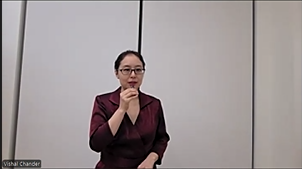
On September 17, 2026, the Asian American Bar Association of New York (“AABANY”) presented “Public Charge – What We Need to Know About Upcoming Changes,” a hybrid CLE program, at the Chinese-American Planning Council (“CPC”) Manhattan Community Center. The program addressed significant changes to the public charge ground of inadmissibility scheduled to take effect on September 18, 2026.

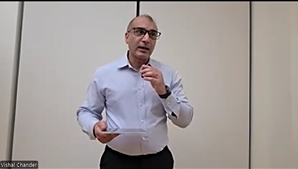
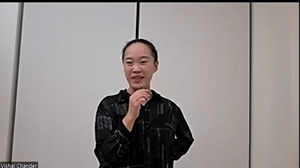
Rachel S. Lee, AABANY Board Director and Issues Committee Co-Chair and President & General Counsel of Stand with Asian Americans, moderated the program. Vishal Chander, AABANY Board Director and Issues Committee Co-Chair and Managing Attorney of The Chander Law Firm, P.C., served as the presenter. The program provided one hour of New York CLE credit in the Areas of Professional Practice category, with 24 people attending both online and in person. (Only those who attended in person received the CLE credit.)

A central focus of the presentation was the 2026 Final Rule and revised USCIS guidance, which removed much of the 2022 regulatory framework and shifted operational standards to the USCIS Policy Manual. Vishal explained that public charge determinations remain individualized, totality-of-the-circumstances inquiries, with officers considering factors such as finances, employment, education, health, household composition, and benefit use. He also discussed the broader treatment of means-tested public benefits, the continuing but non-dispositive role of Form I-864, the renewed use of public charge bonds, and the differing roles of USCIS, the Department of State, and CBP. The presentation concluded with an overview of pending litigation challenging the new framework and the legal questions surrounding DHS’s authority and use of subregulatory guidance.

Jack Hsia, Senior Attorney at CPC and a Vice Chair of the AABANY Issues Committee, joined  after Vishal’s presentation to share information about CPC’s programs and resources for the community. Jack thanked the speakers and attendees for being part of an informative discussion. AABANY thanks CPC for co-hosting the program and everyone who attended in person and online. To learn more about the Issues Committee and how you can get involved, go here.

Written by Rachel Lee, AABANY Board Director and Issues Committee Co-Chair

AABANY Asia Practice Committee Hosts U.S.–China Legal Elite Dialogue Forum & Dinner

On April 29, 2026, AABANY’s Asia Practice Committee successfully hosted the U.S.–China Legal Elite Dialogue Forum & Dinner in New York City, bringing together approximately 75 attorneys, legal professionals, and business leaders for an afternoon of insightful discussion and cross-border engagement.

Held at Club 135 by Industrious, the forum convened leading practitioners across the U.S. and China to examine the evolving legal and business landscape shaping cross-border transactions and disputes. The program featured keynote presentations and a dynamic panel discussion focused on the theme: “How U.S. and Chinese lawyers can create value for cross-border business under the new global landscape.” 

The panel brought together an accomplished group of practitioners, including Hardy Zhou, Tax Attorney at Cooley LLP and Co-Chair of AABANY’s Asia Practice Committee, and Genny Ngai, Partner at Morrison Cohen LLP and Co-Chair of AABANY’s Litigation Committee. Moderated by Haiyan Tang, Managing Partner at Quinn Emanuel Shanghai, the discussion explored the increasing complexity of cross-border legal work, including heightened regulatory requirements, shifting investment trends, and the need for closer collaboration between U.S. and Chinese counsel. 

Panelists shared practical perspectives on how lawyers can deliver value in this environment—ranging from structuring transactions and managing risk to navigating disputes and aligning multi-jurisdictional strategies. 

The forum also featured keynote remarks from Yang Chen, the Executive Director of AABANY and Chris M. Kwok, Mediator at JAMS and Co-Chair of AABANY’s Alternative Dispute Resolution Committee, and other distinguished speakers across corporate, litigation, and dispute resolution practices, providing attendees with a well-rounded view of current developments in U.S.–China legal relations. 

Following the formal program, participants continued their conversations during a networking reception and dinner, fostering meaningful connections and further strengthening the AABANY community.

AABANY extends its sincere thanks to all speakers, organizers, and attendees for contributing to the success of this event. The Asia Practice Committee looks forward to continuing to facilitate dialogue and collaboration among legal professionals engaged in cross-border practice.

-Written by Hardy Zhou, Co-Chair, AABANY’s Asia Practice Committee

AABANY Member Profile: James Chou Appointed Managing Partner of Saul Ewing’s New York City Office

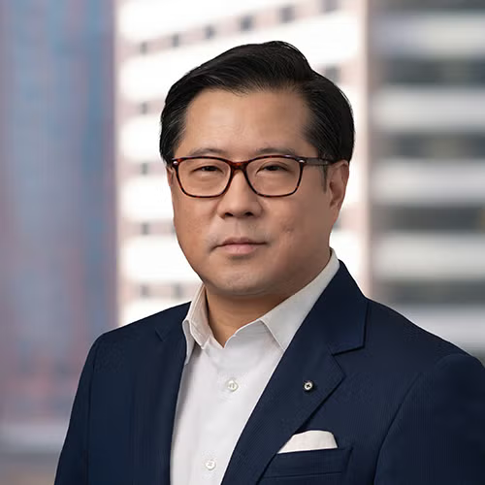
The Asian American Bar Association of New York (AABANY) is excited to share that in June 2026, James Chou, former AABANY President of AABANY (2009) and long-time AABANY member began his tenure as the new Managing Partner of Saul Ewing‘s New York City office.

James came to law by way of a detour: he started at NYU, intent on majoring in biochemistry and chasing his family’s expectations. His grandmother, one of the few women of her generation to earn a medical degree, had instilled in all her children and grandchildren, that it was her wish for them to follow in her and her late husband’s footsteps as medical doctors. James’ distaste for organic chemistry and frustration with the confining nature of the hard sciences convinced him otherwise. The breadth of a liberal arts education with its exposure to a wide array of fields and focus on critical thought, analysis, and communication provided a more attractive alternative. In his words, “the questions felt bigger, more interesting, and practically impactful.” He graduated magna cum laude from NYU and went on to Georgetown Law, where he served on the Journal of Legal Ethics and also tried his first case as a student advocate.

After a brief stint at Schulte Roth & Zabel, James spent seventeen years at Akin Gump, where he cut his teeth as a lawyer, handling all manner of complex commercial disputes. Those years were highly significant to his professional development, and he remains deeply grateful for his training and mentors there.

In 2015, he left Big Law and took a bet on himself to help build the New York office of a Long-Island-based firm, Moritt Hock & Hamroff, spending nine years there enhancing the firm’s Manhattan presence and brand in the New York market before making a returning to a broader platform at Saul Ewing in July 2024.

In May 2026, he was named the New York Office Managing Partner, effective June 1. In his new role, James is responsible for helping to develop and implement the office’s strategic vision to enhance its market position within the New York legal market and key practice areas and industries, build strategic client relationships, attract and develop top talent, and drive revenue growth and profitability. He takes on this role while maintaining a very active litigation practice as well as serving on the Board of the New York City Bar Association and as Chair of its Council on Judicial Administration.

When asked whether his Asian American identity presented a structural obstacle in his career, James replied that rather than encountering structural obstacles, he did think his cultural sensibilities—humility, deference, and polite restraint rather than aggressive self-promotion—prevented him from succeeding earlier in his career than he did. But James sees no value in dwelling on setbacks, and he views each challenge as an opportunity for growth and development. In this regard, he practices “the discipline of gratitude”—an intentional, regular practice of prioritizing thankfulness as a steady habit of mind and spirit, built on stoicism’s premise that we will all cease to exist, as well as a recognition that every experience in our life journey shapes who we are today.

Over the course of his long career, two cases stand out, both of which were pro bono. The first was in the mid-2000s, when James and his colleagues represented the New York County Democratic Committee in defending New York’s judicial convention—the system by which political parties nominate candidates for the New York State Supreme Court—against a constitutional challenge. In New York State Board of Elections v. López Torres, the Democratic Committee  argued that the First Amendment protects a political party’s right to determine how it selects its own nominees, and in 2008, the U.S. Supreme Court agreed, with a  9–0 decision. The second was in in 2012, when James represented an Angolan asylum seeker who had been wrongly linked to a violent independence movement and a high-profile 2010 attack he had no part in. The man’s only tie to the group was a membership card he received after attending a single meeting of the group in which they were promoting basic social services. Working alongside the New York Legal Assistance Group, James secured the man’s asylum in February 2012 and eventually reunited him with his wife and young son.

James shared that Saul Ewing prides itself in being a “people-first firm,” which is not just a mantra, but a core value manifest across the Firm’s platform. Consistent with that ethos, his vision as New York managing partner is to invest in people and cultivate a collaborative environment where they can maximize their potential, which, in turn, is essential to excellent client service. His message for AABANY’s members is that your reputation will be built not by the cases you win, but by the trust you earn, the people you develop, and the institutions you leave stronger than when you found it, so make sure to invest in those things.

Please join AABANY in congratulating James on this milestone achievement in his career and wishing him further success as he takes on leadership of Saul Ewing’s New York City office.

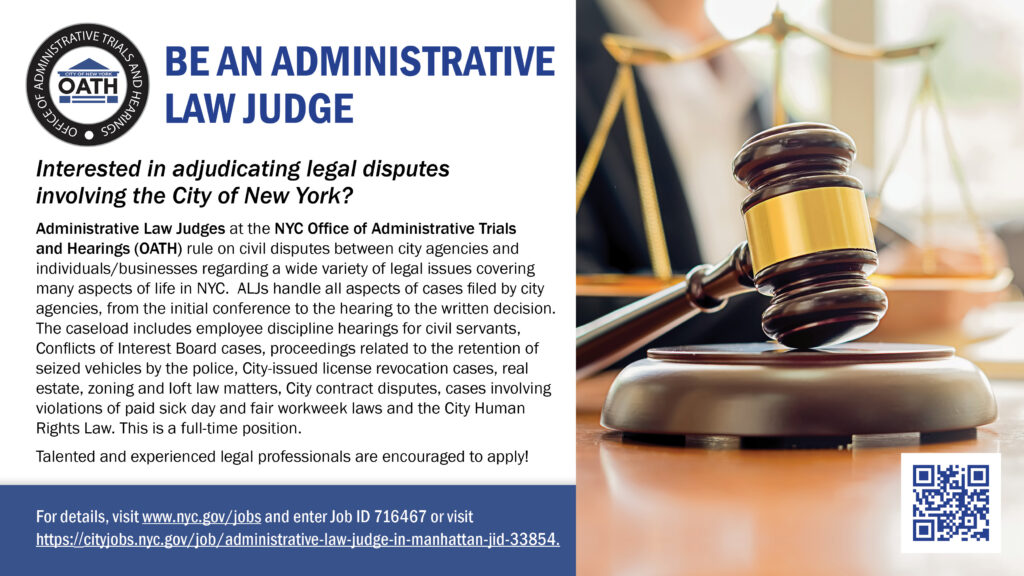
Administrative Law Judge Job Opening at NYC Office of Administrative Trials & Hearings (OATH)

About OATH

The City of New York’s Office of Administrative Trials and Hearings (OATH) is the nation’s largest administrative tribunal, holding approximately 400,000 trials and hearings a year. As the City’s central, independent administrative law court, OATH adjudicates a wide range of matters filed by nearly every city agency, board and commission. OATH also houses the Center for Creative Conflict Resolution which provides mediation and restorative justice support to City government agencies and the general public, and the Administrative Judicial Institute, a resource center that provides training, continuing education, research and support services for administrative law judges and hearing officers.

The OATH Trials Division adjudicates a wide range of issues that can be referred by any City agency, board or commission. Its caseload includes employee discipline hearings for civil servants, Conflicts of Interest Board cases, proceedings related to the retention of seized vehicles by the police, City-issued license revocation cases, real estate, zoning and loft law violations, City contract disputes, cases involving violations of paid sick day and fair workweek laws and the City Human Rights Law.

Job Description

OATH is seeking a talented and experienced legal professional to serve as an Administrative Law Judge within OATH’s Trials Division. OATH Administrative Law Judges handle all aspects of cases filed by city agencies, from the initial conference to the written decision. Administrative Law Judges are supported by a shared team of administrative professionals and law clerks. The core work includes:

– Presiding at pre-trial settlement conferences;
– Conducting formal trials pursuant to OATH’s rules of procedure (including opening statements, witness testimony, documentary evidence, closing arguments, etc.);
– Adjudicating motions and other legal requests from the parties;
– Researching and applying the relevant federal, state, and local law to cases;
– Preparing written decisions that include a summary and analysis of evidentiary and legal issues; and
– Participating in special projects at OATH

OATH Administrative Law Judges are subject to the NYS and NYC Codes of Judicial Conduct, and must maintain the highest standards of ethics, both professionally and personally. OATH Administrative Law Judges work under the supervision of the Chief Administrative Law Judge and a Supervising Administrative Law Judge. OATH Administrative Law Judges are appointed to a term of five years by the Chief Administrative Law Judge.

HYBRID OFFICE / REMOTE WORK SCHEDULE AVAILABLE AFTER INITIAL TRAINING PERIOD.

ADMINISTRATIVE LAW JUDGE – 30181

Minimum Qualifications

1. A license to practice law in the State of New York and not less than five (5) years of recent full-time relevant legal experience gained subsequent to Bar admission; or
2. A satisfactory equivalent.

Preferred Skills

– Ten (10) years experience as a litigator and/or neutral adjudicator (hearing officer, judge, referee, mediator, etc.). – Exceptional analytical ability, ability to prepare well-reasoned decisions within strict time frames. – Demonstrated ability to manage a diverse caseload in a timely manner, from case initiation to closure – Outstanding writing skills. – Qualities of judicial demeanor, including poise, discretion, patience, collegiality, and sound judgment. – Experience handling complex trials. – Drafting, revising, and finalizing high quality judicial decisions that include detailed factual narratives and thorough legal analysis, and issuing these decisions promptly. – Proficiency in Word, Microsoft Outlook, and computerized legal research, and adept at learning new computer systems to manage cases and research caselaw. – Experience working with shared administrative and support resources.

Public Service Loan Forgiveness

As a prospective employee of the City of New York, you may be eligible for federal loan forgiveness programs and state repayment assistance programs. For more information, please visit the U.S. Department of Education’s website at https://studentaid.gov/pslf/.

Residency Requirement

New York City residency is generally required within 90 days of appointment. However, City Employees in certain titles who have worked for the City for 2 continuous years may also be eligible to reside in Nassau, Suffolk, Putnam, Westchester, Rockland, or Orange County. To determine if the residency requirement applies to you, please discuss with the agency representative at the time of interview.

Additional Information

The City of New York is an inclusive equal opportunity employer committed to recruiting and retaining a diverse workforce and providing a work environment that is free from discrimination and harassment based upon any legally protected status or protected characteristic, including but not limited to an individual’s sex, race, color, ethnicity, national origin, age, religion, disability, sexual orientation, veteran status, gender identity, or pregnancy.

AABANY Membership Committee Co-Sponsors Outing to Celebrate AAPI Heritage Month with the Mets

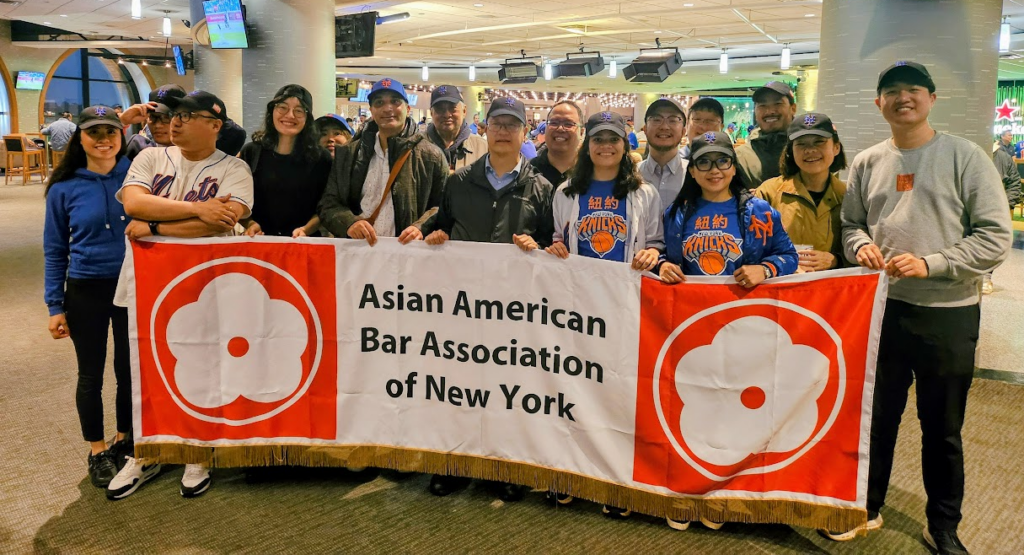
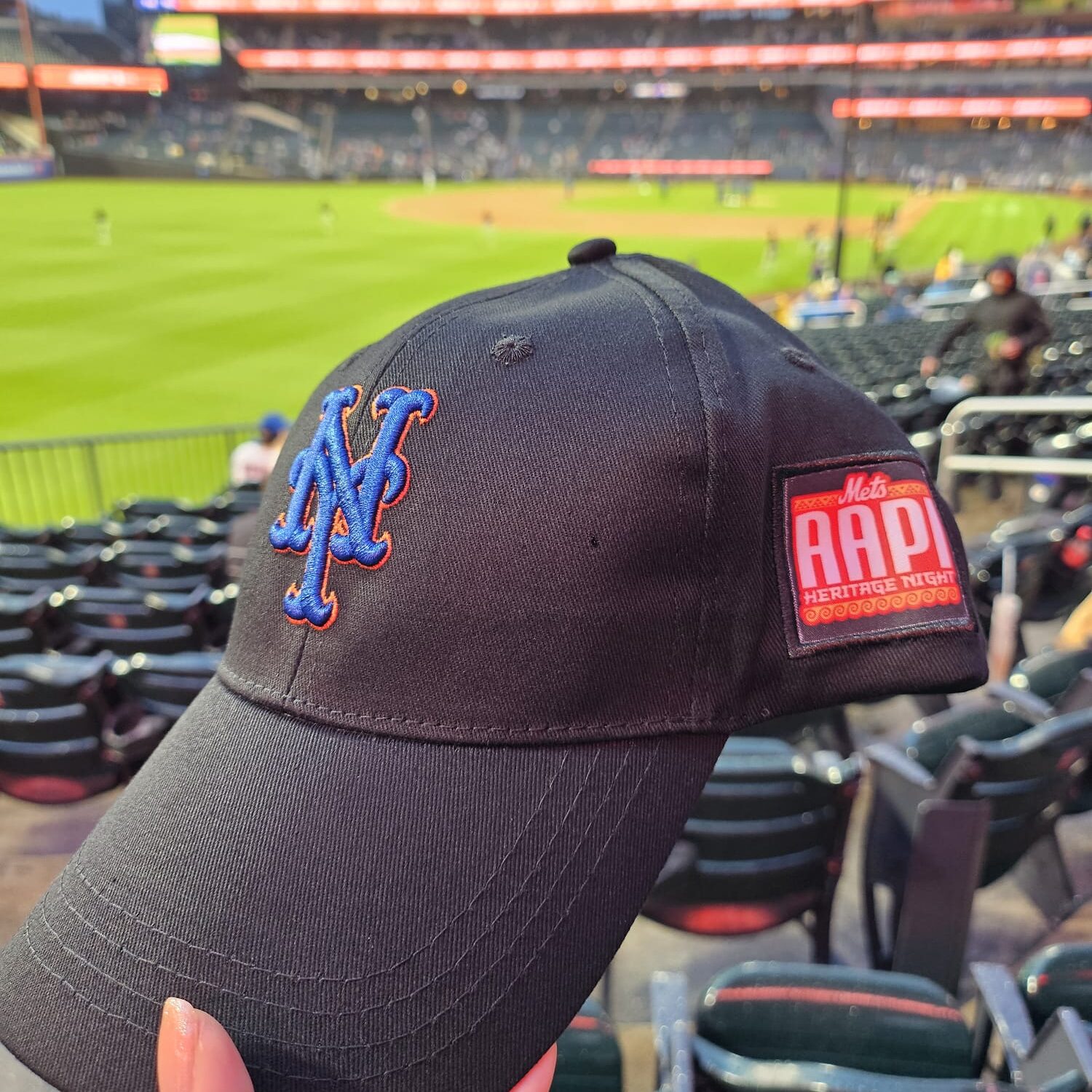
AABANY Membership Committee led a group to Citi Field on May 14th, 2025, to catch the Mets in action on AAPI Heritage night!

The Mets featured local Asian musicians, artists and lion dancers performing throughout the night. The fans heard the familiar “Take Me Out of the Ballgame” on a on a pipa, a traditional Chinese instrument.

The attendees also received a limited edition Mets/ AAPI Hat.


When rain started to fall, the group of 16 attendees went up to the Heineken Lounge to dry off. The rain eventually let up in the later innings, which was a welcome relief. Despite the rain and the loss, attendees had a great time at the ballpark!

Let’s go, Mets!

We thank Membership, Government Service & Public Interest, Litigation, Solo & Small Firm, Young Lawyers, and Women’s Committees for co-sponsoring!

Thanks to our sponsor, EcoScribe.

 If you need a process server, translation services, transcriptions or depositions, email Cynthia Kaplan 

[email protected]

  • Leading the Industry in Remote Deposition Technology for Over a Decade.
  • Eco-friendly Court Reporting and Litigation Services With a Reduced Carbon Footprint
  • Lower Cost Solutions Without Compromise
  • Strong Worldwide Network with Compatible Partnerships.

NAPABA Condemns Executive Orders Undermining the Legal Profession

For Immediate Release:
Date: March 20, 2025
Contact:
Rahat N. Babar, Deputy Executive Director

WASHINGTON – The legal profession is of constitutional significance. The right to counsel is fundamental, and the judiciary as a coequal branch of government is charged with peacefully resolving disputes that inevitably arise in a vast and complex nation. Undermining the legal profession undermines democracy.

Over the past few weeks, the Administration issued executive actions against three law firms: Covington Burling LLP, Perkins Coie LLP, and Paul, Weiss, Rifkind, Wharton & Garrison LLP. These actions included the suspension of security clearances and a review and termination of government contracts. For two of the firms, the Administration limited their access to federal government buildings and interactions between the firms and government officials.

One executive order accused global law firms of having a role “in the destruction of bedrock American principles.” Another executive order described one of the law firm’s activities as “dishonest and dangerous.” The executive actions plainly expressed a displeasure with the firms’ representation of certain clients that the Administration disfavors. Some of the executive actions are now subject to litigation.

The National Asian Pacific American Bar Association (NAPABA) condemns these attacks. From the founding of this Nation, lawyers have represented clients regardless of their stature in society. NAPABA is the national voice of the Asian Pacific American legal profession. We promote justice and equality. Members throughout our community zealously represent their clients each and every day, including those at the three law firms. When attorneys are unable to represent their clients free from intimidation and threats, our profession and justice system are jeopardized.

NAPABA also rejects the calls for the impeachment of judges simply because of their rulings. As Chief Justice John Roberts shared recently, “impeachment is not an appropriate response to disagreement concerning a judicial decision. The normal appellate review process exists for that purpose.” We agree.

For the NAPABA community, we ask you to engage and express our collective voice. Become a member. Join us at NAPABA Lobby Day. Attend the NAPABA Convention. Your leadership is pivotal.

###

The National Asian Pacific American Bar Association (NAPABA) represents the interests of over 80,000 Asian Pacific American (APA) legal professionals and nearly 90 national, state, and local APA bar associations. NAPABA is a leader in addressing civil rights issues confronting Asian American, Native Hawaiian, and Pacific Islander communities. Through its national network, NAPABA provides a strong voice for increased diversity of the federal and state judiciaries, advocates for equal opportunity in the workplace, works to eliminate hate crimes and anti-immigrant sentiment, and promotes the professional development of people of all backgrounds in the legal profession.