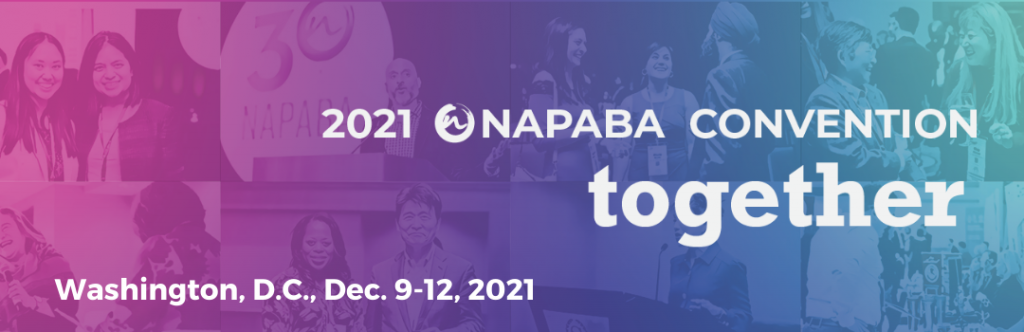
The deadline to apply for the NAPABA Prospective Partners Program (PPP) has been extended! PPP aims to increase the number of Asian American and Pacific Islander partners at major law firms through introduction, mentorship, and relationship building. In anticipation of the program’s eleventh year, the PPP is inviting candidate applications and nominations for participation in PPP sessions taking place at the 2021 NAPABA Convention in Washington, D.C., from December 9-12, 2021.
There’s one week left to apply as in-house counsel as part of NAPABA Connects, an exclusive program available to in-house counsel convention registrants and Solo and Small Firm, Gold, or higher-level firm sponsors.
Through NAPABA Connects, diverse law firm attorneys are given a forum to meet one-on-one with in-house counsel to make meaningful connections and cultivate a business relationship. In-house counsel can grow their diverse preferred provider portfolios.
In-house counsel and law firm participants will be matched for one-on-one meetings during NAPABA Convention. All participants are invited to attend the exclusive Sponsor Breakfast and NAPABA Connects VIP Reception during the NAPABA Convention December 9-12, 2021.
To participate as in-house counsel, you must fill out NAPABA’s brief application form. You can be matched with diverse law firm attorneys to cultivate new business relationships, or you may choose from a list of participating firms to expand your network with existing provider firms who may be in your preferred network. NAPABA will also send a list of all certified minority or women-owned firms to participating companies that may already have a preferred provider firm list.
The deadline to submit an IHC application is August 25 at 8 pm ET. For questions, please contact Operations Director, Maureen Gelwicks, at [email protected].
NAPABA Connects participants are eligible to receive a $750 reimbursement to the 2021 NAPABA Convention. You are encouraged to register by September 20, NAPABA’s early bird deadline. Attendees of the NAPABA Convention can earn up to 14 hours of CLE Credit, which will be focused on changes unfolding in this turbulent year as well as challenges lawyers have faced for decades.
WASHINGTON – The National Asian Pacific American Bar Association (NAPABA) expresses its grave concern at the humanitarian crisis unfolding in Afghanistan. The United States has historically been a beacon to those fleeing oppression and persecution, and NAPABA has long championed resettlement and humanitarian protections for refugees and asylum seekers. In the case of Afghan nationals who have risked their lives to support the efforts of the United States government or the International Security Assistance Force, including as interpreters, NAPABA urges the Administration to expeditiously safeguard, evacuate, and process at-risk Special Immigrant Visa eligible persons and ensure that our refugee and asylum system is equipped to handle the influx of those facing immediate threat by the Taliban, including women, children, and religious, and ethnic minorities.
“As a former flag officer in the United States Navy, I greatly appreciate the danger and risk that our Afghan colleagues assumed in order to support the global war on terrorism in Afghanistan and to secure the country from the repressive rule of the Taliban, who banned education for girls, and severely restricted the rights and freedom of women,” said A.B. Cruz III, President of NAPABA. “We must ensure that those who risked so much to support our mission are not forgotten or left behind, and that women, children, and others at risk can be protected.”
The National Asian Pacific American Bar Association (NAPABA), represents the interests of over 60,000 Asian Pacific American (APA) legal professionals and nearly 90 national, state, and local APA bar associations. NAPABA is a leader in addressing civil rights issues confronting APA communities. Through its national network, NAPABA provides a strong voice for increased diversity of the federal and state judiciaries, advocates for equal opportunity in the workplace, works to eliminate hate crimes and anti-immigrant sentiment, and promotes the professional development of people of all backgrounds in the legal profession.
The deadline to apply for the NAPABA Prospective Partners Program (PPP) is two weeks away! PPP aims to increase the number of Asian American and Pacific Islander partners at major law firms through introduction, mentorship, and relationship building. In anticipation of the program’s eleventh year, the PPP is inviting candidate applications and nominations for participation in PPP sessions taking place at the 2021 NAPABA Convention in Washington, D.C., from December 9-12, 2021.
NAPABA will be featuring 25 CLE sessions, plus the International Law Symposium, Solo & Small Firm Bootcamp, and Women’s Leadership Workshop at the 2021 NAPABA Convention! Below is a sample of the sessions we have on the schedule:
1:00 – 2:15 pm | Going Global—Insights on How to Succeed in an International Legal Career Part of the International Law Symposium
2:30 – 3:45 pm | Automating Law Practice: Sales, Marketing, Social Media, and Customer Service Part of the Solo and Small Firm Bootcamp
2:45 – 3:45 pm | Growth, Leadership, and Intentional Visibility in a Hybrid Environment Panel Discussion Part of the Women’s Leadership Workshop
9:00 – 10:15 am | Portrait Project 2.0 AAPIs in the Legal Profession—Judicial Clerkships
10:30 – 11:45 am | Coming to America: How Current Immigration Policies and Reforms Will Impact AAPIs
1:30 – 2:45 pm | The Hidden Epidemic of Elder Abuse in AAPI Communities
9:15 – 10:30 am | Emerging COVID-19 Employment Challenges: The Civil Rights Issues We Should Have Seen Coming 10:45 am – 12:00 pm | Reaching Beyond the Brass Ring—Understanding Your Career Options Other Than GC
Is the cost of attending the 2021 NAPABA Convention adding up? Apply for a Convention scholarship! The scholarship may be used towards Convention registration (Gala Admission Only not covered), reasonable travel and lodging, and ground transportation from the airport to Convention hotel. The deadline to apply for this scholarship is Wednesday, September 1, 2021, at 5 pm ET. You must be a NAPABA member to apply.
Have you registered for the 2021 NAPABA Convention yet? We would love to see you in Washington, D.C. in December! Register now to take advantage of our early bird rates! Early bird rates are available until Monday, September 20, 2021, at 11:59 pm ET.
NAPABA remains committed to the safety and well-being of its members and invited guests at its annual Convention. As such and given the continued existence of COVID-19, NAPABA will observe a COVID-19 safety protocol at this year’s Convention. To learn more about our COVID-19 Safety Protocol for the 2021 NAPABA Convention, click here.
The 2021 NAPABA Convention is generously supported by our Title sponsor:
WASHINGTON – The National Asian Pacific American Bar Association (NAPABA) applauds the American Bar Association’s (ABA) adoption of Resolution 514, which calls for Federal, State, local, territorial, and tribal jurisdictions that have not already done so to enact bias-motivated crime legislation to encompass arson, trespass, mischief, harassment, intimidation, and other criminal conduct as predicate acts of hate crimes. This is the first ABA resolution that NAPABA has co-sponsored in its history, and it comes at a critical juncture in the history of our country as the nation confronts the twin scourges of both the pandemic and a precipitous rise in anti-Asian American hate crimes and incidents. “The number of reported hate crimes and incidents represents only the tip of the iceberg,” said NAPABA President A.B. Cruz III and NAPABA Past President Wendy Shiba, who serves as NAPABA’s delegate before the ABA’s House of Delegates, in a joint statement. “Racism, xenophobia, and hate crimes have been on the rise not only against Asian Americans, but against other groups of color and religion as well. This resolution recognizes that we are not alone in our suffering, and that a consistent, nationwide approach to battling bias-motivated crimes and improving the reporting and collection of data about such acts is required.”
The Resolution also urges all jurisdictions to enact civil remedies for victims to recover damages for bias-motivated crimes and urges all jurisdictions to require data collection on bias-motivated crimes and to adequately fund law enforcement best practices, policies, training on data collection, and victim services in response to such crimes. NAPABA extends its gratitude to the ABA’s Section of Civil Rights and Social Justice and to all the co-sponsors who have championed adoption of this resolution.
In addition to co-sponsorship of Resolution 514, this session NAPABA also co-sponsored Resolution 102, which urges members of the legal profession to devote at least 20 hours each year to efforts to advance and promote diversity, equity, and inclusion in the legal profession; and Resolution 801, urging support for the U.S. Department of the Interior’s Federal Indian Boarding School Initiative, which was launched after the discovery in the United States and Canada of unmarked mass gravesites at boarding schools designed to forcibly assimilate indigenous children. The Federal Indian Boarding School Initiative is designed to investigate, locate, and record such burial sites as well as to study the historical legacy of such schools. NAPABA is grateful to the other co-sponsors and leaders of these important efforts before the ABA House of Delegates, including by NAPABA Past President Jin Y. Hwang, who as NAPABA’s representative to the ABA’s Diversity and Inclusion Advisory Council and Chair of the Council’s Policy Innovation and Resolution Incubator Subcommittee, co-authored and co-shepherded Resolution 102.
###
The National Asian Pacific American Bar Association (NAPABA), represents the interests of over 60,000 Asian Pacific American (APA) legal professionals and nearly 90 national, state, and local APA bar associations. NAPABA is a leader in addressing civil rights issues confronting APA communities. Through its national network, NAPABA provides a strong voice for increased diversity of the federal and state judiciaries, advocates for equal opportunity in the workplace, works to eliminate hate crimes and anti-immigrant sentiment, and promotes the professional development of people of all backgrounds in the legal profession.
NAPABA Connects is an exclusive program available to in-house counsel convention registrants and Solo and Small Firm, Gold, or higher-level sponsors.
Through NAPABA Connects, diverse law firm attorneys are given a forum to meet one-on-one with in-house counsel to make meaningful connections and cultivate a business relationship. In-house counsel can grow their diverse preferred provider portfolios.
In-house counsel and law firm participants will be matched for one-on-one meetings during NAPABA Convention. All participants are invited to attend the exclusive Sponsor Breakfast and NAPABA Connects VIP Reception during the NAPABA Convention December 9-12, 2021.
To participate as in-house counsel, you must fill out our brief application form. You can be matched with diverse law firm attorneys to cultivate new business relationships, or you may choose from a list of participating firms to expand your network with existing provider firms who may be in your preferred network. NAPABA will also send a list of all certified minority or women-owned firms to participating companies that may already have a preferred provider firm list.
The deadline to submit an IHC application is August 25 at 8 pm ET. For questions, please contact Operations Director, Maureen Gelwicks, at [email protected].
NAPABA Connects participants are eligible to receive a $750 reimbursement to our 2021 NAPABA Convention. You are encouraged to register by September 20, our early bird deadline. Attendees of the NAPABA Convention can earn up to 14 hours of CLE Credit, which will be focused on changes unfolding in this turbulent year as well as challenges lawyers have faced for decades.
The NAPABA Prospective Partners Program (PPP) aims to increase the number of Asian American and Pacific Islander partners at major law firms through introduction, mentorship, and relationship building. In anticipation of the program’s eleventh year, the PPP is inviting candidate applications and nominations for participation in PPP sessions taking place at the 2021 NAPABA Convention in Washington, D.C., from December 9-12, 2021.
Invited prospective partners will have the opportunity to meet with a panel of senior in-house counsel (GCs or others with outside counsel hiring authority) during one of two sessions at the Convention on either Thursday, December 9, or Friday, December 10. Additionally, the PPP will pair prospective partners with a “partner mentor” from a different law firm to provide feedback and guidance on the prospective partner’s introduction presentation and career development.
Registration for the 2021 NAPABA Convention is now open! Join NAPABA at the Marriott Marquis Washington, D.C. from December 9-12 as we celebrate our 33rd anniversary. Whether you are looking to network with others, earn continuing legal education credits, learn the latest legal insights and trends, or find your next career or business opportunity, the NAPABA Convention is sure to have something for you! Register by September 20 to receive up to an additional $150 off.
Book Your Hotel We have a room block at the Marriott Marquis Washington, D.C.! Take advantage of our $199/night discounted room rate. Apply for a Scholarship NAPABA offers a scholarship to defray the cost of the Convention. Learn more about our scholarship and apply today!
Don’t miss this opportunity to come together and connect with other AAPI leaders and legal professionals!
Your Safety at the 2021 NAPABA Convention NAPABA remains committed to the safety and well-being of its members and invited guests at its annual Convention. As such and given the continued existence of COVID-19, NAPABA will observe a COVID-19 safety protocol at this year’s Convention. To learn more about our COVID-19 Safety Protocol for the 2021 NAPABA Convention, click here.
The 2021 NAPABA Convention is generously supported by our Title sponsor:
Correction: NAPABA would like to note that Todd Kim is the second AAPI to serve as Assistant Attorney General for the U.S. Department of Justice Environment and Natural Resources Division. Shiro Kashiwa previously held the post from 1969-1972.
WASHINGTON – The National Asian Pacific American Bar Association (NAPABA) congratulates Todd Sunhwae Kim on his confirmation to become Assistant Attorney General for the U.S. Department of Justice (DOJ) Environment and Natural Resources Division (ENRD). Mr. Kim will be the second Asian American Pacific Islander (AAPI) to helm the Division.“Todd Kim is intimately familiar with ENRD’s vast and varied portfolio and has the necessary experience to be ready on day one,” said A.B. Cruz III, President of NAPABA. “NAPABA congratulates Mr. Kim on his confirmation to lead the DOJ’s efforts to protect this nation’s environment and natural resources.”Previously, Mr. Kim served as an attorney in the appellate section of ENRD where he argued appeals on behalf of the United States in all thirteen U.S. Circuit Courts of Appeals. He ably represented ENRD’s interests, which span 10 sections and includes prevention and cleanup of pollution, land acquisition, protection of wildlife, management of public lands, protecting the rights and resources of federally recognized Indian tribes and their members, and prosecution of environmental crimes.In 2006, Mr. Kim was selected to serve as the first-ever Solicitor General for the District of Columbia, a position he held for over 11 years. Mr. Kim graduated from Harvard College and Harvard Law School and then clerked for the Honorable Judith Rogers on the U.S. Court of Appeals for the District of Columbia. He is an active member of NAPABA and the Asian Pacific American Bar Association of the Greater Washington, D.C. Area.
###
The National Asian Pacific American Bar Association (NAPABA), represents the interests of over 60,000 Asian Pacific American (APA) legal professionals and nearly 90 national, state, and local APA bar associations. NAPABA is a leader in addressing civil rights issues confronting APA communities. Through its national network, NAPABA provides a strong voice for increased diversity of the federal and state judiciaries, advocates for equal opportunity in the workplace, works to eliminate hate crimes and anti-immigrant sentiment, and promotes the professional development of people of all backgrounds in the legal profession.