
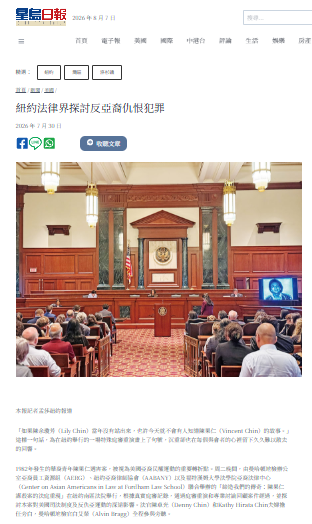
In The News: “Building Our Legacy: The Murder of Vincent Chin,” A Trial Reenactment Covered by 星島日報 (Sing Tao Daily)

On Tuesday, July 28, 2026, the Asian Employee Resource Group of the Manhattan District Attorney’s Office, in partnership with AABANY and the Center on Asian Americans and the Law at Fordham Law School, hosted the trial reenactment, Building Our Legacy: The Murder of Vincent Chin, at the U.S. District Court for the Southern District of New York at 500 Pearl Street in Manhattan. The 1982 homicide of Vincent Chin, a young Chinese American, is considered a pivotal moment in the Asian American civil rights movement. This reenactment was covered by 星島日報 (Sing Tao Daily).

The article, published on July 30, 2026, covers the specifics of this case, including how racial tensions played an instrumental role in it. According to Sing Tao Daily, at the time of Vincent Chin’s murder, anti-Japanese sentiment was high due to intense economic anxiety from inflation and nationwide unemployment in industrial fields. This sentiment was especially acute in Detroit because of the city’s heavy reliance on the auto industry. The court testimony revealed that two white auto workers, Ronald Ebens and his stepson Michael Nitz, continuously verbally abused Chin, saying, “We lost our jobs because of you motherfuckers.” This verbal abuse ultimately ended in the chase and murder of Vincent Chin with a baseball bat. 

The article described the post-reenactment discussion, which featured Hon. Denny Chin, United States Circuit Judge for the Second Circuit, and Kathy Hirata Chin, who both spoke about AABANY’s trial reenactments project. AABANY Executive Director Yang Chen spoke about the work of AABANY’s Anti-Asian Violence Task Force.

A relative of Vincent Chin, Annie Tan, also participated in the post-reenactment discussion. She was quoted by Sing Tao Daily, stating, “We cannot remain silent; instead, we must continue to tell Vincent Chin’s story and speak out bravely,” expressing the hope that—just as Lily Chin wished during her lifetime—no other mother would ever have to endure such suffering.

Click here to read the full article. 
AABANY Immigration Law Committee Gathers for its Second Virtual Monthly Meeting

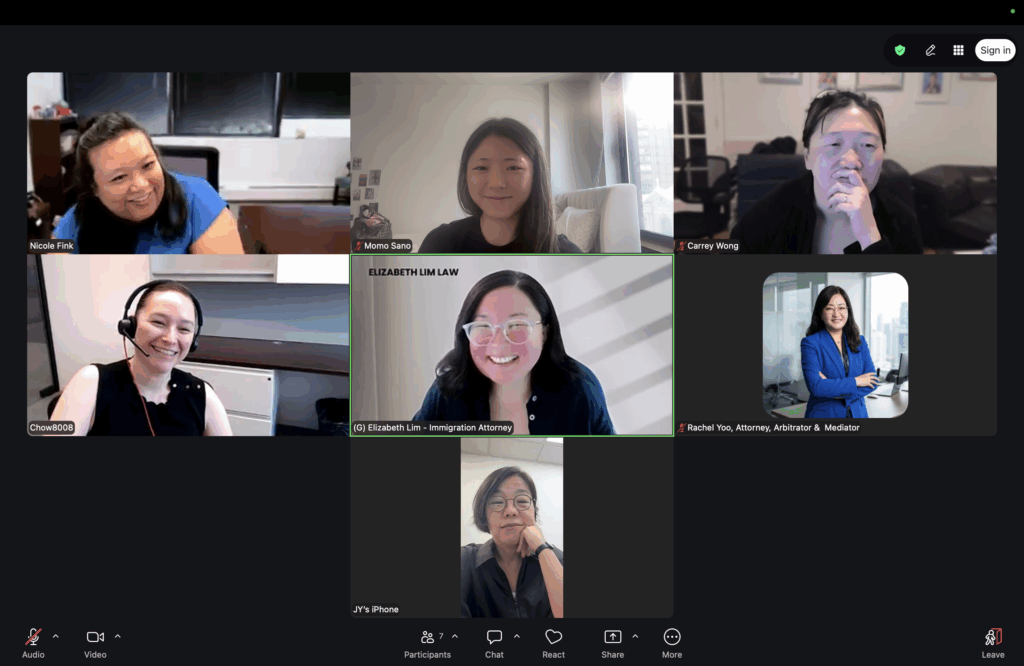
On July 31, 2026, the Immigration Law Committee of the Asian American Bar Association of New York (AABANY) held its second meeting of the fiscal year on Zoom. Nicole Fink, Chair of the Immigration Law Committee, took the opportunity to generate interest in future events, including the Committee’s upcoming educational programming, and opened the floor to new ideas from participants. 

Welcoming old and new participants alike, the meeting opened with self-introductions and an overview of the Immigration Law Committee’s objectives. Next, the group turned to forthcoming programs. Nicole emphasized the webinar on August 27 in Temporary Protected Status (TPS), which will discuss how new laws will affect immigration processes and legal practice.

Another exciting event mentioned was the Committee’s program at the 2026 Fall Conference on Saturday, September 26, titled “Beyond Forms & Filings: How Tomorrow’s Immigration Attorneys Build Power Through Tech, Data, and Storytelling.” Nicole highlighted the program’s themes of AI in storytelling, data, and program management. She also introduced the panelists: Emily Ryo, a Duke Law School faculty member who uses data analysis in immigration courts; Joseph Lin, a staff member at the Asian American Legal Defense and Education Fund (AALDEF); and Rick Liu, a Director at Epiq Global for AI Solution Architecture. The program will offer 1.5 CLE credits in skills (pending approval).

Next, the attendees talked about a potential in-person CLE event in the fall. The group hopes to partner with local law schools and law student associations. The event will likely occur in September or October, including a panel and time for lively mingling and networking.

The meeting moved on to cover the Committee’s possible future wellness-themed event, including ideas for chair or spa massages for immigration attorneys. The Committee is currently seeking partnerships with individuals or organizations interested in sponsoring the event or who have connections to massage therapists. “It would be a good way to end the year,” said Lizabeth Chow, a meeting participant and business immigration practitioner at Ogletree Deakins

Nicole concluded the meeting by opening the floor to receiving requests from the attendees for future projects. Committee members expressed their interest in more high-level informational discussions, including topics on I-751 Conditional Residency, in collaboration with family law or trusts & estates professionals; and also creating a forum for case strategy discussions. Nicole proposed sending a survey to gauge interest in this initiative. Nicole expressed openness to hearing these ideas and was gratified by everyone’s enthusiasm.

To learn more about the Committee and get involved, please visit the Immigration Law Committee page.

APALA-NJ, SABA-NJ, and NAPABA Applaud the Enactment of the John R. Lewis Voter Empowerment Act of New Jersey

WASHINGTON – As we commemorate the 61st anniversary of the Voting Rights Act of 1965, the Asian Pacific American Lawyers Association of New Jersey (APALA-NJ), the South Asian Bar Association of New Jersey (SABA-NJ), and the National Asian Pacific American Bar Association (NAPABA) applaud the recent enactment of the John R. Lewis Voter Empowerment Act of New Jersey. As one of the most comprehensive state-level voting rights laws in the country, the Act strengthens and enhances language access rights for all New Jersey voters, which includes a large and growing Asian American, Native Hawaiian, and Pacific Islander (AANHPI) population.

As we collectively noted in our written testimony to the New Jersey Legislature, New Jersey is one of the most diverse states in the country, which is due in large part to the AANHPI communities in the state.  AANHPIs—the fastest growing demographic group in the country—make up more than 11% of the state’s residents.  New Jersey is home to the nation’s fourth largest Asian American population, accounting for an 83% share of the state’s overall growth over the past two decades.

Barriers to voting, however, persist for the Asian American population.  Approximately one third of all Asian Americans in this country are limited English proficient, with over 100 distinct languages and dialects spoken amongst over 50 AANHPI ethnic groups.  

The Act, which builds on the language access provisions of Section 203 of the Voting Rights Act, strengthens and enhances language rights for Asian American communities in New Jersey.  It represents one of the strongest language access protections for voters in the country.  At a time when the federal government has removed certain language access guarantees in the delivery of critical federal services, New Jersey’s choice to improve meaningful access to the ballot box for limited English proficient voters is a welcome action for the AANHPI communities that we serve.

We thank Governor Mikie Sherrill for signing the Act into law.  We also thank the New Jersey Legislature for passing the legislation ahead of this year’s midterm elections along with all of the sponsors and champions of the law.

AABANY Book Club’s Reflection on Nora Ephron’s “I Feel Bad About My Neck”

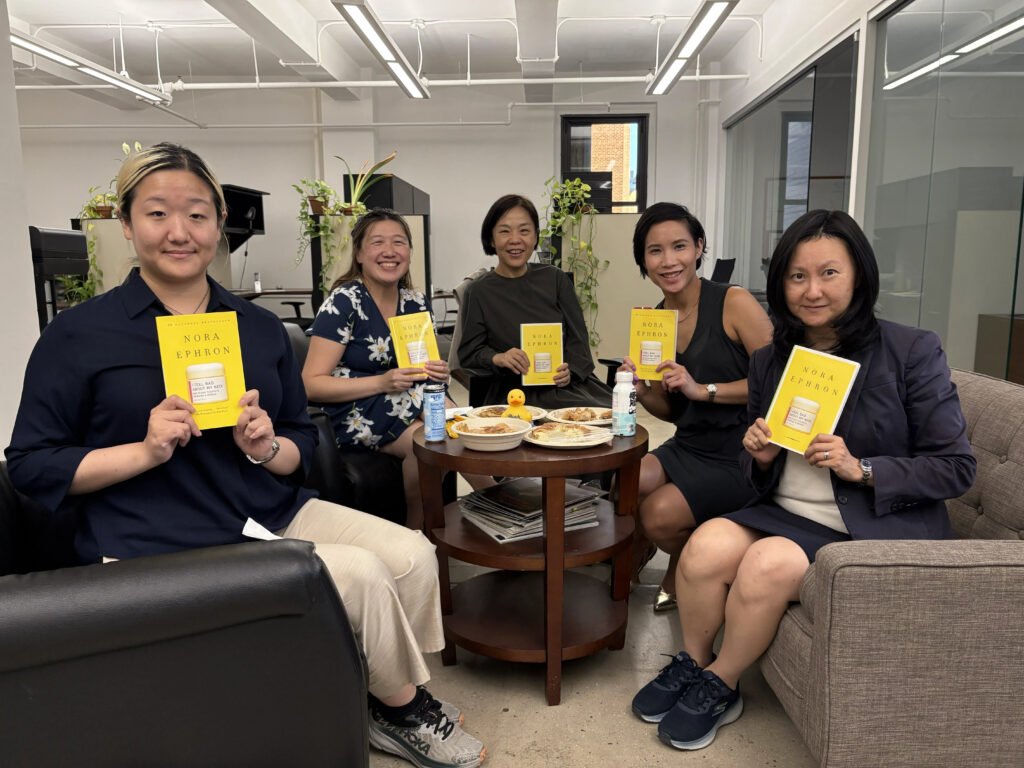
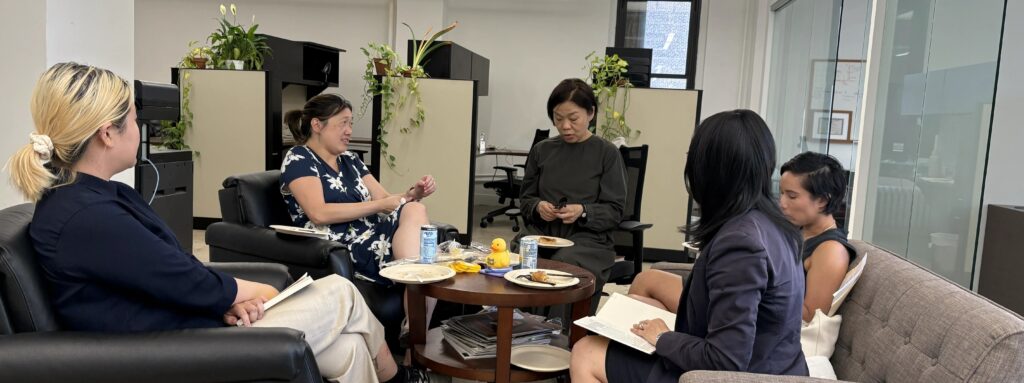
On August 4, 2026, a group of dedicated AABANY Book Club members gathered to share their insightful thoughts on this month’s book club selection.  This month, the group decided to read Nora Ephron’s I Feel Bad About My Neck: And Other Thoughts on Being a Woman. This monthly book club meeting was hosted by AABANY Book Club organizers Yen-Yi Anderson and Yan Sin, and was held at the offices of Anderson and Associates Law, P.C.

The members discussed a plethora of topics relating to this book and its author: from how “New York” this book is, aging, career reflections, maintaining success while thriving through changes brought on by womanhood, to the Chinese dishes mentioned in the book. The members could relate to Ephron’s reflections on being a passionate city dweller and mother. They also shared their thoughts about the author’s many other notable and engaging works such as the movies Julie and Julia, Sleepless in Seattle, When Harry Met Sally, and You’ve Got Mail. As the attendees conversed and deliberated on their reviews, they enjoyed cabbage strudel, a dish mentioned in Ephron’s  book.

I Feel Bad About My Neck: And Other Thoughts on Being a Woman brings candor, humor, and comfort to the dialogue of aging, reflection, and maintenance as a woman. Through this book, Ephron strips the shame from the inevitable process of aging. She encourages women to find beauty in more than their skin and physical appearance and to take pride in their growth as people. Ephron’s witty advice, thoughtful reflections, and fresh perspectives on getting older brings attention to the fact that women are so much more than their physical appearance. She urges the readers to instead focus on the daily joys and bittersweet moments life has to offer—to be present in life. 

This book evoked a mix of serious, humorous, and insightful conversations from our Book Club members. This gathering reminded us that reading is a way to reflect, grow, and build a stronger community within AABANY. Whether you’re here for the books or for the engaging conversation, we would love to have you join us for our next Book Club meeting!

Written by Constance Tu, Intern at Anderson & Associates