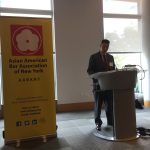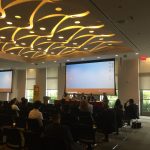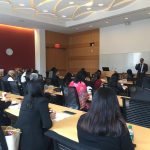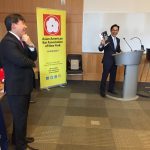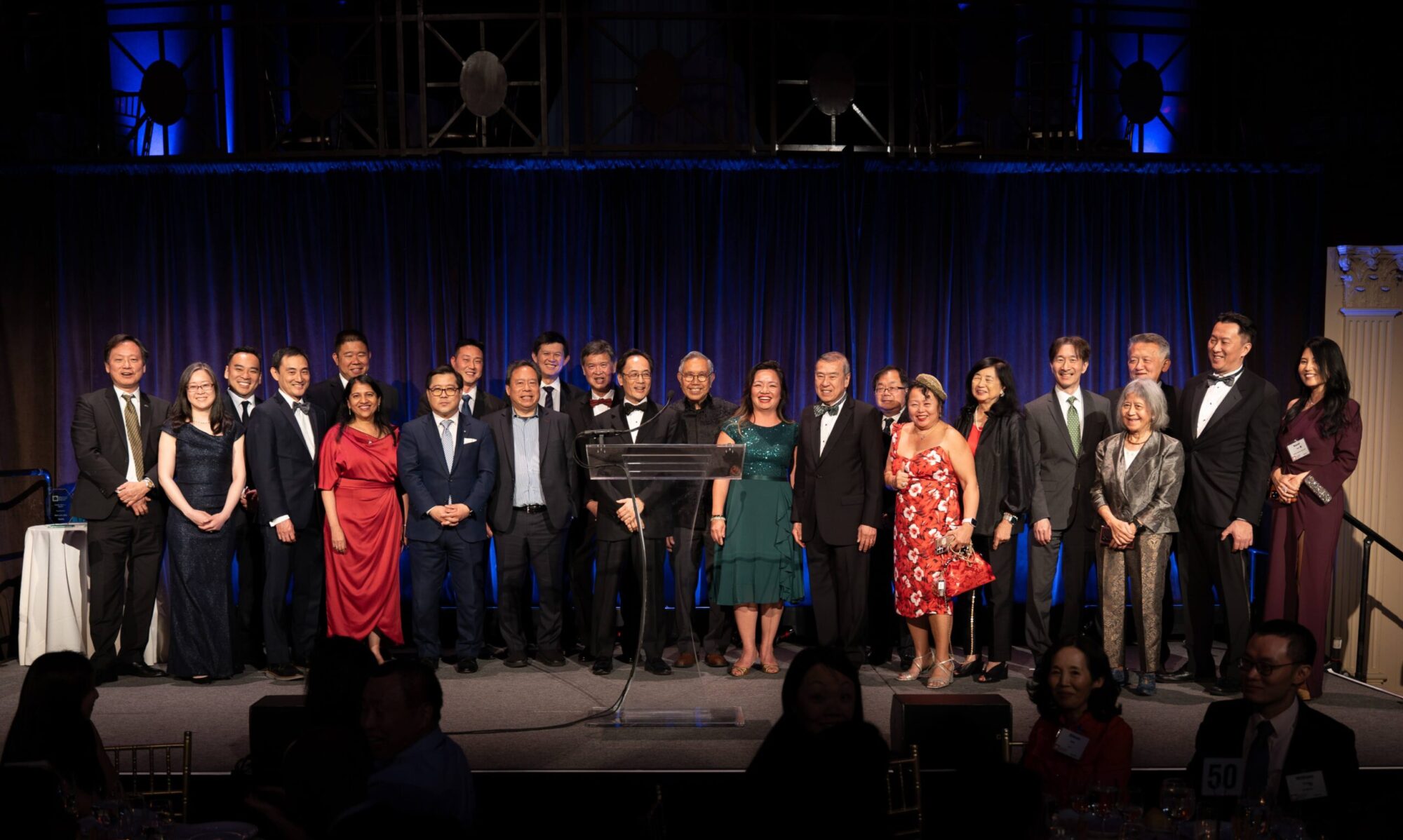

AABANY Fall Conference: APA Women in the Legal Profession Panel

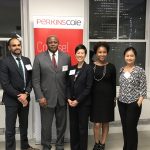
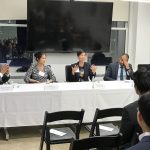
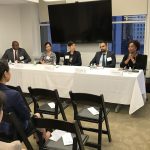
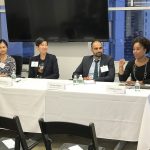
“Stronger Together: APA Women in the Legal Profession – Strategies to Support, Lead, and Advance” was one of the many panels presented at AABANY’s Fall Conference this year. Held on Saturday, September 26 from 10:45 am to 12:15 pm, the panelists consisted of:

Moderators:

  • Connie Montoya, Partner, Hinshaw & Culbertson
  • Sandra Yamate, CEO, Institute for Inclusion in the Legal Profession

Speakers:

  • Anna Mercado Clark, Partner, Phillips Lytle LLP
  • Judy Lam, Partner, Maynard Cooper & Gale
  • Honorable Grace E. Lee, Administrative Law Judge, State of New York
  • Sandra Leung, General Counsel, Bristol Myers Squibb
  • Sapna Palla, Partner, Wiggin and Dana

The panel was not recorded to create a safe environment for panelists as well as listeners so that there could be a candid conversation about race and the experiences APA women have had to face throughout their legal careers.

The panel started off with discussing the challenges and barriers of being an APA woman in the legal profession. Shared experiences among the panelists were that they were often overlooked in the courtroom, being perceived and mistaken as the court interpreter or court reporter rather than as the lawyer or judge. Even when they were correctly perceived as the lawyer, the panelists were still treated differently compared to their white male counterparts. In response to these challenges, the panelists discussed how it was okay to feel uncomfortable about these topics and it is important to focus on the microaggressions. If people are more vocal about the uncomfortable situations and share their experiences with the community, it creates a greater ability to mobilize and create change.

The panelists stressed the importance of seeing more APA women in higher positions and one way of achieving that is through having role models and mentors for rising APA lawyers. Current AABANY President, Sapna Palla, highlighted the AABANY Leadership Development Program which has been successful in teaching participants the skills to advance into executive positions, and she hopes to see more programs that do the same.

The panel ended with each panelist going over one action item they were willing to commit to within the next year that will help support and advance APA women in the legal profession. The general consensus among the panelists was to start a mentoring circle. Not only do the panelists want to be an available resource for people who come up to them and have questions, but also they want to be active in following up with mentees and seeking feedback from them.

The panelists also vow to use their positions as a platform to continue this dialogue. Advancing APA women in the legal profession is an ongoing conversation and hopefully, listeners of the panel are inspired to continue the dialogue with their friends, peers, and colleagues.

Thank you to the panelists, Anna Mercado Clark, Judy Lam, Honorable Grace E. Lee, Sandra Leung, and Sapna Palla, and moderators, Connie Montoya and Sandra Yamate for sharing their experiences and leading an important discussion about supporting APA women in the legal profession.

Fall Conference 2020: Enforcement in a Fragmented World

On September 26, 2020, as part of the second day of the 2020 Fall Conference, AABANY hosted Enforcement in a Fragmented World, a panel on unique challenges currently facing attorneys representing clients in white collar and enforcement matters. On the panel were:

  • Edward Y. Kim, Co-Founder of Krieger Kim & Lewin LLP (Moderator)
  • Charu Chandrasekhar, Assistant Regional Director of the Division of Enforcement of the U.S. Securities and Exchange Commission
  • Una Dean, Partner at Fried Frank LLP
  • Joon H. Kim, Partner at Cleary Gottlieb (and former Acting U.S. Attorney for the Southern District of New York)
  • Leo R. Tsao, Chief of the Bank Integrity Unit at the U.S. Department of Justice

The discussion started with the panelists talking about how their work has been affected by the pandemic. They discussed how a lot of the work they do — interviewing witnesses, talking and negotiating with the authorities, and gathering information — relied on in-person work. However, they agreed that justice delayed is justice denied, especially for the people and companies they are investigating. With statutes of limitations and fading memories, enforcement attorneys have been interviewing people over video and phone calls. Despite many successful interviews, they still have the obstacle of building relationships and rapport with potential cooperators over the phone. All in all, they agreed that enforcement has been very active recently and will continue to be for years to come.

Then, each of the attorneys discussed their personal experiences in enforcement. Although the attorneys each had different career paths, they agreed that they all loved their jobs because they are able to focus on doing justice, not winning cases. They discussed how their job is also an incredible honor and responsibility to be able to serve their community and country.

Next, the speakers talked about challenges they have encountered as Asian Pacific American (APA) practitioners. While dealing with drastic underrepresentation in their fields, as well as the ever persistent Model Minority Myth and the Perpetual Foreigner stereotype, the attorneys often faced overt and subtle racism in their work. However, they see a strong trend in many organizations towards actively diversifying the workplace to create a base of attorneys who actually reflect the communities they serve. Additionally, Chandrasekhar and Dean discussed the added challenges of being female APA practitioners. They discussed how government work can actually be a great equalizer. Although there are still many difficulties that come with many sacrifices and compromises, women in government service are taught to stand up and speak out in court about their cases, which builds confidence.

The panel concluded with some of the attorneys discussing the importance of separating the system from the service. They agreed that there are many serious injustices and inequities in the justice system, and the justice system must be reformed and improved by educating people within the justice system. The speakers acknowledged that many of the people working and handling individual cases within the system are genuinely passionate about upholding justice. And these attorneys will continue to do so proudly for the rest of their careers.

In these uncertain times, it is incredibly inspiring to hear from leading practitioners and enforcers in the field of white collar enforcement. Thank you to the panelists Charu Chandrasekhar, Una Dean, Joon H. Kim, and Leo R. Tsao and moderator Edward Y. Kim for sharing their experience and insights in the field of justice.

To view a recording of this program, please click on the video image at the top of this blog post.

2019 NAPABA Northeast Regional/AABANY Fall Conference

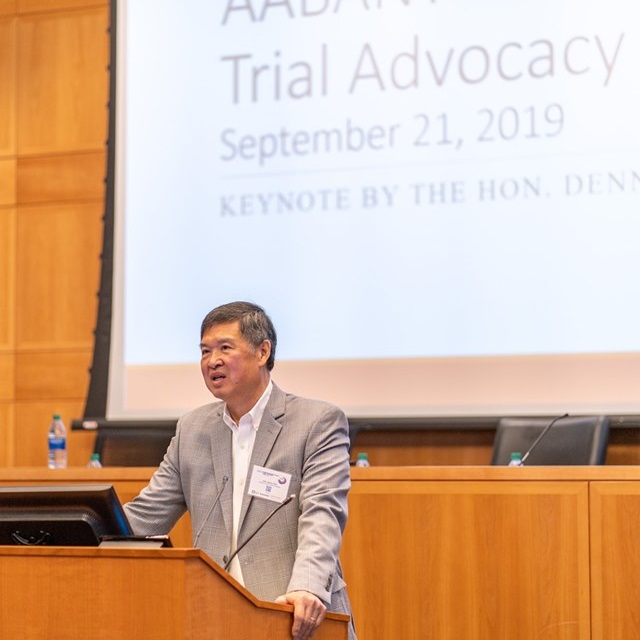
On Saturday, September 21, 2019, AABANY held its 10th annual Fall Conference together with NAPABA for the 2019 NAPABA Northeast Regional/AABANY Fall Conference, “United in Action and Vision: Towards 2020 Together.” For the third year in a row, the conference took place in Fordham University School of Law. This year marked our biggest yet, with about 450 attendees throughout the day. On Friday evening, September 20, we held a Welcome Reception at Supernova, a rooftop bar in the Novotel Hotel on West 52nd Street, to kick off the Conference, open to all attendees from New York and the Northeast region.

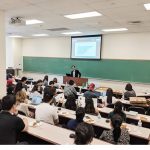
This year, many programs throughout the morning and afternoon offered CLE credits to attending attorneys. Twenty CLE programs were available, covering many different topics ranging from Asian American Voter Protection to Pro Bono Clinics. Also available were non-CLE programs such as the In-House Counsel Forum and “Asian American Women Corporate Counsel in Television.” In addition to all the programs offered at the Fall Conference, we had Pitch Sessions, Trial Advocacy Program (TAP), Professional Development Coaching sessions, and a Diversity Career Fair and Expo. Numerous employers from all over New York City and State set up informational tables at the Diversity Career Fair to speak with prospective candidates. This was a great way for law students, recent graduates, and practicing attorneys to learn more about the employers and their different areas of practice. Some of the employers set up onsite interviews to speak with Fall Conference attendees who submitted resumes in advance.

In one of our morning programs, the Pro Bono Committee hosted “The Art and Science of Interviewing Pro Bono Clients.” The program addressed how to communicate with and educate the clients, collect information, and manage clients’ frustrations. This included a necessary discussion regarding proper translation issues that would arise as well as establishing a reliable relationship with an interpreter. Beatrice Leong and Jonathan D. Hernandez simulated an effective and ineffective client intake meeting to demonstrate the important takeaways of this program.

Another program that took place was “State and Federal Clerkships: A Primer on Seeking, Landing, and Succeeding in the Right Clerkship for You,” organized by AABANY’s Judiciary Committee, which discussed the benefits of a clerkship, steps to landing a clerkship, and some tips on how to be successful at a clerkship. The panelists highlighted how a clerkship can help with professional development, legal writing and research skills, and building a network. The panelists were also able to give some insight into the differences between state and federal court clerkships, the application process, and how to approach interviews.

The Plenary Lunch Session featured a Special Screening of the award-winning documentary “And Then They Came for Us.” This documentary reflects on the story of Executive Order 9066 and the internment of 120,000 Japanese-Americans during World War II. It also highlighted the landmark Korematsu v. United States case and its relation to the civil rights issues people of color and under-represented communities face today. The screening was followed by a discussion with NAPABA Trailblazer Dale Minami, who was Fred Korematsu’s lawyer, and the filmmaker, Abby Ginzberg.

More programs continued in the afternoon including the Connecticut Asian Pacific Bar Association’s “Opioids and the Courts” program. This program discussed the national opioid epidemic created by certain pharmaceutical companies and how states and individuals are bringing lawsuits against those companies. We heard directly from William Tong, Attorney General of the State of Connecticut, and his approach to the multi-district litigation in Ohio that is scheduled for trial in October 2019.

Our afternoon included additional insightful programs such as “Cybersecurity: 20/20 Hindsight Not Good Enough in 2020,” organized by AABANY’s Commercial Restructuring and Bankruptcy Committee, which discussed the cybersecurity industry today, and how lawyers can help prevent data breaches and safeguard against bad actors. The panelists gave advice on how attorneys can stay ahead of data breaches and protect their clients – mainly through diligent pre-breach planning, training staff on signs of a breach, and preparing a response plan in case of a breach. The panelists also offered some advice on the ethical concerns that arise when a breach occurs, and how to best handle them. 

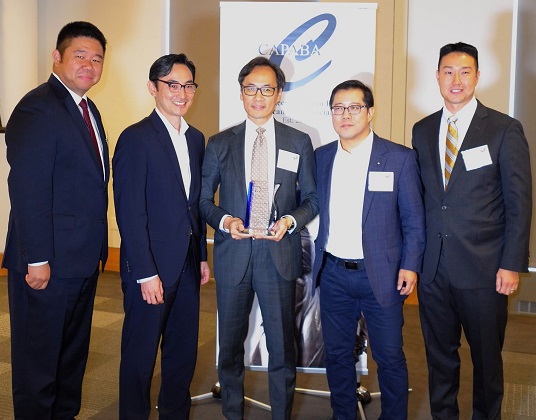
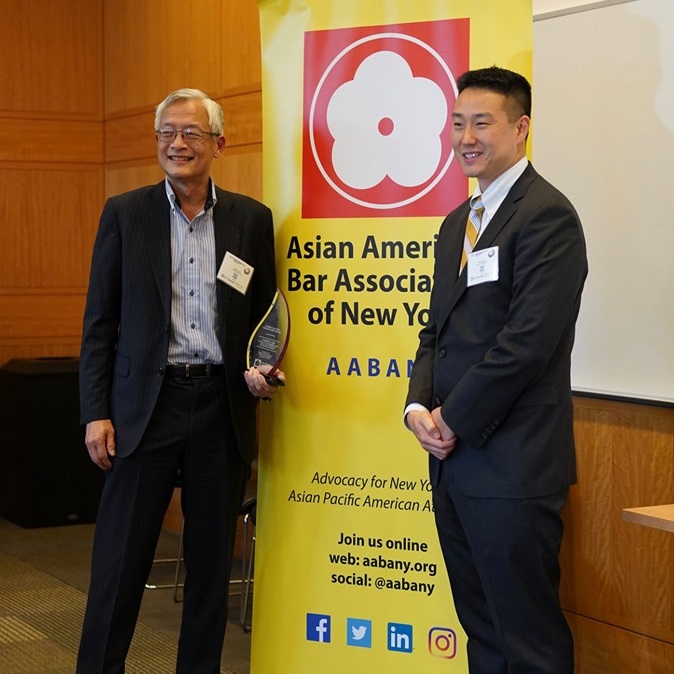
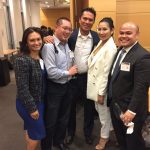
After the programs concluded, a Cocktail Reception was held in the Bateman Room and the terrace outside the Soden Lounge. Attorneys and participants connected and reconnected with peers, friends and colleagues from AABANY and NAPABA. Connecticut Attorney General William Tong offered opening remarks to all in attendance, followed by President Brian Song presenting AABANY’s Norman Lau Kee Trailblazer Award to Parkin Lee, Chief Legal Officer of the Rockefeller Group. Parkin Lee is a pillar of the Asian American legal community who has paved the way for generations of Asian American attorneys in New York and across the country.

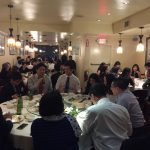
The night didn’t stop there as we continued the festivities in the heart of New York City at the Ascent Lounge to enjoy a Post-Conference Dinner. Located in Time Warner Center in Columbus Circle, the lounge was the celebratory finale to the Conference, and participants got to mix and mingle over a dinner buffet, drinks and dessert, with views of Central Park at night.

Many thanks to all the participants including the speakers, moderators, program coordinators, and volunteers. Thanks to our sponsors for their support which made this successful Conference possible. We also thank Fordham Law School for hosting us at their exquisite facility.

For some photos from the Conference visit AABANY’s Facebook page. The albums are organized according to the volunteers who took them: Laura Tsang, Guanlan Shen, Katherine Shen and Ziqi Guan.

Thanks to Justin Chan, Tiffany Cheung, Dasheng Lin, Wai Wong, and Lia Kim, our law student volunteers from Cardozo Law School, for their help in drafting this blog post.


AABANY Fall Conference: Program Submission Form

AABANY Fall Conference: Program Submission Form

Important Information for Those Interested in Attending the Diversity Career Fair and Expo (DCF) at the 2017 AABANY Fall Conference

If you are planning to attend the DCF please note the following:

  1. The DCF is being held in conjunction with AABANY’s Fall Conference at Fordham Law School, on Saturday, September 23. To attend the DCF you must first be registered for the Fall Conference. You must also complete an intake form. DCF is scheduled to take place from 10:30 am to 4 pm. More details here on the Fall Conference website.
  2. Registration is open via the AABANY website at http://bit.ly/fc17reg
  3. If you are an AABANY member who has not paid to attend the Fall Conference, you can attend DCF – and only DCF – for free. You may NOT attend any of the programs at the Fall Conference, including the lunch session and the cocktail reception at the end of the day.
  4. To register to attend DCF for free as an AABANY member, click here.
  5. If you are not an AABANY member, you can join online and pay the appropriate membership fee at http://www.aabany.org/?page=J2.  Once you have done that, follow the instructions above in paragraph 4.
  6. If you are not an AABANY member and you are not interested in joining but you wish to attend DCF, then you must register for and pay to attend the Fall Conference at http://bit.ly/fc17reg.
  7. The deadline to sign up for onsite interviews passed on Sept. 7.
  8. If you have not already done so, please submit a copy of your resume to resume@aabany.org by Thursday, Sept. 14. In the subject line, please list 2017 DCF, your name and “Informational Tables.” Your resume will be included in a resume book that will be circulated to participating employers.

If you have any questions about DCF, contact careers@aabany.org.

Third Annual Diversity Career Fair and Expo

Get excited!  The Career Placement Committee will host the Third Annual Diversity Career Fair and Expo on September 23, 2017 as part of AABANY’s Fall Conference.  The Diversity Career Fair is an exciting opportunity to meet with a variety of public sector and private sector employers that are looking to hire diverse candidates with all levels of experience.  Employers will set up informational tables, collect resumes, and/or conduct on-site interviews.  More than 20 employers have already committed to participating this year.  More information will follow in upcoming newsletters and on the Fall Conference website, but in the meantime, feel free to send any questions to the Career Placement Committee Co-Chairs at careers@aabany.org