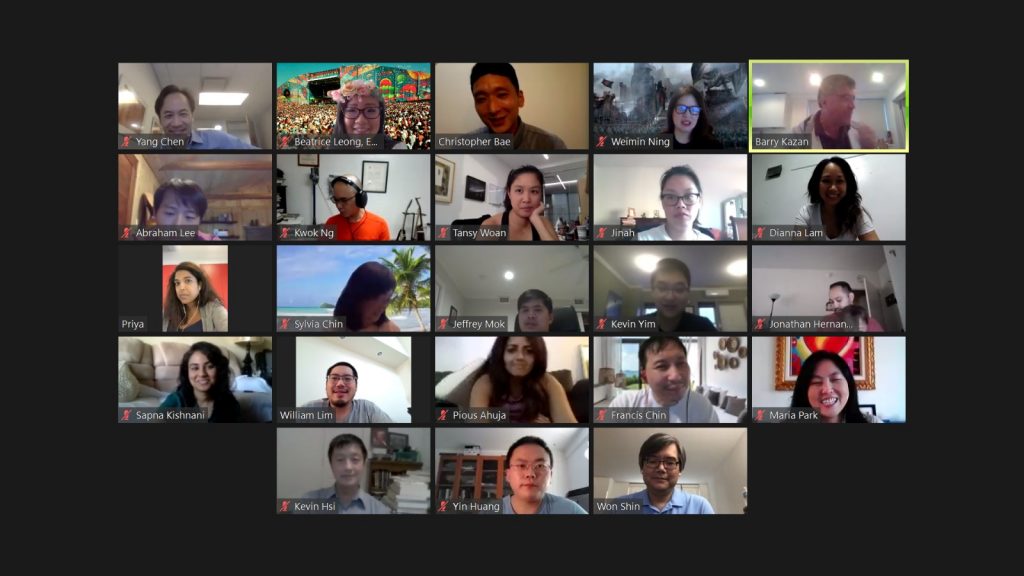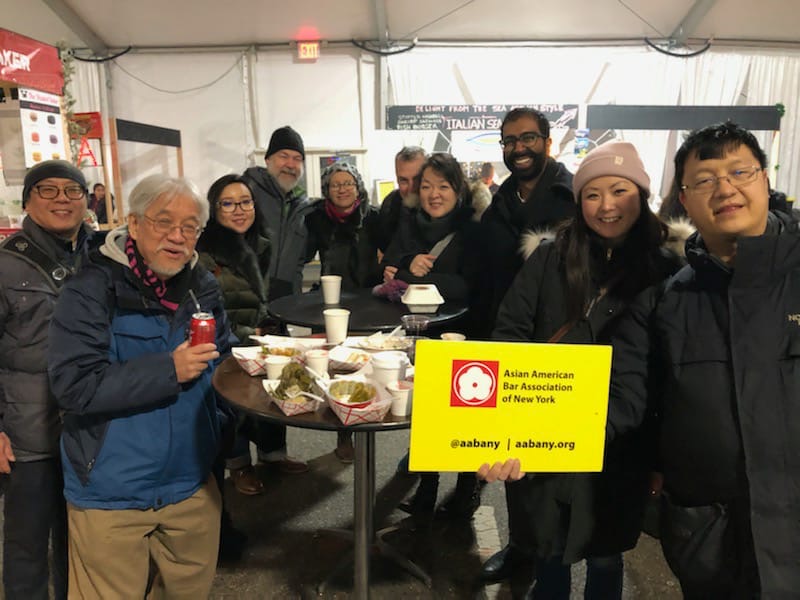

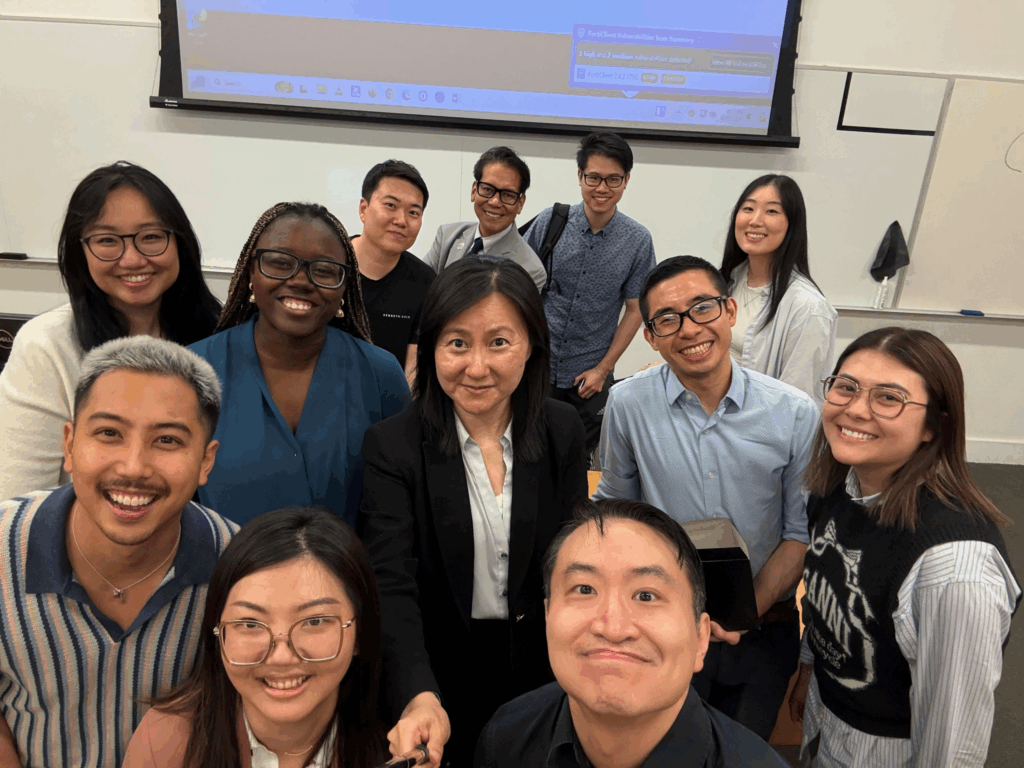
On April 15, 2026, the Asian American Bar Association of New York (AABANY)’s LGBTQ Committee, in collaboration with the Solo and Small Firm Practice Committee, hosted a dynamic and insightful panel at Fordham Law School titled “Table Talk: Careers Beyond Big Law.” Generously co-sponsored by Fordham APALSA and Fordham OUTLaws, with support from AABANY’s Student Outreach Committee, the event brought together an accomplished group of legal professionals and an engaged audience of students and early-career professionals eager to explore alternative pathways within the legal profession.
Mina Yi, a Fordham Law student representing Fordham APALSA, served as moderator and kicked off the discussion by asking the panelists to introduce themselves, their practice areas, and their current roles. Then, she asked them to share their advice on how students can pursue non-traditional or non-Big Law career paths.
The panel featured a diverse lineup of speakers, including Gregory Hom (Nixon Peabody), Kayla Lucia (Mintz), Yen-Yi Anderson (Anderson & Associates), Thomas Wu (New York State Housing Finance Agency), Daobo Wang (New York State Unified Court System), and Glenn Magpantay (U.S. Commission on Civil Rights). Almost all the speakers were AABANY leaders: Gregory is the current Co-Chair of the LGBTQ Committee. Kayla was Co Chair during the last fiscal year, and Daobo is Co-Chair this fiscal year. Yen-Yi is Co-Chair of the Solo and Small Firm Practice Committee. Glenn is a Director on AABANY’s Board.
The speakers’ careers spanned public finance, employment litigation, immigration, small law firm practice, government service, judicial clerkships, and civil rights policy. Their varied trajectories illustrated a central theme of the evening: legal careers are rarely linear. The panelists conveyed that professional fulfillment often emerges from adaptability in one’s circumstances, persistence, and meaningful relationships.
From the outset, panelists demystified the notion of a singular “Big Law path.” Gregory Hom offered a nuanced perspective on large-firm practice, noting that not all firms operate under the same high-turnover model often associated with the industry. He mentioned that instead, firms like Nixon Peabody prioritize sustained interest in specialized practice areas, such as his own work in public finance, and rely heavily on faculty recommendations and personal connections in hiring. In his daily practice, he acts as a “watchdog” for state agencies and investment banks, meticulously reviewing documents to ensure securities law disclosures are consistent and avoid SEC investigations. Gregory shared that he secured his role after heavily leaning on a professor for guidance, and he recommended that students not shy away from doing the same.
Kayla Lucia echoed this sentiment, reflecting on her own nontraditional journey, starting in Legal Aid, then moving to “Midlaw,” and eventually to a major firm specializing in employment law. She noted that she transitioned into private practice to find a more sustainable professional life and to avoid the burnout she felt in the public interest sector. Kayla encouraged students to think critically about the kind of professional and personal life they hope to build, and to consider factors like team size and environmental competitiveness, rather than defaulting to prestige-driven choices. Her current work involves bridging the gap between poorly written statutes and the concise answers employers need, while also assessing the factual viability of litigation claims.
Yen-Yi Anderson provided a compelling account of forging an independent path to starting her own small firm practice. She recounted that her career did not follow a direct route after law school, spending years in nonprofit and media work before returning to the legal field and building her own practice through relationships she had developed with foreign entrepreneurs. In a small-firm setting, she emphasized that attorneys must “wear many hats,” balancing legal work with responsibilities such as managing hiring, payroll, office management, and client development. At the same time, she noted that her practice areas in immigration and commercial litigation require constant attention to evolving laws and policies, which makes adaptability essential. Despite the challenges, Yen-Yi relished the autonomy that comes with running her own firm. She is able to choose her clients, shape her workload, and maintain flexibility in her schedule to allow her to prioritize family alongside her career.
The discussion was further enriched by perspectives from the public sector, illustrating how legal work can directly shape public policy and address community needs. Thomas Wu detailed his role at the New York State Housing Finance Agency, where legal practice operates at the intersection of law and urban development. In this capacity, attorneys work alongside policymakers and financial institutions to structure deals that support affordable housing initiatives across the state. He described the work as both technical and mission-driven as it requires attorneys to translate legal frameworks into practical tools that enable large-scale development projects. Thomas also emphasized the importance of fellowship programs, such as the Excelsior Fellows Program, as accessible and structured entry points into government service for recent graduates seeking substantive experience and long-term pathways into public sector careers.
Similarly, Glenn Magpantay offered a broader, long-term perspective shaped by decades of experience across civil rights enforcement, nonprofit leadership, AABANY, and his current role as a Commissioner on the United States Commission on Civil Rights. Glenn encouraged students to view their careers as evolving journeys that may have uncertainty and deviation from previous expectations. Glenn advised, “Don’t worry too much about getting it right the first time—your career will evolve, and you’ll get where you want to go,” reinforcing the idea that resilience and adaptability with the legal community are often more determinative of long-term success.
The discussion also highlighted the critical role of networking and mentorship. Speakers consistently emphasized that relationships, such as those cultivated through bar associations like AABANY and broader community engagement, are often instrumental in securing opportunities. Glenn noted that in a competitive field where many candidates appear equally qualified on paper, it is frequently personal connections and trusted recommendations that set applicants apart.
During the Q&A portion, one student asked how the law is actually applied in day-to-day practice as opposed to the case-based learning emphasized in law school. Speakers responded by illustrating their actual responsibilities in vivid detail. Whether it was Gregory ensuring regulatory compliance in complex financial disclosures, Kayla interpreting ambiguous statutes to advise clients, or Daobo drafting judicial opinions grounded in meticulous legal research, each speaker illustrated how legal reasoning operates in real-world contexts. These insights helped bridge the gap between classroom learning and professional application where students were able to gather a clearer understanding of what legal work truly entails.
The evening concluded with an interactive session in which attendees also introduced themselves and shared their aspirations, followed by informal networking over pizza. Thank you to AABANY’s LGBTQ Committee and Solo and Small Firm Practice Committee for organizing and hosting this thoughtful and engaging program, as well as to Fordham APALSA and Fordham OUTLaws for their generous co-sponsorships and collaboration. Special appreciation also goes to the Student Outreach Committee for their continued support in creating meaningful opportunities for students to engage with practitioners across diverse areas of the legal profession.