
AABANY Immigration Law Committee Holds its First Virtual Monthly Meeting on 6/16/2026

On June 16th, 2026, the  Immigration Law Committee of the Asian American Bar Association of New York (AABANY) held its first meeting of the year on Zoom. Nicole Fink, Chair of the Immigration Law Committee, used this occasion as an opportunity to reconnect with fellow immigration attorneys and to gauge interest in potential events later this year. 

At the start of the meeting, Yang Chen, the Executive Director of AABANY, sought applications for  AABANY’s Legal Referral and Information Services (LRIS) program. Currently, the LRIS program is looking for experienced lawyers to join its panel due to high demand for qualified immigration lawyers.

Next, the meeting focused on plans for the Immigration Law Committee’s growth and potential topics of interest for the near future. Nicole Fink made a request for more participation in AABANY’s Pro Bono Clinics, especially from immigration lawyers. The Pro Bono Clinics take place in community settings, to create a more welcoming environment for those seeking legal advice. Lawyers serving in the Clinic provide limited scope representation and would only give brief advice and refer clients to legal resources, and are thus not committed to representing any client after the consultation at the Clinic ends. As an  incentive, Fink offered to buy a free meal for any lawyers on the call who volunteered at the Clinic. 

The meeting also covered  continued legal education (CLE) programs. After AABANY’s well received training on habeas corpus on June 4th, meeting attendees expressed interest in more CLE opportunities on immigration-related issues and other topics, such as AI usage in the legal field. The discussion also focused on overlapping areas such as matrimonial law and legal issues affecting juveniles. The group talked about the need to connect lawyers with different areas of expertise, and who may be able, for example, to aid conditional residence cases or special immigrant juvenile status cases.  

The meeting concluded with a reminder about the 2026 Fall Conference on Saturday, September 26th, in which the Immigration Law Committee is presenting a panel on AI and data analytics in the immigration field, “Beyond Forms & Filings: How Tomorrow’s Immigration Attorneys Build Power Through Tech, Data, and Storytelling.” The meeting attendees also brainstormed on possible wellness opportunities for immigration lawyers, to combat the tough legal environment they operate in by offering more relaxing options to connect and refresh. Committee members were encouraged to reach out in the weeks ahead with additional ideas or interest in getting involved with Pro Bono Clinics, wellness opportunities, or networking across practice areas.

To learn more about the Committee and get involved, please visit the Immigration Law Committee page

AABANY Presents Program on Habeas Corpus Practice in Immigration Detention

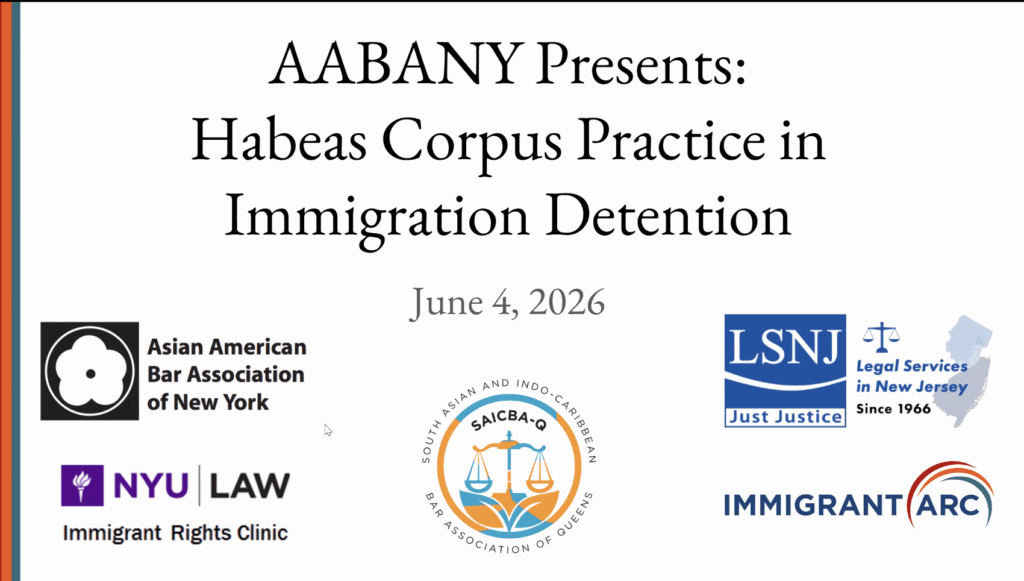
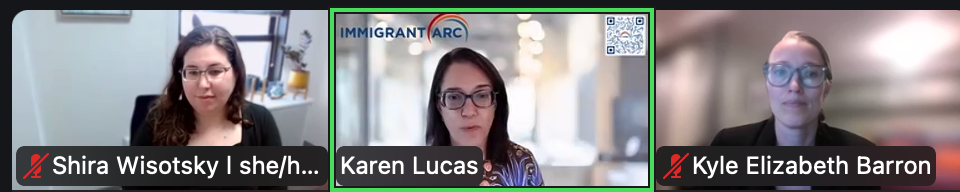
On June 4, 2026, the Asian American Bar Association of New York (AABANY) presented “Habeas Corpus Practice in Immigration Detention – A Training for Lawyers, a program addressing habeas litigation as a tool for challenging unlawful immigration detention. The program featured speakers Karen Lucas of Immigrant Advocate Response Collaborative (I-ARC), Kyle Barron of the New York University School of Law, and Shira Wisotsky from Legal Services of New Jersey (LSNJ). The event was organized by the AABANY Issues Committee and Immigration Law Committee and was cosponsored by the South Asian and Indo-Caribbean Bar Association of Queens.

The presentation discussed the importance of habeas corpus as the federal government expands immigration detention. The program provided an overview of the statutory framework governing civil immigration detention and discussed the constitutional limits on civil detention, underscoring that immigration detention remains subject to procedural and substantive due process.

The program also reviewed common habeas claims in both pre-order and post-order detention contexts. These included statutory misclassification, unlawful revocation of release, due process challenges to prolonged mandatory detention, claims arising from statutory protections such as the Violence Against Women Act (VAWA), and post-order detention challenges where removal is not reasonably foreseeable. Attendees received practical guidance on drafting a habeas petition. 

Attendees had opportunities to participate in case studies throughout the program and ask questions, showing their passion, curiosity, and dedication.

The program concluded with an invitation for attorneys and volunteers to provide pro bono habeas representation by volunteering for I-ARC and the NYU Law Immigrant Rights Clinic’s NY Habeas Project and LSNJ’s Detention and Deportation Defense Initiative. AABANY thanks the speakers and organizers for providing this important training.

To learn more about the Issues Committee, go here. To learn more about the Immigration Law Committee, go here.

– Written by Vishal Chander, Board Member and Co-Chair of AABANY’s Issues Committee

Criminal Justice Act (CJA) Panel Applications Now Open for US Court of Appeals, 2d Cir.

The Criminal Justice Act Committee of the United States Court of Appeals for the Second Circuit is accepting applications for service on the Court’s Criminal Justice Act Panel. CJA Panel Members represent indigent criminal defendants and petitioners for habeas corpus.

Admission to practice before this Court is a necessary qualification for membership on the Panel. The Court seeks attorneys of superior experience and proven competence in federal appellate criminal defense work. The qualifications of attorneys applying for service on the Panel will be examined by the CJA Committee’s Attorney Advisory Group, which will make recommendations for membership on the Panel. Membership on the Panel will be for a term of one to three years, at the discretion of the Court. Attorneys currently serving on the panel need not reapply until the expiration of their present term.

Application forms for membership on the Criminal Justice Act Panel are available at the Court’s website at www.ca2.uscourts.gov, or by calling 212-857-8702.

A signed original application, one copy of each of your appellate briefs, and three paper copies of the completed application and your resumé, along with a CD containing both your completed applications and resumé, must be received by the Clerk of Court by 5:00 p.m. on Monday, April 6, 2026.

Please check the Court’s website (www.ca2.uscourts.gov) periodically for CJA developments.

Criminal Justice Act (CJA) Panel Applications Now Open for US Court of Appeals, 2d Cir.

The Criminal Justice Act Committee of the United States Court of Appeals for the Second Circuit is accepting applications for service on the Court’s Criminal Justice Act Panel. CJA Panel Members represent indigent criminal defendants and petitioners for habeas corpus.


Admission to practice before this Court is a necessary qualification for membership on the Panel. The Court seeks attorneys of superior experience and proven competence in federal appellate criminal defense work. The qualifications of attorneys applying for service on the Panel will be examined by the CJA Committee’s Attorney Advisory Group, which will make recommendations for membership on the Panel. Membership on the Panel will be for a term of one to three years, at the discretion of the Court. Attorneys currently serving on the panel need not reapply until the expiration of their present term.


Application forms for membership on the Criminal Justice Act Panel are available at the Court’s website, or by calling 212-857-8702.


A signed original application, one copy of each of your appellate briefs, and three paper copies of the completed application and your resumé, along with a CD containing both your completed applications and resumé, must be received by the Clerk of Court by 5:00 p.m. on Monday, April 3, 2023.


Please check the Court’s website periodically for CJA developments.

On Friday, February 24, AABANY, together with the Korean American Lawyers Association of New York (KALAGNY), the Filipino American Lawyers Association of New York (FALA-New York), the Muslim Bar Association of New York (MuBANY) and the Migrant Center, Church of Saint Francis of Assisi, presented a Writ of Habeas Corpus Training to a full house at San Damiano Hall at the Church of Saint Francis of Assisi on West 31st Street.

The course covered the recent Executive Orders on immigration and provided training on filing habeas corpus petitions. Among the speakers was Immigration and Nationality Law Committee Co-Chair Amanda Bernardo.

For more photos from the event, click on the embedded Facebook post above from FALA-New York.

Thanks to everyone who took part in this important and timely program, and thanks to KALAGNY for spearheading the organization of this event.