WASHINGTON – The National Asian Pacific American Bar Association (NAPABA) strongly opposes the Administration’s renewed effort to undermine the constitutional guarantee of birthright citizenship. In an executive order issued yesterday, and just over a month after the U.S. Supreme Court struck down a previous executive order limiting birthright citizenship, the Administration purports to create additional categories of children born on American soil who would be denied birthright citizenship based solely on the status of their parents.
The law is clear. Under Trump v. Barbara, 609 U.S. ____ (2026), children born in the United States—even to parents unlawfully or temporarily present—are subject to the jurisdiction of the United States and are citizens at birth. The Supreme Court recognized longstanding yet narrow exceptions to this rule, which include those born to foreign diplomats or invading armies. In reaffirming birthright citizenship, the Court upheld United States v. Wong Kim Ark, 169 U.S. 649 (1898), which rejected consideration of the status of the parents outside of the narrow exceptions.
Yesterday’s executive order attempts to unilaterally expand the categories of children ineligible for birthright citizenship. It would, among other things, deny citizenship to children born to parents employed by a foreign government or designated as an “alien enemy,” a term that invokes the spectrum of historical injustices during World War II when the federal government removed and incarcerated approximately 120,000 individuals of Japanese ancestry.
NAPABA will remain vigilant and stands ready to ensure that the Fourteenth Amendment’s promise of citizenship to all persons born in the United States, regardless of the stature or circumstances of their parents, is kept.
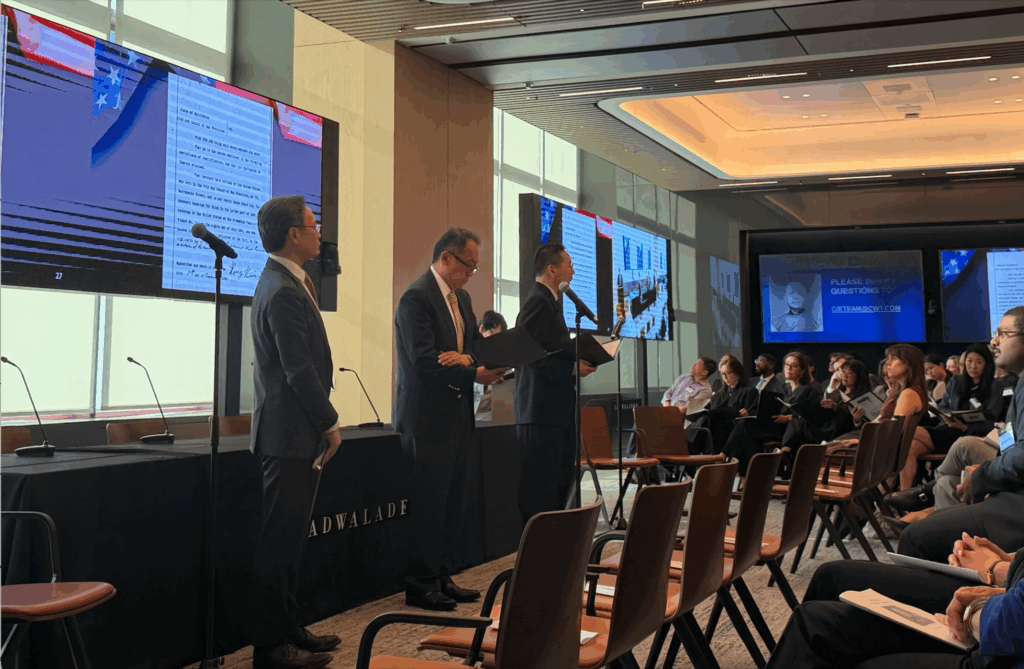
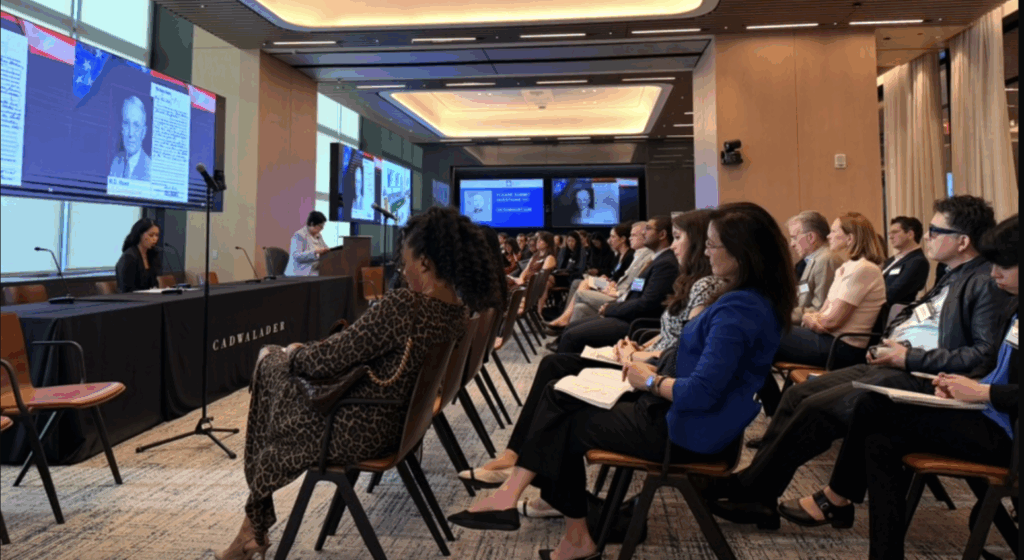
As Asian American, Native Hawaiian, and Pacific Islander Heritage (AANHPI) Month wound down, attendees gathered on May 27, 2026 in downtown Manhattan to watch the latest historical trial reenactment produced by the Asian American Bar Association of New York (AABANY) entitled Born American: United States v. Wong Kim Ark.
United States v. Wong Kim Ark, which established birthright citizenship as a Constitutional right in 1898, is AABANY’s 17th trial reenactment. This project brings to life notable cases involving Asian Americans, Native Hawaiians and Pacific Islanders, to spotlight significant ways that AANHPI individuals contributed to the legal, social, and political history of the United States. Reenactments are first performed at the National Asian Pacific American Bar Association (NAPABA) Convention in November, then again in May during AANHPI Heritage Month in New York.
AABANY’s latest trial reenactment made its New York debut at Cadwalader, Wickersham & Taft LLP. Attendees settled in to watch a cast of 37 characters played by some 17 lawyers, including many AABANY members.
The reenactment had two narrators, who are also the writers, producers, and leaders of the AABANY Trial Reenactment team: Hon. Denny Chin, Senior United States Circuit Judge for the U.S. Court of Appeals for the Second Circuit, and Kathy Hirata Chin, a retired Partner of Crowell & Moring LLP and previously a retired Cadwalader Partner.
Other cast members included:
Anna Mercado Clark, Phillips Lytle LLP, Partner and Chief Information Security Officer (past NAPABA President, former AABANY Board Officer)
Vincent T. Chang, Law Clerk for Hon. James d’Auguste, Supreme Court, New York County, Commercial Division (former AABANY President)
Andrew T. Hahn, Hawkins, Delafield & Wood LLP, General Counsel (former AABANY, KALAGNY, and NAPABA President)
Yasuhiro Saito, Saito Law Group PLLC, Managing Partner
Francis H. Chin, Opensity Solutions, Senior Systems Engineer (AABANY Membership Director)
Yang Chen, Asian American Bar Association of New York, Executive Director (former AABANY President)
Pamela K. Chen, United States District Judge, Eastern District of New York
Concepcion A. Montoya, Hinshaw & Culbertson, Partner
Lauren U.Y. Lee, Korean American Family Service Center, Board of Directors; Cadwalader, Wickersham & Taft LLP, former Special Counsel
Kiyo A. Matsumoto, Senior United States District Judge, Eastern District of New York
Rose Cuison Villazor, Rutgers Law School, Professor of Law and Chancellor’s Social Justice Scholar
Jacob Chen, DGW Kramer LLP, Litigation Partner
Jane Kim, Wigdor LLP, Partner; former clerk for Hon. Denny Chin
Janicelynn Asamoto Park, Proskauer Rose LLP, Partner; former clerk for Hon. Denny Chin
Jessica C. Wong, Cadwalader, Wickersham & Taft LLP, Special Counsel
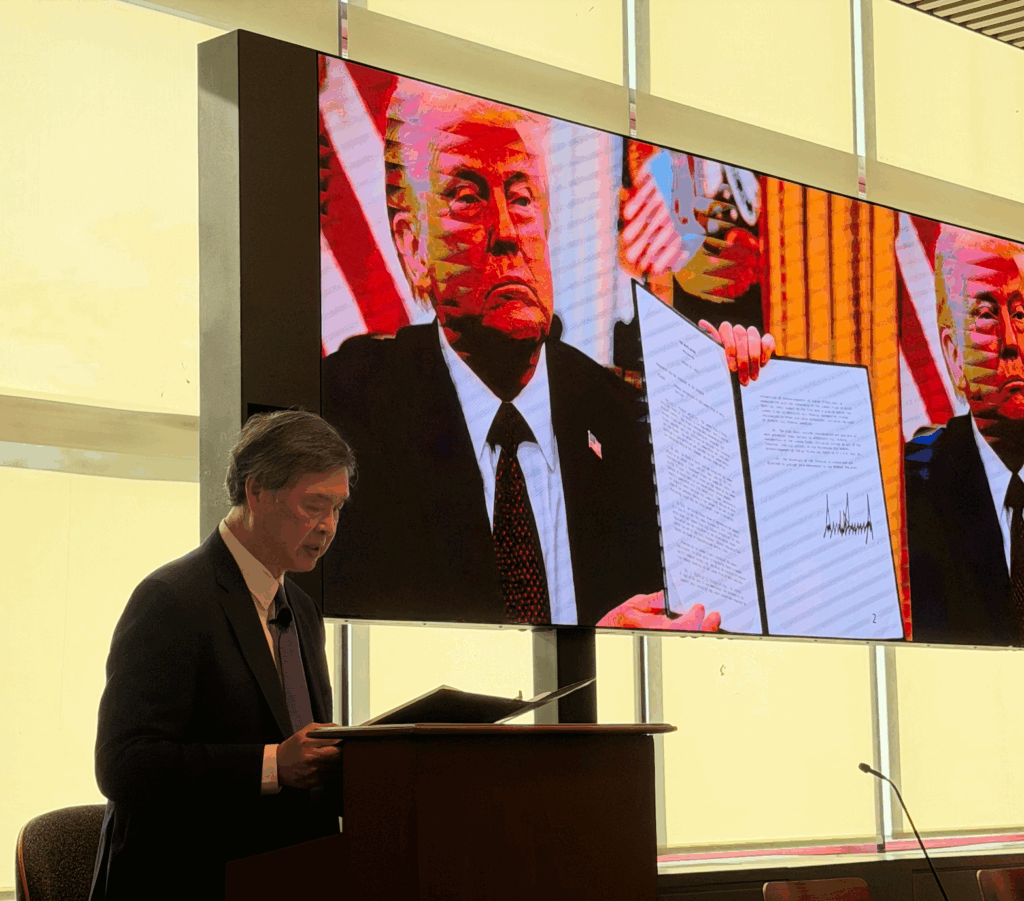
This reenactment was bookended by the case’s connection to current events. The narrators described President Donald Trump’s January 2025 Executive Order 14160, “Protecting the Meaning and Value of American Citizenship,” which sought to remove birthright citizenship from US-born children of parents who are undocumented or in the country temporarily.
This case follows the story and life of Wong Kim Ark, who was born in San Francisco to Chinese immigrant parents in 1870, one of only 518 ethnic Chinese born in the United States that year. Wong took multiple trips back to China, before returning to America in 1894, at which point he was denied entry on the grounds of not being a citizen.
That denial was appealed all the way to the United States Supreme Court. The question before the Court was whether Wong should follow the citizenship of his parents or of where he was born. The reenactment reconstructed the Supreme Court argument, for which no transcript exists, using the briefs, the resulting court opinions, news reports, and other historical documents. Arguments revolved around whether children born in the U.S. are “subject to the jurisdiction thereof,” under its plain meaning as stated in the Fourteenth Amendment. The original intent of Congress with regard to children born to foreign-born parents, as well as the implications of barring Wong Kim Ark’s birthright citizenship upon existing immigrant communities—European immigrants—and children of other nationalities, were also explored in the reenactment.
United States v. Wong Kim Ark affirmed Wong’s citizenship in a 6-2 decision in 1898, setting a legal precedent for more than a century. The majority ruling held that the 14th Amendment’s “ancient and fundamental rule of citizenship by birth within the territory” and its “peremptory and explicit language” all made Wong an American citizen.
However, Wong’s immigration troubles did not stop there, for either himself or his children. He lived in a time when anti-Chinese sentiment was rampant. Even within the decision itself, Justice John Marshall Harlan, for the dissent, wrote that “There is a race so different from ours that we do not permit those belonging to it to become citizens of the United States.” This captures the discrimination that society had at the time towards Chinese immigrants in America.
The reenactment further explored Wong’s life, as well as his family’s, after the Supreme Court’s ruling. Wong was later arrested in 1901 upon crossing the US-Mexico border, though the case was eventually dismissed—because of United States v. Wong Kim Ark. His four sons, born in China, faced intense scrutiny when they sought to come to the United States seeking citizenship as sons of a U.S. citizen. They faced heightened suspicion and interrogation that stretched over weeks or months of detention and aimed to determine their familial relationship to Wong, a form of scrutiny common to Chinese immigrants in the early 20th century.
The end of the reenactment returned to Trump’s executive order. The many lawsuits and preliminary injunctions that responded to Trump’s January order make frequent reference to United States v. Wong Kim Ark as well-settled precedent for birthright citizenship. The reenactment shares the responses to Trump’s Executive Order, including one from Judge Deborah Boardman in Maryland, who said that the executive order “conflicts with the plain language of the 14th Amendment [and] contradicts 125-year old binding Supreme Court precedent.”
In this context, it becomes vitally important to revisit Wong Kim Ark’s life and times. Amid the prevalence of anti-immigrant rhetoric during the 1890s, United States v. Wong Kim Ark set precedent for generations of immigrants, including Asian Americans, and was reaffirmed throughout a series of 20th century Supreme Court cases, including INS v. Errico, 385 U.S. 214 (1966) and Plyler v. Doe, 457 U.S. 202 (1982).
A discussion panel and Q&A session followed the reenactment, where questions of relevance to current times were at the forefront. Attendees questioned and discussed how America would change if birthright citizenship gets overturned. Mere months ago, the Supreme Court heard oral arguments for Barbara v. Donald J. Trump, the class action against President Trump’s executive order banning birthright citizenship. It was especially enlightening to hear Judge Chin talk about how putting together this reenactment made him understand his own family’s immigration history better and shined a light on often unspoken parts of the Chinese immigrant experience.
The reenactment highlighted the reaction from Wong Kim Ark’s great-grandson Norman Wong. Norman said in an interview for a documentary, “We thought [birthright citizenship] was a dead issue. These were rights we did not have to fight for anymore. It wasn’t something that anybody would have to worry about. … Now I’m glad [my great-grandfather] stood up.”
Following the reenactment, guests and participants enjoyed a networking and dinner reception, which included hors d’oeuvres, a dinner buffet, and a delicious handroll bar. Attendees mingled as they ate, reflecting on the reenactment and congratulating the actors for a job well done.
AABANY’s reenactment of United States v. Wong Kim Ark will be made available on AABANY’s trial reenactment website, where the script and materials can be shared upon request. AABANY’s past trial reenactment scripts are also available upon request. In fact, our most popular reenactment, “The Murder of Vincent Chin,” has been performed over 30 times globally.
We are grateful to all of the participants in the reenactment for dedicating their time to this project. To learn more about the other trial reenactments AABANY has organized, please visit our reenactments website.
Just over a month ago, NAPABA held its annual Lobby Day in Washington, DC. We convened our members in the Nation’s capital to support the Asian American, Native Hawaiian, and Pacific Islander (AANHPI) community, advance a fair and humane immigration system, defend the rule of law and the legal profession, and advance democracy and civil rights. With over 60 congressional meetings and over 20 states represented, NAPABA demonstrated its commitment to change the status quo for our community.
Since then, and since NAPABA’s last update to you, we have been tracking developments that impact our organization, our mission, our legal community, and the broader AANHPI community. Please find some of these updates below
I. NAPABA-Led Coalition Continues to Defend Birthright Citizenship
After our filing in the U.S. Court of Appeals for the Ninth Circuit in April 2025, NAPABA continued to lead a coalition of nearly 50 of its affiliates and national associates from across the country to defend birthright citizenship. Besides our amicus brief in the Ninth Circuit, which is available here, NAPABA filed substantially similar amicus briefs defending birthright citizenship in matters pending in the First Circuit and the Fourth Circuit. Those briefs can be viewed here and here.
Our brief explains the critical historical context behind United States v. Wong Kim Ark, 169 U.S. 649 (1898). The case was decided during an era of intense anti-Chinese sentiment, immigration restrictions, widespread violence, and mass expulsions. In Wong Kim Ark, the U.S. Supreme Court declared that birthright citizenship is automatically conferred to children born on American soil, even to those whose parents were from the most disfavored migrant group in the country at the time. NAPABA’s amicus brief underscores the importance of understanding Asian American legal history as a critical part of American history. Wong Kim Ark and other cases involving Asian American litigants in the late 19th century are foundational precedents for today’s immigration and civil rights law.
On Friday, June 27, 2025, the U.S. Supreme Court narrowed the scope of the preliminary injunctions that can be available to pause the executive order limiting birthright citizenship. The Court did not address the constitutionality of the executive order. Thus, litigation will continue as does NAPABA’s advocacy. The question of a child’s citizenship in the United States ought not to be dependent on the stature or circumstances of their parents. Nor should it turn on whether a child is born in one state versus another. For the guarantees of the Fourteenth Amendment to be vindicated, birthright citizenship must apply to all children across the United States.
II. NAPABA Condemns Political Violence and Hate
In recent weeks, we have witnessed incidents of hate and political violence that are antithetical to the values of our community and our country. In the early morning hours of June 14, 2025, an armed perpetrator shot two Minnesota state legislators and their respective spouses in the suburbs outside of Minneapolis in an “act of targeted political violence,” according to the Governor of Minnesota. State Representative Melissa Hortman and her husband, Mark, died. State Senator John A. Hoffman and his wife, Yvette, survived and sustained injuries from the attack.
Weeks earlier, on May 21, 2025, a deadly shooting in Washington, DC, targeted Israeli Embassy diplomats. And on June 1, 2025, eight people in Boulder, Colorado, were injured when a perpetrator threw incendiary devices into a crowd during a demonstration intended to remember hostages in the Middle East. One of those injured died from her wounds.
On top of these horrific acts, some elected leaders have sought divisiveness rather than inclusion. In a social media post, a member of Congress expressed that it was “deeply troubling” that a Sikh faith leader, Giani Surinder Singh, led a prayer on the floor of the U.S. House of Representatives. The member, who had misidentified Giani Surinder Singh as Muslim, declared that Singh “should never have been allowed” to lead a prayer in Congress.
In the race for New York City’s mayor, some members of Congress have lodged Islamophobic comments against Zohran Mamdani, the winner of the primary election. One member of Congress posted an offensive cartoon of Mamdani, referred to Mamdani with a slur, and called on the Attorney General to institute denaturalization proceedings and remove him from the United States. Another member of Congress posted a photo on social media of Mamdani wearing a kurta and greeting others for an Eid service with the caption, “After 9/11, we said, ‘Never Forget.’ I think we sadly have forgotten.”
Further, the U.S. Department of Justice, Bureau of Justice Statistics, revised the National Crime Victimization Survey and removed questions about gender identity and about hate crimes against transgender people. Previously, the questions on sexual orientation and gender identity allowed researchers, policymakers, and advocates to quantify the disproportionate victimization of the LGBTQ+ community. Comprehensive data collection surrounding hate crimes and hate incidents is critical in order to better combat such conduct and to take legislative action. NAPABA joined 90+ organizations opposing the decision. Following our advocacy, the Bureau of Justice Statistics reinstated the question pertaining to hate crimes involving gender identity.
The Justice Department’s action preceded a recent decision of the U.S. Supreme Court to uphold a Tennessee law that banned hormone therapies for transgender minors.
Hate, regardless of the form, political violence, and the marginalization of vulnerable communities must be rejected. NAPABA will continue to oppose hate, support the diverse AANHPI community, and work to strengthen the rule of law and democracy.
III. NAPABA Calls for a Fair and Humane Immigration System
Fundamental to a fair and humane immigration system is one that is subject to constitutional limits, non-discriminatory, and ensures meaningful due process. Recent developments, however, brush against these values.
On May 28, 2025, the federal government announced that it would work to “aggressively revoke visas for Chinese students.” This policy declaration has not only caused needless anxiety throughout our community, but it is also wholly misguided. While policymakers have the prerogative to address the legitimate national security concerns confronting the United States, they may not enact discriminatory policies like blanket visa revocations based only on national origin and alien land laws. Instead of measures that are tailored to an evidence-based, national security nexus, these recent policies foster an atmosphere of distrust that targets Asian Americans generally, not just the Chinese American community.
NAPABA is also concerned about the federal government’s invocation of the Alien Enemies Act. On June 2, 2025, NAPABA joined 60 other AANHPI organizations, led by the Japanese American Citizens League (JACL), in filing an amicus brief that urged the court to fulfill its role in preserving the right to due process and ensuring meaningful judicial review of executive orders. The last invocation of the Alien Enemies Act justified the incarceration of over 120,000 Japanese Americans during World War II. The amicus brief shared the stories of these Americans and their families. We urged the court to uphold the right of meaningful due process and judicial review of executive actions.
Lastly, starting on June 6, 2025, protests erupted in Los Angeles in response to federal immigration enforcement actions in the city. On June 7, 2025, for the first time in 33 years, the President deployed National Guard and military service members in Los Angeles to protect federal law enforcement and federal property. The protests continued until around June 15.
NAPABA recognizes the widespread anxiety throughout the AANHPI community and the broader immigrant community. Whether involving the changes in immigration enforcement policy or the announcement of new immigration policies generally, the shifting landscape of immigration law has created much uncertainty. This includes a recent policy change from U.S. Immigration and Customs Enforcement pertaining to the removability of certain Vietnamese immigrants who arrived in the United States prior to 1995. Please visit the Asian Law Caucus’s website for more information.
In the coming days, NAPABA will promote educational programming to cover many of these changes and more. Please stay tuned.
We have a lot of work ahead of us, and the NAPABA Policy Team will do its part. But we need your partnership, too. Engage in our committees and networks and register for the NAPABA Convention in Denver, which will be held on November 6-8, 2025. We look forward to seeing you.