

A First on New York’s Highest Court: Hon. Margaret Chan Designated to Preside at the Court of Appeals

On October 20th, 2026, Justice Margaret Anne Pui Yee Chan of the Appellate Division, First Department, made New York State history when Chief Judge Rowan D. Wilson designated her to preside over a matter before the Court of Appeals. Her appearance marked the first time an Asian American woman has sat on the bench of New York’s highest court, a milestone celebrated across the Asian American Pacific Islander judiciary and legal community.
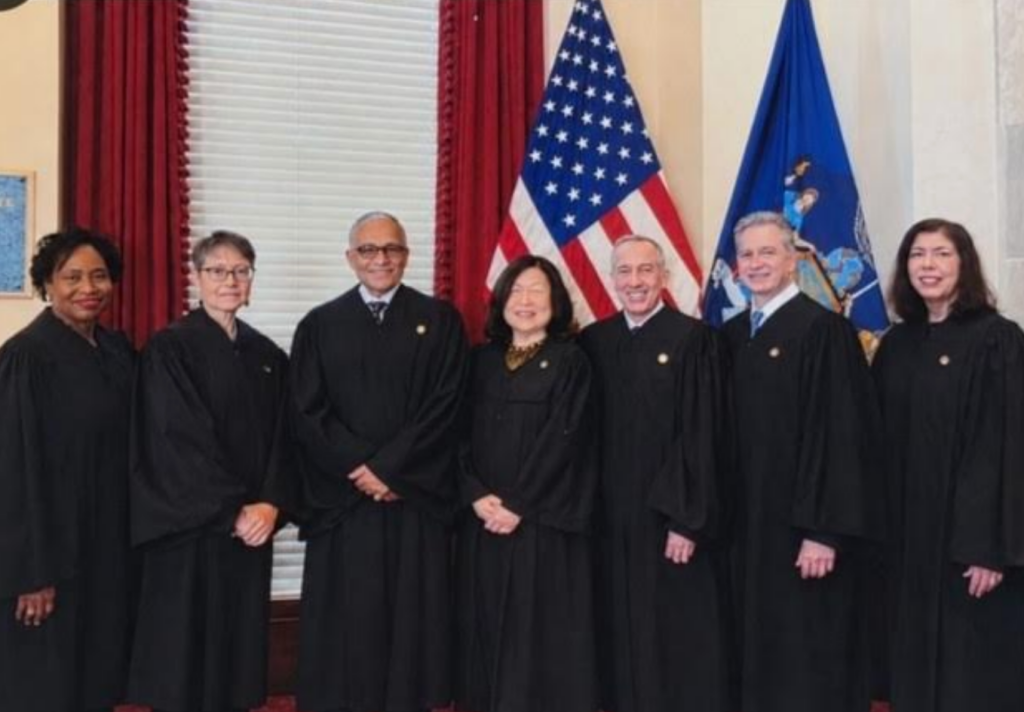
Photo (L-R): Court of Appeals Associate Judges Shirley Troutman and Jenny Rivera, Chief Judge Rowan D. Wilson, Appellate Division, First Department Associate Justice Margaret Anne Pui Yee Chan, Court of Appeals Associate Judges Anthony Cannataro, Michael Garcia, and Madeline Singas at Court of Appeals Hall on October 20. Justice Chan made history that day, becoming the first Asian American woman to sit on New York’s highest court. 

Her presence on the Court of Appeals reflects a judiciary increasingly committed to representing the diversity of the communities it serves. For many, this moment signifies long-awaited progress in elevating voices and perspectives historically underrepresented at the State’s highest levels of judicial decision making. 

Justice Chan’s path to this achievement began far from Albany. Born in Hong Kong, she immigrated to Canada at age seven and later to Brooklyn at fourteen. Her judicial career started in 2006 with her election to the New York City Civil Court, where she became the first Asian immigrant woman to serve as a New York judge. She went on to serve as an Acting Supreme Court Justice beginning in 2012 and was elected to the Supreme Court in 2021, overseeing matters including mass torts, constitutional litigation, and complex commercial disputes. 

In 2025, she again broke new ground as the first Asian-born woman judge appointed to any New York appellate court when Governor Kathy Hochul named her to the Appellate Division, First Department. Before joining the bench, Justice Chan practiced immigration and appellate law in Manhattan’s Chinatown and built her legal foundation through years of dedicated study and service, including roles as a senior court attorney and managing editor of her law review. 

Justice Chan continues to contribute to the court system through committee service and legal education. Her historic appearance on the Court of Appeals stands as both a personal milestone and a powerful symbol of progress for the AAPI community and the New York judiciary. 

Photo: Justice Chan and her husband, New York County Supreme Court Justice Gerald Lebovits, at Albany’s Court of Appeals, New York’s highest court

Written by Hon. L. Austin D’Souza, Supervising Judge, New York City Civil Court 

Reprinted with permission from InsideUCS – Intranet of the NYS Unified Court System

NAPABA Endorses the Preemption of Real Property Discrimination Act

For Immediate Release: 
Date: May 25, 2023
Contact:  Rahat N. Babar, Deputy Executive Director for Policy

WASHINGTON – In response to the troubling rise in state legislative activity attacking an individual’s right to purchase real property based on the purchaser’s citizenship, the National Asian Pacific American Bar Association (NAPABA) endorses the Preemption of Real Property Discrimination Act. Introduced today in the United States House of Representatives by Rep. Judy Chu of California, who chairs the Congressional Asian Pacific American Caucus, and Rep. Al Green of Texas, the bill would nullify any state law that prohibits or otherwise restricts an individual’s right to purchase real property based merely on that individual’s citizenship.

“NAPABA will not stand idly by when our community, especially those who trace their ancestry to China, becomes the target of ill-advised efforts by state policymakers to strip them of their fundamental rights to pursue a livelihood,” said Sandra Leung, the President of NAPABA.

“These efforts eerily recall ancient alien land laws, which were enacted over a hundred years ago, that barred Asian immigrants from owning land. Such laws belong in the dustbin of history, and they have no place in our nation today. While policymakers are free to address the legitimate national security concerns of the United States, they may not enact discriminatory laws on the backs of the Asian American, Native Hawaiian, and Pacific Islander community.”

NAPABA’s support today for the Preemption of Real Property Discrimination Act coincides with the leadership of NAPABA affiliates across the nation to combat state legislation targeting our community. This past week, the Louisiana Asian Pacific American Bar Association (LAPABA), with NAPABA’s support, opposed legislation that, if enacted, would have barred innocent parties from purchasing or leasing real estate. Similarly, the Alabama Asian Bar Association (AABA), also with NAPABA’s support, led the opposition to a bill in Alabama that would prevent “any individual who is a citizen of China” from purchasing any real estate.

The actions of LAPABA and AABA build on NAPABA’s collaboration with our Florida affiliates – the Asian Pacific American Bar Association of Tampa Bay (APABA-TB), the Asian Pacific American Bar Association of South Florida (APABA-SF), the Greater Orlando Asian American Bar Association (GOAABA), and Jacksonville Asian American Bar Association (JAABA) – and our Texas affiliates – the Asian American Bar Association of Houston (AABA Houston), the Austin Asian American Bar Association (Austin AABA), and the Dallas Asian American Bar Association (DAABA) – in combatting similar efforts in Florida and Texas. NAPABA is grateful for their leadership.

NAPABA extends its thanks and appreciation to Chairperson Chu and Rep. Green for introducing the bill.

#

The National Asian Pacific American Bar Association (NAPABA), represents the interests of over 60,000 Asian Pacific American (APA) legal professionals and nearly 90 national, state, and local APA bar associations. NAPABA is a leader in addressing civil rights issues confronting APA communities. Through its national network, NAPABA provides a strong voice for increased diversity of the federal and state judiciaries, advocates for equal opportunity in the workplace, works to eliminate hate crimes and anti-immigrant sentiment, and promotes the professional development of people of all backgrounds in the legal profession.