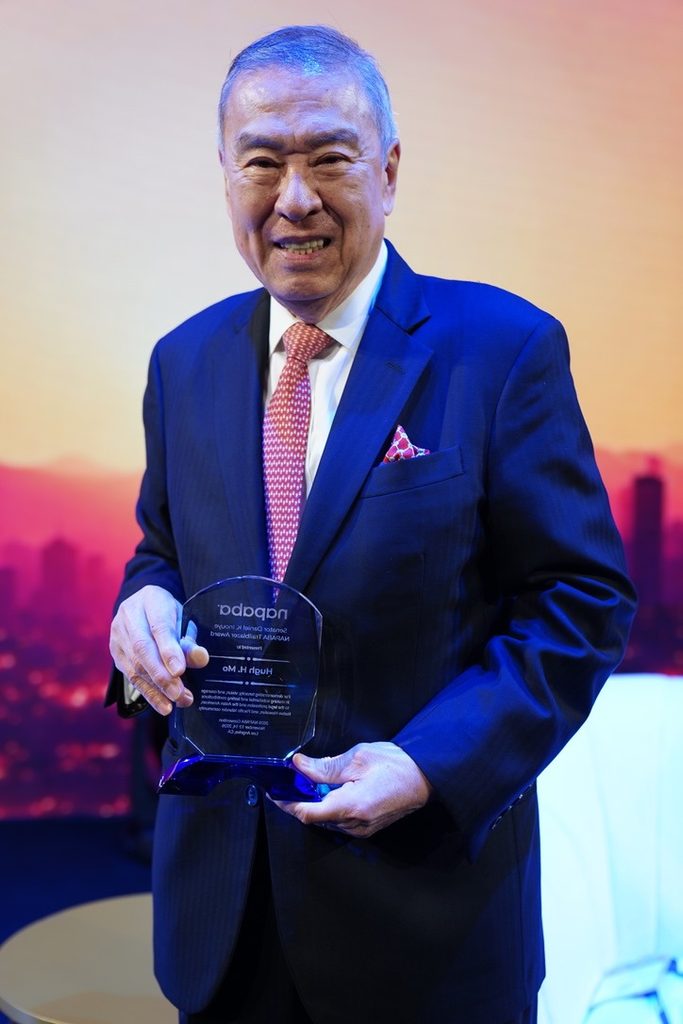

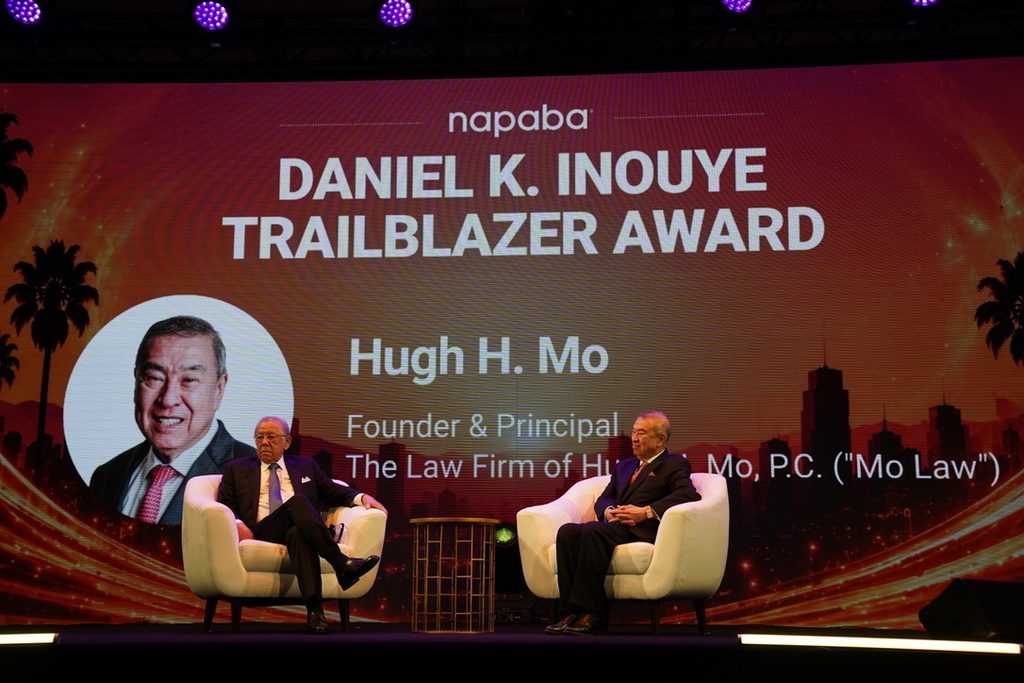
The National Asian Pacific American Bar Association (NAPABA) has honored Hugh H. Mo, Founder and Principal of The Law Firm of Hugh H. Mo, P.C., with its 2026 Daniel K. Inouye Trailblazer Award. This award is NAPABA’s lifetime achievement award and its highest honor, presented to attorneys who have paved the way for AANHPI (Asian American Native Hawaiian Pacific Islander) lawyers and shown “vision, courage, and tenacity” in their careers. Hugh is one of the founders of AABANY in 1989, and AABANY recognized him with its own Norman Lau Kee Trailblazer Award in 2024. On November 13, 2026, NAPABA honored Hugh with the Trailblazer Award during the President’s and Trailblazer Awards Reception at the NAPABA Convention in Los Angeles.
Hugh’s record for being a trailblazer is well known within the AABANY community. He was the first Asian American Assistant District Attorney in the Manhattan District Attorney’s Office and the first Asian American Deputy Commissioner in Charge of Trials at the NYPD. He has tried more than fifty jury cases to verdict and has led his own practice for over three decades. In a recent interview with AABANY, Hugh, now 76 and fifty years into his legal career, spoke less about these milestones, but focused more on his resolve and the stories behind them. It is that resolve that sets him apart and makes him worthy of the NAPABA Trailblazer Award.
Identity as a Source of Strength
Born in Shanghai, Hugh spent his early childhood in Hong Kong, Taiwan, and Madrid before arriving in New York at age nine. His parents, both graduates of Fudan University in China, raised him to see his heritage as “something to be proud of.” When others in his Chinatown childhood looked down on him, he said, “The slights rolled off like water off a duck’s back.” He believes young people need the same footing: a firm knowledge of their family history and of where they come from.
That footing has shaped how others see him. Justice Sonia Sotomayor, whom he mentored at the Manhattan DA’s Office, described him in her memoir as an “all-around confounder of stereotypes.” Hugh named the stereotypes himself: that Asian Americans are shy, quiet, meek, risk-averse, and unsuited to leadership. He credits his mother with teaching him to disregard them wholly. “When I talk in court, you don’t have to worry about a microphone,” he said. Long before Asian American lawyers were a familiar presence in New York courtrooms, he simply declined the role the profession expected him to play. That refusal is the courage the award recognizes. His advice to younger attorneys follows from it: “Don’t be defined by [how] other people perceive you, or by what society expects of you.”
Tenacity in Practice
While Hugh does not let others or society define him or what is expected of him, he always expects more of himself and persistently strives to rise to the occasion. He illustrated this philosophy through stories from his early career, and each one turns on the same principle: take your fate into your own hands.
In August 1973, newly graduated from NYU, Hugh was admitted to Boston University School of Law but could not afford the $2,700 first-semester tuition, despite having saved $2,000 driving a cab on weekends. Rather than simply decline, he drove four hours to Boston from Chinatown, appeared unannounced at the assistant dean’s office, sweaty, tired, but never resigned. He left with a financial aid package. “I figured I won my first case,” he recalled.
Two years later, while trying to find a position with the Manhattan DA’s office, he found every on-campus interview slot already filled. Hugh was not deterred. He waited outside the interview room for two days and added his name to the bottom of the list as the forty-first candidate and pleaded with the recruiter, Bill Murphy, to give him a shot when Murphy was about to go home on the second day. Murphy started by warning him that the City, then near bankruptcy, might not hire at all. Hugh replied that whatever the outcome, he wanted to come back home to Chinatown and make a difference there. This resonated with Mr. Murphy, whose office sat just across Chinatown. And so, an interview that was never supposed to happen spanned 45 minutes. Murphy ranked him first among roughly 200 candidates across the northeast and marked his file “Must Hire.”
In 1984, after Mayor Ed Koch appointed Benjamin Ward as the city’s first African American Police Commissioner, Hugh wrote to Ward to congratulate him and ask to join him in making history. Hugh was offered an Assistant Commissioner post, but he declined and asked for the more senior position of Deputy Commissioner instead. He got it soon afterwards at 33. “I had no hook,” he said. “I created my own opportunity.”
Hugh is quick to note that opportunity comes in two forms: what is available and what one creates. The second kind, he said, requires reading widely, following current events closely, finding common ground with whoever stands at the door, and above all else a strong education and a learned mind. For a generation of Asian American lawyers with few mentors in positions of influence, opportunities often had to be created this way. His career shows that tenacity in practice.
Leaving the Door Open
During his 1984 interview for the Deputy Commissioner position, Commissioner Ward asked Hugh one final question: what would he do once he climbed the ladder? “I’ll reach as far down as I can,” he replied, “and bring up the next brother.” That was the promise he made on the way up, and he has kept it ever since.
He returned to the idea when asked about the sacrifices his career required. He described sacrifice as “glorious,” meaning time, effort, and guidance given to others. “When you reach a certain height, don’t be a placeholder,” he said. “Open the door, leave that door open.” He still writes recommendation letters for judges and young attorneys, often spending an hour or two on each, because he knows a single letter can change a career.
Hugh also sees his own work in the courtroom as a responsibility to those who follow, a chance to raise expectations for the next Asian American lawyer. When he began practicing, he said, Asian Americans were a rarity in the legal profession. He pointed to NAPABA’s representation of around 80,000 AANHPI lawyers as evidence of how far the community has come, and of how many doors were opened along the way. “The only achievement I’m ever going to leave behind,” he said, “is those that I can help.”
Even now, Hugh practices what he advises. He recommends that every attorney stop every five years to ask what they have accomplished, what their purpose is, and what they should do differently. He also cautions against letting any single setback or success define a career. Fifty years in, with no intent of slowing down, and with shelves full of honors and recognitions, he jokes that further awards should wait until he turns ninety.
AABANY congratulates Hugh H. Mo on this well-deserved recognition and thanks him for his continued dedication to the advancement of all AANHPI lawyers.