
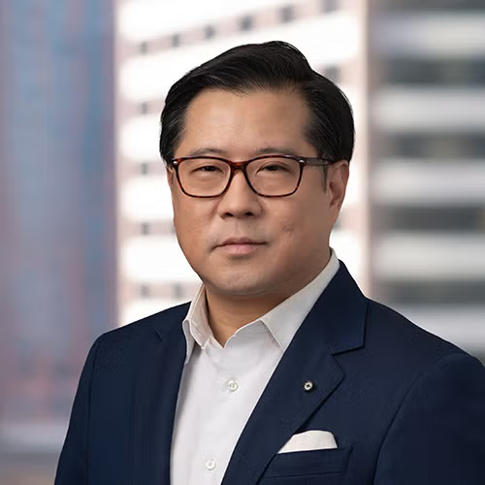
The Asian American Bar Association of New York (AABANY) is excited to share that in June 2026, James Chou, former AABANY President of AABANY (2009) and long-time AABANY member began his tenure as the new Managing Partner of Saul Ewing‘s New York City office.
James came to law by way of a detour: he started at NYU, intent on majoring in biochemistry and chasing his family’s expectations. His grandmother, one of the few women of her generation to earn a medical degree, had instilled in all her children and grandchildren, that it was her wish for them to follow in her and her late husband’s footsteps as medical doctors. James’ distaste for organic chemistry and frustration with the confining nature of the hard sciences convinced him otherwise. The breadth of a liberal arts education with its exposure to a wide array of fields and focus on critical thought, analysis, and communication provided a more attractive alternative. In his words, “the questions felt bigger, more interesting, and practically impactful.” He graduated magna cum laude from NYU and went on to Georgetown Law, where he served on the Journal of Legal Ethics and also tried his first case as a student advocate.
After a brief stint at Schulte Roth & Zabel, James spent seventeen years at Akin Gump, where he cut his teeth as a lawyer, handling all manner of complex commercial disputes. Those years were highly significant to his professional development, and he remains deeply grateful for his training and mentors there.
In 2015, he left Big Law and took a bet on himself to help build the New York office of a Long-Island-based firm, Moritt Hock & Hamroff, spending nine years there enhancing the firm’s Manhattan presence and brand in the New York market before making a returning to a broader platform at Saul Ewing in July 2024.
In May 2026, he was named the New York Office Managing Partner, effective June 1. In his new role, James is responsible for helping to develop and implement the office’s strategic vision to enhance its market position within the New York legal market and key practice areas and industries, build strategic client relationships, attract and develop top talent, and drive revenue growth and profitability. He takes on this role while maintaining a very active litigation practice as well as serving on the Board of the New York City Bar Association and as Chair of its Council on Judicial Administration.
When asked whether his Asian American identity presented a structural obstacle in his career, James replied that rather than encountering structural obstacles, he did think his cultural sensibilities—humility, deference, and polite restraint rather than aggressive self-promotion—prevented him from succeeding earlier in his career than he did. But James sees no value in dwelling on setbacks, and he views each challenge as an opportunity for growth and development. In this regard, he practices “the discipline of gratitude”—an intentional, regular practice of prioritizing thankfulness as a steady habit of mind and spirit, built on stoicism’s premise that we will all cease to exist, as well as a recognition that every experience in our life journey shapes who we are today.
Over the course of his long career, two cases stand out, both of which were pro bono. The first was in the mid-2000s, when James and his colleagues represented the New York County Democratic Committee in defending New York’s judicial convention—the system by which political parties nominate candidates for the New York State Supreme Court—against a constitutional challenge. In New York State Board of Elections v. López Torres, the Democratic Committee argued that the First Amendment protects a political party’s right to determine how it selects its own nominees, and in 2008, the U.S. Supreme Court agreed, with a 9–0 decision. The second was in in 2012, when James represented an Angolan asylum seeker who had been wrongly linked to a violent independence movement and a high-profile 2010 attack he had no part in. The man’s only tie to the group was a membership card he received after attending a single meeting of the group in which they were promoting basic social services. Working alongside the New York Legal Assistance Group, James secured the man’s asylum in February 2012 and eventually reunited him with his wife and young son.
James shared that Saul Ewing prides itself in being a “people-first firm,” which is not just a mantra, but a core value manifest across the Firm’s platform. Consistent with that ethos, his vision as New York managing partner is to invest in people and cultivate a collaborative environment where they can maximize their potential, which, in turn, is essential to excellent client service. His message for AABANY’s members is that your reputation will be built not by the cases you win, but by the trust you earn, the people you develop, and the institutions you leave stronger than when you found it, so make sure to invest in those things.
Please join AABANY in congratulating James on this milestone achievement in his career and wishing him further success as he takes on leadership of Saul Ewing’s New York City office.