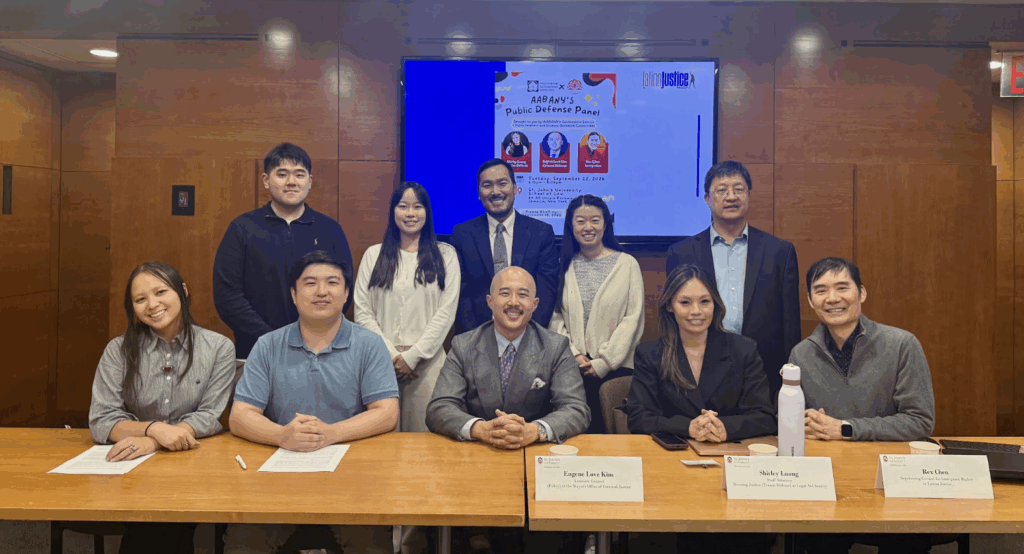

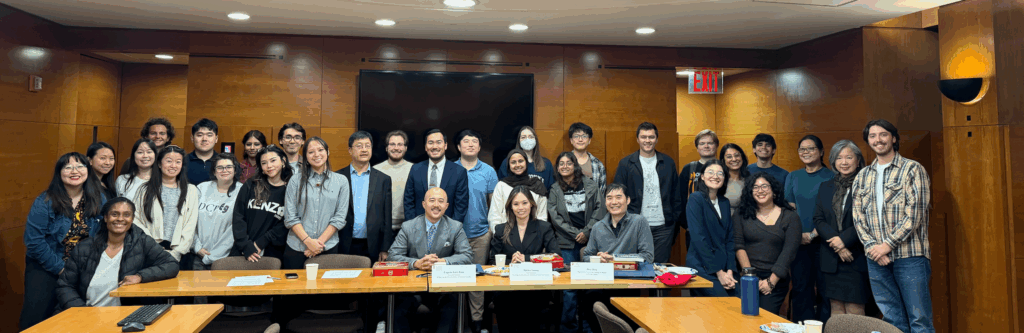
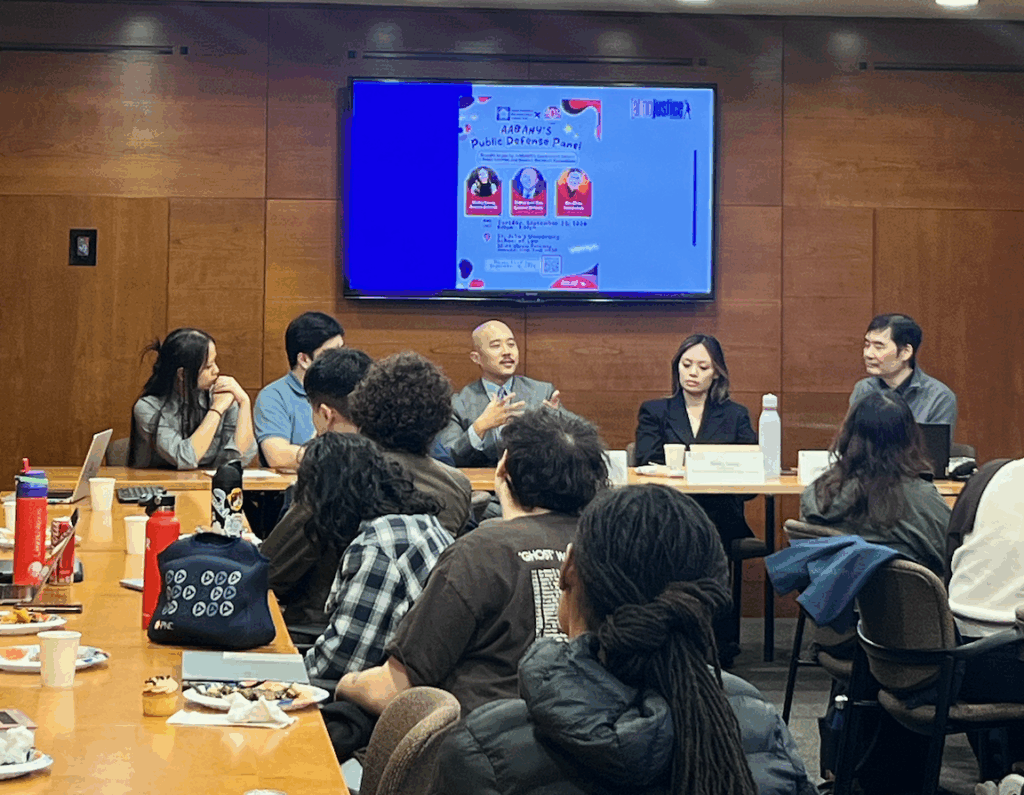
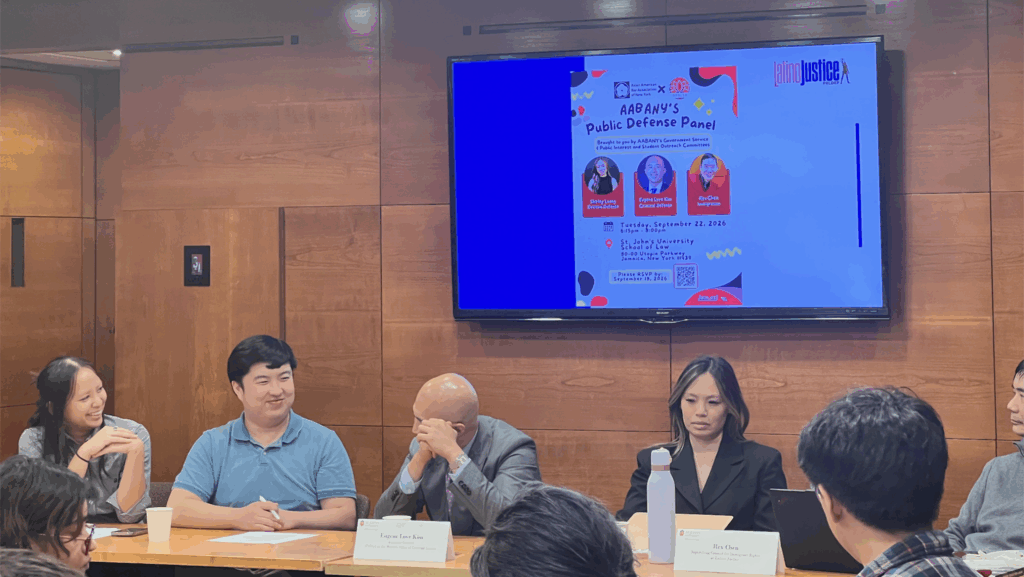
On September 22, 2026, AABANY’s Student Outreach Committee and Government Service and Public Interest Committee co-hosted a panel discussion at St. John’s University School of Law on public defense and public interest careers, bringing together law students, attorneys, and community members. Three lawyers – Eugene Kim, Criminal Defense; Shirley Luong, Tenants’ Rights; and Rex Chen, Immigration – provided insight on their day-to-day, the work that keeps them going, and how their practices confront systemic struggles while serving and representing the Asian American Pacific Islander (AAPI) community.
Criminal Defense: Eugene Kim
After graduating from Northeastern University School of Law, Eugene began his career at the Legal Aid Society, where he spent many years representing approximately 3,000 clients. He went on to work in the Mayor’s Office, but during the panel, Eugene reflected on his time at the Legal Aid Society. He has also served previously as Vice Chair and Co-Chair of AABANY’s Pro Bono & Community Service Committee.
When asked to describe what his typical day at work looked like, he talked about time spent staffing the courtroom, moving between court appearances, legal research, and visits to Rikers Islands to take on new cases.
Eugene described both the challenges and rewards of his practice. The biggest challenge, he said, was that there are “no moral victories in court,” especially in criminal defense. For Eugene, the most rewarding aspect is “winning for a client when their family is in the room,” which he said is what kept him going.
On the issue of racism in his profession, Eugene was direct: In the criminal justice system, racism is unfortunately a “feature” of it. As a public defender, his goal was to provide “the best defense that money can’t buy.” Turning to the AAPI community, Eugene expressed his belief that AAPI residents are underrepresented because there are fewer attorneys who share their backgrounds and can understand them, and he called for greater advocacy towards proper representation. His advice for attorneys entering the profession: leadership cannot be forced. “Figure out who you are and stay true to it, because people will notice if you don’t.”
Tenants’ Rights: Shirley Luong
A lifelong New Yorker born and raised in Flushing, Shirley attended Brooklyn Law School. From 2024-25, she served as Vice Chair of AABANY’s Pro Bono & Community Service Committee and is currently Vice Chair of AABANY’s Government Service & Public Interest Committee. She is a Staff Attorney in housing justice and tenant defense at the Legal Aid Society, where she has worked for the past decade. Shirley is passionate about pursuing justice for her clients’ housing circumstances. For example, just before the pandemic struck, she compelled a landlord to build a wheelchair-accessible ramp so that her client could safely and conveniently access his own home.
For Shirley, secondary trauma is the greatest challenge of her direct service work. As a client’s first line of defense, she found it difficult to balance sympathy with maintaining the emotional distance needed for her profession. The reward is the flip side: the impact on people’s lives is immediate and tangible.
When asked about racism in her area of practice and how her work addresses it, she describes it as systemic and deeply rooted – a theme all the panelists shared. Housing policies like redlining, she explained, historically excluded communities of color from homeownership and, with it, generational wealth. This turns into exclusion from employment opportunities, education, and other benefits, rights, and privileges. Though such practices are now illegal, they have lasting effects, and minority communities continue to be targeted in housing court today. To Shirley, tenants’ rights form an essential aspect of racial justice work. For AAPI clients specifically, language access remains a barrier, as housing law is difficult to understand, even for attorneys, and interpretation often can’t accurately communicate legal terminology.
Immigration Law: Rex Chen
Rex Chen has over 20 years of immigration law experience. After graduating from New York University School of Law, he worked at the Legal Aid Society and the Safe Passage Project, later served as Director of Immigration at Legal Services NYC, and now serves as Supervising Attorney for Immigrant Rights at LatinoJustice PRLDEF, where his work includes impact litigation meant to benefit whole groups of people. His days mix client consultations, tracking constant shifts in immigration law, and mentoring pro bono attorneys on their own cases.
For Rex, keeping a moral compass when everything is changing has presented his biggest challenge. His reward is knowing that he and his work are on what he deems “the right side of history.” Rex spoke candidly about the systemic racism rooted in immigration law and how his team responds: commenting on proposed rules, prioritizing antiracist projects, and educating communities. On AAPI communities specifically, he pointed to how criminal convictions can lead to deportation, including Southeast Asian community members for offenses committed when they were young, and increasingly racist policies aimed at South Asians and Muslims. Stereotypes, he noted, affect AAPI attorneys and inevitably enter public interest spaces – something that continued community engagement and advocacy will help address.
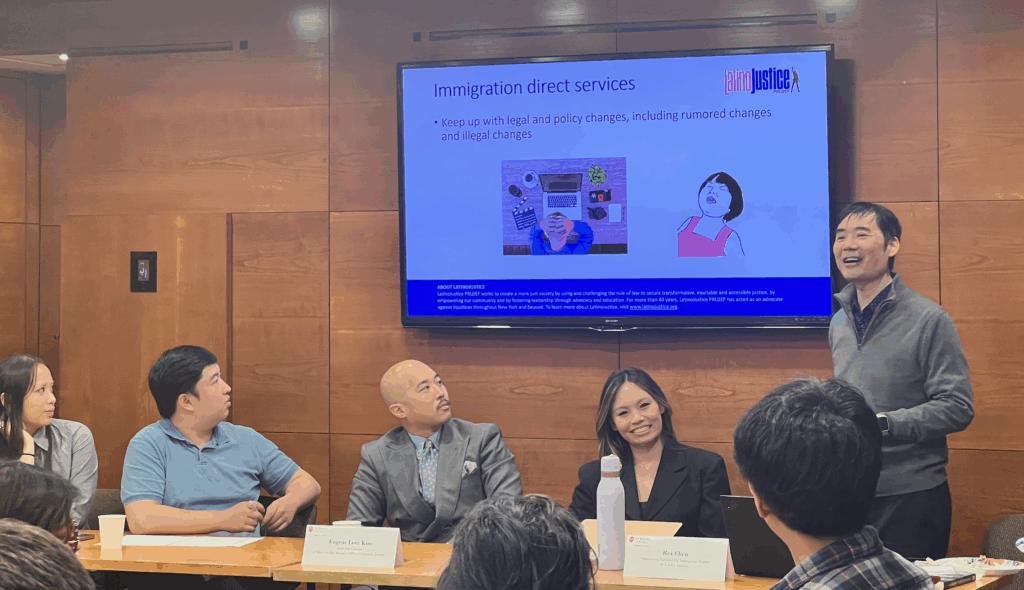
Together, the three panelists offered an introspective and candid look at what it takes to sustain a career in public defense and public interest law: the emotional weight of the work, the systemic issues it addresses, and the communities it serves.
AABANY thanks Eugene, Shirley, and Rex for sharing their perspectives and for the work they do, and Victoria Elise and Nathan Cao of St. John’s University School of Law for moderating. AABANY also thanks St. John’s University School of Law for hosting this event and gratefully acknowledges Student Outreach Committee Co-Chairs, Helen Ding and Joseph D. Eng Jr., and the Government Service & Public Interest Committee Co-Chairs, Kevin Hsi and Johnny Thach, for organizing this event. To learn more about the Student Outreach Committee and how you can get involved, go here. To learn more about the Government Service and Public Interest Committee go here.